I keep hearing reports of Bogong Moth’s moving through Canberra, and thought I would add this link to a great overview of this iconic species.
Bogong Moths, Agrostis infusa, migrate over 1,000 km each year from the black soil plains of Queensland and western NSW to the Australian Alps, seeking refuge from the summer heat. Along the way, they travel by night and then in the morning, drop down to the ground to rest in the shade during the day.
This article was written by Abbie Thomas and is available here.
2011/12 Victorian Alps Hawkweed Surveillance Volunteer Program
Help to protect Australia’s biodiversity from King Devil and Orange Hawkweed on the Bogong High Plains
Orange Hawkweed. Image: Parks Victoria
Native to Europe, Hawkweeds have recently become established on mainland Australia. Posing a serious threat to Australian biodiversity and the structure of natural communities, it is imperative that the incursion is eradicated before it’s too late.
Hawkweeds spread quickly via runners and above-ground roots forming dense mats, inhibiting and out-competing native vegetation. In grassy ecosystems like the High Plains, dense patches of the weed dominate the spaces between grass tussocks that are vital for the survival and recruitment of native flora and fauna.
Survey sessions will be conducted during the active flowering period. All of the sessions will be five days long. Attendance for the full sessions is preferred but is not essential.
Accommodation will be provided at Falls Creek. Breakfast and snacks will be provided as well as one dinner at a local eatery, other meals self catered. Transport will be provided from Falls Creek.
The surveys for 2011/2012 season will be held over the following dates: Session 1: Tuesday the 27th – Saturday the 31st of December Session 2: Monday the 16th – Friday the 20th of January
For more information or to express your interest in the program, please contact:
Keith Primrose
hawkweed@parks.vic.gov.au
Mt. Beauty Parks Victoria Office: (03) 5754 4693
The Federal Government has introduced a regulation under national law that overrides the Victorian Government on Alpine cattle grazing.
Environment Minister Tony Burke today annunced that the new regulation under the Commonwealth’s Environment Protection and Biodverisity Act means that the Gillard Labor Government now has power to stop the Baillieu Liberal Government from introducing cattle into Victoria’s Alpine National Park without proper scrutiny.
“The Baillieu Government was wrong to reintroduce cattle to the Alpine National Park and has set a dangerous precedent for the management of national parks across Australia,” Mr Burke said.
“This whole debacle has been another reminder that when the Liberals win, the environment loses.”
Mr Burke says he is also consulting with state and territory governments on a proposed new regulation which would give extra protection to national parks across Australia.
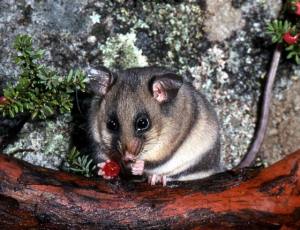
Mountain Pygmy-possum (Burramys parvus). Source: Department of the Environment and Heritage
This article comes from The Age. Journalist: Bridie Smith.
Since 2007, the mountain pygmy possum captive breeding program at Healesville Sanctuary – the only one of its kind in Australia – has been breeding hybrid animals, with one parent from Mt Buller and the other from Mt Hotham.
The first hybrid litter was born in 2008. Now, Melbourne University researchers have shown for the first time that hybrid males are fertile – providing a vital new path for boosting the species’ genetic diversity.
This report comes from The Age, journalists are Josh Gordon and Tom Arup.
A REPORT on the government’s controversial grazing trial in the Alpine National Park has been ridiculed by environmentalists .
Critics said the report — which found ‘‘ large grazing areas with abundant food are preferred by cattle’ ’ and that fences can be useful to keep cattle out of sensitive areas — revealed nothing new.
They said the report on last summer’s trial, released without fanfare by the state government yesterday, represented an expensive and politically motivated exercise that has added no new knowledge about whether grazing cuts the risk of bushfires.
Victorian National Parks Association spokesman Phil Ingamells said the results ‘‘ must be a considerable embarrassment to the government’’ , showing the trial was a waste of time and money, with the effort better spent ridding the park of feral animals and weeds.
The Department of Sustainability and Environment report concluded that cattle damage is most visible in wet areas, that cattle don’t like steep areas occupied by unpalatable shrubs and that they prefer eating exotic grass species over native species.
The report, which will form the basis of a five-year trial, also says the DSE engaged a consultant who confirmed that the government’s choice of remote sites for the trial had made access difficult.
The Age revealed in July the state government had launched a second attempt to reintroduce cattle to the park, after last summer’s trial was derailed by a federal finding that it could represent a ‘‘ controlled action’ ’ under the Commonwealth environment law.
Federal Environment Minister Tony Burke has promised to stop the trial by including almost all of Australia’s 500-odd national parks — the domain of state governments — under federal laws, giving him power to block new grazing, logging and mining projects in the parks.
Mr Burke has now promised the states a lengthy consultation process for the changes to all parks, but will pass a specific regulation to protect just the Alpine National Park in coming months to try to head off any grazing this summer.
Victorian Environment Minister Ryan Smith vowed last night to continue with the trial next summer.
This article comes from the Bright Observer, journalist: ALEX BAIRD
Hopes are high
Group waits for government to back push to give chalet new lease of life
The Gorge, Buffalo Plateau
DESPITE no word from the State Government on the future of the Mount Buffalo Chalet, hope remains strong among members of the consortium fighting to reopen the building that a positive outcome will occur.
The Mt Buffalo Community Enterprise (MBCE) group submitted a comprehensive proposal to Parks Victoria in May, which was designed to show the merits of returning the chalet to its former glory.
MBCE executive director Mark McKenzie-McHarg said while talks were still in place, there had been no official word from the government on whether it would back the chalet, which has been closed since 2007 after a lease dispute.
“There’s no further news at this stage, but we are hoping to hear something in the coming weeks,” he said.
“We are involved in discussions and are hopeful we can come to some sort of arrangement.
“We still feel positive, we don’t have any certainty about this.
“It’s a big project and we feel it’s important to be patient.”
For any plans to go ahead to restore the famous building, Mr McKenzie-McHarg said it would need a “significant government contribution” and while the group had plenty of local support, until a government response was forthcoming, the group wasn’t getting too excited.
“We’ve had a lot of interest from a range of different community groups,” he said.
“We really need the State Government to commit, but until that happens we aren’t trying to have too big a profile.
“We think it’s important to be patient, because it’s such a big project, we’ve already submitted business cases and proposals.
“If we do get their backing, that’s when we’d go out and try and get more people onboard.”
As spring bears down on us, I know lots of people are off on last minute missions to the hills before its all over. Am off soon to Mt Stirling to see whats on offer in Stanley Bowl. It reminded me of this nice little story from my friend Andrew from last spring.
“Below, one last drop before the long summer and dusty roads and work and endless heat, waiting for those cold fronts to push through off the southern ocean. Just before I drop, I feel on the cusp of height and gravity, a small, fleeting moment of grace. I wait a minute more, weightless and happy and alone and yet in company. The whole world below beckons, and I treasure the thought of those few minutes of turns and no time for any other thoughts, and then push off into that space and that moment. One last time”.
Once again, the media is reporting further evidence that the controversial alpine grazing re-introduced to Victoria’s alpine national park early this year has very little to do with scientific research and a lot to do with grubby politics.
The following article comes from The Age, the journalist is Melissa Fyfe.
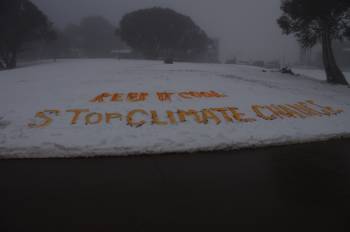
'keep it cool. Stop climate change'. Dinner Plain, June 2011
Ben Laycock is a “painter and occasional sculptor” from Castlemaine in Central Victoria. His wonderfully vivid paintings are his interpretation of the essence of the landscapes he visits and works in. He is turning his hand to writing and we will feature some of his work on the site in coming months.
His first installment, ‘greetings from the Wonnangatta’, is now on the site. It involves reflections from a week picking walnuts on the Wonnangatta River near Dargo.
A walker has been found near Mt Skene in the Victorian Alps after an overnight search.
The man, 30, was walking from Walhalla to Canberra on the Alpine Walking Track (AWT) when he activated his emergency position-indicating radio beacon on thursday May 12. He was found the next morning, appears to be in good health, and is walking out with police and the search and rescue team.
A police spokeswoman said crews had been searching Mt Skene for the Alphington man on the east side of the Jamieson Licola Rd. There had been substantial snow falls across the Alps over the last few days and conditions have been below zero.
It is understood from media reports that the man was taking six weeks to do the AWT from Walhalla to Canberra.
As a sub division within a snow gum woodland, developers at Dinner Plain, near Mt Hotham in the Victorian Alps, have done a good job of keeping as many mature trees as possible, whilst building houses and businesses quite densely. The ‘green’ aspect within the village is aided by the small bushland reserves that break up the housing.
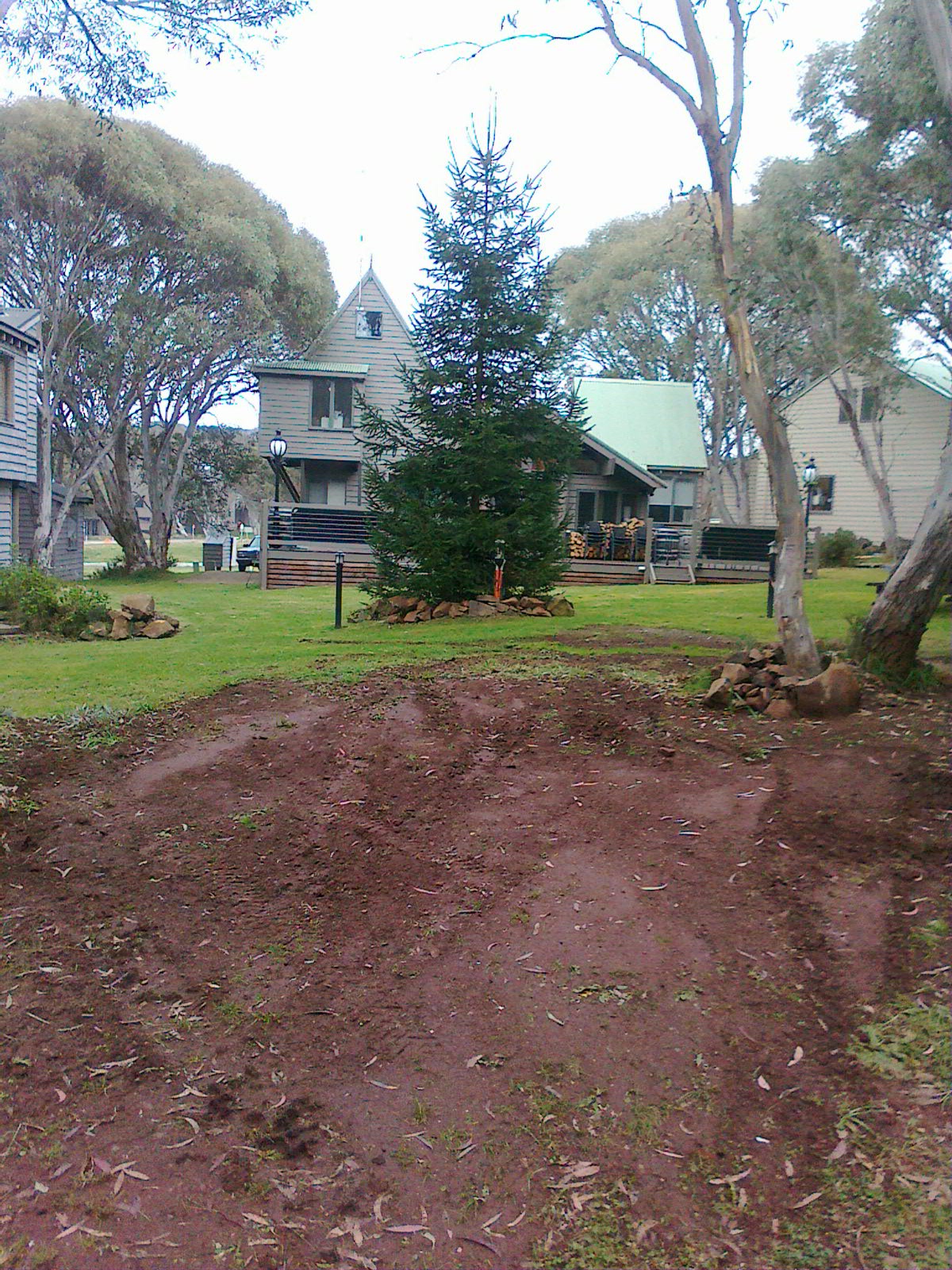
Alphutte at Dinner Plain: bare earth where native veg existed. Introduced tree in background.
Guidelines require people to use indigenous species where they are putting in plants (Council guidelines say ‘only indigenous plant material can be used at Dinner Plain’), and lack of fencing has meant that small pockets of remnant understory also exist between houses. This enhances the feeling of still being in a forest.
However, Dinner Plain could be a very different place in coming years.
There is a disturbing ‘suburban creep’ that is evident, with a reasonable number of land owners now opting to destroy their remnant ground storey species and replace them with lawns.
In one obvious example of this, the people who run the Alphutte pizza restaurant recently completely removed all the remaining remnant understorey at the back of their block.
In spite of the fact that local indigenous species are meant to be planted at DP, Alphutte flout this law and have a large conifer growing as well.
While this was just a small patch of shrubs and flowers, if everyone at Dinner Plain destroyed their remnant vegetation and replaced it with lawn, and planted exotic (and potentially invasive) species on their land, the place would look profoundly different. There would also be substantial loss of biodiversity within the village itself. Dinner Plain is a small enclave of private housing within the Alpine National park, and weed invasion into the park is an obvious and, sadly, growing problem.
Often, these people retain most of the older snow gums on their properties yet don’t seem to understand (or care) that mature trees have to come from seedlings, meaning young trees must be put in to allow them to replace older trees when they do eventually die. The ‘clear the scrub and plant grass’ mentality and absence of new trees being planted will see a profoundly different village in coming years.
If poor environmental management upsets you, you may want to avoid Alphutte the next time you’re in Dinner Plain.
You might want to support Mountain Kitchen, which stocks local indigenous plant species.
Thankfully, the majority of people do seem to appreciate the remarkable landscape they are staying or living in, and do the right thing at Dinner Plain, by protecting or even replacing indigenous species.
Seems the wheels have fallen off the 'sustainability' bus
With winter almost in view, the resorts are announcing their highlights and new activities for 2011.
In Victoria, there are the usual snow making investment announcements and continued diversification of activities. At Falls Creek, the final stage of the Slalom Plaza redevelopment has been opened. Apparently Falls also has new aerial walkways, which take pedestrians through the village via a network of elevated stairways. At Hotham, in contrast, the main new announcement is some extra investment in snow making.
Mt Buller has put another $1 million into new snow guns and the snow grooming fleet.
However, on the environment front, I doubt I have ever seen such an un-inspiring effort.
In a rather bizarre move, some reports say that Buller now has a heated walkway from the Village Square up to the Ski and Snowboard School and the Buller Kids Centre. This would be great if Buller was pitching itself as a nudist colony, but most of us wear boots in the snow, and it seems like they must have money (and carbon) to burn if they think using energy to heat an outdoor pathway is a good idea.
Hotham is pushing air travel to get to the snow. Falls and Hotham continue to push the gas guzzling obscenity that is the 6 minute heli link ride so you can ski two mountains. Great for people with no values but a healthy credit card limit. Hotham runs kids snowmobile operations. Mention of environmental initiatives seems to have disappeared almost completely from resort promotional material in 2011 (for instance, there is a one paragraph mention of environmental practise in this years 50 page booklet from Hotham).
Meanwhile, Falls has announced that 10 ‘brand new luxury Snowmobiles’ have been added to the tours fleet, allowing guests to ride or pillion on their own snowmobile into the ‘pristine backcountry’ of Falls Creek.
Not content with imposing their operations on ‘pristine’ areas within the resort boundary with last years tours run by Steve Lee, they appear to be wanting to increase their noise and carbon footprint with these new skidoos.
On the positive side, Falls has made access to their many groomed cross country trails free. Perhaps encouraging more people to get away from the resort will balance out some of the increased carbon footprint that comes with putting a bunch of new snowmobiles into the backcountry.
Lake Mountain has substantial new building infrastructure and snow making and needs support as it recovers from the devastating fires of 2009. Baw Baw stands out amongst the Victorian resorts because it continues to focus on its ‘green’ image.
Just a few years ago, environmental initiatives were reasonably prominent in a number of the main resorts. From actively spruiking the Keep Winter Cool behaviour change program to buying green power to run some of their tows, resorts seemed serious about reducing their ecological footprint. Sadly, that all seems to have evaporated this year. Rather than acting decisively to reduce their greenhouse footprint, most have gone all out to re-badge themselves as ‘year round’ resorts. That’s where the money has gone, into mountain bike trails and many out of season festivals and events. All of that is great, and a common sense way of stretching use of existing infrastructure. But the loss of responsible activity and leadership by resort management on the environmental front is deeply disappointing.







 Mountain Journal
Recent Comments