Search

Mountain Journal

Environment, news, culture from the Australian Alps

Month

January 2012

Will cattle grazing continue in Victoria’s Alpine National Park?

UPDATE: On tuesday January 31, Federal Environment Minister Tony Burke banned cattle grazing in the state’s Alpine National Park.

Mr Burke rejected the state government’s proposal to reintroduce 400 cattle into the park to graze for up to five months a year for five years.

He said his decision was based on departmental advice that cattle grazing would damage the pristine environment, rather than his own personal opposition to the proposal.

‘Mountain cattlemen ignore history in claiming their place in the Alps’. Maybe it’s time to remember some of the other voices of the mountains? Article available here.

The following comes from ABC Rural.
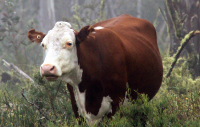
Image: VNPA

Cattlemen says it’s almost too late to put cattle into Victoria’s Alpine National Park this summer.

It’s been two weeks since Federal Minister for Environment, Tony Burke, was expected to make a decision on whether farmers can resume a cattle grazing trial in the Park.

Mark Coleman, president of the Mountain Cattleman’s Association, says the situation has become too caught up in politics and Minister Burke needs to make a decision.

“I believe that the fate of that alpine area rests at his feet and next time we do get a major holocaust through there where our complete ecosystems are completely wiped out from these super hot fires.

“I just hope he’ll be accountable for that till the day he dies.”

Personally I love the statement from the MCAV that “the situation has become too caught up in politics”. Its been about politics from day 1, and the MCAV were quite happy to ‘secretly’ put cattle back in the Park and be involved in ‘politics’ when it suited them. Yet suddenly they’re concerned about politics coming into play – sounds like a case of the ‘Pot calling the Kettle Black’.

Article: Another reminder that alpine grazing is just about politics.
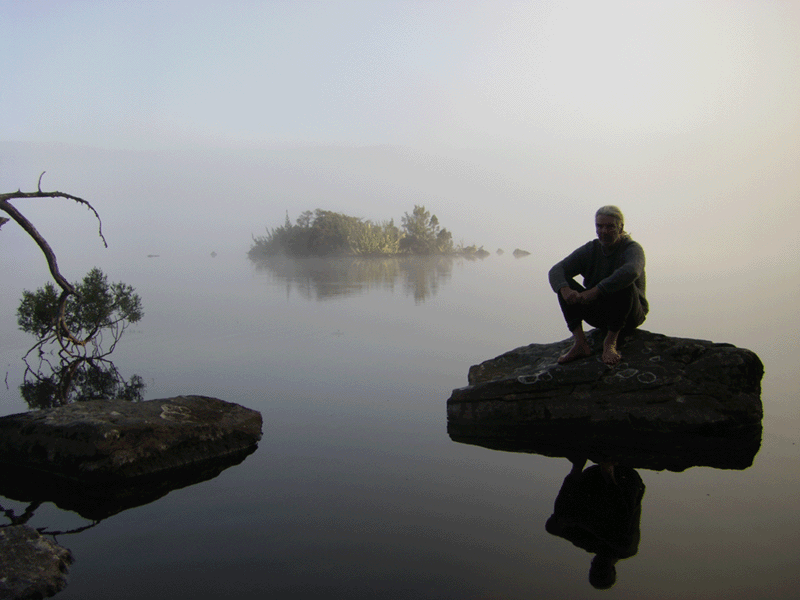
Greetings from Cradle Mountain

Castlemaine-based artist Ben Laycock continues his series of reports from mountainous places, this time he’s fresh off the Overland Track. Rumour has it that his musically inclined party was welcomed by some travellers but not universally accepted on the trails. One would have thought that if you wanted a quiet ‘nature experience’ you wouldn’t be staying in a hut on one of the busiest walking tracks in the country in peak season …. but as they say, ‘you can’t please all the hikers all the time’.

His report-back from the walk, which involves limited accounts of littering, cannibalism and minor embellishment of facts, will upset fans of Lord of the Rings and can be found here.

Residents and activists defending old forests at Toolangi

The tree sit at Toolangi

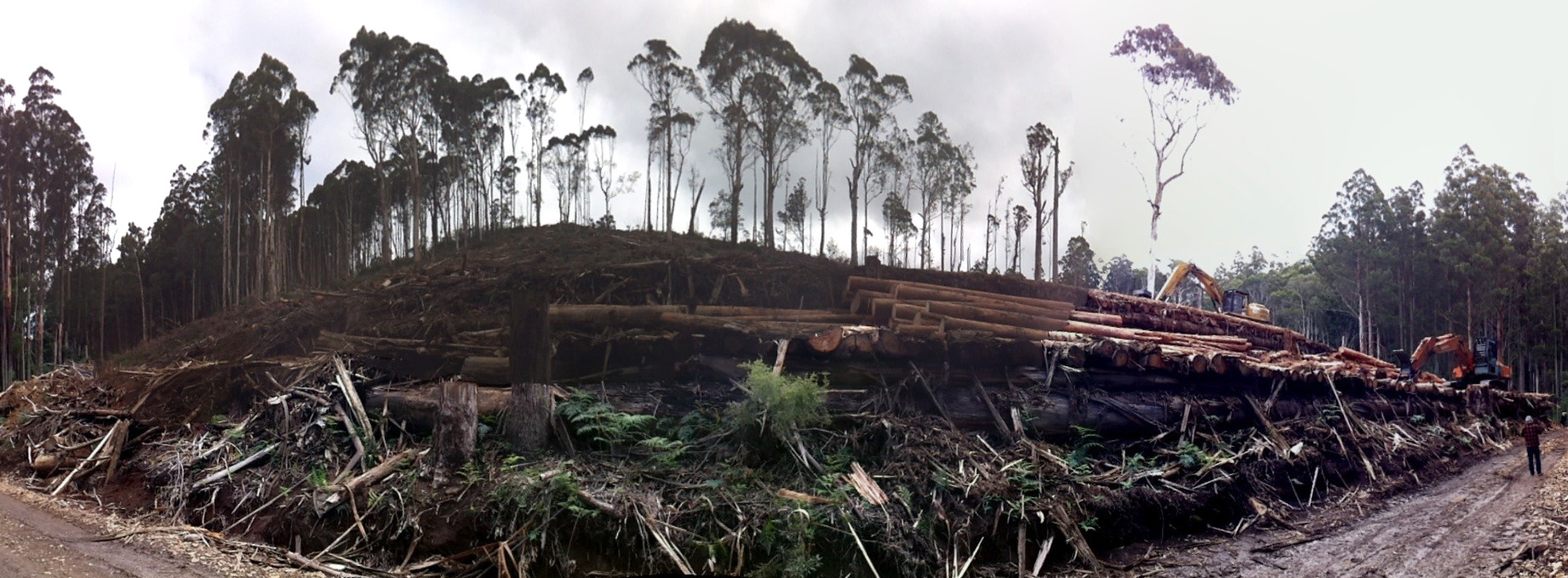
For the past two days, more than 30 people from the Central Highlands Action Group and local Toolangi and Healesville residents have been occupying a large logging coupe on Yellowdindi rd in Toolangi state forest.

Two 30m tree sits, which are suspended by ropes attached to two log-harvesters and two ‘bunnies’ with their arms locked through the tracks of a third machine have ensured that no clear-felling took place in the coupe on Monday January 16.

Much of the Toolangi forests were burnt in the fires of 2009. One Toolangi local said that “residents are concerned that following the Black Saturday fires in 2009 that clear-fell logging in the area will increase the risk of mega-fires due to the large amount of wood waste which is left behind in coupes. The resulting mono-species regeneration after logging operations is far more combustible than the mature age forests which are being removed. This is a recipe for further fire disasters”. They point to research by eminent forest ecologist Dr David Lindenmayer, which clearly indicates that clear-felling practices in the Central highlands notably increases fire risk and thus threatens the whole region.

Activists also point to other values of the forests: “These forests give us protection against climate change and provide habitat for native fauna which is such a feature of this area.”

There is a report available here.

These images by Emma-Jayne Heather.

the coupe at Yellowdindi

Climate Change Pushing Alpine Plants Off the Mountain

This piece comes from Treehugger, and looks at impacts in the European Alps, but obviously warming of alpine environments is a real issue here in Australia as well (for instance, see the recent piece Alps could be snow free by 2050). The author is David DeFranza.

Aster bellidiastrum. Image: Alpine Exploratory

It seems obvious: As the average temperatures of alpine climates increase, cold-loving plant and animal species are forced to move up to higher elevations to find the conditions they are best suited for. New research, however, has found a surprise in this simple process—that it’s happening much faster than previously thought.

By analyzing plant samples from 60 summits in 13 European nations, researchers found that the phenomenon is continental in scale. Michael Gottfried, a researcher with the Austria-based Global Observation Research Initiative in Alpine Environments, explained that the team “expected to find a greater number of warm-loving plants at higher altitudes, but we did not expect to find such a significant change in such a short space of time

“Many cold-loving species are literally running out of mountain,” he continued, “in some of the lower mountains in Europe, we could see alpine meadows disappearing and dwarf shrubs taking over within the next few decades.”

Researchers compared data collected between 2001 and 2008, indicating the change is happening much more quickly than previously thought.

The Twins

Mid summer. Time to be out in the hills. I have been out exploring some of the less known peaks in the Vic High

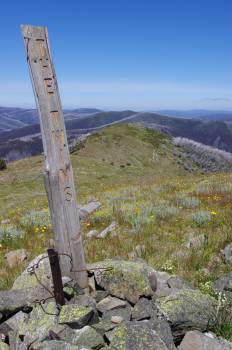
Twins summit

Country, like Big Hill, south of Mt Beauty, and Mt Sugarloaf just near the old ticket station on the Mt Hotham road above Harrietville.

The stand out mountain so far has been the Twins, a bulky, almost hump-backed mountain just south-west of Mt St Bernard in the Central Alps.

Although it is generally seen from the Great Alpine Road, this peak really presents itself from the south side, with impressive slopes and wonderful views and a sense of remoteness despite being barely 9 km in a straight line from Hotham village.

There are some on notes here.

Blog at WordPress.com.

Up ↑