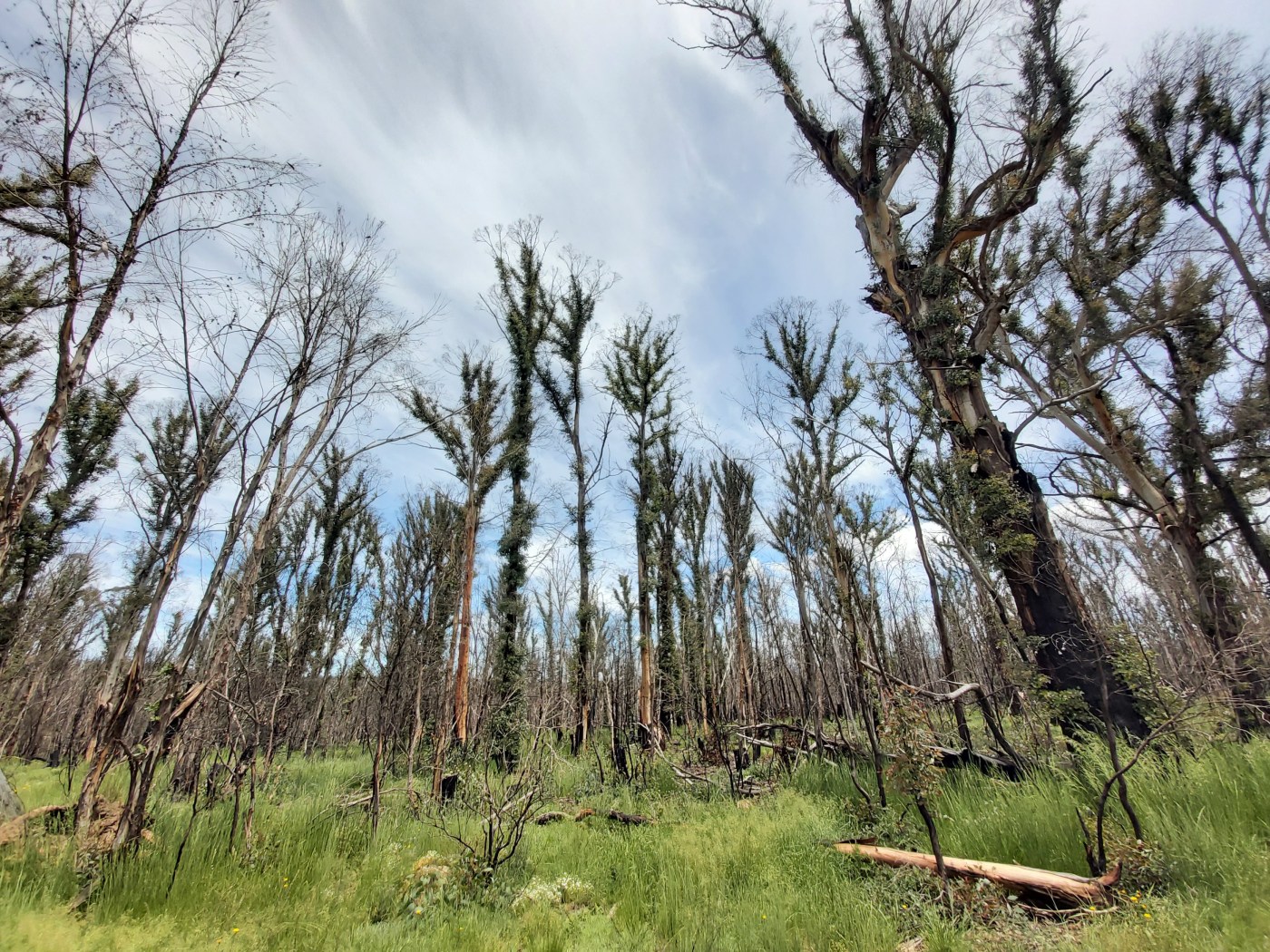
Widespread wildfires in early 2016 caused devastating damage across large areas of the Tasmanian World Heritage Area, including significant sections of vegetation which is not fire adapted, such as Pencil Pine forests.
At the time, and in follow up investigations, it became clear that increased fire risk due to climate change posed an existential threat to these vegetation types. Then additional research confirmed that there was a trend towards more extreme fire seasons. Some researchers suggested that we reached a ‘tipping point’ sometime around the year 2000 and that, since then, there has been an increase in the number of lightning-caused fires and an increase in the average size of the fires, “resulting in a marked increase in the area burnt”.
On the mainland, fires increased significantly from about the same time. There were major fires in the Victorian high country in 1998, 2002/3, 2006/7, 2013 and 2019/20. Fires are becoming more common and more intense across the Alps.
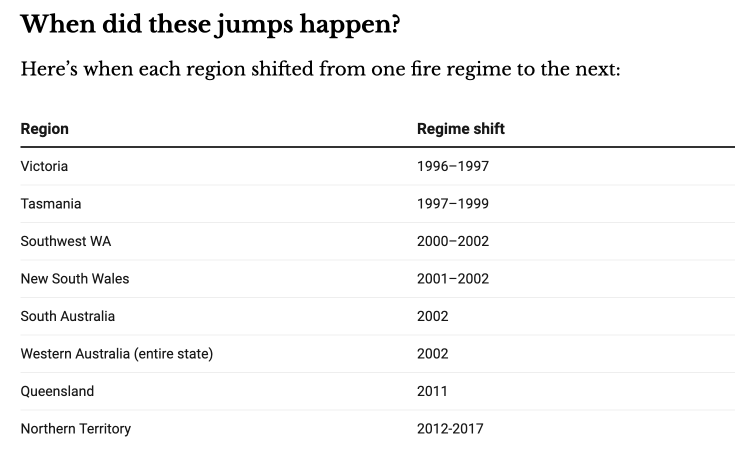
It turns out that something similar was happening around the country. Fire regimes around Australia shifted abruptly 20 years ago.
A recent story by Roger Jones from Victoria University, and published in The Conversation, says that ‘almost everywhere in Australia is now in a different fire climate than it was just 20 years ago, with falling relative humidity a key factor’.
The research used high quality seasonal and annual climate inputs to estimate the annual fire climate for different regions of Australia from 1957–58 to 2021–22.
We tracked changes in this fire danger index over that 64-year period across all states and the Northern Territory. We also looked at distinct sub regions such as southwest Australia. What we found was startling. Rather than a linear increase, fire regimes tracked along a similar line – and then suddenly jumped. For most states and territories, that happened around the year 2000.
There is no evidence for a long-term trend. Instead, the data shows a shift from one stable fire climate regime to another.
We’re already seeing these changes play out. Whenever you see a news article about intense fires in areas not used to fire, that’s likely to be due to a shift in fire climate. Think of the fires devastating Tasmania’s alpine regions in 2016, killing off many old pencil and King Billy pines.
Why is this happening? Roger says:
We found the main driver was relative humidity in combination with higher daily temperatures during the fire season. Recently, we examined global humidity data and found large-scale downward shifts in humidity. In the Southern Hemisphere, that happened in 2002. In the Northern Hemisphere, it happened in 1999.
Humidity reductions in each region of Australia were closely followed by shifts to higher fire season maximum temperatures, amplified by soils drying out.
This has enormous implications for Australia: what resources we need to fight a growing threat from fire, how we manage the shared resources (crews, aircraft and equipment) that we need to fight longer seasons, how ecosystems cope with increased fire impacts, and the personal, community and economic impacts of more frequent fire.




 Mountain Journal
Leave a comment