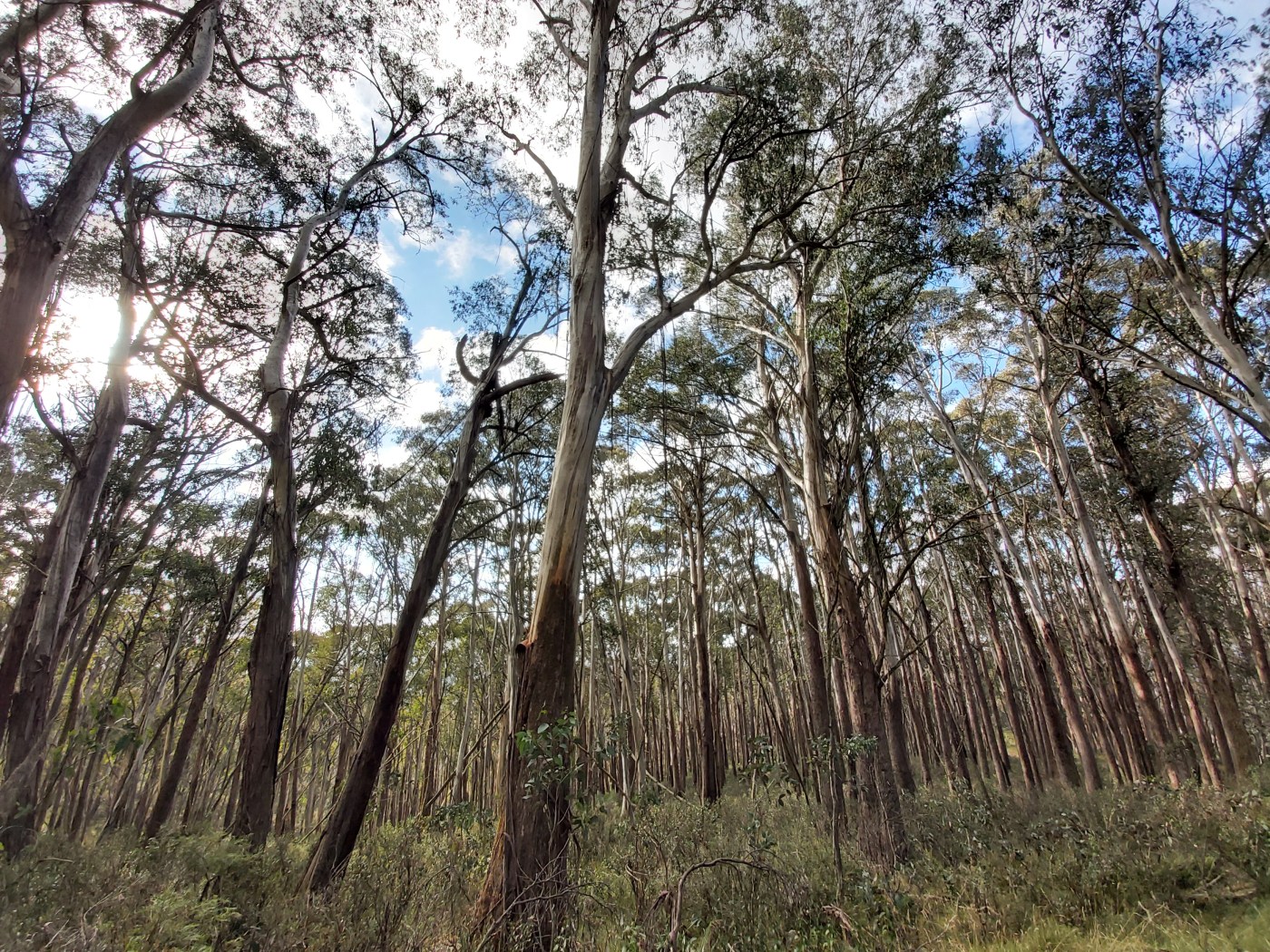
For the past decade, Mountain Journal has posted regular stories about the fact that Alpine Ash communities are facing the prospect of ecological collapse – that is, the loss of these forests and their conversion to something else – most likely a grassy and scrubby system perpetually stuck in a loop of fire followed by rapid development of flammable regrowth, followed by fire.
The Alpine Ash is closely related to the better known Mountain Ash which. New research says that the threats faced by Mountain Ash are significant enough for the species to be listed as threatened under national legislation. We would agree and argue that the Alpine Ash communities need the same level of recognition.
In a story published in The Conversation, researchers say:
When we think of extinction, we think of individual species. But nature doesn’t operate like that. Entire communities and even whole ecosystems are now so compromised they could be lost entirely. Australia now has about 100 ecological communities at risk.
One of those is the iconic Mountain Ash (Eucalyptus regnans) community in Victoria’s Central Highlands. Many of us know and love these regal trees, the tallest flowering plant in the world. But decades of logging, repeated wildfires, and fragmentation of these forests means they and the species which rely on them like Leadbeater’s possum and gliders now face existential threats.
In our new research, we point to the need to list the entire community as threatened.
The researchers note that in the species stronghold, the Central Highlands of Victoria, the forests there are now largely regrowth. ‘Many have been fragmented, making it harder for wildlife to cross between patches. Biodiversity is still declining, including threatened species, while changing fire regimes are placing intensive pressure on the remaining forests’.
These forests have been subject to decades of intensive clearfell logging, as well extensive cutting dating back to the late 1920s.
And of course, fire:
And because the Mountain Ash community is dominated by younger trees, it is now at risk of reburning. Younger trees are highly fire-prone – even those regenerating from the Black Saturday fires of 2009. This has left the entire ecological community vulnerable to future fires.
Exactly the same situation exists for Alpine Ash – decades of logging and more frequent wildfires is pushing the species towards ecological collapse.
You can read a recent update on the state of Alpine Ash communities in Victoria here, where there is about 140,000 ha of vulnerable (young) ash regrowth in the state that will not self-regenerate if burnt.




 Mountain Journal
Leave a comment