Phil Campbell has written a short story on the length of the snow record in Australia.
Ask anyone interested in Australia’s snow country where the longest record of snow depth is located, and you’ll almost certainly be told it is at Spencers Creek, in the New South Wales Snowy Mountains.
Snow depth and density measurements have been recorded continuously at the Spencer’s Creek site by Snowy Hydro for the past seven decades, commencing in the early years of the Snowy Mountains Scheme in 1954. The site consists of a series of seven poles at a mean elevation of 1830 metres and is one of three ‘index’ sites maintained by Snowy Hydro for snowpack and runoff modelling, along with two other sites at Deep Creek and Three Mile Dam. Numerous lesser known sites exist scattered at different elevations across the Snowy Mountains, many monitored for a few brief years to fit operational needs at the time, with a handful still monitored to this day.
The site with the longest record of snowfall, however, is not Spencers Creek, nor is it found in New South Wales, but is located at Rocky Valley Dam in the Victorian high country. As with its counterpart at Spencers Creek, the Rocky Valley Dam site was born out of a need to monitor the local snowpack for hydroelectric power generation as part of the Kiewa Hydroelectric Scheme.
The Kiewa scheme pre-dates the far better known Snowy Mountains Scheme by more than a decade, with its first power station fully operational by 1944 – five years before the first sod was turned in the Snowy Mountains. The Kiewa scheme was first mooted as early as 1918, with technical investigations, including investigations into the characteristics of the snowpack, commencing as early as 1923. Unfortunately, these early records have been lost, but by 1935 a snow course has been established at the Rocky Valley Dam site with 102 poles spaced at 100 feet (30 metres) over an extraordinary 3.1 kilometres at a mean elevation of 1640 metres. In 1959, the filling of the Rocky Valley Dam drowned half of the original pole line, with snow depth measurements since taken from every second of the remaining poles along the transect and averaged.
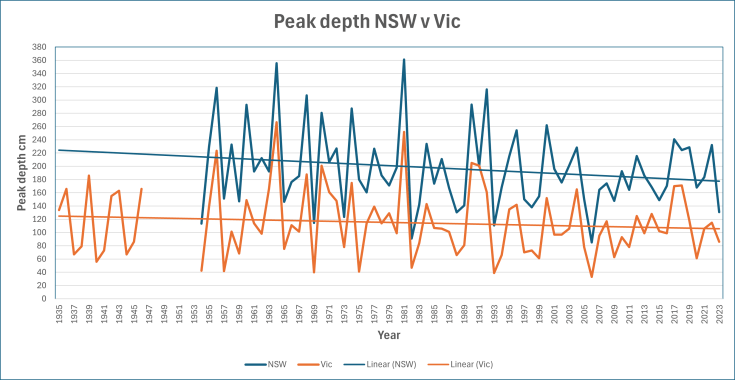
While the commencement of measurements in 1935 makes the Rocky Valley Site the oldest in Australia, its record is not a continuous one. The reasons are lost to time, but records ceased being taken in 1946, not recommencing until 1954, the same year measurements commenced at Spencers Creek. The current site owner, AGL Energy, still monitors the site, with measurements having been taken continuously, if sometimes irregularly, until the present day.
Both the Rocky Valley Dam and Spencers Creek sites provide an invaluable record of snow depth, and are highly valued by scientists for the length, quality and frequency of measurement. When peak snow depth for each year at both sites is plotted together, a gradual decline over the past ninety years is evident, as is a reduction in winters with exceptionally deep snow depths. While the decline in peak depth at Rocky Valley Dam is less than that at Spencers Creek, the data is affected by the absence of several very large snow years such as 1949, and by the unusual global warmth of the period from 1938-1945 that may have supressed the peak snow depths observed during that period. The graph also only shows peak depth, not the volume of snow or the length of the snow season, both of which show substantial changes.
While we might not appreciate the dams and power stations dotting our alpine landscape, thanks to them we have these invaluable records of our snowpack and the effects of climate change helping scientists to understand the effects of climate change so we can best manage our unique alpine environment.
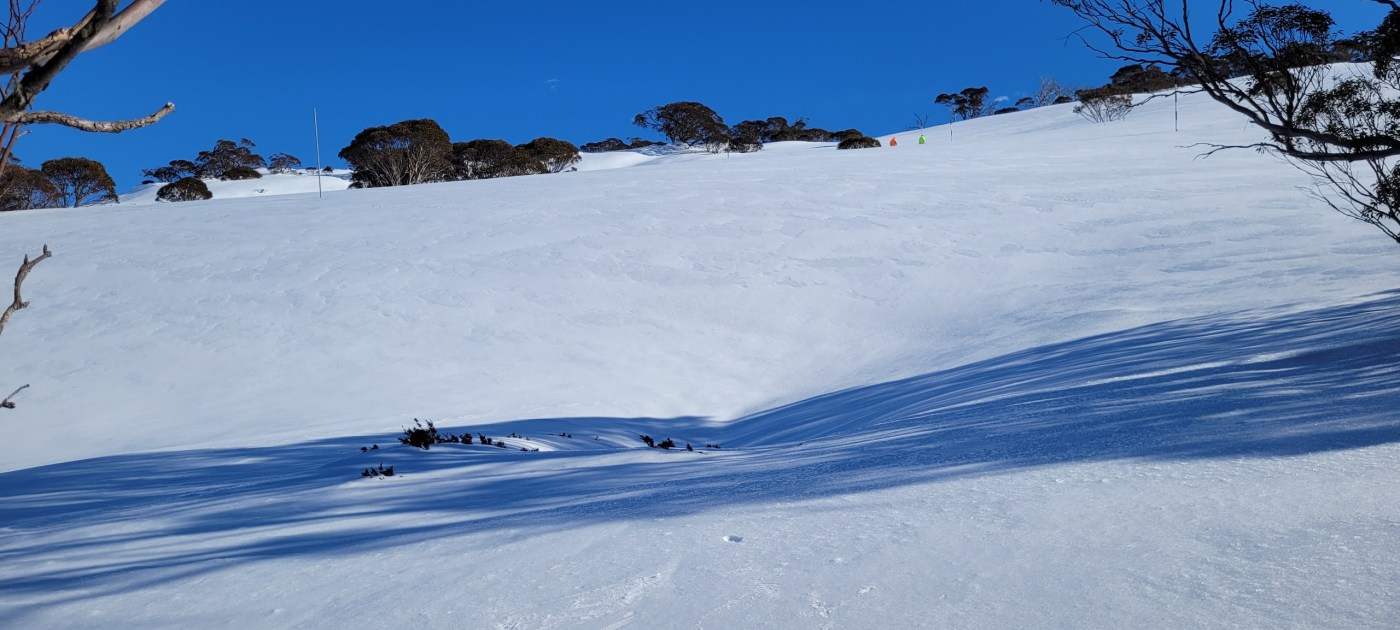
HEADER IMAGE: Spencer Creek.
Phil is a PhD Candidate at the University of Canberra. You can find him via:
Phil.Campbell@canberra.edu.au




 Mountain Journal
Leave a comment