
Red Robin Mine will be a familiar name for many people who visit Mt Hotham and the surrounding area. When operating, it was the highest altitude mine in the state. Red Robin Mine is located on the Machinery Spur track between Mount Hotham and Mount Feathertop. William (Bill) Spargo discovered gold there in 1940, which initiated Victoria’s last gold rush.
Stephen Whiteside has been documenting previously unknown aspects of high country history, including the story of the Red Robin mine. In this instalment of the larger story he delves into the life of O C Smith, who surveyed Bill Spargo’s Red Robin gold mining lease on Machinery Spur in the 1940’s.
One of the people I interviewed in 1987/88 as part of the research for my book, ‘Snow, Fire and Gold – the story of Bill Spargo and Evelyn Piper’s life in the Australian mountains’, was O C Smith. Smith surveyed Bill Spargo’s Red Robin gold mining lease on Machinery Spur (near Mt Hotham) in 1941. A fourth-generation mining surveyor, his family all came from Maryborough in central Victoria. He recalled Mark Twain’s comment about Maryborough during his visit to Australia in 1895. Smith said that Twain referred to Maryborough as “a railway station with a town attached.” This quote is commonly attributed to Mark Twain but is not strictly accurate. In fact, what he really said was:
Don’t you overlook that Maryborough station, if you take an interest in governmental curiosities. Why, you can put the whole population of Maryborough into it, and give them a sofa apiece, and have room for more.
Smith was fond of such references, and was clearly a man of some artistic sensibility. During the course of our conversations he quoted Albert Einstein, and commented that he felt Bill Spargo would have been comfortable in the company of men like Vincent Van Gogh and Henry Lawson. He had great admiration for Bill Spargo.
I always felt he was a remarkable man. Not a fellow you’d notice in a crowd at all. Nothing extroverted about him at all. In fact, he was an introvert, but I mean, he must have had tremendous willpower to keep prospecting the way he did. No other man could have done it, I don’t think…when you think of the primitive living conditions, and he lived in the winter, you see. He never got out of the country during the wintertime. I would say he was a man of great determination…a loner…not a socialiser by any means. He’d prefer his company to any socialising…just living by himself. Of course, no other man could have done what he did up there unless he WAS like that.
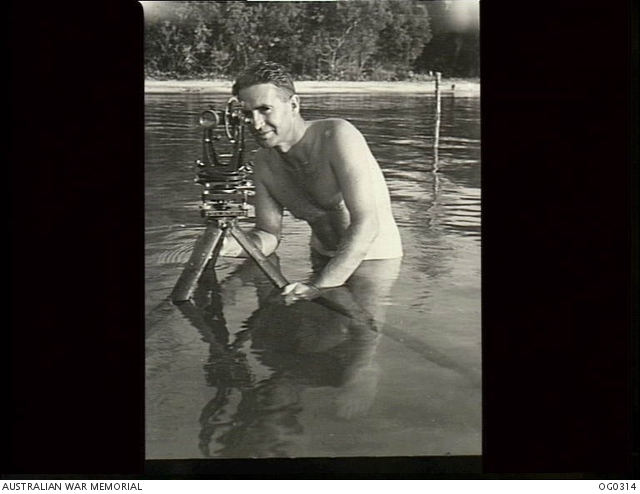
(photograph and caption courtesy the Australian War Memorial)
The announcement of Bill Spargo’s discovery of the rich Red Robin gold reef in 1941 triggered a rush, with claims being pegged far and wide in all directions from the Red Robin. The task of surveying all these leases fell to O C Smith.
I camped there for up to a fortnight on Mt Loch…they pegged the whole country, you know. Pegged it right back almost to where his hut was.
Smith compared Bill Spargo to Eric Johnson, best known for fitting show shoes to his horses, and packing gear up the Bon Accord Spur to Mt Hotham in the 1940s.
Well, he was a long way ahead of Johnson, and he’s got a monument up there. (There is a monument and plaque in memory of Eric Johnson at Diamantina Springs – ed.) Well, Johnson wasn’t a bad sort of a fella, but he didn’t seem to look after his horses. They had sores on them, you know. It used to irritate me. Where the saddles and harness had been rubbing, you see. It didn’t seem to worry…he didn’t seem to think much of his horses. Didn’t seem to care about them much.

He described an unfortunate experience he had had while riding one of Johnson’s horses.
Yeah, well, I surveyed a (gold mining – ed.) lease for this fella Johnson up…oh, it’d be well north of the…on the slopes of Mt Feathertop…well north of the Red Robin, and he put me on a horse. I knew damned well it wasn’t a mountain horse, you know. We went up this trail. It was about three feet wide, this bridle path, you see, and we came to a place where the bridle path suddenly turned. It turned more than ninety degrees. Well, this horse, that I was on, it couldn’t find the bloody track, and it went straight over the top. It went down about thirty feet. But the horse missed me by two feet. The horse went about fifty feet. The horse sort of panicked as soon as it couldn’t see the track. The deviation was that sharp, I couldn’t blame the horse for not seeing it, but I did blame him for going over the top. I grabbed it down there, and we went back. It climbed back and got on the track.
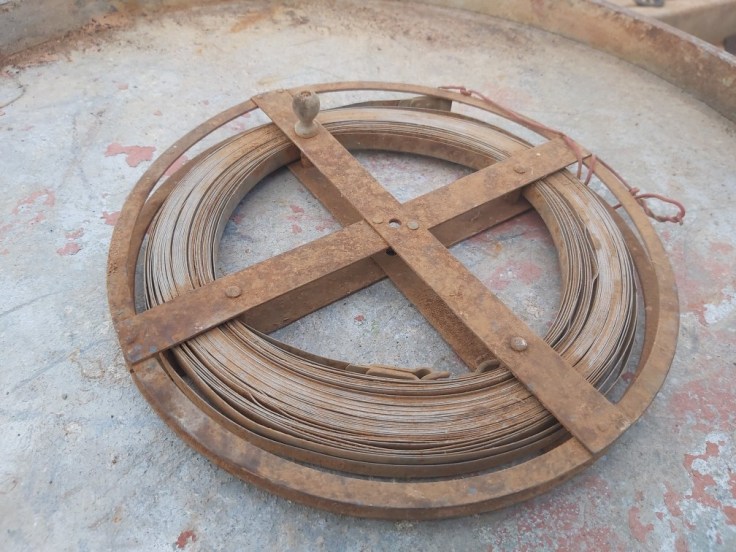
Smith enlisted in 1942 or 43 – he couldn’t recall which. He joined the No. 7 Mobile Works Squadron RAAF, later known at No. 7 Airfield Construction Squadron (7ACS), as a surveyor. Their job was to repair and build airfields. The squadron played a part in the US campaign to oust the Japanese from New Guinea, and Smith was present at the ‘Landing at Nadzab’, in which US infantry were dropped by parachute. General Douglas MacArthur observed proceedings from above in a B-17 Flying Fortress with one of its four engines not working. Recalling his time in New Guinea, Smith said:
Oh, it was all right…the Japs used to strafe us…they’d have a bit of a strafing run over us…and one or two bombings, but there was nothing really rough.
He added:
I had a bad time when I went to New Guinea, really. I got anaemic as a result of the years in New Guinea…and I suppose I was anaemic…felt anaemic…for about twenty years after I came back…
Smith was also a member of the British Commonwealth Occupation Force that occupied Japan in early 1946, soon after the Surrender.
We went…right up through the islands, right up to Tokyo…to Japan…with the Yanks, mainly. I was with an airfield construction squad. As soon as the Yanks took somewhere, we had to go in and build airstrips…so that the aircraft could keep leapfrogging towards Japan…under MacArthur right through to Japan.
He described the scene in Tokyo when he arrived.
There were…square miles just burnt down, you know…square miles of the city just…devastation…and at all the major intersections there’d be a jumble of burnt-out cars, with people trying to get out of the place. It must have been just chaos in Tokyo at the height of all the air raids.
Smith was born in 1906. He moved from Maryborough to Wangaratta in 1937 in search of work and, aside from several years during the latter stages of the Second World War, he remained there all his life. He told me he had no regrets about moving to Wangaratta.
© Stephen Whiteside 04/09/2025
HEADER IMAGE: The Red Robin mine in 1953.
Source: https://snowfireandgold.com.au/photo-category/the-red-robin-mine/




 Mountain Journal
Leave a comment