The National Climate Risk Assessment (the National Assessment) was released this week. Prepared by the Australian Climate Service, it aims to provide an assessment of risk across 8 key systems and 11 regions on the continent, prioritising key risks both within each system and across systems.
This approach aims to provide an understanding of who or what might be at risk from a changing climate, across different areas of the country and paints a national picture for decision makers, to help them prioritise adaptation actions.
A key finding is that Australia’s climate is already changing and will continue to change into the future. The country is likely to experience more intense and extreme climate hazards, and in some cases in areas where people and places haven’t experienced these hazards before.
It is a complex document and while it doesn’t specifically focus on mountain areas, many references are relevant to the mountainous region of the south east and lutruwita/ Tasmania. Risks from climate change include increased stress from higher temperatures, increased fire risk and continued decline in snow pack.
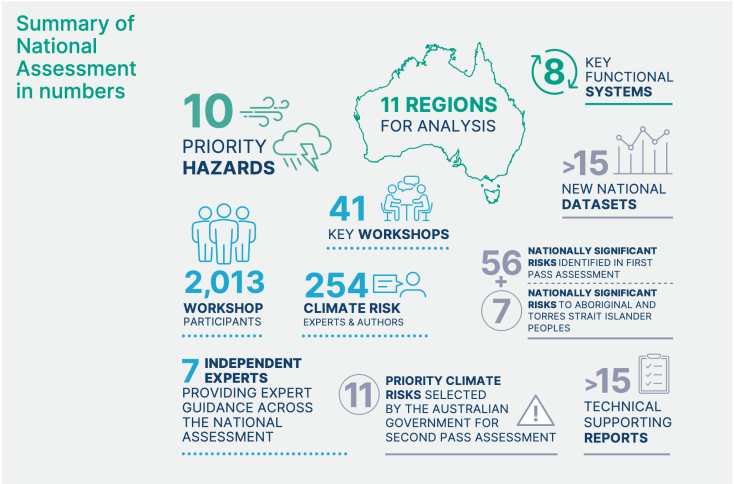
The report focuses on the entire continent and has a huge range of findings and recommendations. The image below gives a sense of the scale of the issues covered.
Specific commentary from the report relevant to mountain areas.
Temperature
Exposure to the long-term pressure of increased temperature combined with more frequent and intense heatwave events is threatening species and ecosystems across the continent. This includes extreme temperatures in the arid interior and the north, and high summer temperatures in relatively intact temperate systems and in areas not adapted to heat or previously sheltered by moist or shaded microclimates.
Extreme temperatures are likely to increase nationwide, with the greatest increases over the Great Dividing Range in the southeast.
Severe and extreme heatwave events are projected to double if global warming reaches +2ºC and to more than quadruple under +3ºC of warming.
Over the coming century, Australia is projected to become drier and to experience shifts in aridity, with longer periods of drought on average in the south and east, and increased aridity in southern areas.
The time spent in drought averaged across Australia is projected to increase under all future warming scenarios, with areas of southern Australia (Victoria, South Australia, Tasmania, Western Australia south) likely to experience the highest increases.
Fire
Higher temperatures and drier conditions will bring increased risk of bushfires in most currently forested areas, threatening terrestrial ecosystems that rely
on long intervals between fires, and resulting in changes in the stand structure of trees and loss of fire-sensitive tree species.
Bushfire risk is expected to increase across parts of Australia under future warming, with increases in the number of dangerous fire weather days and
an extended fire season projected for southern and eastern Australia, with the potential for more megafires. The susceptibility of wet forests to fire is projected to increase due to reduced rainfall and increasing heat, which dries vegetation.
Fire-sensitive ecosystems, such as temperate Gondwanan rainforests and tall open eucalypt forest, are highly vulnerable to ecosystem collapse.
More fire-tolerant systems are still likely to experience change, with increasing fire resulting in changes in the stand structure of trees and loss of fire-sensitive species, especially as weather conditions result in higher-intensity fires than in today’s environment.
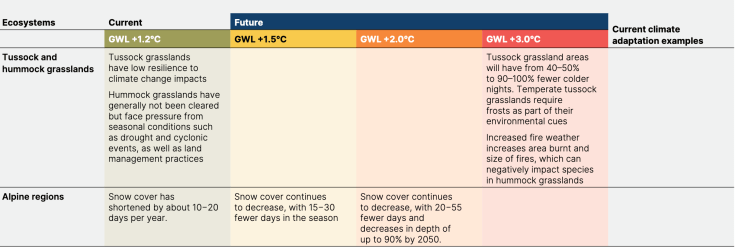
Snow pack
Summary
The findings in this report are the same as for previous research. A key understanding from this (as with previous research) is that climate change is happening and impacting all ecosystems on the continent, these are largely negative impacts, but what we do locally and globally to reduce further global heating will influence future impacts on ecosystems and people.
As always the take home message is Action is the antidote to Despair.
Locally here are some things we can do:
Get involved in a local climate or environment group (link)
Support the call to protect snow gum forests from fire and dieback (link)
Support the call for additional fire fighting resources (link)
Further information
There is a summary of the findings of the report from the Climate Council available here.
You can find a link to the report here.




 Mountain Journal
Leave a comment