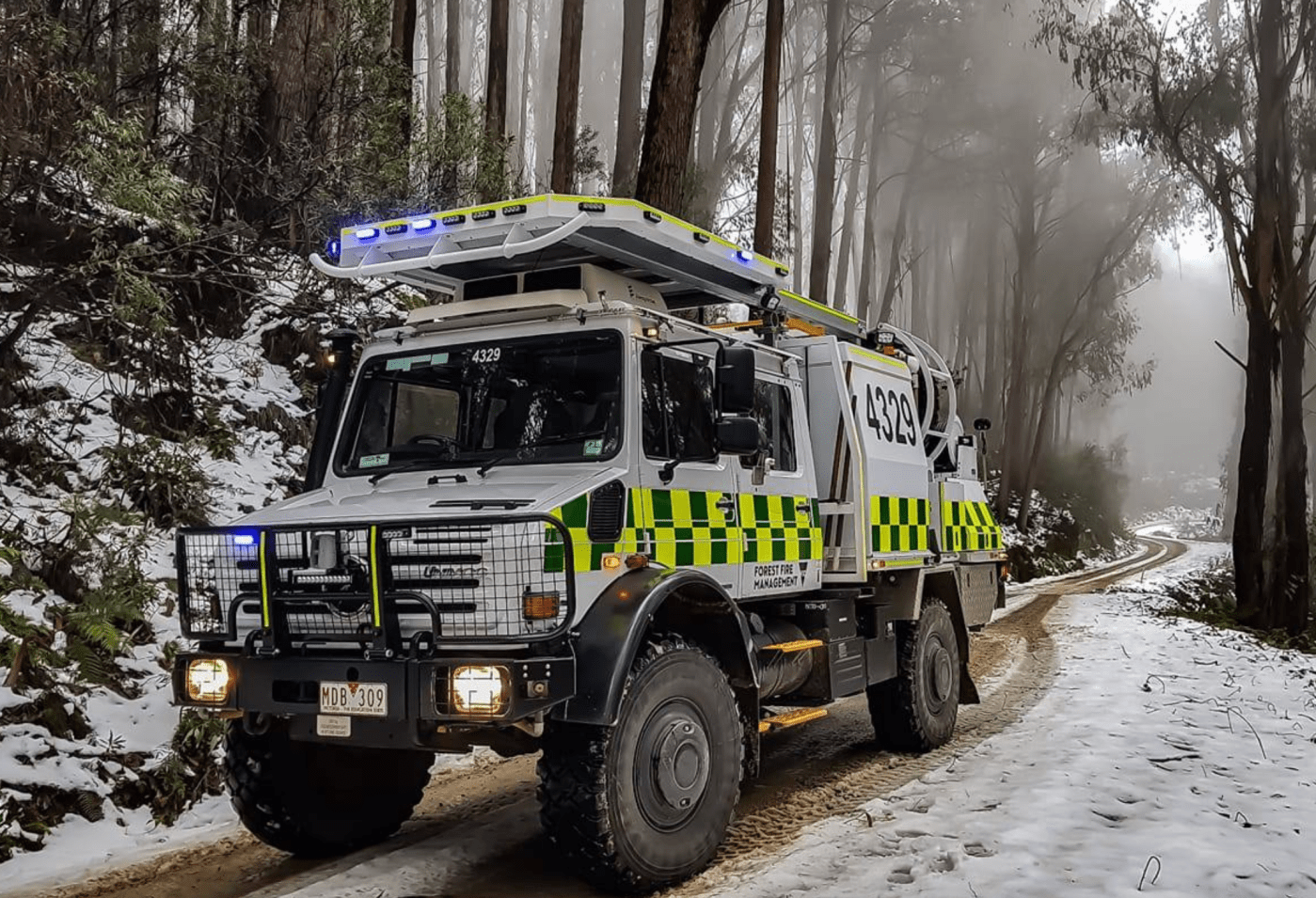
DEECA and Forest Fire Management Victoria have grounded the entire ultra-light firefighting fleet in Victoria just weeks before fire season commences.
Forest Fire Management Victoria (FFMVic) and the Department of Environment, Energy, and Climate Action (DEECA) have grounded their fleet of 290 Mercedes-Benz G-Wagons and 59 Unimogs. According to reporting from the ABC this was due to safety concerns. There are reports of cracking in the chassis of G-Wagons.
What will this mean for fire fighting in the high country?
The vehicles, critical for rapid response and navigating remote terrain, were part of a $32 million government investment made in 2017 to strengthen the state’s firefighting capacity. We understand that these vehicles were expected to have a working life of 10 to 15 years, and so natural wear and tear would start to impact on the fleet. However, according to Ross Kenna of the Australian Workers Union (AWU) cracks were found in the chassis of some of the G-wagons in the firefighting fleet. “From that period on, there’s been inspections of the vast majority of the fleet” which has resulted in the fleet being taken off line.
In the meantime, with fire season starting, there has been an attempt to secure spare vehicles from the CFA (for instance tankers which are kept in reserve to provide back ups when local brigades need to send their vehicles off for repair), and trucks that were due to go to disposal, and from fire authorities interstate. Additionally, as part of the Department of Energy, Environment and Climate Action, FFMV has a contingency fleet that includes Toyota landcruiser vehicles. FFMV has said that repairs are being ‘fast-tracked’ over the next two months and it appears that most vehicles will be back in operation by the end of December.
In the meantime, fears have been expressed that lack of vehicles will place additional pressure on CFA brigades near to public lands (those brigades likely to be called to a fire led by FFMV but requiring additional trucks and crews). The government maintains that there will be enough vehicles available to run full fire fighting capacity. Thankfully the mountains aren’t at high risk from fire at this end of the season (its drier in the west and green in the east) and hopefully the full fleet will have been brought back on line by the time the season kicks off in the high country. Based on experience, we do know that when fire fighting resources are stretched by large fires, it will be the wild places that are left undefended as we focus on human assets like buildings. So a lack of trucks suitable for remote fire fighting – the G-Wagons and Unimogs – could signal big environmental damage if there are large fires. Let’s hope that the vehicles are back on line and available in the high country by the time the fire danger becomes significant in Gippsland and the high country.
As usual, the issue has been politicised. For instance, Shadow Minister for Public Land Management, Melina Bath, slammed the Allan Labor Government for leaving regional Victoria ‘dangerously exposed’ ahead of a high-risk fire season, and blaming the government for not doing enough fuel reduction burning.
UPDATE, NOV 19
The Weekly Times (a pro Coalition, anti ALP weekly newspaper) reports under the heading ‘tanker loans prove chaos‘ that
- FFMV have asked interstate agencies for a loan of ‘about 30’ tankers from the NSW RFS and 5 from the SA Country Fire Service
- RFS have offered a ‘mix of light and medium tankers’. It is not clear how many vehicles that FFMV will take from NSW
- The G-wagon vehicles are undergoing inspections, with ‘sources’ saying that 2 vehicles had been written off due to problems with their chassis that could not be prepared. Once cleared, the vehicles are being returned to the fleet
HEADER IMAGE: DEECA Hume.





 Mountain Journal
Leave a comment