
Although most of our mountains are still a wild landscape, largely free of housing and direct development, they are a deeply peopled landscape. In the ‘story’ of the high country, the cattle people have been dramatically over represented in films, books, books and even poetry. First Nations people barely get a mention. The hydro workers have a lot of literature around their story and mining is a distinct sub set of history, although when Australians think of our mining history, I don’ think many connect with mining in the high country.
I spend a lot of time around the Mt Hotham – Dinner Plain area, and mining features in the early story of those places. And there is one story that often intrigues me that doesn’t seem to have an answer. What happened with the miner’s strike near Mt Hotham in 1883?
The history of Victoria’s high country is rich in gold and other forms of mining. The first gold discoveries in the area were made by diggers travelling over the ranges between the Omeo diggings and Beechworth, Buckland and the Upper Ovens fields during the 1850s. But it wasn’t until the early 1860s that a substantial population would return to prospect and mine these high country gold deposits.
Alluvial gold (stream deposits) were worked in upper branches of the Ovens, Dargo and Cobungra Rivers for many decades.
There are still remnants of the mining past in the area around Mt Hotham. One of the most notable features that remains from that era is associated with the Cobungra Diggings.
The Cobungra Ditch Walking Track follows the course of an abandoned water race that conveyed a stream of water for the hydraulic sluicing operations of the Cobungra Gold Mining Company. Commencing from the head of Swindler’s Creek and terminating at the Brandy Creek Mine towards Dinner Plain, the Ditch is retained for much of its 10.5km length by an impressive dry-stone wall. Gold was mined at Brandy Creek for about seventy years from the 1860s into the 1930s.
While initial mining in the area was done by hand by individuals or small groups, during the 1880s, publicity and good reports of gold finds had prompted capitalists to get involved. A company named the Cobungra Gold Mining Co. was formed to work the ground in earnest. With capital behind it, Brandy Creek subsequently pioneered new technology in sluicing techniques with the ‘Little Giant’ hydraulic nozzle. The nozzle was at the end of a large hose which pulled its water pressure from a water race high above the workings. The water race was dug from a point below Hotham Heights around the contours of the high plains for a distance of seven miles. It became known as ‘The Cobungra Ditch’.
A small township developed at Brandy Creek with two hotels, stores, post office, a baker and butcher to support the workers.
The ditch was cut by the Cobungra Gold Mining Company in 1883/4 at the cost of £11,000, and employed upwards of 120 men in its construction. The work force lived in a temporary workers camp known as the Cobungra Ditch Camp.
In November 1883 the company suddenly dismissed the workers on the ditch and, in response the workers banded together and held a protest march along the Alpine Road. They carried a large calico banner at the head of the march.
These notices (below) were posted around the camp and Mt Hotham, a year later which suggests the work continued.
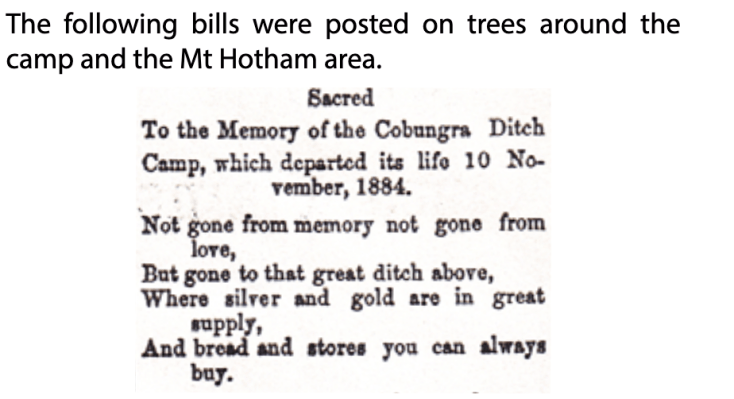
But what became of the strike? Did it succeed? The Ditch was completed so hopefully the workers were reinstated.
Sources used in this story
Luke Steenhuis, writing on the Gippsland History facebook page
https://www.facebook.com/groups/gippslandhistory/posts/2337398846490129/
Click to access Track-Notes-Cobungra-Ditch.pdf
https://www.mthotham.com.au/summer/discover/connect-with-us/news/walking-the-cobungra-ditch
https://www.victoriashighcountry.com.au/listing/cobungra-ditch/




 Mountain Journal
Leave a comment