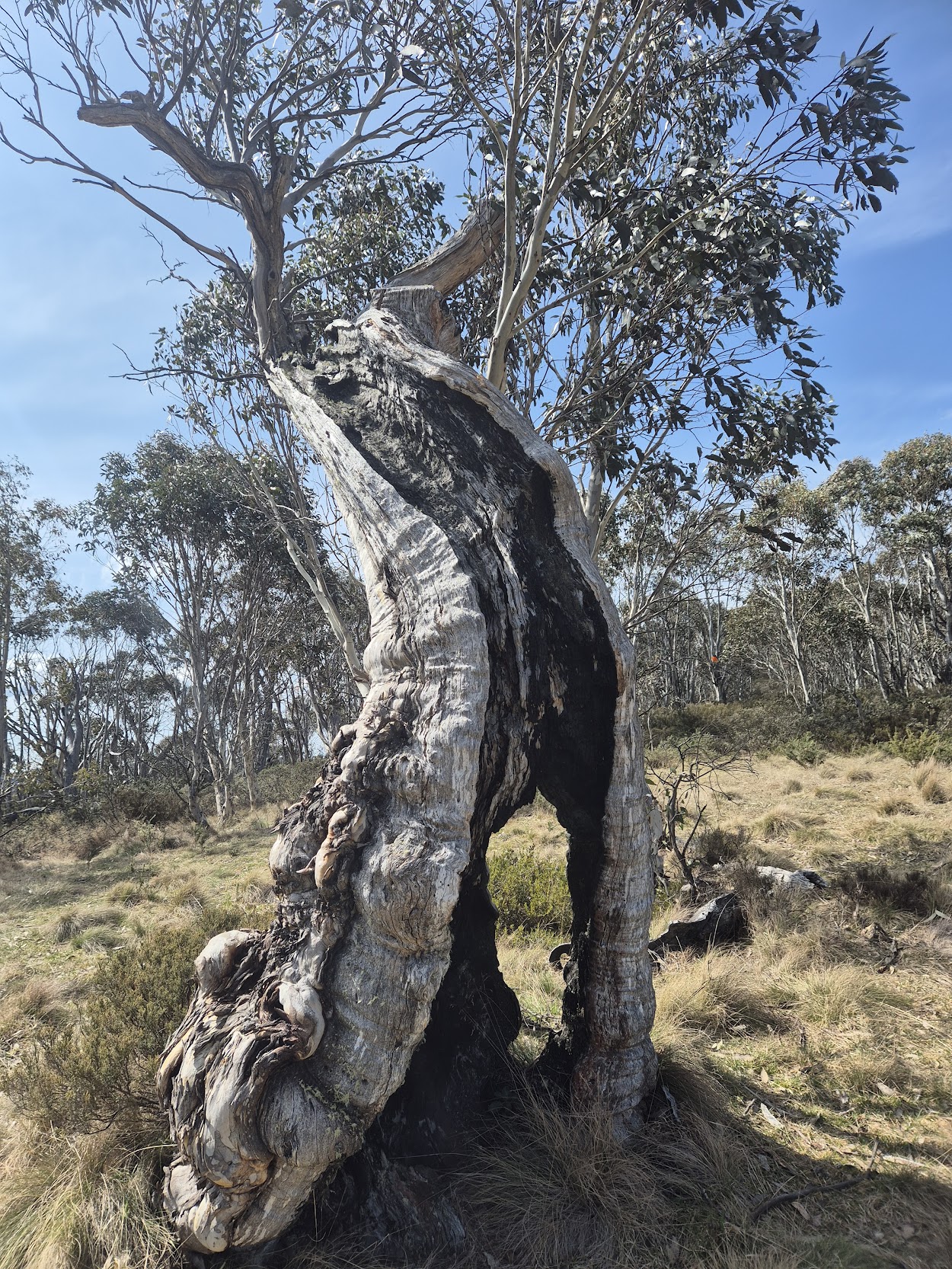
Snow Gums (Eucalyptus pauciflora) are the classic tree of the Australian High Country. They are profoundly different to the trees found in mountain areas in other parts of the world, and give a uniquely Australian sense to our high country. However, they are facing a double threat: they are at risk from dieback and climate change driven bushfires.
Like most eucalypt species, the snow gum can survive fire. However, climate change is leading to more frequent and intense fire, which is causing more death of trees and changes to forest structure. And while dieback, caused by a native beetle, is a natural occurrence, the dieback is getting worse and more widespread because climate change is making winters warmer and summers drier and hotter.
While most snow gums in Victoria are included in national parks, we are on the verge of losing the landscapes that we spent decades protecting.
Friends of the Earth have been running a campaign to ensure that the Victorian government acts in a meaningful way to head off these threats. Here is an update on recent progress made in the campaign, and new directions in the work.
Forward movement is happening
Our campaign is straight forward. We urge the state government to do the following:
1/ authorise an investigation into the ecological health of the forests, which would make recommendations to the state government about what to do next.
PROGRESS: in July 2025, we were told by the environment ministers’ advisers that he supports our call for an investigation into the health of snow gum forests.
You can read more about the progress we have made here.
2/ increase our capacity to stop small fires before they become uncontrollable blazes. One of our key ideas is to introduce a volunteer remote area firefighting team (a RAFT) who will be tasked with working alongside government firefighters to stop small fires in remote areas.
PROGRESS: the CFA and FFMV both support this idea. The training guidelines for remote and arduous firefghting have now been published and in late November 2025, the first group of volunteers were trained in arduous firefighting techniques.
3/ increase the fire fighting fleet and allocate additional planes (most likely Type 2 helicopters) primarily to protecting fire sensitive communities. Locate these aircraft primarily at bases near large national parks and state forests as needed according to weather and fire conditions.
Type 2 helicopters, such as the Bell 205A-1++, are well-balanced in terms of size and maneuverability. They can carry a substantial amount of water and maneuver well, making them valuable assets in firefighting operations. These aircraft are often used for initial surveillance and to support ground crews.
Type 3 helicopters, like the Bell 407, are smaller and more agile than their larger counterparts. They are often used for reconnaissance, transporting crew members, and performing precision water drops on smaller fires. While their carrying capacity may be less, their maneuverability makes them extremely valuable in navigating challenging terrain and accessing hard-to-reach areas.
4/ ensure that incident controllers, who manage how resources are applied to fires, are required to consider ‘ecological assets’ like fire sensitive vegetation in managing fires.
While we are seeing specific fires being managed well so as to protect fire sensitive communities like snow gums (as happened with this fire in early 2025 near the Wellington Plains) this is still up to the discretion of individual incident controllers. We need to set mandatory guidelines to ensure this becomes standard practise that that protection of ecological assets is considered in fire management plans in the same way human safety and asset protection is.




 Mountain Journal
Leave a comment