
The awful fires of Black Summer linger in our memory. The land slowly recovers. Since then, things have been fairly quiet in recent summers in the mountains of the mainland high country. With the first mountain fire of the season now contained, and vast areas of fire damaged forests in recovery from previous fires, it is essential that with any new start fire the authorities:
- Get on to new start fires as rapidly as possible
- Escalate the availability of resources to contain the fire, rather than ‘letting it burn’
- Ensure that fire management plans highlight the need to exclude fire from fire sensitive or recovering areas and the protection of ecological as well as human assets.
There are sometimes criticisms made of Forest Fire Management Victoria (FFMV) being too slow to respond to and contain fires in remote areas. According to figures released by the Victorian government, 83% of bushfires are contained on first attack by FFMVic, and 92% of bushfires are contained before they become bigger than 5 hectares. There is no doubt that FFMV crews do an outstanding job. The question here is whether resources (remote area or rappel crews and aircraft) are deployed quickly enough where there is no threat to human assets.
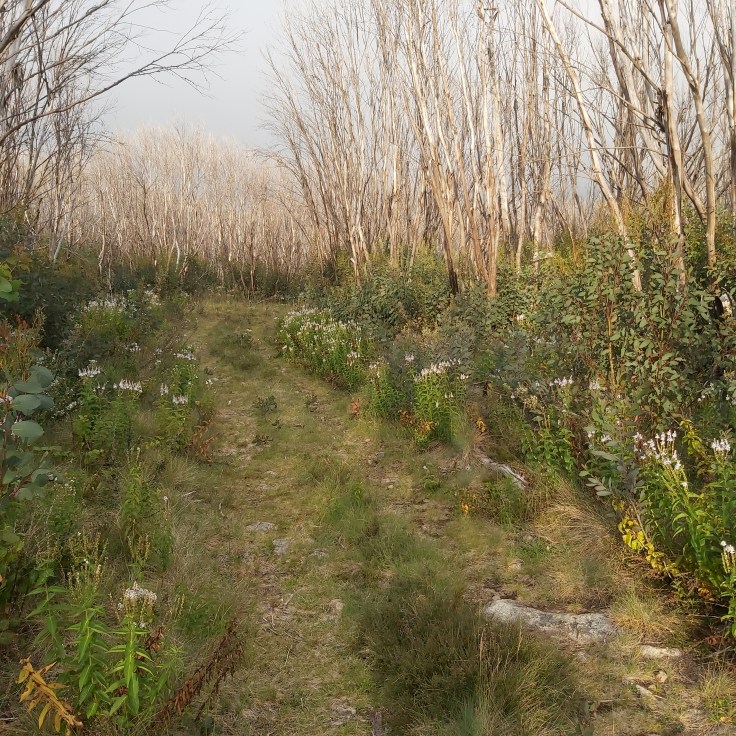
The large fires in the Victorian mountains last summer were in the Thomson catchment and around the Avon wilderness. Mountain Journal has reported on the fact that incident controllers in this second fire priortised protecting important ‘ecological assets’ as well as human assets. In this instance it meant keeping fire off the Wellington Plains, where fire damaged snow gum woodlands are facing ecological collapse if a blaze occurs again. There is a report on that fire available here. This is the sort of fire management we encourage, where natural and human assets are both priortised when it comes to decision making about where to allocate fire fighting resources.
A good start to the 2025/26 season
The response to the first significant fire of this season in the VIC high country is encouraging.
On December 13, lightning started a fire in the Snowy River National Park, about 15Km south west of Tubbut in far east Gippsland.
At the time FFMV reported that “the fire is in a challenging and steep remote forest area, and FFMV crews and water-bombing aircraft have been working hard to stop the fire from spreading. This includes specialist rappel crews, who have been deployed in the area.
A quick response by our firefighting crews has seen the Tubbut-Bowen Track fire brought under control”.
“Two rappel teams, local FFMVic crews and forest contractors with large dozers worked on the fire for four days in hot conditions, dealing with steep terrain and poor accessibility.
A large air tanker from Avalon air base provided the initial response, dropping retardant on the fire to help slow its spread before rappel crews could be inserted.
The Aerial Intelligence Gathering (AIG) helicopter used infra-red cameras to detect hot spots which could then be extinguished by ground crews.
Coordinating air resources and ground crews allowed for an efficient containment of the fire, which never grew beyond two hectares in size. Without this response, the fire could have grown into a significant bushfire during this week’s hot, windy conditions”.
A number of people have suggested that a fire last summer just south of Mt Howitt was not attacked aggressively early on and hence became larger than it should have. We acknowledge that this fire (December 2024) occurred when major fires were burning in the west of the state, especially in and around Gariwerd/ The Grampians. Accordingly, many fire fighting resources (both planes and ground crews) were allocated in the west.
This first fire of the 2025/26 season near Tubbut highlights the value of (and need for) strong initial attack.




 Mountain Journal
Leave a comment