Whether it is in a national park or other public land, a paddock or a house fire, one of the most important aspects of stopping fires is to get on to them quickly. The sooner that firefighters arrive, the smaller the fire will be and the easier it is to contain. In Victoria, one of the ways we try to keep fires small during high fire danger days is by launching aircraft as soon as a fire is detected. Often aircraft can then get on scene and start to contain the fire before local brigades arrive. This system (called pre-determined dispatch or PDD) was developed as part of the response to the Victorian Bushfire Royal Commission (VBRC), and was based on a model used in a number of other states. Under PDD, fire fighting aircraft are mobilised as soon as a call out occurs for local fire brigades with a trigger needed to authorise the launch of aircraft.
Other ways we get onto fires quickly includes things like deploying remote area firefighters onto new start fires, inserting rappel crews from helicopters, and sending multiple vehicles at the same time to ensure there are enough resources to tackle the fire. We use real time analysis of satellite images and on some days put aircraft up for surveillance (rather than firefighting) purposes. There is lots of chatter about using drones that could carry water or fire retardant that could be sent to put out small new start fires. And of course, we have traditionally relied on staffed fire lookout towers to spot fires while they are small.
In recent years Artificial Intelligence (AI) has been billed as being a new option for spotting new start fires quickly.
As with any new technology, there is the profit imperative, which can influence the development and use of the technology, and people involved in the industry will tend to boost it (often by over claiming how great it will be) and it can sometimes be difficult to see through the hype.
AI is now being used to identify new start fires in Australia. A key question to ask will be: if AI cameras work efficiently, will they be used to replace staffed fire lookout towers? If so, what will that mean for overall safety and employment in the sector? To be clear: I do not support the replacement of people in towers with AI cameras. I am simply having a bit of a look into where the technology is at in the south east of Australia.
Fire lookouts vs AI
According to the website Fire lookouts down under (which has a wonderful photo gallery of old towers) ‘FFMV now operates 72 fire towers across Victoria (a recent report from the ABC says there are currently 67 fire towers across the state). The CFA, Melbourne Water, Hancock Victorian Plantations (HVP) also operate some. Melbourne Water has four towers that look over the land around Melbourne’s water catchments.
They are essential for early warning detection of new start fires. As a fire fighter, I have often been on a truck that has been able to locate a small fire in thick bushland due to triangulation from multiple fire towers before there is an obvious smoke column becomes visible to guide you to the site.
As was noted in a story that appeared in the Sydney Morning Herald (SMH), ‘the art of fire spotting hasn’t changed much over the years. When smoke is seen, a bearing is taken and compared to another bearing sent over from a different tower. When combined on a map, the point where the bearings cross is the location of the fire, and it is called in. There are no computers and no GPS.’
As reported in the SMH story, ‘it is a decidedly low-tech, but highly effective process, and is one that looks unlikely to change in the near future’.
Victoria
Since the Black Summer, AI has increasingly been trialled by a range of institutions.
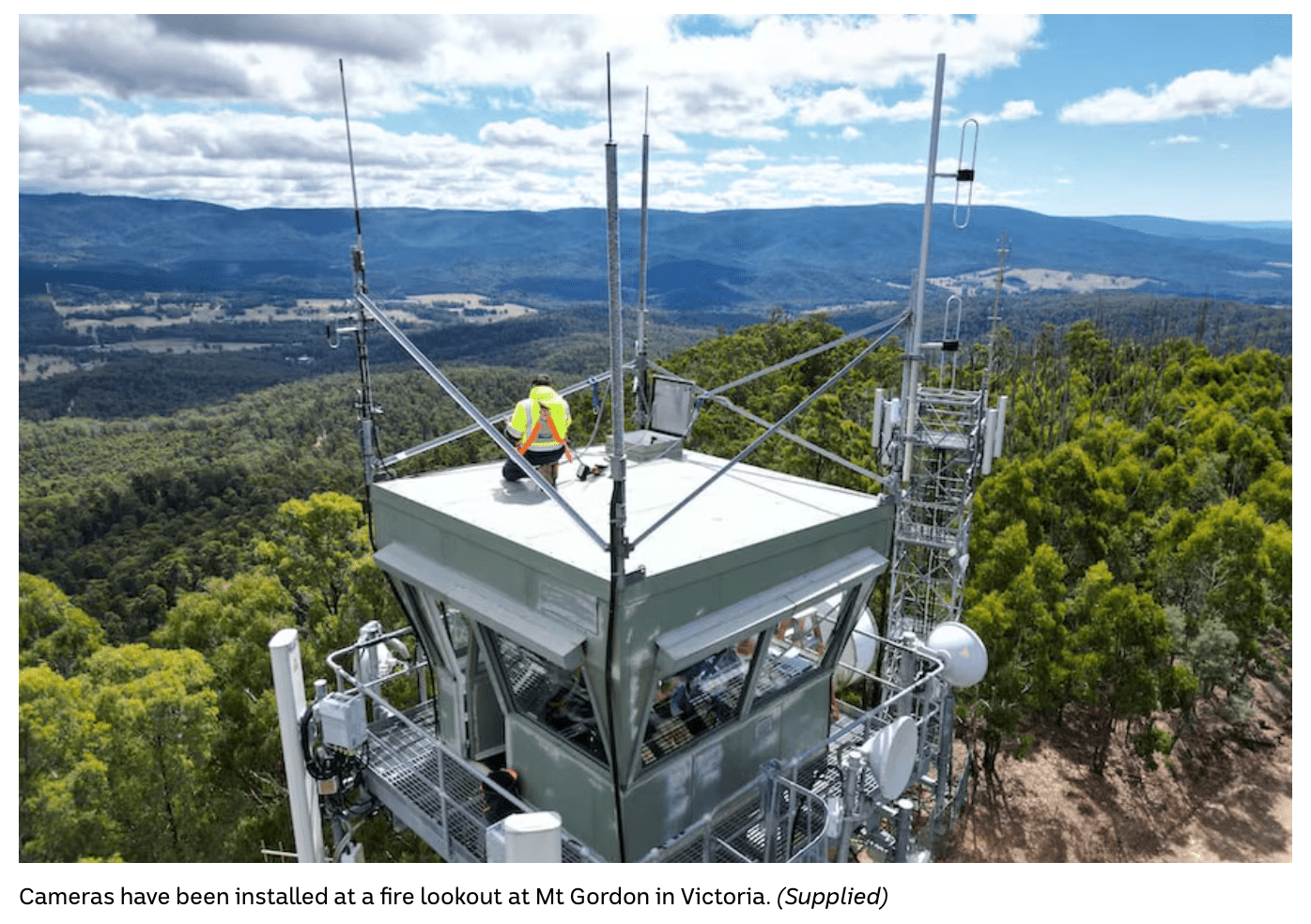
In Victoria, both the Australian and Victorian Governments have contributed $1.5 million to a Remote Sensing Bushfire Detection project through the Australian Government’s Disaster Ready Fund (DRF). The Remote Sensing Bushfire Detection project is assessing the reliability and timeliness of smoke-detecting AI software using ground cameras mounted on specific fire lookouts across the state. The testing of these cameras is intended to assist Forest Fire Management Victoria (FFMV) in deciding how the technology may be used in the future.
During the 2023-24 fire season, cameras were installed on fire lookouts at Mt Gordon near Marysville, Mt Wombat, Peters Hill near Angelsea, and on a mobile trailer stationed in Mt Vandyke. During the 2024-2025 fire season cameras were installed on fire lookouts at Big Hill in Stawell, Mt Mittamatite and Mt Ida.
And in the current fire season, FFMV have announced that ‘a brand-new AI-powered smoke detection camera has been installed at the Mount Tarrengower lookout in Maldon.
Using advanced technology to assist the tower operator, the camera can spot smoke early and send real-time alerts straight to Forest Fire Management Victoria, assisting crews respond faster and keep communities safer’.
According to FFMV, the cameras will ‘give us a GPS location as to where that smoke may be and it’s at that stage then we will deploy an aircraft or confirm the sighting from other fire towers or other opportunities’. That is, it acts as an early warning system (as a human lookout in tower is) and then allows resources to be mobilised to get to the fire and put it out once it has been verified.
FFMV say “It doesn’t make decisions for us. It gives us information to help guide the decisions that we as human beings make.”
A privately run system is also in operation in south western Victoria. A network of 7 AI-powered fire detection camera network funded and operated by the Green Triangle Fire Alliance (GTFA) is ‘proving to be a critical asset in boosting firefighting intelligence and response times, identifying 46 unplanned fires in south west Victoria this past fire season’. Reps from GTFA (which is an industry-led initiative established to ‘improve the efficiency and effectiveness of fire suppression, detection, and prevention across the Green Triangle region’) noted that the system was a success because of close collaboration with firefighting agencies, who could use the information generated by the cameras to quickly tackle fires.
NSW
Fire-spotting artificial intelligence technology will be deployed in 22 locations around NSW forests as part of a $1.4 million investment announced by the state government in Septmber 2025.
According to a report in City News:
“By integrating AI-powered detection into our fire tower network, we’re enhancing traditional firefighting methods with cutting-edge technology that delivers real-time intelligence and faster response times,” Ms Moriarty said.
The specialised devices, developed by US firm Pano AI, use ultra high-definition cameras to scan for signs of fire and upload findings to trained analysts who can send alerts to landholders and emergency services.
The cameras will be installed on 22 fire towers in an area between Tamworth and the NSW and Victorian border, Pano AI Australia spokesman Andrew Prolov said, and will monitor 1.2 million hectares of land.
The technology is also being used to monitor parts of South Australia and Tasmania.
With involvement of private sector, a total of 36 AI cameras have now been installed by the Rural Fire Service, National Parks and Wildlife Service, Forestry Corporation of NSW and private timber companies across NSW. There is an intended use in fire fighting operations, as well as detection. For instance, RFS Riverina Highlands District operational officer Mathew Mill said ‘the cameras also provided valuable information about the resources needed to fight a fire’, the size and direction of spread, and so on.
Are fire spotters obsolete? (not yet!)
Most of the public commentary from land managers and government is that the use of AI will complement the information provided by humans in fire towers, rather than replace them. For instance, Forestry Corporation NSW innovation manager Jamie Carter said the cameras would not replace human fire-spotters in towers but would complement their efforts, which is similar to statements from FFMV in Victoria.
FFMV do say that AI offers coverage when towers are not staffed. ‘The software and cameras will complement and support the work of FFMVic’s specially trained Fire Lookout Observers, especially at times when lookouts aren’t staffed after hours or due to health and safety concerns such as operating or climbing in the dark and extreme weather conditions’.
But as we know, there is a widespread obsession with AI among many decision makers, corporations and within the broader community. New tech is always a way to make money and is often billed as a panacea to specific problems. So we do have to remain vigilant as governments continue to roll out the use of AI in early warning systems.
In the USA, things have gone slightly further. Late last year it was announced that in Orange County in California, AI cameras were set up that cut people out of the picture. Instead of sending an alert about a possible fire sighting that would need to be verified by a human operator, the AI would alert local Orange County firefighters to the location of the fire, without the need for any intervention by humans.
The system was developed by a high school student from Orange County, Ryan Honary. ‘The technology, integrates infrared sensors with AI to identify heat sources — including open flames as small as a floor tile. The sensor’s camera continuously refreshes, capturing new images every few seconds, and can even detect heat plumes, providing an early warning system for emergency responders’. While the initial automated use of the system appears to have been a great success, I have not found resources online explaining how effective this system has been or how widely it is being used.
Fire spotting in the mountains
We know that lightning is a common cause of bushfires in the mountains. There are fewer people than in most other parts of the state, and deep valleys, weather conditions, and thick forests can hide fires when they are very small. After periods of lightning, reconnaissance aircraft patrol forested areas to detect fires, and Fire Lookout Observers stationed across the high country in dedicated fire towers also help identify fires. But the chances of a fire going un-noticed until it grows to a decent size is higher in this part of the world.
It does seem that, as long as they are not used as a replacement to staff, that AI can complement the observations from other parts of the system – including towers and crewed aircraft – and help protect the mountains from destructive fire.
What about the satellites? Or drones?
This is just a quick look at the use of AI to spot fires, and doesn’t attempt to cover the other tech being developed for early warning, but we do note that the NSW Rural Fire Service (RFS) has also partnered with the Minderoo Foundation and Californian researchers to trial satellite-based technology to spot fires earlier through optical recognition.
There is also a huge amount of work that is being done at the Australian National University around increasing our ability to identify and put out wild fire ignitions while they are small. Ideas being pursued include the development of fire fighting drones. Researchers say that ‘Drone technology extends the capabilities of existing human-crewed aircraft when fighting fires’ and notes that drones can operate in poor weather conditions and at night. There are some summaries of the work here and you can read about the ground breaking work at ANU here.
Got an opinion?
You’re welcome to get in touch or leave a comment below. Cam.walker@foe.org.au
The HEADER IMAGE used here comes from an ABC news piece. https://www.abc.net.au/news/2025-12-23/early-detection-cameras-spotting-fires-in-nsw/106148476




 Mountain Journal
Leave a comment