
The devastation of Black Summer lingers in the back of everyone’s mind who knows the high country. Each year we wait to see what fires will happen, and how quickly those fires will be contained. It has been a number of years since we have had a truly awful fire season in the mountains of the mainland high country. 2025/26 has seen large and very destructive fires across much of Victoria, with Harcourt, Longwood, the Otways and Walwa probably the best known.
It has also been a summer of significant activity in the high country. This is a quick look at some of the key fires in Victoria, up until mid February. Lets hope the fire season starts to slow down from here.
With vast areas of fire damaged forests in recovery from previous fires, this summer’s fires have underscored some important points. With so much damage in recent decades, it is essential that the authorities:
- Get on to new start fires as rapidly as possible
- Escalate the availability of resources to contain the fire, rather than ‘letting it burn’
- Ensure that fire management plans highlight the need to exclude fire from fire sensitive or recovering areas such as fire damaged snow gums or young alpine ash.
There are often criticisms made of Forest Fire Management Victoria (FFMV) being too slow to respond to and contain fires in remote areas. According to figures released by the Victorian government, 83% of bushfires are contained on first attack by FFMVic, and 92% of bushfires are contained before they become bigger than 5 hectares. This is not a critique of workers, FFMV crews do excellent work in often very challenging conditions. The question here is whether resources (remote area or rappel crews and aircraft) are deployed quickly enough to limit the spread of fires where there is no threat to human assets.
The larger fires in the Victorian mountains last summer were in the Thompson catchment and around the Avon wilderness. Mountain Journal has reported on the fact that incident controllers in this fire priortised protecting important ‘ecological assets’ as well as human assets. In this instance it meant keeping fire off the Wellington Plains, where fire damaged snow gum woodlands are facing ecological collapse if fire occurs again. There is a report on that fire available here.
Let’s have a look at some of this season’s fires and how incident controllers managed them. Generally it seemed that
- The authorities were quick to get onto fires and allocate specialist teams such as rappel crews who can be inserted by helicopters, and there was good use of aircraft
- It is not clear that environmental protection was prioritised in the largest fire (the Dargo/ Wonnangatta)
- Interstate crews were essential to increase local capacity in bad fire seasons
A summary of some of the significant fires of 2025/26 in the Victorian mountains
December 13, 2025 – Snowy River National Park
The response to the first significant fire of this season in the VIC high country was encouraging.
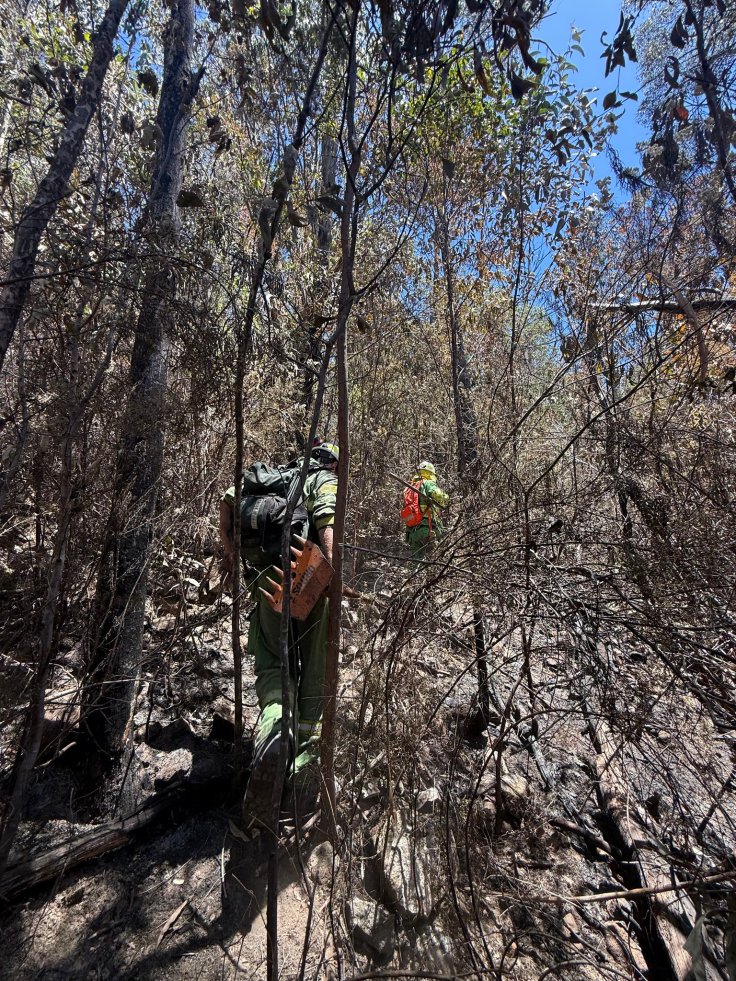
On December 13, lightning started a fire in the Snowy River National Park, about 15 km south west of Tubbut in far east Gippsland.
At the time FFMV reported that “the fire is in a challenging and steep remote forest area, and FFMV crews and water-bombing aircraft have been working hard to stop the fire from spreading. This includes specialist rappel crews, who have been deployed in the area.
A quick response by our firefighting crews has seen the Tubbut-Bowen Track fire brought under control”.
“Two rappel teams, local FFMVic crews and forest contractors with large dozers worked on the fire for four days in hot conditions, dealing with steep terrain and poor accessibility.
A large air tanker from Avalon air base provided the initial response, dropping retardant on the fire to help slow its spread before rappel crews could be inserted.
The Aerial Intelligence Gathering (AIG) helicopter used infra-red cameras to detect hot spots which could then be extinguished by ground crews.
Coordinating air resources and ground crews allowed for an efficient containment of the fire, which never grew beyond two hectares in size. Without this response, the fire could have grown into a significant bushfire during this week’s hot, windy conditions”.
December 31 – Alpine national park
Several fires were called in on the last day of the year. One was burning in a remote area within the Alpine National park just north of the Mitta Mitta River near Bingo Munjie. The site was difficult to access and aircraft were used and quickly contained the fire.
December 31 – Buffalo national park
FFMV reported that firefighters were currently working to contain a fire within the Mt Buffalo National Park.
The fire, which was started by lightning, is 0.25 hectares in size and is not posing a threat to the community.
Specialist rappel firefighters based at the Ovens airbase were inserted into the fire area, which is not accessible by vehicles. Additional firefighters also hiked into the fire ground.
Fire-bombing aircraft worked to support ground crews to contain the fire in the steep, rocky terrain.
The fire was first reported on DEC 31 and contained later that day.
January 4, 2026 – lots of small fire activity
In the early hours of the 4th, a fire was called in about a ‘glow’ seen in a remote area on Saw Mill Spur Track, to the west of the Dargo High Plains road and north of Dargo. Given it was 1.30 in the morning, it was decided by a local CFA brigade and FFMV that it would be investigated at first light. It was marked as Safe by 9am.
Later in the day there were a number of fires in the northern edge of East Gippsland around Mt Cobberas and Mt Taylor.
Early January
3 fires were reported in the Namadgi national park in the ACT. Remote area crews were deployed to contain them.
‘Specialist Remote Area Firefighter Teams (RAFT) and firefighting aircraft are attending to the incidents today, working to establish control lines to contain the fires as quickly as possible.’
Jan 8
The Walwa fire burnt through much of the month, impacting communities and large areas of the Upper Murray catchment. Around this time, the scale of the fire was so large and intense that it generated its own thunderstorm. Lightning from this storm has been detected just west of Khancoban and smoke from the fire drifted in an easterly direction towards Jindabyne and Cooma. Spot fires from the lighting have started on the NSW side, with RFS and Parks Service crews deployed to stop them before they took off.
The big one – the Dargo Wonnangatta complex
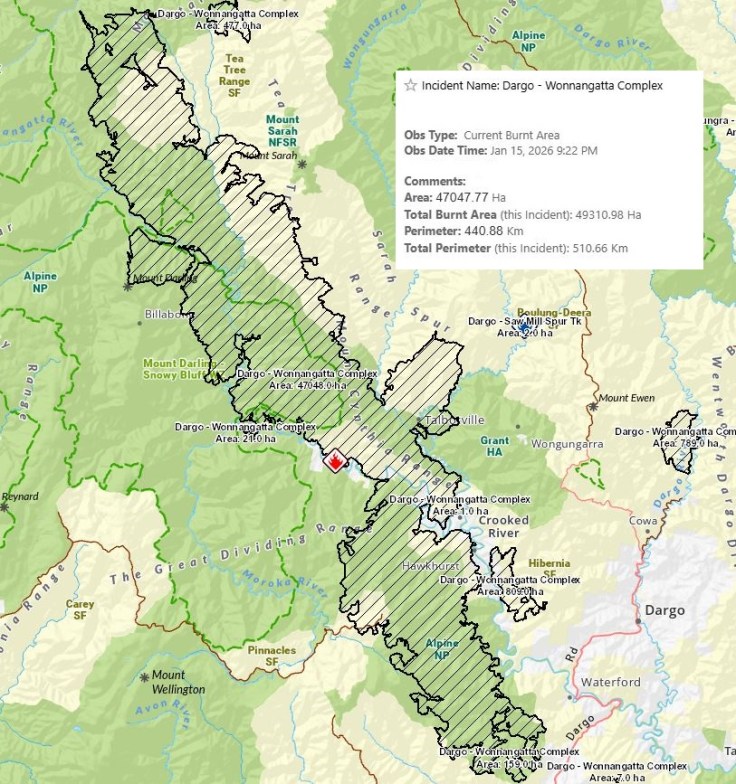
What came to be called the Dargo Wonnangatta complex started on monday night (5 January) at the top end of Wonnangatta Valley and was caused by lightning (multiple fires in the high country had started at similar times). According to reports posted on social media, Forest Fire Management Victoria (FFMV) crews went in to check it before 8am the following morning and started working on it straight away, with both aircraft and ground crews.
However, the fire took off rapidly, and according to reports was spotting well ahead of the main fire front once it got going. According to people in Dargo, a pyrocumulonimbus cloud was observable rising over the mountains to the north.
You can read our longer report about this fire here.
From Jan 18 onwards there were continued small fires started due to dry lightning, including in the Viking Razor area.
Jan 21: 32 arduous fire-fighters were deployed to the Razor-Viking fire using helipads constructed by rappel crews. Along with aircraft, they targeted hot spots and did ‘dead edging’ (deliberate burning in front of the fire to create a burnt area that is intended to slow the oncoming fire front. Dead edging refers to bringing a fire to a mineral earth break. That can be done by direct attack on the fire edge, burning out, or letting downslope fire reach that edge.)
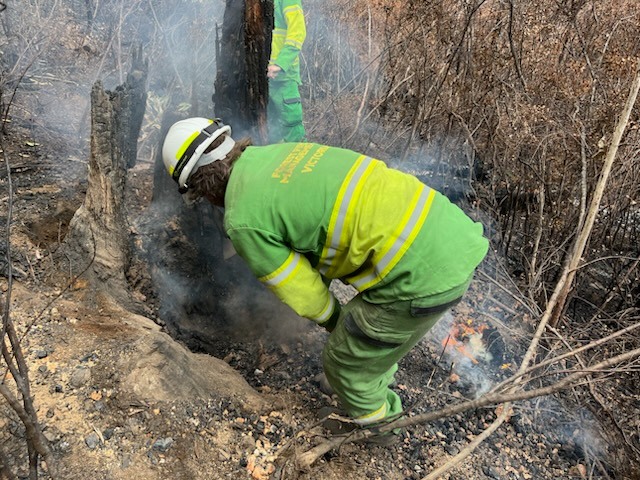
FFMV reported that along the western edge of the fireground, crews conducted protection works of heritage huts and cultural sites. This protection work included mineral earth breaks and fire protection wrapping around the huts.
During this stage of the fire, FFMV was assisted by at least 2 contingents from Western Australia one from South Australia.
The fire burnt through the rest of the month, with multiple outbreaks beyond the main fire footprint. On Sunday, 1 February 2026, the Wonnangatta-Dargo fire was successfully contained thanks to the tireless efforts of firefighters. The fire burnt more than 50,000 hectares, largely lower foothill country, although snow gum woodlands were impacted in the northern end of the fire around the Great Divide and the Pinnacles area.
We rely on interstate and international support in bad fire seasons
A total of 460 personnel from almost every Australian state and territory were deployed to Victoria during January, plus 22 arduous terrain firefighters from New Zealand who were brought in to support operations near Tallangatta (the Walwa fire). A further 74 personnel from Canada arrived on 27 January.
There were thousands of responders from local agencies including the Country Fire Authority (CFA), Forest Fire Management Victoria (FFMVic), Fire Rescue Victoria (FRV), Victoria State Emergency Service (VICSES), and they were supported by more than 70 aircraft.
Hundreds more volunteers and staff from local Councils, Government departments and emergency support organisations such as Red Cross and Salvation Army, provided support through relief centres.
In addition to coordinating personnel, the AFAC NRSC coordinated movement of the National Aerial Firefighting Assets. The 5 national aircraft assets are funded by the Australian Government to supplement each state and territory’s own contracted fleet in times of increased risk or activity. Of these assets, the large airtanker (NLAT) was deployed to WA twice to assist in fire suppression operations during this time.
On 9 January 2026, Victoria experienced catastrophic fire and heatwave conditions, with multiple districts and communities impacted by fast-moving bushfires. The AFAC NRSC coordinated assistance for Victoria, calling on incident management teams, crew roles, deployment management, and liaison support from other states and territories.
Further support from the National Aerial Firefighting Assets was provided to Victoria through the deployment of the NLAT, and the 2 National Black Hawk helicopters.
Over a 6-day period, 480 resources were deployed to Victoria as well as 47 tankers from NSW and SA.
As of Jan 28, 1,300 personnel from interstate, Canada and New Zealand had been deployed to support our response in Victoria, helping out at fire grounds and in Incident Control Centres.
A note on this report: I wasn’t involved in any firefighting efforts in the high country this summer (I was kept busy at home with my brigade in Central VIC). So this report is based on a combination of what was publicly available online from official sources, yarns with friends from FFMV and CFA who were on fires, and some conversations with people in incident control rooms.
This story focuses on Victoria (rather than NSW, ACT or lutruwita/ TAS simply because I am based in Victoria).




 Mountain Journal
Leave a comment