I work with Friends of the Earth, and live in Castlemaine in Central Victoria, Australia. Activist, mountain enthusiast, telemark skier, volunteer firefighter.
The following comes from the Mountain Watch website:
So you might have heard that yesterday the resorts copped a little bit of a soaking? Don’t panic! It is completely normal! Here at Mountainwatch we consulted our resident meteorology sensei “The Grasshopper” for a few words about the weather of the last few days.
“It’s a real shame to see all of that beautiful early season snow washed away, but unfortunately rain like we’ve just witnessed was always a strong possibility,” the Grasshopper said.
The weather pattern of the last few weeks has been a strong indicator of a great season ahead. The typical pattern in early to mid May in the last few seasons has seen the mid latitude band of high pressure systems become well established over SA, pushing a lot of the cold moist weather south of the continent. Luckily this year these ‘blocking highs’ haven’t become properly established, letting the cold fronts push north and bringing with them cold moist winds.
The following report comes from the NSW Office of Environment and Heritage. ‘Diversity – beyond the boundaries’
An exceptional seventh annual Alpine Resorts Sustainability Forum was hosted by the NSW Office of Environment & Heritage (OEH) and held 9-10 May 2011 at Lake Crackenback Resortexternal link, Jindabyne NSW. This years forum theme was ‘Diversity – beyond the boundaries’.
The forum was officially opened by Bob Conroy, Executive Director Park Management Division, OEH. Mr Conroy emphasised the NSW government would not forsake environmental responsibility in the pursuit of being economically competitive. He also spoke about the challenge that the Australian alpine resort industry faces on a daily basis while managing businesses in Australia’s fragile alpine environment. Mr Conroy announced that in 2011 NSW National Parks & Wildlife Service will be publishing the inaugural annual NSW alpine resorts environmental performance report covering Kosciuszko National Park.
Three outstanding keynote speakers: Professor Mike Archer a vertebrate palaeontologist and mammalogist; Rachael Oakes-Ash, social media commentator and ski journalist; and the futurist Mark Pesce delivered thought-provoking presentations. The remainder of the program included presenters, workshop facilitators and field trips. The other presenters challenged people’s thinking when they spoke on a broad range of topics including improved initiatives in sustainable use and management of alpine resorts including better use of technology, social networking sites, sustainable tourism and marketing and environmental reporting as well as the development of improved snowmobiles.
Delegates had wonderful networking opportunities throughout the forum, particularly at the opening dinner and at one of four workshops or fieldtrips: ‘Thredbo EMS: the Challenge of the EMS in an Alpine Environment’; ‘Climbing the Social Media Ladder’; ‘Keys to Successful Rehabilitation in the Alps’; and a guided mountain bike ride On the Tourism Track in Thredbo Valley’.
A walker has been found near Mt Skene in the Victorian Alps after an overnight search.
The man, 30, was walking from Walhalla to Canberra on the Alpine Walking Track (AWT) when he activated his emergency position-indicating radio beacon on thursday May 12. He was found the next morning, appears to be in good health, and is walking out with police and the search and rescue team.
A police spokeswoman said crews had been searching Mt Skene for the Alphington man on the east side of the Jamieson Licola Rd. There had been substantial snow falls across the Alps over the last few days and conditions have been below zero.
It is understood from media reports that the man was taking six weeks to do the AWT from Walhalla to Canberra.
Past Cooma, on the edge of the Southern Highlands, an innovative project is underway.
Farmers are taking part in workshops which is teaching them Indigenous land management techniques.
It’s hoped that owners will not only gain an appreciation of the methods, but also use them on their own properties.
And as part of the lessons, we’re learning about one of the oldest form of land management: fire.
Before the tractor was king, much of Australia was controlled by fire, and it’s a technique that Indigenous elder Rob Mason believes should be used more on Australian farms.
“We’re trying to do it in a way so that local landowners can have a bit more vision on their local resources,” he said.
“A farmer will look out on his area and might say, okay, I think that might a suitable area for growing peas or it might be a suitable area to put my sheep.
“Same with Aboriginal people. We look out into the areas and we actually know by animal indications that suitable areas are where they are.
“We tend to think of ideas or management plans like that for the areas, such as burning practices. That’s quite an old technique of land management, and I believe that’s totally missing from this important area here.”
Geoff Robertson owns a 270 hectare property outside of Nimmitabel, half an hour south of Cooma, and is hosting this unique workshop as part of a cultural heritage agreement he signed with the Murrumbidgee Catchment Management Authority.
“Some years back we signed up to a stewardship agreement for biodiversity,” he said.
“And when we did that we were contacted by their Indigenous unit, and we were very interested in that for all sorts of personal reasons.
“So we signed this agreement, and part of that was sharing of knowledge of traditional Aboriginal knowledge through Friends of Grasslands.”
Geoff, who has been involved for many years with Friends of Grasslands, says he wasn’t concerned that that signing the agreement would take away control over his property.
“But there was nervousness about opening oneself up to a different way of thinking, because I guess us White Australians have this side of our history that we’re not too proud of or don’t want to know about, so I guess confronting that, that’s scary,” he said.
“Since my early 20s, I’ve taken a lot of interest in Aboriginal communities.
“My first wife and I actually adopted a Torres Strait Islander child who’s now very much an adult, so we have personally within our family Indigenous people, so every day in some sense we deal with that issue of being Indigenous and not being Indigenous.”
Geoff’s property was formerly used for grazing, and he says that the Indigenous farming techniques wouldn’t interfere if the property were to return to that practice.
“In lots of properties in this area, they’re not too different to this one, so there’s nothing that would prevent what we’re doing here from happening in other parts of the country.”
But how feasible is this kind of management as an alternative, or even addition, to modern farming techniques? Monaro grazier Charlie Massy was excited by the workshop he attended at Nimmitabel.
“There is some really exciting holistic land management grazing going on in this country,” he said.
“Whilst we didn’t have ruminant herbivores in the past, Tim Flannery and others are talking about what the megafauna might have been doing and that new types of grazing might be starting to emulate that and stimulate landscape function.”Indigenous land management on farms in the Monaro
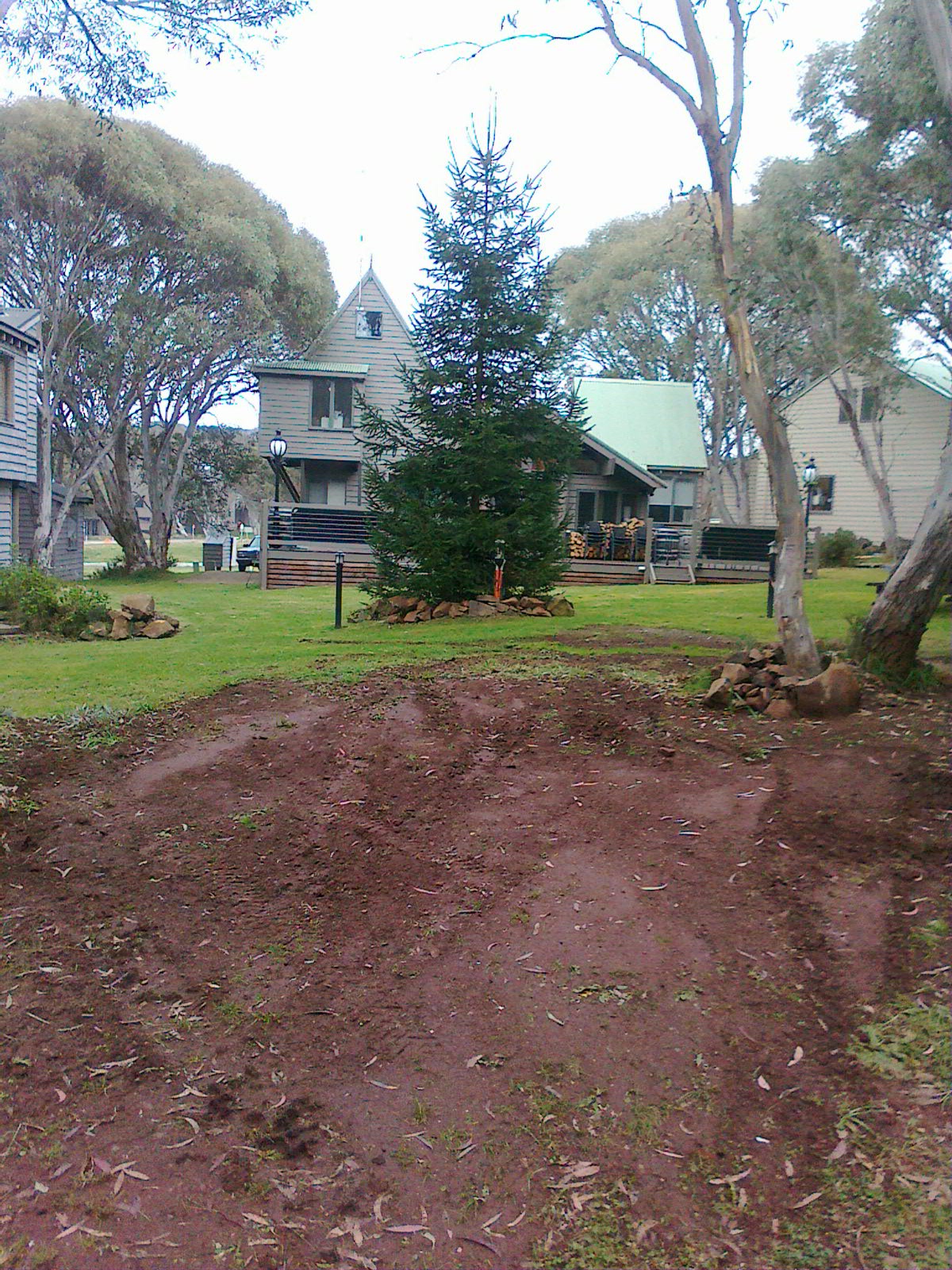
As a sub division within a snow gum woodland, developers at Dinner Plain, near Mt Hotham in the Victorian Alps, have done a good job of keeping as many mature trees as possible, whilst building houses and businesses quite densely. The ‘green’ aspect within the village is aided by the small bushland reserves that break up the housing.
Alphutte at Dinner Plain: bare earth where native veg existed. Introduced tree in background.
Guidelines require people to use indigenous species where they are putting in plants (Council guidelines say ‘only indigenous plant material can be used at Dinner Plain’), and lack of fencing has meant that small pockets of remnant understory also exist between houses. This enhances the feeling of still being in a forest.
However, Dinner Plain could be a very different place in coming years.
There is a disturbing ‘suburban creep’ that is evident, with a reasonable number of land owners now opting to destroy their remnant ground storey species and replace them with lawns.
In one obvious example of this, the people who run the Alphutte pizza restaurant recently completely removed all the remaining remnant understorey at the back of their block.
In spite of the fact that local indigenous species are meant to be planted at DP, Alphutte flout this law and have a large conifer growing as well.
While this was just a small patch of shrubs and flowers, if everyone at Dinner Plain destroyed their remnant vegetation and replaced it with lawn, and planted exotic (and potentially invasive) species on their land, the place would look profoundly different. There would also be substantial loss of biodiversity within the village itself. Dinner Plain is a small enclave of private housing within the Alpine National park, and weed invasion into the park is an obvious and, sadly, growing problem.
Often, these people retain most of the older snow gums on their properties yet don’t seem to understand (or care) that mature trees have to come from seedlings, meaning young trees must be put in to allow them to replace older trees when they do eventually die. The ‘clear the scrub and plant grass’ mentality and absence of new trees being planted will see a profoundly different village in coming years.
If poor environmental management upsets you, you may want to avoid Alphutte the next time you’re in Dinner Plain.
You might want to support Mountain Kitchen, which stocks local indigenous plant species.
Thankfully, the majority of people do seem to appreciate the remarkable landscape they are staying or living in, and do the right thing at Dinner Plain, by protecting or even replacing indigenous species.
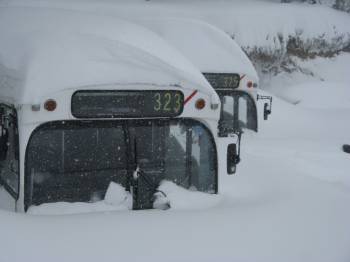
Seems the wheels have fallen off the 'sustainability' bus
With winter almost in view, the resorts are announcing their highlights and new activities for 2011.
In Victoria, there are the usual snow making investment announcements and continued diversification of activities. At Falls Creek, the final stage of the Slalom Plaza redevelopment has been opened. Apparently Falls also has new aerial walkways, which take pedestrians through the village via a network of elevated stairways. At Hotham, in contrast, the main new announcement is some extra investment in snow making.
Mt Buller has put another $1 million into new snow guns and the snow grooming fleet.
However, on the environment front, I doubt I have ever seen such an un-inspiring effort.
In a rather bizarre move, some reports say that Buller now has a heated walkway from the Village Square up to the Ski and Snowboard School and the Buller Kids Centre. This would be great if Buller was pitching itself as a nudist colony, but most of us wear boots in the snow, and it seems like they must have money (and carbon) to burn if they think using energy to heat an outdoor pathway is a good idea.
Hotham is pushing air travel to get to the snow. Falls and Hotham continue to push the gas guzzling obscenity that is the 6 minute heli link ride so you can ski two mountains. Great for people with no values but a healthy credit card limit. Hotham runs kids snowmobile operations. Mention of environmental initiatives seems to have disappeared almost completely from resort promotional material in 2011 (for instance, there is a one paragraph mention of environmental practise in this years 50 page booklet from Hotham).
Meanwhile, Falls has announced that 10 ‘brand new luxury Snowmobiles’ have been added to the tours fleet, allowing guests to ride or pillion on their own snowmobile into the ‘pristine backcountry’ of Falls Creek.
Not content with imposing their operations on ‘pristine’ areas within the resort boundary with last years tours run by Steve Lee, they appear to be wanting to increase their noise and carbon footprint with these new skidoos.
On the positive side, Falls has made access to their many groomed cross country trails free. Perhaps encouraging more people to get away from the resort will balance out some of the increased carbon footprint that comes with putting a bunch of new snowmobiles into the backcountry.
Lake Mountain has substantial new building infrastructure and snow making and needs support as it recovers from the devastating fires of 2009. Baw Baw stands out amongst the Victorian resorts because it continues to focus on its ‘green’ image.
Just a few years ago, environmental initiatives were reasonably prominent in a number of the main resorts. From actively spruiking the Keep Winter Cool behaviour change program to buying green power to run some of their tows, resorts seemed serious about reducing their ecological footprint. Sadly, that all seems to have evaporated this year. Rather than acting decisively to reduce their greenhouse footprint, most have gone all out to re-badge themselves as ‘year round’ resorts. That’s where the money has gone, into mountain bike trails and many out of season festivals and events. All of that is great, and a common sense way of stretching use of existing infrastructure. But the loss of responsible activity and leadership by resort management on the environmental front is deeply disappointing.
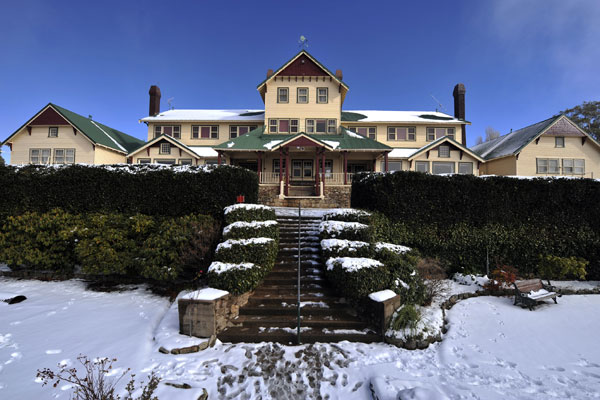
A BID to breathe new life into the Mt Buffalo Chalet continued last week with members of the Mt Buffalo Community Enterprise group meeting with the state environment minister.
Bill Sykes (MLA, Benalla) led a deputation made up of enterprise chair John Brown and directors Mark McKenzie-McHarg and Cameron McKern to visit Environment Minister Ryan Smith at Parliament House on Thursday.
The visit was part of the group’s bid to rejuvenate the 100-year-old building, which has been lying idle for more than three years.
The meeting was an opportunity for the group members to meet Mr Smith and familiarise him with their case.
Mr Sykes said the minister agreed that “something needs to be done”.
“The minister requested that once the group has their presentation ready for Parks Victoria, they also present it to him and Minister for Tourism Louise Asher,” he said.
“He was keen to see what the group comes up with.”
The group has until the end of May to develop a comprehensive project plan for presentation to Parks Victoria, which will include solutions for issues with energy and power supply on the mountain.
The aim is to have the go-ahead by September, which will allow detailed architectural planning, applications and governmental negotiations to begin.
Ryan Smith says the trial will continue but they are still working on the details.
Snow gums, Mt Stirling
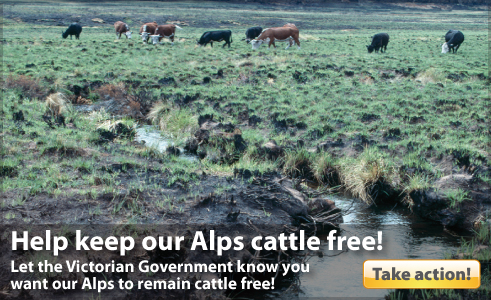
The Victorian Government has decided to return cattle grazing to the Alpine National Park next season, despite telling the Federal Government that they had no definite timetable for grazing trials to continue.
In January, 400 cattle were released into the park as part of a trial by the Victorian Government, to determine if grazing reduces the risk of bushfire.
However the trial did not have Commonwealth approval.
The Federal Environment Minister, Tony Burke, has ordered the cattle out of the park.
However today, the Victorian Environment Minister, Ryan Smith, told ABC Local Radio the trial will continue.
“We just haven’t put together the details of how it will go forward. We’re taking a careful approach, we’re using the data collected over the last few months to inform the next stage,” he said.
“We also want to be very open and transparent so that when the plan is put together, when Professor [Mark] Adams is advising us on it, there will be a panel overseeing that, who can ask the questions that perhaps need to be asked.”
Mountain Pygmy-possum (Burramys parvus). Source: Department of the Environment and Heritage
The surprise discovery of a rare possum colony in the New South Wales Snowy Mountains has been hailed as a major step forward in the study of the species.
An Ecologist, Doctor Linda Broome, has surveyed the animals for 25 years, and has found 59 Mountain Pygmy Possums at Cabramurra, north of Thredbo.
Dr Broome says they are 30km north of existing colonies, at an altitude 450m lower than previously thought possible.
She says the find was possible through advanced technology.
“The beauty of what we have now, compared to 20 years ago, is we’ve got a good geographic information system with all the aerial satellite photos,” Dr Broome said.
“We can look at the aerial photos and scan in.
“I did that, and low and behold, there was a huge boulder field outside Cabramurra.
“I thought ‘wow, that’s where we should be looking’.”
Today’s statement by Tony Burke MP, Minister for Sustainability, Environment, Water, Population and Communities.
Victorian Government told to get cattle out of National Park
Environment Minister Tony Burke today demanded the reintroduction of cattle in the Alpine National Park undergo a full and public assessment under national environmental law.
Mr Burke said after considering advice from his department, he had determined cattle grazing in the Alpine National Park satisfied the Environmental Protection and Biodiversity Conservation (EPBC) Act requirement that it “may be” a controlled action.
Mr Burke said as outlined under federal law, the Victorian Government now had 15 business days – until April 8 – to refer its current cattle grazing actions for Commonwealth decision or he would force a referral.
Under the EPBC Act, a referral by the Victorian Government following this request or a forced referral by the Minister means cattle will need to be removed from the Alpine National Park until a decision is made by the Minister.
“The Victorian Government was wrong to reintroduce cattle to the Alpine National Park and I have now determined that it needs to be fully scrutinised under national environmental law,” Mr Burke said.
“It is extraordinary how little information the Victorian Government has provided.
“The referral will allow me to determine whether the impacts of cattle grazing in the Alpine National Park have a significant impact on matters protected under national environmental law.
“The Victorian Government has 15 business days to refer the actions to the Commonwealth for decision or I will force the referral.
“Until I have made a decision on the referral, the cattle grazing actions must stop and cattle will need to be removed from the Alpine National Park.
“Cattle grazing in the Alpine National Park is setting a dangerous precedent for the management of national parks across Australia. Victoria can’t expect us to wait around while cattle are stomping over endangered wetlands.”
When the Victorian Government reintroduced cattle to the Alpine National Park, it did not refer the action for consideration under national environmental law.
Since that time, the Department of Sustainability, Environment, Water, Population and Communities (SEWPaC) has been meeting with the Victorian Department of Sustainability and Environment and requesting the information on which the decision to not refer the action was based.
On March 1 the Commonwealth set Victoria a two week deadline to provide all relevant information about the reintroduction of cattle grazing in the Alpine National Park by March 15, 2011.




 Mountain Journal
Recent Comments