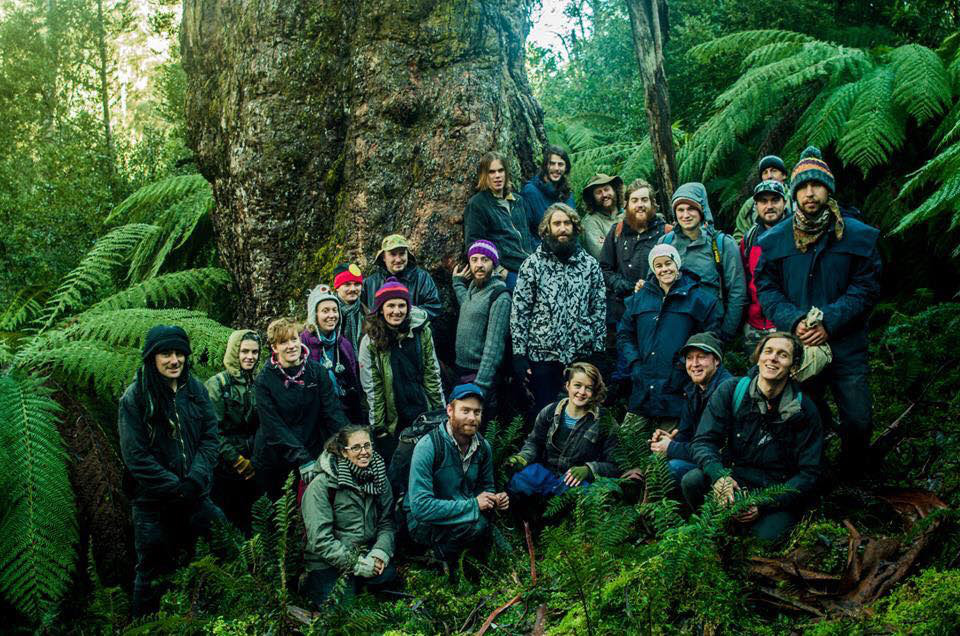
Goongerah Environment Centre (GECO), based in a mountain valley in far east Gippsland, is organising two weeks of ‘citizen science’ and a range of activities intended to protect the native forests of the region.
It runs from Friday, December 4 until Friday, December 18.
Wild dogs are a big problem for graziers in the high country of Gippsland. Of course, its a complex problem: should we be running sheep in areas adjacent to national parks where there will be populations of dingoes or wild dogs? Should farmers be electrifying the boundaries of their properties (and what are the impacts of that on other species like kangaroos and wombats?). Is shooting, trapping or baiting more humane?
Wild dogs are a huge problem in farming areas around the mountains in north east Victoria. They also prey heavily on native fauna. The issue of dog control has risen again recently in Victoria because of claims that there are fewer people employed to control population numbers.
According to a report in The Weekly Times (29/4/15):
“The Victorian Government employs 18 dog trappers, 10 in Gippsland and eight across the North East.
The Victorian Farmers Federation says that five years ago there were 25 trappers for the same area.
But the community engagement officer for the Government’s wild dog program, Barry Davies, said there were now “five or six casual wild dog controllers, two contractors and 25 field services officers who are trained to various degrees, some capable of trapping dogs.”
The full article, by journalist Kath Sullivancan be found here. It highlights the impacts on farmers and animals as a result of dog attacks on stock.
There are, of course, a number of ways of dealing with the problem. Trapping and shooting is a traditional method. Is funding for dog-proof fencing an option in key farming areas around the high country national parks? Some farmers use Maremmas (is a breed of livestock guardian dog indigenous to central Italy), while others bait.
There is also some question about whether the government will allocate more resources to employ additional hunters in the state budget, due to be released in early May.
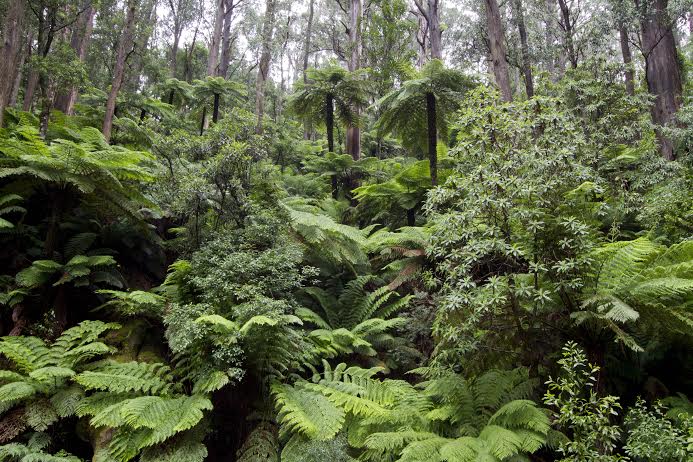
The spectacular old growth forest of Kuark in East Gippsland provides habitat for threatened species such as the Sooty, Masked and Powerful owls, Greater gliders, Long footed potoroos and a rare rainforest type where warm and cool temperate rainforest blend together in an ‘over lap” assemblage.
The state owned logging company VicForests plan on conducting extensive clear fell logging operations in the forest this year and local conservationists are getting organised to halt the proposed destruction.
Victorian conservation group, Goongerah Environment Centre (GECO) are stepping up their efforts to protect these forests from logging. The group have launched a citizen science program and public campaign to collect data and publicise the Kuark forest in the far east of Victoria.
Spend Easter in the heart of East Gippsland 18-21 April, 2014
Every Easter for the past 30 years Environment East Gippsland has been showing people the best of East Gippsland’s beautiful and complex forests as part of its Forests Forever ecology camps.
Participants camp on the Brodribb River surrounded by peppermint and manna gums.
Over four days people can spotlight for nightlife, sample hearty home made soups, learn the history of the ongoing fight to save these forests and how they can help.
A range of guided short and longer drives and walks into the forests are led by experts in forest conservation, wildlife and rainforests.
NATURE’S ARK
East Gippsland has some of the most ancient and beautiful forests in the world. The area’s huge trees and rich dense understorey capture and store carbon, create rain and produce clean water in abundance.
Although they have been relentlessly clearfelled for the past 50 years, the remaining stands of unaltered forest are like an ark; habitat for some of Victoria’s most charismatic wildlife, like the Quoll, Yellow-bellied Glider, Long-footed Potoroo and large forest owls and Glossy Black Cockatoo.
CAMP HIGHLIGHTS
Be guided by expert ecologists and botanists into old growth and rainforests, spotlight for nocturnal animals.
Spend four days learning about East Gippsland’s ancient forests and the impacts of logging.
Camp by the beautiful Brodribb River in Goongerah.
This event has been organised by Environment East Gippsland and the Victorian National Parks Association.
All proceeds go to help the campaign to save these forests.
COST
Full 4-day weekend (18-21 April): $60 (concession $40)
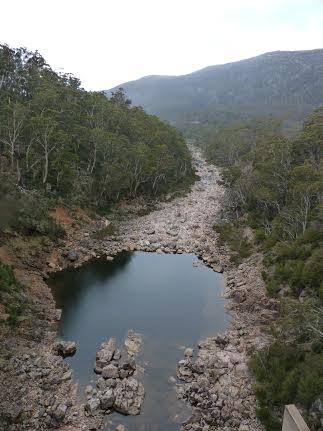
The Snowy River, in Kosciusko National Park looking downstream from Island Bend Dam
The NSW Government’s Bill to amend the Snowy Hydro Corporatisation Act and replace the independent Snowy Scientific Committee with an advisory committee under the control and direction of Katrina Hodgkinson (NSW Minister for Primary Industries) passed the Lower House last week.
One of the key benefits of the current Committee is that it was “firmly independent of government” as Ms Hodgkinson puts it (ie, doesn’t tow a government line).
According to a report in the SMH:
Scientists, including former members of the six-member scientific committee, said the separation from powerful interests such as the giant Snowy Hydro Ltd gave the panel a critical watchdog role that is likely to be lost. Irrigators, Snowy Hydro and government officials from NSW and Victoria are likely to hold sway, they say.
Independence is “the way scientists give you the best advice”, said Sam Lake, an aquatic expert from Monash University, who served on the committee.
It is set to pass the Upper House Tuesday 25th March unless the Shooters and Christian Democrats change their mind and vote against it.
An independent Snowy Scientific Committee is vital for the restoration of the Snowy River and all other rivers affected by the Snowy scheme.
take action
If you value the Snowy, please write to the Christian Democrats and Shooters and Fishers policy managers, urging them to oppose the government’s Bill.
A quick email is sufficient.
Possible text:
(cut and paste, make any changes you want, add your name and address and email to the two emails below).
Dear Paul and Robert
Snowy Hydro Corporatisation Act
I write to you to express my concerns about the NSW Government’s Bill which will amend the Snowy Hydro Corporatisation Act and replace the independent Snowy Scientific Committee with an advisory committee under the control and direction of Katrina Hodgkinson.
I believe it is essential that the panel continue to be composed of independent, appropriately skilled people. If the proposed changes in the Bill are passed, a critical watchdog role is likely to be lost. Irrigators, Snowy Hydro and government officials from NSW and Victoria are likely to hold sway, rather than scientists.
Having the ability to get independent advice is the best way for government to make sound, long term decisions about the Snowy River. An independent Snowy Scientific Committee is vital for the restoration of the Snowy River and all other rivers affected by the Snowy scheme.
I urge you to vote against the proposed amendments to the Snowy Hydro Corporatisation Act.
The following update is an excert from an article in The Age, journalist is Jason Dowling.
Surge of activity could see Victoria playing mine host
Victoria could soon boast a new commercial iron ore mine amid a surge of mining activity.
A combination of increased mineral prices and a supportive state government is driving a rejuvenated local mining sector with hot interest in exploration licences.
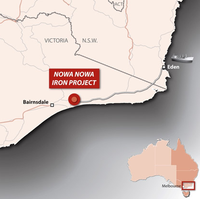
This week Eastern Iron advised the stock exchange it had moved into the environmental approvals phase for a commercial iron ore mine at Nowa Nowa, 30 kilometres from Lakes Entrance.
The proposed East Gippsland iron ore mine would be in the Tara State Forest, and would include a 25-hectare open pit.
The mine would have a span of about 10 years and produce about 1 million tonnes of iron ore a year to be exported from near Eden.
Eastern Iron’s managing director, Greg De Ross, said he did not believe there were environmental reasons to prevent the mine, and said the area had already been heavily logged.
”It is certainly not pristine wilderness,” he said. ”There are no show-stoppers from an environmental perspective.”
Most fires in the mountains (so far) have been in the foothills (see news item below from The Gippsland Times) or East Gippsland. However the CFA is now reporting fire activity in various locations in the high country.
There is a fire roughly 20km NNE of Benambra Township and the high ridge country near Mt Matlock. Check the CFA site for details.
As of friday morning, Jan 17, the CFA is reporting that
Firefighters are responding to a fire in the TAMBORITHA-CAREY RIVER area 15kms NE of Licola.
UPDATE ON TAMBORITHA FIRE, Jan 22
Fire is still going, now 150 ha in size, and the regions identified below are still closed.
UPDATE JAN 19
The fire is currently 120 hectares in size.
The Lake Tarli Karng walking track network is closed. Visitors should also stay away from tracks north of the Avon Wilderness area and the Mount Wellington to Millers Hut 4WD area.
JAN 17 NOTE ON TAMBORITHA FIRE:
Campers and walkers in the Carey River catchment, north of the Avon Wilderness Park, the Lake Tarli Karng track network and the Mount Wellington to Millers Hut 4WD area are advised to leave and all visitors should stay away from these areas.
Ground crews will be checking for vehicles and walkers, with air support if necessary.
Additionally, there is advice for Ensay, Omeo, Swifts Creek, Benambra:
Firefighters are responding to a fire in the 33 KM NE SWIFTS CREEK area in the vicinity of Brumby Rock.
There is currently no threat to communities, but you should continue to stay informed and monitor conditions.
Fire crews battle High Country lightning blazes
FIRE conditions are predicted to significantly worsen on Friday with Severe Fire Danger Ratings forecast across Gippsland.
For Sale a top temperature of 41 degrees has been forecast for Friday with a light shower of two and the chance of a thunderstorm from the early afternoon.
Work by DEPI, Parks Victoria and CFA fire fighters on Wednesday prevented the spread of many fires across Gippsland.
A band of lightning crossed parts of central and east Gippsland and sparked many small fires.
The majority of these fires have been in the area north of Briagolong and the area north of Bruthen.
Firefighting aircraft and dozers were dispatched to support firefighters on the ground.
Gippsland regional fire controller Bryan Russell commended fire crews for their speedy work in very hot and uncomfortable conditions.
As the Gippsland Times went to press crews were fighting fires at Briagolong, Dargo, Treasures, Waterford, Castleburn, Cobbannah.
In the east fires were also burning.
An all clear advice had been issued for fires at Mossiface, Bruthen and Wiseleigh.
Mingling Waters Music Festival is a small, grass-roots, high quality, well-organised, community-focused, family-friendly music event, supporting local artists and business, promoting Nowa Nowa as a special place to visit.
We plan to bring new and interesting artists in from the wider community.
We aim to create a scene that brings people together to talk, listen, play, and dance and celebrate together, in a beautiful natural environment!
It is a high priority to pay and look after all the participating artists as best we can.
We hope to do well enough to donate to two local charities, The East Gippsland Rail Trail and Melon’s Cottage.
There will be a small market, including food stalls, a bar, workshops, children’s activities and FINE MUSIC!
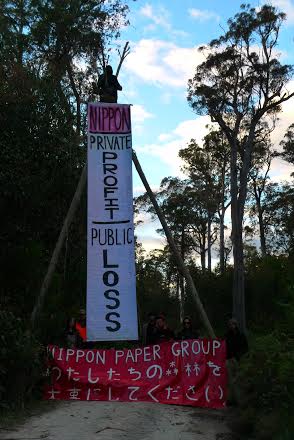
Image: GECO. NB: this photo is from the Dec 12 action
Environmentalists have halted logging in state forest on the iconic Errinundra Plateau in East Gippsland. One person has climbed a tree more than 40 metres, and sits on a platform tied to machinery.
“Until recently this area of forest was reserved as a special protection zone, it contains a number of different forest types and is of high conservation value. It also contains old growth forest and is a known site for the endangered powerful owl.” Said David Caldwell, spokesperson for Goongerah Environment Centre (GECO)
“This area was made available for logging in 2011as part of changes to the informal reserve system. This process swapped a large number of forest areas reserved for specific values, for areas that don’t reflect the same value. This has been something of a lifeline to the logging industry, who have repeatedly shown poor management of Victoria’s forests at the expense of the taxpayer.” He said.
“This is another example of forest destruction in the face of evidence of threatened species. Our native forests are becoming degraded and without areas like this one, they won’t be able to provide our endangered animals with a chance to survive. This is a looming extinction crisis that is being assisted by forest agencies around the nation.” Said Miranda Gibson spokesperson for Still Wild Still Threatened.
Today’s action is the latest in a series of actions over the last week, known as Fearless Summer, a coalition of grassroots environment groups, committed to an end to industrial scale native forest logging and export woodchipping.
The following media release comes from Still Threatened, Still Wild, and marks the beginning of a summer of actions to protect remaining old growth forests.
Today’s protest action continues to stop logging operations in a stand of forest at Stony Creek, East Gippsland, Victoria. Two conservationists remain at the top of tripods, blocking the road at different access points to the logging zone. While one person remains 30 meters above the ground in a tree sit in the middle of the logging coupe. Around 40 others remain in the area.
Department of Environment and Primary Industries (DEPI) workers attended the site at around 11am. The DEPI workers then cut down trees in an area believed to be part of the Snowy River National Park, in an attempt to drive around a blockade tripod. Forestry workers are currently in the logging coupe, below the tree sit, assessing the situation.
“Three conservationists are today putting themselves on the line, up tripods and tree sits, and risking arrest in order to halt the destruction of this stand of forest that is home to the endangered long footed potoroo” said David Caldwell of Goongerah Environment Centre (GECO).
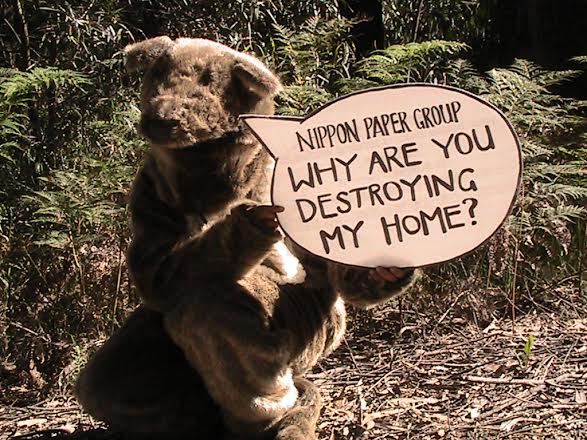
“Continued funding from tax-payer dollars to this industry for the benefit of a few private companies, like Nippon Paper, should be of concern to all tax payers. Australia is not only losing millions of dollars to prop up this industry, we are also losing our irreplaceable native wildlife species” said Mr Caldwell.
“Today’s action has brought a national focus to the destruction of wildlife habitat that is occurring here in East Gippsland as well as forested landscapes around Australia. It comes the day after a court appeal was lost by My Environment which now allows the ongoing logging of endangered leadbeater possum habitat.” said Poppy King of Central Highlands Action Group (CHAG).
“These dedicated conservationists are committed to continuing today’s action as long as possible, in order to protect this precious forest from industrial scale logging. This is part of a nation-wide movement that will see ongoing actions across the country in a call for protection of our native forests” said Miranda Gibson of Still Wild Still Threatened.
Gippsland Iron Pty Ltd (a wholly owned subsidiary of Limited) is planning to develop and operate the Nowa Nowa Iron Project (known as the Five Mile Deposit).
The proponent hopes to gain final approvals by late 2013.
Some salient points about this proposal:
It will be on public land (state forest to the north of Nowa Nowa)
It will be an open cut mine and the footprint of the actual mine will be approximately 25 hectares
approximately 146 hectares of land will be cleared
The mine will operate 24 hours a day, 7 days a week and an expected operating mine life of between 8 and 10 years.
Approximately 24 Mt (mega tonnes) of waste rock will be mined over the life of the mine and permanently disposed within a waste rock stockpile adjacent to and upstream of the open pit. The final waste rock pile will be revegetated on mine closure.
One site of cultural heritage sensitivity has been identified within the vicinity of the mine access road.
Eastern Iron has decided not to use a wet separation process to separate the iron ore. Instead, Dry Low Intensity Magnetic Separation (“Dry LIMS”) will be used. This means that water use will be limited to dust suppression and is estimated at approximately 164 ML per annum.
The proponent says that there will be no down-stream impacts on creeks and catchments, including Lake Tyers
Trucks will be used to transport the ore to an existing bulk loader on the southern side of Two Fold Bay at the Port of Eden in NSW. The scale of the operation will mean that there would be around 74 vehicle return trips per day of large trucks on a winding road used widely by local and tourist traffic.
When the mine is finished, the open pit will be allowed to flood via groundwater and surface water inflows.
There are community consultations going on now (mid November 2013).








 Mountain Journal
Recent Comments