Search

Mountain Journal

Environment, news, culture from the Australian Alps

Tag

ecological restoration

volunteers needed to protect the Bogong High Plains from Hawkweed

2011/12 Victorian Alps Hawkweed Surveillance Volunteer Program

Help to protect Australia’s biodiversity from King Devil and Orange Hawkweed on the Bogong High Plains

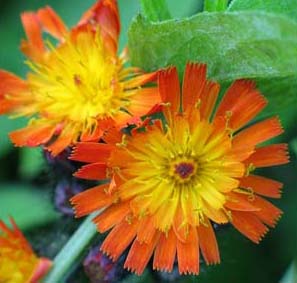
Orange Hawkweed. Image: Parks Victoria

Native to Europe, Hawkweeds have recently become established on mainland Australia. Posing a serious threat to Australian biodiversity and the structure of natural communities, it is imperative that the incursion is eradicated before it’s too late.

Hawkweeds spread quickly via runners and above-ground roots forming dense mats, inhibiting and out-competing native vegetation. In grassy ecosystems like the High Plains, dense patches of the weed dominate the spaces between grass tussocks that are vital for the survival and recruitment of native flora and fauna.

Survey sessions will be conducted during the active flowering period. All of the sessions will be five days long. Attendance for the full sessions is preferred but is not essential.

Accommodation will be provided at Falls Creek. Breakfast and snacks will be provided as well as one dinner at a local eatery, other meals self catered. Transport will be provided from Falls Creek.

The surveys for 2011/2012 season will be held over the following dates:
Session 1: Tuesday the 27th – Saturday the 31st of December
Session 2: Monday the 16th – Friday the 20th of January

For more information or to express your interest in the program, please contact:
Keith Primrose
hawkweed@parks.vic.gov.au
Mt. Beauty Parks Victoria Office: (03) 5754 4693

More rare possums found in Snowies

The following report comes from the ABC.

Mountain Pygmy-possum (Burramys parvus). Source: Department of the Environment and Heritage

The surprise discovery of a rare possum colony in the New South Wales Snowy Mountains has been hailed as a major step forward in the study of the species.

An Ecologist, Doctor Linda Broome, has surveyed the animals for 25 years, and has found 59 Mountain Pygmy Possums at Cabramurra, north of Thredbo.

Dr Broome says they are 30km north of existing colonies, at an altitude 450m lower than previously thought possible.

She says the find was possible through advanced technology.

“The beauty of what we have now, compared to 20 years ago, is we’ve got a good geographic information system with all the aerial satellite photos,” Dr Broome said.

“We can look at the aerial photos and scan in.

“I did that, and low and behold, there was a huge boulder field outside Cabramurra.

“I thought ‘wow, that’s where we should be looking’.”

Endangered mountain frog thriving again

The following article comes from the ABC, and seemed worth a re-run given its a nice bit of good news about an endangered species.

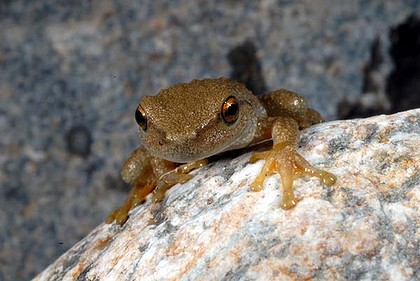
Photo: David Hunter

There has been a major breakthrough in efforts to save an endangered frog in the New South Wales Snowy Mountains.

In 1998, the Spotted Tree Frog population in Kosciuszko National Park was down to one male.

Nicknamed “Dirk”, he was taken from a stream and became part of a captive breeding program in Victoria.

Frog expert, Dr David Hunter, says it took about seven years for tadpoles to appear, but the offspring are now thriving back in a High Country stream.

“Through the monitoring program, we were able to show that post-release survivalship has been quite good,” he said.

“Not only that, they’ve now reached sexual maturity, and they’ve actually bred in the wild which was fantastic.

“What we’re doing with the Spotted Tree Frog is something we’d also like to be able to achieve with many other threatened frogs.”

Volunteers needed for weed surveys on Bogong High Plains

Orange Hawkweed. Image: DPI

Parks Victoria is looking for volunteers to help look for King Devil and Orange Hawkweed on the Bogong High Plains

Native to Europe, Hawkweeds have recently become established on mainland Australia. They pose a serious threat to Australian biodiversity and to the structure of natural communities.

Hawkweeds spread quickly via runners and above-ground roots, forming dense mats and outcompeting native vegetation. In grassy ecosystems like the High Plains, dense patches of the weed dominate the spaces between grass tussocks that are vital for the survival and recruitment of native flora and fauna.

Three survey sessions will be conducted during the flowering period and each session requires 8 volunteers. All of the sessions will be 5 days long, Monday to Friday. Attendance for the full sessions is preferred but is not essential.

Accommodation will be provided at Falls Creek.
Breakfast and snacks will also be provided.

The surveys for 2010/2011 season will be held over the following dates:
Session 1: November 29 – December 3 (Mon – Fri)
Session 2: December 27 – December 31 (Mon – Fri)
Session 3: January 17 – January 21 (Mon – Fri)

If you would like more information or to take part in a survey session please contact:
Sally Summers
hawkweed@parks.vic.gov.au
Mt. Beauty Parks Victoria Office: (03) 5754 4693
Louise Perrin

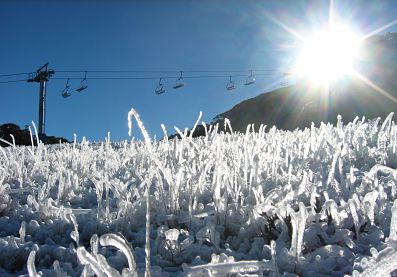
First snow. Image: Louise Perrin

Louise Perrin is Environmental Manager for the Mt Buller and Mt Stirling Alpine Resort Management Board. She has been the driving force behind an innovative – and very successful – recovery plan for the endangered Mountain Pygmy Possum.

The possum is the only native mammal that lives in the alpine environment above the treeline and its habitat is threatened by development, climate change and introduced flora and fauna.

The Recovery Plan for the species on Mt Buller was developed in 2005. It contains a range of actions to assist in the continued survival and conservation of the Mountain Pygmy-possum on the mountain. This has relied on substantial support from the Resort Board, the ski lift company, and the Department of Sustainability and Environment, and has even involved the construction of boulder fields to create habitat for the animals.

In spite of the pressures from ski field development through its habitat, the fires of 2007, and the longer term impacts of climate change on alpine environments, the Mt Buller project is a showcase of a program which has helped bring a species back from the brink of extinction.

Lou says “I just want to do my best to ensure that my kids can enjoy this little patch of alpine Australia as much as I do”. But her contribution to this effort has been huge and deserves widespread acknowledgement.

There is a profile on Lou here.

Elizabeth MacPhee, Tumut, NSW

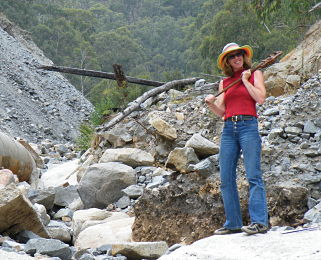
Liz at Deep Creek, a rehab site near the Tooma dam in Kosciuszko National Park

Elizabeth MacPhee has been working across the Australian Alps for two decades, and has a life long commitment to helping repair degraded ecosystems in the Alps. She is Rehabilitation Officer with the Department of Environment, Climate Change & Water, in NSW.

The Parks Service are doing great work on rehabilitation in the Kosciuszko National Park, and her work has been pivotal in this. For the past 5 years she has been working on the former construction sites of the Snowy Hydro-electric scheme.

Check here for a profile and interview on her work

Blog at WordPress.com.

Up ↑