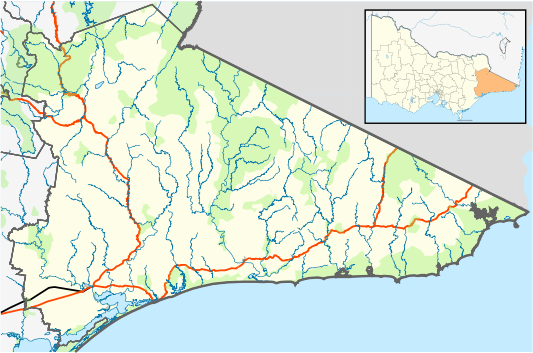
The eastern edge of Victoria Alpine National Park is set to receive one of the most thorough surveys ever, involving palaeontologists, geologists and biologists beginning 18 November.
Parks Victoria, Museum Victoria and 4WD Victoria will cooperate to examine the wildlife in the area and gather information about how well certain species are inhabiting the alpine terrain of the park compared to some threatened populations in other areas of Victoria.
“We love exploring the bush and this project presented a unique opportunity for our volunteers to be used for the first time in a major fauna research survey,” Project and Events Manager of 4WD Victoria Wayne Hevey said.
“Many of the high altitude species in the highest parts of Victoria are the most vulnerable in the state,” Dr Mark Norman, Head of Sciences, Museum Victoria, said.
“Over 80 researchers will be seeking the signs, sounds and movements of these wonderful creatures. The data we collect will help establish the status of many of the area’s endangered species,” said Dr Norman.
This is the fifth Bioscan to be undertaken by Parks Victoria and Museum Victoria as part of a five-year program designed to study wildlife across Victoria’s national parks, from deserts to forests to underwater kelp reefs. The program commenced in 2011.
Results will be presented at programs with four local schools and students and local residents will be able to interact with the scientists who conducted the survey at a Friday night ‘Science at the Pub.’
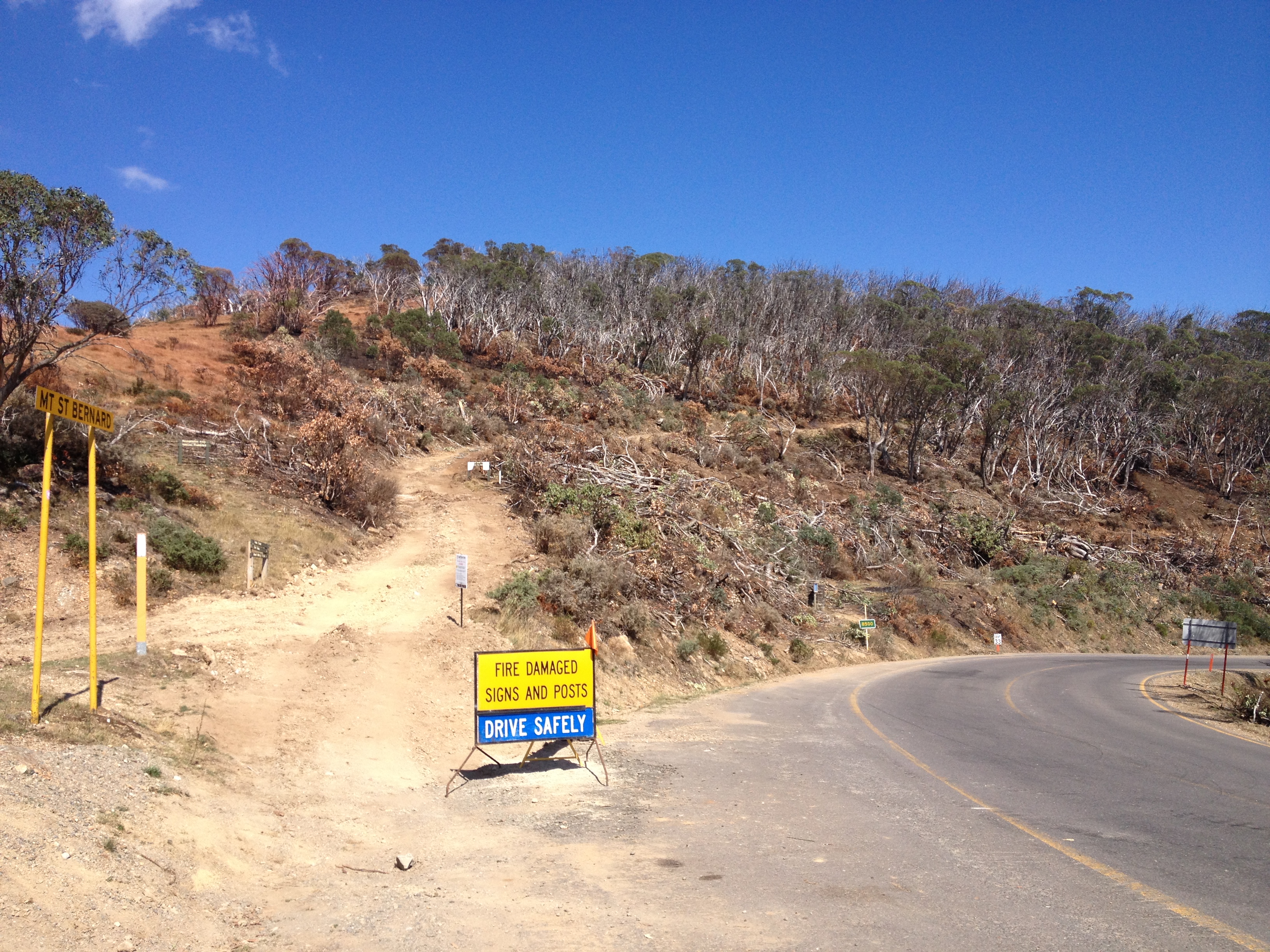
The North West Spur fire burnt hot up and out of the Upper East Ovens valley, over the St Bernard – Sugarloaf ridge, killing a lot of the remaining Alpine Ash forests along the upper sections of the Great Alpine Road that had survived previous fires, and snow gum forests at higher elevations.
A huge effort was made to get the road open in time for Easter and winter, with massive tree felling operations along the road, and removal of debris.
The final stage in these operations is now underway, and Vic Roads will be doing works on the Great Alpine Road from November 11th through until early December to remove fire damaged trees effected by the 2013 bushfires. One of the problems has been the large number of trees killed in previous fires being burnt again this year, and becoming very likely to collapse.
For anyone that has driven the road in recent months, you will be painfully aware of the visual impacts of these operations.
What is less clear at this point is the environmental impacts of effectively clear felling a large swathe of forest along the road. As noted by VicRoads, this clearing is substantial in some areas, between 10 and 40 metres from the roadside. There have been attempts to reduce the impacts of this work, for instance removing many of the trees being felled beyond what would be normal on the forest floor, and aerial seeding of alpine ash.
But the fact remains that safety considerations for traffic has resulted in a 20 km clearcut, mostly within a national park.
VicRoads advises that access to sections of the Great Alpine Road will be reduced at various times from Monday 11 November until Friday 20 December to enable the safe removal of dead and dangerous bushfire damaged trees.
These works are a continuation of the tree removal works that were undertaken prior to the 2013 snow season. It is essential for VicRoads to remove these hazardous fire damaged trees from the roadside as soon as possible as they present a potential road safety hazard.
From Monday 11 November until early December, the Great Alpine Road will be closed to traffic between Harrietville and Dargo High Plains Road between 8.00am & 1.00pm and 2.00pm & 5.00pm on weekdays to enable tree removal from within 10 metres of the roadside. However, the road will be open at all other times including weekends.
From early December until Friday 20 December, tree removal will continue in an area 10-40 metres from the roadside in the Alpine National Park. This work is being undertaken in consultation with Parks Victoria. Local traffic closures will be in place with delays expected. In addition to the tree removal, VicRoads will also be replacing fire damaged guardrail at 11 locations.
The Alps Link bus service between Omeo and Bright will continue to run during this time.
During the road closure period, Mount Hotham and Dinner Plain will remain accessible via Omeo and Dargo at all times.
Access between Bright and Omeo will be available via Bright-Tawonga Road (C536), Kiewa Valley Highway (C531) to Mount Beauty, then along the Bogong High Plains Road (C531) and the Omeo Highway (C543) to Omeo.
VicRoads encourages motorists travelling through the area to plan ahead and allow for significant additional travel time.
Motorists are requested to observe the changed traffic conditions for their own safety and the safety of workers nearby the road, including adhering to reduced speed limits.
VicRoads thanks the community for their patience while these important works are carried out.
For enquiries or more information about the works, please contact VicRoads on 5761 1827.
The Tasmanian Parliament has “moved to open up Hobart’s Mount Wellington (indigenous name Kunanyi) to development, with one MLC happy to see shopping on the summit”.
All but one Upper House MP have backed a Liberal plan to remove the Mount Wellington Park Management Trust’s power to veto developments.
The Independent Member for Western Tiers, Greg Hall, hopes that will clear the way for developers to build a cable car to the summit. This idea has been proposed for some time and includes major developments, including a ‘choice of dining experiences’ on the summit. The proponents describe their idea in this way:
Hobart has an opportunity to show deeper respect for our beloved backdrop. At the Park’s primary destination, the pinnacle, MWCC is offering to include space for a free-to-access, public visitor space that provides deeper interpretation of our mountain’s past; it’s colonial adaptation, aboriginal heritage and geological formation.
In a slightly bizarre twist,
Independent Apsley MLC Tania Rattray, who admitted she has never been up Mount Wellington, said she would like to see shops on the summit. She said “It would be a fantastic opportunity” (for what? The great consumer experience? Because we have a shortage of shops in Tasmania?).
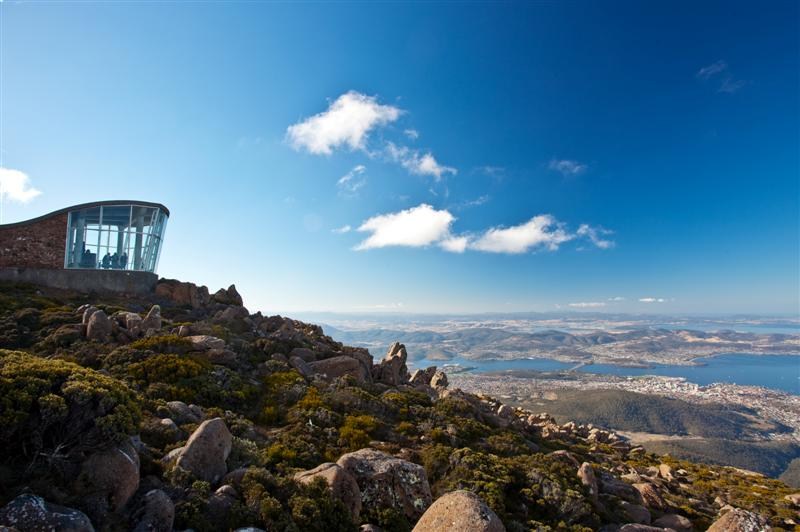
there is already substantial viewing infrastructure on the mountain
Government MLC Craig Farrell also backed the change, with Rob Valentine the only MP against it.
In the Lower House, the Greens also voted against the veto being removed.
Hobart is blessed to have such a beautiful mountain right above it. It is the backdrop to the city and although it has very easy access via a road to the summit, it is easy wander off into a fairly wild alpine environment. There are already large carparks and a viewing centre and associated walkways and platforms, and massive communications towers on the summit. In my opinion, proposing shops on the summit is a significant over development of a mostly wild landscape, and indicative of the mind set that is endlessly greedy and which has no sense of enoughness. Why create further impact on such a gorgeous, natural environment?
Radio National today reported on new research from Griffith University about the potential of horses to spread weeds in national parks. The Griffith University findings were published in the journal Ecological Management and Restoration.
Researchers found that weeds germinate from dung and are spread by activities like riding.
Researchers looked at the number and type of weeds that are spread through horse manure and found that 16 of the plants were listed noxious weeds in Australia.
Associate Professor Catherine Pickering says governments around Australia should take heed of her team’s findings before opening national parks to horse riding.
She said that researchers had examined 15 studies from around the world and found many weeds germinate in horse manure, enabling their spread.
They also found that horses cause disturbance by trampling the ground, further helping weeds to thrive.
In a ‘nothing to see here, move along’ response, the former president of the Mountain Cattlemen’s Association of Victoria, Mark Coleman, said horses are not solely to blame, as many other native and introduced species also spread weeds. In response, Ms Pickering pointed out that native animals are not generally grazing in pasture – which is where the weeds are being introduced from.
He says riding horses in national parks can actually help control weeds (yeah, ok, would you like to elaborate on that one Mark?)
And in another strange twist in the ‘blame someone else’ strategy, Mr Coleman said ‘other native and introduced species also spread weeds’.
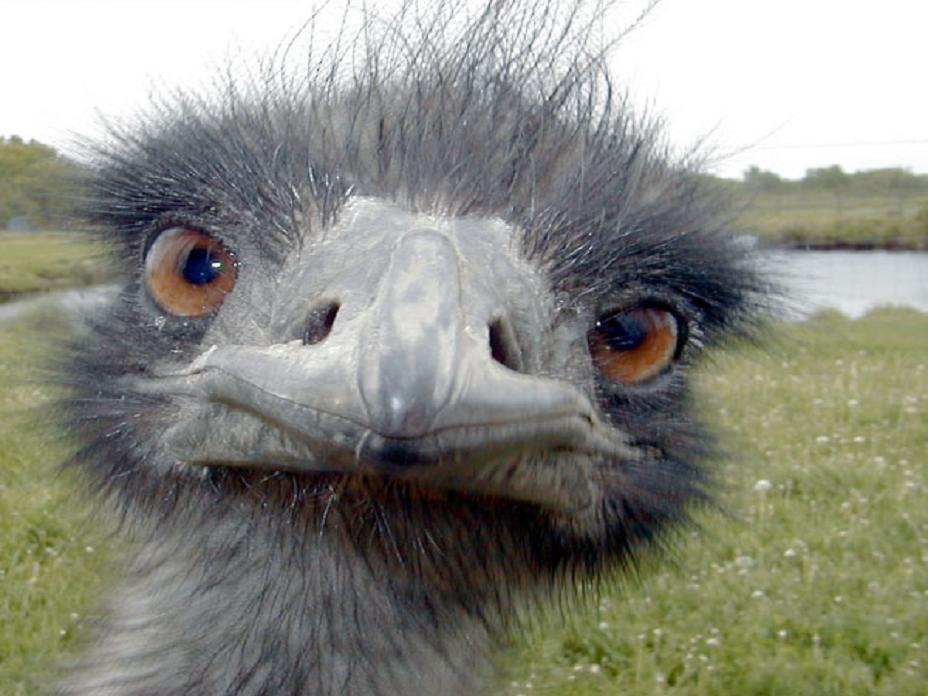
“With the introduction of blackberry into Australia, which is a horrific weed, you couldn’t get a better spread of blackberry than the emu, followed probably by the deer.”
“We were still the eyes and ears of these areas and once we were removed you remove man out of management” he said. Does that mean that all park rangers and other land managers are women? Or are they some strange form of alien? Or perhaps there is just no land management in our national parks …. that may come as some surprise to many of you
Images of mountain grazing tend to be positive, often evoking the frontier ethos
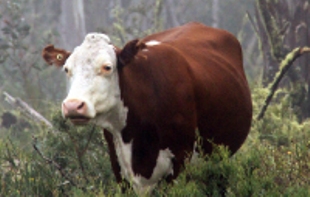
From my earliest days of walking in the Alps, cattle were a prominent feature of many places I visited. I would often meet cattlemen (almost invariably men), who would assure me the cattle were a benign influence on the environment.
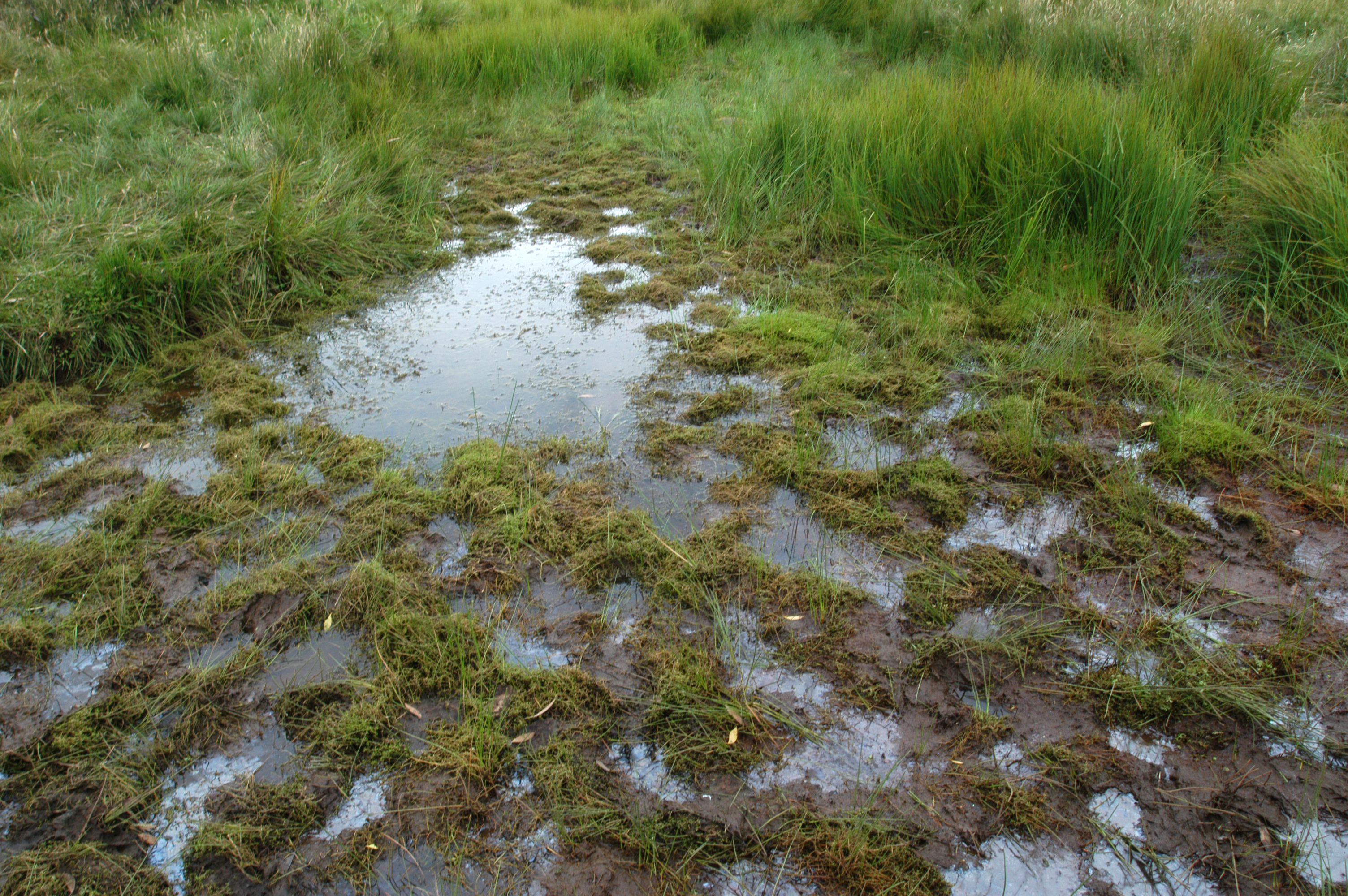
But what I saw was trampled wetlands and stream beds. I saw cattle standing in the headwaters of crystal clear streams, crapping and stomping the stream banks. I saw them spreading weeds. And I saw them selectively eating the succulent low lying vegetation in meadows rather than the flammable shrubs on the edges of those systems. More than once I was chased by a herd, and a scarey and heart thumping run and scramble up a tree got me out of a few situations. At Mt Stirling I saw that the ‘exclusion zone’ around the alpine summit was somewhat aspirational – the fence was normally damaged and there were almost always cows wandering around up on the summit. I drank from streams that had been polluted by huge animals with damaging hard hooves. At Macalister Springs we were warned of intestinal worms that had been introduced by cattle years before.
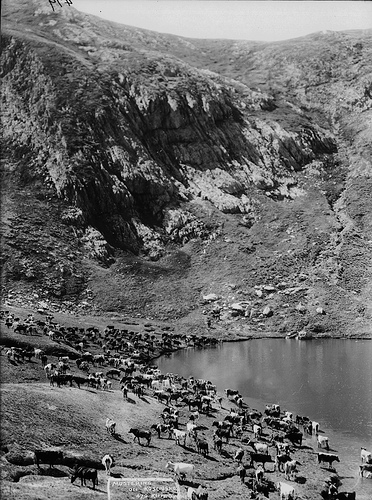
But my experience of alpine grazing was more like this.
At 16, I wanted a sticker that said ‘cattle grazing increases blazing’.
Cattle were finally removed from the Alpine National Park in 2005 by the Bracks Government after a thorough investigation by the Alpine Grazing Parliamentary Taskforce. Cattle continued to graze in state forest next to the park.
In recent years I have witnessed the recovery of alpine systems as cattle caused erosion slowly healed.
That should have been the end of the matter. But we all know that it was plain old politics that saw the newly elected Coalition government try to fulfil a promise to the mountain cattlemen for their support in ousting East Gippsland independent MP Craig Ingram at the 2010 state election. They allowed the cattlemen to return cattle to the Alpine national park in a sneaky operation under the guise of ‘scientific grazing’. Thankfully that was thwarted by the federal government.
As has been noted on this site, the election of the Coalition to federal Coalition to power has changed the dynamic, and the president of the Mountain Cattleman’s Association, Charlie Lovick, says alpine grazing is ‘back on the agenda’.
He says there is no other way to effectively control fire fuel loads above an elevation of 1,200 metres.
“How else do you reduce the fuel load because grass and scrub grows,” he said.
“We’re saying that cattle are a perfect balance to manage the higher stuff, to chew it down and keep it nice and green and you can more confidently burn the other areas.”
Mr Lovick red tape is the only thing stopping the federal and state governments from moving ahead with the plan.
If you’ve never been to the high country, it might seem sensible to argue that there will be less fire where cattle graze. But the idea doesn’t actually stack up when you look at the science.
The most significant research on alpine grazing and fire was carried out shortly after the 2003 fires swept across Victoria’s Alpine National Park, and was published in a peer-reviewed journal.
The conclusion was that grazing is not scientifically justified as a tool for fire abatement.
Many earlier studies have shown the damage cattle cause in the Alps.
Alpine grazing was not recommended by the Bushfires Royal Commission.
Victoria’s 2009 Bushfires Royal Commission was an inquiry of unparalleled thoroughness. It had no limits to the subjects it could address, was granted a $40 million budget, and sat for 155 days between May 2009 and May 2010.
The Commission made ten recommendations for research into fire related matters. The effectiveness of alpine grazing on reducing fire was not one of them.
The Commission recommended, as a high priority, extensive research into the monitoring of the effectiveness of fuel reduction burning programs across Victoria, and monitoring of the impacts of bushfires and fuel reduction burning on biodiversity.
The Department of Sustainability and Environment’s own Code of Fire practice says that ‘(domestic stock) grazing is appropriate only for significantly modified habitats’, such as roadsides.
There is compelling peer-reviewed evidence showing that alpine cattle grazing has no significant effect on mitigating bushfires.
So, as Mr Abbott works his way through his top order list, like ‘stopping the boats’ and winding back the price on carbon, cutting ‘green tape’ and so on, will he eventually get to the wish list of the mountain cattlemen?
It seems to me that alpine grazing would be entirely consistent with the world view of Tony Abbott and the mountain cattlemen: if you don’t like what the science is telling you, ignore it and do what you wanted to do in the first case.
If you’re not a huge fan of this world view, you may want to send a message to the federal environment minister, Greg Hunt.
Gippsland Iron Pty Ltd (a wholly owned subsidiary of Limited) is planning to develop and operate the Nowa Nowa Iron Project (known as the Five Mile Deposit).
The proponent hopes to gain final approvals by late 2013.
Some salient points about this proposal:
It will be on public land (state forest to the north of Nowa Nowa)
It will be an open cut mine and the footprint of the actual mine will be approximately 25 hectares
approximately 146 hectares of land will be cleared
The mine will operate 24 hours a day, 7 days a week and an expected operating mine life of between 8 and 10 years.
Approximately 24 Mt (mega tonnes) of waste rock will be mined over the life of the mine and permanently disposed within a waste rock stockpile adjacent to and upstream of the open pit. The final waste rock pile will be revegetated on mine closure.
One site of cultural heritage sensitivity has been identified within the vicinity of the mine access road.
Eastern Iron has decided not to use a wet separation process to separate the iron ore. Instead, Dry Low Intensity Magnetic Separation (“Dry LIMS”) will be used. This means that water use will be limited to dust suppression and is estimated at approximately 164 ML per annum.
The proponent says that there will be no down-stream impacts on creeks and catchments, including Lake Tyers
Trucks will be used to transport the ore to an existing bulk loader on the southern side of Two Fold Bay at the Port of Eden in NSW. The scale of the operation will mean that there would be around 74 vehicle return trips per day of large trucks on a winding road used widely by local and tourist traffic.
When the mine is finished, the open pit will be allowed to flood via groundwater and surface water inflows.
There are community consultations going on now (mid November 2013).
On sunday 10 November, 2013, a young activist called Hannah Patchett launched the beginning of what is intended to be a long term tree sit to highlight the immediate threats to the Leadbeaters Possum through continued destruction of its habitat.
Friends of the Earth – Media Release
Saturday 9 November 2013
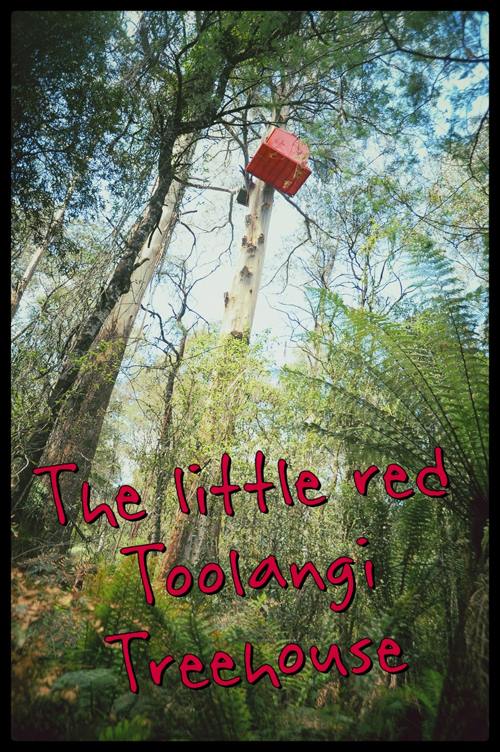
Tomorrow at 12 noon Hannah Patchett will formally launch her time dwelling in Toolangi’s treetops.
The Little Red Toolangi Treehouse has been built 50 metres up into the canopy of an area of forest habitat for the critically endangered Leadbeater’s Possum.
“I’ve chosen to stay in the Little Red Toolangi Treehouse because I want to see real action taken to save the Leadbeater’s Possum from extinction,” says Hannah Patchett.
“Removing clearfell logging from these forests is the first step.”
Logging of the remaining unburnt forest area following the 2009 bush fires has become increasingly controversial, and the subject of extensive community opposition.
Today the Toolangi forest continues to be logged, mostly for pulp for paper.
Leading expert on the Leadbeater’s Possum, Professor David Lindenmayer, has called for an end to clearfell logging by the end of 2013.
“The Little Red Toolangi Treehouse is a vital and brave initiative to protect the Leadbeater’s Possum habitat that the Napthine state government continues to log against expert recommendations,” says spokesperson for Friends of the Earth, Lauren Caulfield.
“Friends of the Earth support Hannah’s efforts because like her, our organisation and our supporters want implementation of management changes our forests so desperately need,” says Lauren.
“As it stands current industrial scale clearfelling will see our wildlife emblem managed into extinction’,” says Lauren.
“Real and urgent action must be taken to protect the Leadbeater’s Possum and its forest habitat from logging.”
“Forestry Minister Peter Walsh and environment Minister Ryan Smith must ensure the new management recommendations laid out by Professor Lindenmayer are implemented if the Leadbeater’s Possum is to stand a chance,” concludes Lauren.
What: Launch of the Little Red Toolangi Treehouse
Photo opportunity: Little Red Toolangi Treehouse from the ground, or assisted ascend to tree platform
When: From 12 noon, Sunday 10 November
Where: Toolangi State Forest – contact Amelia Young for directions 0404 074 577
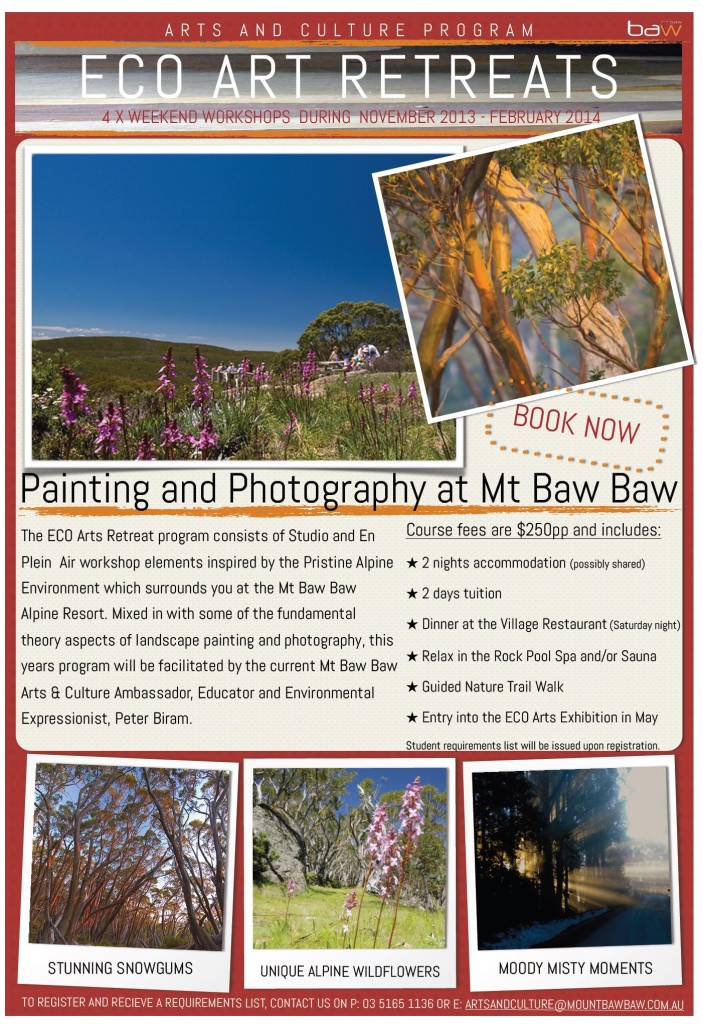
This comes from Baw Baw resort. A nice bit of low impact value adding to the resort.
The ECO Arts Retreat program consists of Studio and En Plein Air workshop elements inspired by the Pristine Alpine Environment which surrounds you at the Mt Baw Baw Alpine Resort. Mixed in with some of the fundamental theory aspects of landscape painting and photography, this years program will be facilitated by the current Mt Baw Baw Arts & Culture Ambassador, Educator and Environmental Expressionist, Peter Biram.
A series of Photography and Painting retreats will be available during summer on the mountain:
9/10 November 2013 : Eco Arts Retreat #1 : Painting
14/15 December 2013 : Eco Arts Retreat #2 : Photography
11/12 January 2014 : Eco Arts Retreat #3 : Painting
1/2 February 2014 : Eco Arts Retreat #4 : Photography
For further information contact:
Caroline Hammond, Mt Baw Baw Arts and Culture Manager on 5165 1136
or email artsandculture@mountbawbaw.com.au
The Victorian Government’s decision to open up the state’s national parks to development and private investment sets a dangerous new direction for our conservation reserves.
The policy essentially puts a ‘for sale’ sign on two thirds of Victoria’s national parks estate.
National parks and other conservation reserves protect our already depleted natural areas. They do not exist as money-making ventures for private hoteliers and or proponents of large-scale tourist accommodation.
National parks are the jewel in the crown of Victoria’s tourism industry, but we need to be careful that we don’t kill the goose that lays the golden egg.
Exposing our parks to tourism development could lead to irreversible damage to some of our most precious natural areas and undermine the integrity of our magnificent system of parks and reserves.
The primary role of national parks is the conservation of nature on behalf of all Victorians. Our parks were not created to end up as building sites for hotels and large-scale infrastructure that can only be used by a privileged few who can afford it.
Now, a group of 21 eminent Victorians including a former state governor, Nobel prize winner and leading academics have written an open letter to Victorian Premier Denis Napthine, describing the privatisation of our national parks as a betrayal of public trust.
What can you do
Sign the petition: By signing the petition you will be joining the fight to protect Victoria’s national parks. Your name will be listed among thousands of others who stand together to win the campaign.
The 2013/2014 summer season of the Falls Creek Volunteer Hawkweed Survey, is now open for volunteer recruitment.
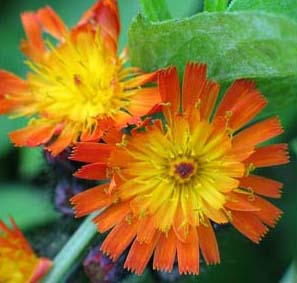
Native to Europe, Hawkweeds have recently become naturalised on mainland Australia. It is highly invasive and spreads quickly via runners and root, forming dense mats inhibiting and outcompeting native vegetation. Hawkweeds can cause major environmental damage in alpine & sub alpine areas and are considered a significant threat to the Victorian Alps.
Participating in the volunteer surveys are a great way to help save the Victorian Alps from this dangerous weed, as well as a fantastic opportunity to enjoy the magnificent alpine environment during the green summer months.
Accommodation has kindly been provided by Falls Creek Resort Management. Breakfast, morning & afternoon tea will be provided each day.
Session 1: Monday 16th – Friday 20th December 2013 (Full, but you can be added to the waitlist)
Session 2: Friday 27th – Monday 30th December 2013 (Full, but you can be added to the waitlist)
Session 3: Monday 6th – Friday 10th January 2014 (Places available)
Session 4: Monday 13th – Friday 17th of January 2014 (Places available)
Session 5: Monday 20th – Friday 24th of January 2014 (Places available)
If you, your friends, family or colleagues would like to attend, please contact me to book a place and provide the number of participants attending with you, their names and emails as soon as possible.
To express your interest in the program please contact:
The Hawkweed Team, Parks Victoria
Mt Beauty Parks Victoria Office
P: (03) 5754 4693 E: hawkweed@parks.vic.gov.au
The following is a media release from National Environmental Research Program’s (NERP) Environmental Decisions Hub and The University of Melbourne, October 14, 2013.
Mt Field national park, TAS
With 28 million visitors camping, tramping, biking, 4W driving, riding and picnicking in them every year, Australia’s iconic nature areas are at risk of being loved to death.
The love affair of urban Australians and foreign visitors with our spectacular wilderness is challenging conservation managers with a new set of problems and tricky decisions, says Dr Kelly Hunt de Bie of The National Environmental Research Program’s (NERP) Environmental Decisions Hub and The University of Melbourne.
“The trend towards nature tourism is increasing year by year. There are more people, doing more travel and an urban culture that is keen to re-establish its links with nature,” says Dr Hunt de Bie. “This all adds up to growing visitor pressure on our wild places, both managed and unmanaged, and the inevitable degradation of some of them.”
“National parks are established with the aim of conserving environmental assets while also providing quality, sustainable recreational experiences. But what if the recreational experiences result in the damaging of environmental assets? Activities of visitors can have significant negative impacts on the natural values of parks, both at the site and landscape scale,” she says.
Typically these include soil compaction and erosion, tree and vegetation damage, waste disposal issues and increasing visitor pressure in areas containing rare and endangered species, or where efforts are being made to re-establish lost species. Visitor safety in the bush is also a factor.
As a result, Dr Hunt de Bie and her colleagues are working on novel ways to help park and wildlife managers navigate the tricky path between meeting the expectations of nature tourists, and keeping the natural wilderness intact for future generations. The work is co-funded through Parks Victoria.
Using Victoria’s famous Grampians National Park and the inter tidal zone walking trails of Port Phillip Heads Marine National Park as case studies, the researchers are investigating ways to help park managers to ease the pressure on wild places of high conservation value – without diminishing the experience that visitors gain from them.
“Managers of the environment are routinely faced with making complex decisions with little information and high levels of uncertainty. It’s a tough ask, but that’s their job. When decisions have to be made regardless of these constraints, structured decision making (often simply referred to as SDM) is a useful tool for guiding managers through the decision process,” she says.
The team is testing a six-step decision process that involves defining the conservation goals and performance measures, developing alternatives and predicting the consequences of each, making a decision – and keeping a careful eye on its results.
“When it comes to making a decision about an area that is getting over-visited, there are basically several alternatives – do nothing, relocate visitors to another area so it can recover or limit visitation in time or space. You can also build permanent features that reduce its vulnerability.
“We are now working on what each of these does for the sustainability of the site in question – and also speaking to visitors to see what they are willing to accept.”
At Port Phillip Heads, for example, the famous visitor walk round the heads at low tide crosses areas covered with the brown seaweed Hormosira banksii, which is a haven for wildlife. “Parks Victoria has identified that a key threat to intertidal reef communities is trampling by humans – which may increase in future,” says Dr Hunt de Bie’s colleague, PhD researcher Prue Addison.
Options range from using rangers and signage to educate visitors, to diverting the route of the walk to less sensitive areas, to opening and closing sections, to building boardwalks over key reef areas. Using the SDM approach, the researchers enabled park managers to score the various options and so choose the most appropriate at the time.
“It is clear that managing our national parks and wildlife reserves is a never-ending task – and that it also includes managing the pressures imposed by visitor numbers which are growing at a steady 3 per cent a year,” Dr Hunt de Bie says.
“Nature tourism brings more than $20 million in from overseas each year, so it is clearly a vital part of the Australian experience, which we don’t want to diminish in any way. At the same time we need to be sure the experience itself does not deteriorate through over-use. These decision making systems can help to achieve that,” she says.
The Environmental Decisions Hub is funded by the Australian Government’s National Environmental Research Program (NERP). The Hub’s research aims to assist Australian governments in their environmental management and decision making.
The Australian Electoral Commission has just declared the outcome for the Federal Seat of McEwen, in central eastern Victoria.
During the election campaign, the Mountain Cattlemen’s Association came out against the sitting Member, Rob Mitchell, because he opposed cattle grazing in the Alps.
“The Mountain Cattlemens Association of Victoria is a small group of people who have historically enjoyed something that few Australians have – free access to public assets to help build their wealth.”
“While we respect and admire their history and their traditions, it’s no longer possible to allow such a small group – mostly wealthy beef producers – to continue grazing cattle in areas that belong to the public, current and future generations.”
Mr Mitchell said there were many “intelligent, rational” reasons to keep cattle out of sensitive alpine ecosystems and noted NSW had decided to stop mountain cattle grazing in the late 1960s.
The Victorian Coalition is in thrall to the mountain cattlemen (as shown recently by them creating an advisory group on the Alpine Park stacked with grazing and pro-grazing interests). The state government was widely criticised for putting its political allegiance with the cattlemen ahead of good policy development in crafting its ‘fuel reduction’ grazing program, which was subsequently stopped after intervention by the federal government . As was reported in The Age, the government pushed ahead with its controversial grazing trial despite being told by Parks Victoria that no “scientific, social or economic evidence existed to support it”.
It would be worth the state government taking note of the fact that in spite of a nation wide swing against the ALP in the election, pro-grazing views within the electorate were not able to affect Mr Mitchell.
In an interesting side note, Victorian Liberal MP Donna Petrovich had resigned from state Parliament to stand against Rob Mitchell in the September election. She holds a regressive position on a range of climate related issues, including supporting continued use of coal and opposing wind energy.
On wind
In Hansard, Ms Petrovich raises various issues about what she sees as the ‘problems’ with wind energy: issues of reliability of wind, health risks, visual impacts.
Ms Petrovich is concerned that the previous government did not consult with the community over wind farm policy (yet she consistently refused to say who the Coalition consulted with in framing their policy).
She says that the No Go zones that block wind energy from much of the state were ‘carefully’ selected where communities ‘on the whole have told us that they are not appreciative of wind farms’. In the same speech she only mentioned anti-wind groups as being the groups she had worked with in forming her opinion rather than the broader community.
She endorses the Coalition’s anti wind policy VC82: ‘The position the government has come to is one that I am proud of.’ (Hansard, 12/10/11).
On coal she says:
“The Coalition looks towards the effectiveness and abundance of brown coal as a means to provide a reliable source of energy for Victorians”. (Hansard October 11, 2011).




 Mountain Journal
Recent Comments