Image: GECO. NB: this photo is from the Dec 12 action
Environmentalists have halted logging in state forest on the iconic Errinundra Plateau in East Gippsland. One person has climbed a tree more than 40 metres, and sits on a platform tied to machinery.
“Until recently this area of forest was reserved as a special protection zone, it contains a number of different forest types and is of high conservation value. It also contains old growth forest and is a known site for the endangered powerful owl.” Said David Caldwell, spokesperson for Goongerah Environment Centre (GECO)
“This area was made available for logging in 2011as part of changes to the informal reserve system. This process swapped a large number of forest areas reserved for specific values, for areas that don’t reflect the same value. This has been something of a lifeline to the logging industry, who have repeatedly shown poor management of Victoria’s forests at the expense of the taxpayer.” He said.
“This is another example of forest destruction in the face of evidence of threatened species. Our native forests are becoming degraded and without areas like this one, they won’t be able to provide our endangered animals with a chance to survive. This is a looming extinction crisis that is being assisted by forest agencies around the nation.” Said Miranda Gibson spokesperson for Still Wild Still Threatened.
Today’s action is the latest in a series of actions over the last week, known as Fearless Summer, a coalition of grassroots environment groups, committed to an end to industrial scale native forest logging and export woodchipping.
The following media release comes from Still Threatened, Still Wild, and marks the beginning of a summer of actions to protect remaining old growth forests.
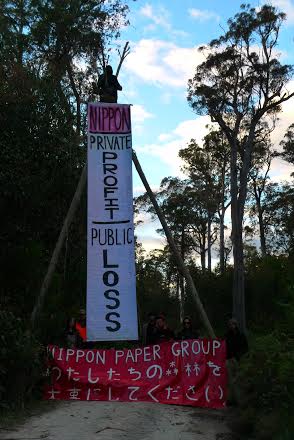
Today’s protest action continues to stop logging operations in a stand of forest at Stony Creek, East Gippsland, Victoria. Two conservationists remain at the top of tripods, blocking the road at different access points to the logging zone. While one person remains 30 meters above the ground in a tree sit in the middle of the logging coupe. Around 40 others remain in the area.
Department of Environment and Primary Industries (DEPI) workers attended the site at around 11am. The DEPI workers then cut down trees in an area believed to be part of the Snowy River National Park, in an attempt to drive around a blockade tripod. Forestry workers are currently in the logging coupe, below the tree sit, assessing the situation.
“Three conservationists are today putting themselves on the line, up tripods and tree sits, and risking arrest in order to halt the destruction of this stand of forest that is home to the endangered long footed potoroo” said David Caldwell of Goongerah Environment Centre (GECO).
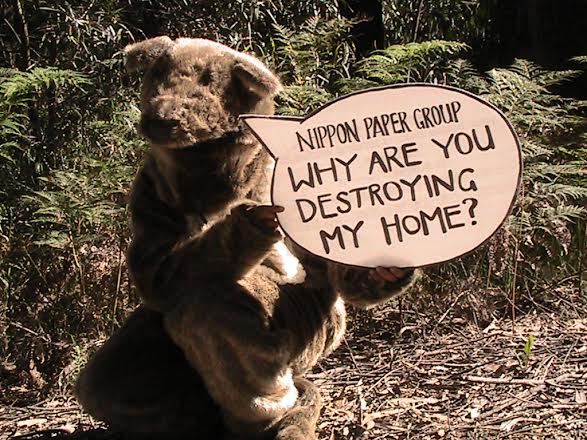
“Continued funding from tax-payer dollars to this industry for the benefit of a few private companies, like Nippon Paper, should be of concern to all tax payers. Australia is not only losing millions of dollars to prop up this industry, we are also losing our irreplaceable native wildlife species” said Mr Caldwell.
“Today’s action has brought a national focus to the destruction of wildlife habitat that is occurring here in East Gippsland as well as forested landscapes around Australia. It comes the day after a court appeal was lost by My Environment which now allows the ongoing logging of endangered leadbeater possum habitat.” said Poppy King of Central Highlands Action Group (CHAG).
“These dedicated conservationists are committed to continuing today’s action as long as possible, in order to protect this precious forest from industrial scale logging. This is part of a nation-wide movement that will see ongoing actions across the country in a call for protection of our native forests” said Miranda Gibson of Still Wild Still Threatened.
This release is from Healesville based MyEnvironment, about the outcome of the recent case seeking protection for the Leadbeaters Possum.
Law fails to guarantee protection for threatened species
The Flora and Fauna Guarantee Act has never before been tested at the level of Appeal. By taking our case to Appeal we have given the law the best possible opportunity to show whether it can be effective in its stated purpose of GUARANTEEING the survival of unique native species.
In this, the law has failed.
This judgement gives the green light to ongoing destruction of Leadbeater’s Possum habitat in Toolangi State Forest at sites where we have photographic and video confirmation that the species is present. Obviously, this is a disappointing outcome for MyEnvironment but, more importantly, for Leadbeater’s Possum and all other species that rely on the protection of the Flora and Fauna Guarantee Act for their ongoing survival.
If the Flora and Fauna Guarantee Act is incapable of guaranteeing the protection of our state’s faunal emblem against a rapacious logging industry, we have to wonder what, if anything, does it protect?
We call on the state government to urgently review the Act to make it functional and effective in saving threatened species, including the Leadbeater’s Possum from extinction.
In the meantime, we call on VicForests and its contractors to demonstrate genuine commitment to their repeated protestations of concern for the survival of Leadbeater’s Possum by properly protecting all sites in logging coupes that contain known colonies of the species, including the three Toolangi coupes that were the subject of this case, where video and photographs of nesting and foraging animals have recently been obtained. Their conduct in coming days and weeks will be a public demonstration of their sincerity and decency.
We shall now take time to study the implications of the judgement for MyEnvironment, the group and its members, and to take advice on future action.
For quotes please call ; Steve Meacher 0447 330 863 or Sarah Rees 0438 368 870
For background on the Toolangi forest issue, check here.
The New South Wales Government has rejected the recommendations of an Upper House enquiry that called for logging in National Parks. However, their response leaves the door open for ‘scientific’ trials that could still see commercial logging crews sent back into sensitive protected areas.
Friends of the Earth welcomes the Government’s response to rule out a moratorium on new National Parks and to open Parks for commercial logging. Politicians of all persuasions can’t ignore the fact that Australians don’t want to see our National Parks trashed. If National Parks aren’t safe from logging, where is? This response is a small win for the millions of Australians who care about our unique ecosystems and want to see them properly protected.
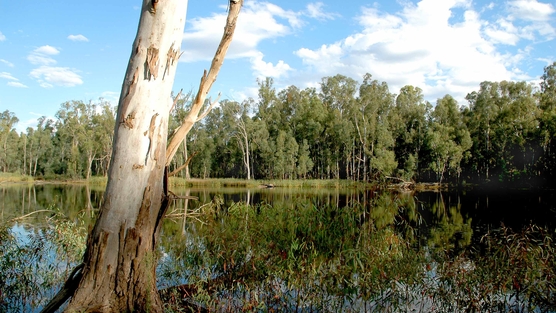
However, the response still provides support for a controversial ‘ecological thinning’ trial in the Barmah-Millewa National Park; Australia’s largest Red Gum forest and an internationally significant Ramsar wetland. This trial mimics a commercial forestry operation and will have significant impacts on this environment of national significance. If the O’Farrell Government is serious about protecting our natural heritage, they should rule out all logging in National Parks, whether commercial or ‘scientific.’
Friends of the Earth worked alongside Traditional Owners, scientists and local communities to ensure that precious remaining River Red Gum forests in Victoria and NSW were protected in National Parks.
We now need to mobilise to safeguard this legacy. Please check out and sign our petition to the federal Government calling for them to reject the proposed thinning trial.
On sunday 10 November, 2013, a young activist called Hannah Patchett launched the beginning of what is intended to be a long term tree sit to highlight the immediate threats to the Leadbeaters Possum through continued destruction of its habitat.
Now in her second week of living in treesit, she has been getting some great media and good local support.
Background on the Toolangi forest campaign available here.
On sunday 10 November, 2013, a young activist called Hannah Patchett launched the beginning of what is intended to be a long term tree sit to highlight the immediate threats to the Leadbeaters Possum through continued destruction of its habitat.
Friends of the Earth – Media Release
Saturday 9 November 2013
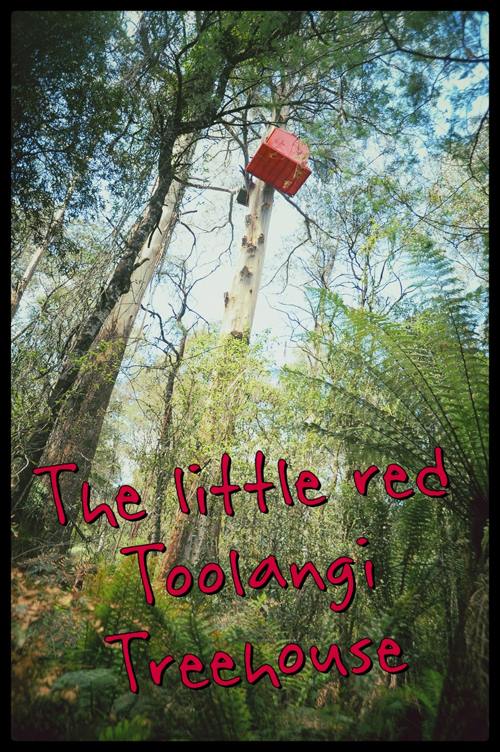
Tomorrow at 12 noon Hannah Patchett will formally launch her time dwelling in Toolangi’s treetops.
The Little Red Toolangi Treehouse has been built 50 metres up into the canopy of an area of forest habitat for the critically endangered Leadbeater’s Possum.
“I’ve chosen to stay in the Little Red Toolangi Treehouse because I want to see real action taken to save the Leadbeater’s Possum from extinction,” says Hannah Patchett.
“Removing clearfell logging from these forests is the first step.”
Logging of the remaining unburnt forest area following the 2009 bush fires has become increasingly controversial, and the subject of extensive community opposition.
Today the Toolangi forest continues to be logged, mostly for pulp for paper.
Leading expert on the Leadbeater’s Possum, Professor David Lindenmayer, has called for an end to clearfell logging by the end of 2013.
“The Little Red Toolangi Treehouse is a vital and brave initiative to protect the Leadbeater’s Possum habitat that the Napthine state government continues to log against expert recommendations,” says spokesperson for Friends of the Earth, Lauren Caulfield.
“Friends of the Earth support Hannah’s efforts because like her, our organisation and our supporters want implementation of management changes our forests so desperately need,” says Lauren.
“As it stands current industrial scale clearfelling will see our wildlife emblem managed into extinction’,” says Lauren.
“Real and urgent action must be taken to protect the Leadbeater’s Possum and its forest habitat from logging.”
“Forestry Minister Peter Walsh and environment Minister Ryan Smith must ensure the new management recommendations laid out by Professor Lindenmayer are implemented if the Leadbeater’s Possum is to stand a chance,” concludes Lauren.
What: Launch of the Little Red Toolangi Treehouse
Photo opportunity: Little Red Toolangi Treehouse from the ground, or assisted ascend to tree platform
When: From 12 noon, Sunday 10 November
Where: Toolangi State Forest – contact Amelia Young for directions 0404 074 577
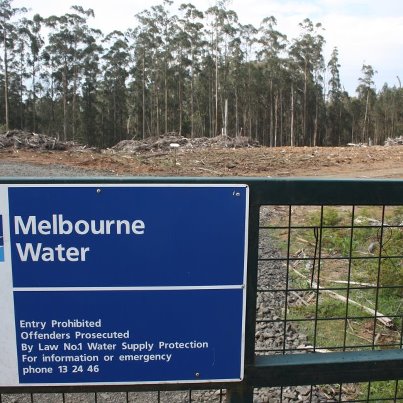
The following comes from Central Highlands Action Group and highlights the logging issue within Melbourne’s drinking water catchments.
Starvation Creek – Yarra Catchment. Image: CHAG.
Melbourne Water and Premier Baillieu overcharge us for a desalination plant while they plunder our free water from Melbourne’s catchments subject to logging.
Logging in Toolangi, tributary to the Upper Goulburn, is already ripping 3,807 billion litres of water from ‘paying’ downstream users and irrigators worsening over the next century. VicForests, the governments logging company, don’t pay for this water cost nor do Australian Paper (makers of Reflex copy paper) who receive 50% of VicForests wood supply. The owners of Australian Paper are the Japanese multi-national pulp conglomerate Nippon Paper, whose office is in Tokyo. VicForests have only paid a legitimate rent for this forest ‘use’ once since their inception in 2004.
VicForest have yet to break even since 2005 without the aid of grants. They are insolvent but are exempt from Part IV of the Trade Practices Act that would see these matters investigated by a third party like the ACCC. VicForests have avoided audits by the Auditor General after 8 years of operating.
In 2008 the Victorian ALP government received the results of the Wood and Water study committed to in the Regional Forest Agreement process (RFA) in 1998. The results of the hydrological study recommended ending logging in 2009/10 in order to improve water yields to Melbourne (DSE/Mein 2008). This was flatly rejected by government and as a result environment and local government stakeholders abandoned participation in the study.
As temperatures broke state records, angry at the state governments response to dismissing the option to end catchment logging, fifteen local governments independently carried a motion to stop catchment logging by 2010, including the Melbourne City Council. The government ignored this concern and proposed a very expensive buffer.
In 2008 the state ALP government commissioned a desalination plant and maintained clearfell logging the catchments, which in effect, firmly privatised the otherwise historically free water resource. Melbourne has enjoyed a clean, heathy water supply as a result of government in the late 1800‘s kicking timber-getters and miners out of the catchments. As Melbourne’s population grew, new water sources were channeled and created like the Thomson dam at a considerable cost to Victorians. The Thomson provides up to 60% of Melbourne’s water and is now the most heavily logged catchment in the network.
In the 2010 election the Coalition Minister for Water and Forestry, Peter Walsh, committed to hastening logging rotations down from 80 years to 50 years in the Timber Industry Action Plan (TIAP) in order to create more resource from the dwindling forests. This ultimately means that regenerating forests, after logging, growing in the band of highest rainfall, will be kept in perpetual thirst. Regrowing ash species forests lose up to 50% of water run off at 50 years of age due to their enormous growth capacity. It’s not HOW MUCH you log its where and what species you log that’s costing Melbourne critical free water!
In the TIAP, Minister Walsh made a commitment to log parks and strengthened commitments to log water catchments as an electoral promise to his National party colleagues (many of whom are loggers). So under current policy and its effects, our catchments will never yield water at their maximum delivery and we have to pay for the forfeiture via a desalination plant no-one can afford. Minister Walsh runs VicForests and Melbourne Water so he sets any checks and balances, should any exist.
In this Melbourne By-Election voters should demand that candidates openly declare their policy on Melbourne’s Water! It maybe the single greatest issue for the sustainability and survival of Melbourne.
Check here for details on protests held earlier in 2012.
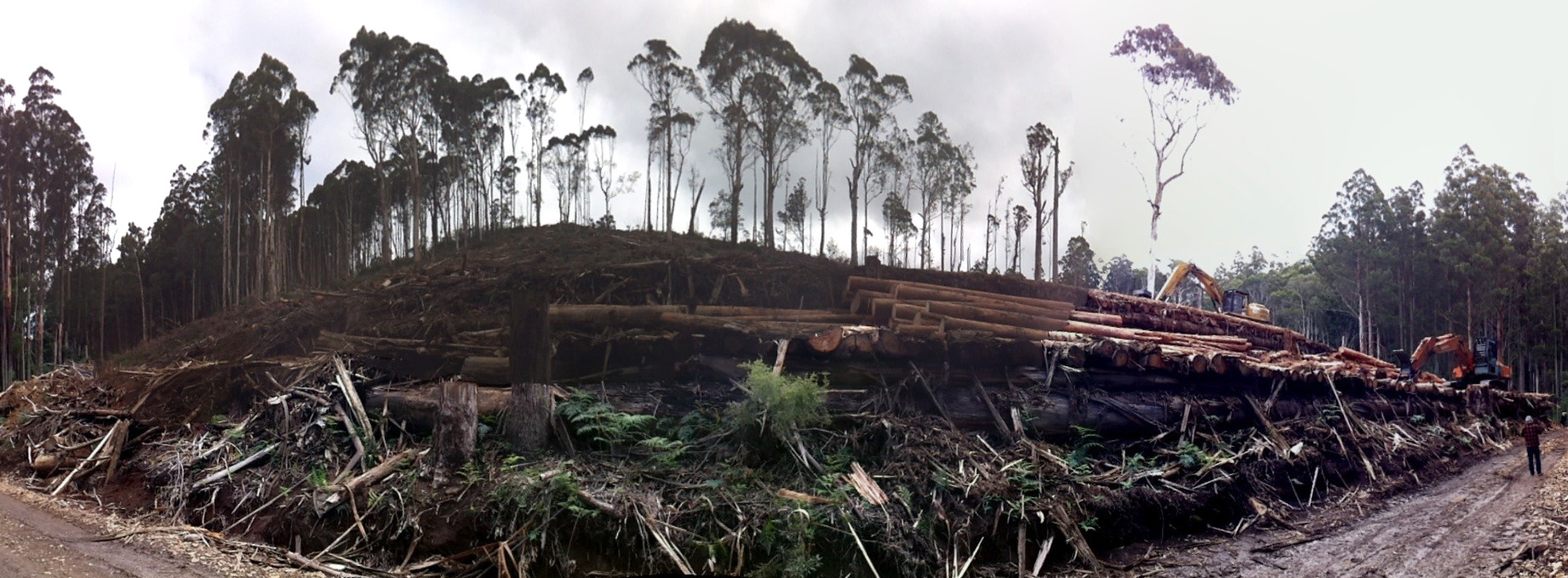
For the past two days, more than 30 people from the Central Highlands Action Group and local Toolangi and Healesville residents have been occupying a large logging coupe on Yellowdindi rd in Toolangi state forest.
Two 30m tree sits, which are suspended by ropes attached to two log-harvesters and two ‘bunnies’ with their arms locked through the tracks of a third machine have ensured that no clear-felling took place in the coupe on Monday January 16.
Much of the Toolangi forests were burnt in the fires of 2009. One Toolangi local said that “residents are concerned that following the Black Saturday fires in 2009 that clear-fell logging in the area will increase the risk of mega-fires due to the large amount of wood waste which is left behind in coupes. The resulting mono-species regeneration after logging operations is far more combustible than the mature age forests which are being removed. This is a recipe for further fire disasters”. They point to research by eminent forest ecologist Dr David Lindenmayer, which clearly indicates that clear-felling practices in the Central highlands notably increases fire risk and thus threatens the whole region.
Activists also point to other values of the forests: “These forests give us protection against climate change and provide habitat for native fauna which is such a feature of this area.”
The proposal to put a biomass plant in southern NSW is heating up again.
South East Fibre Exports wants to build a plant at Eden to generate electricity from woodchip timber waste.
Anti woodchipping group Chip-Busters have previously said “our forests are amongst the most carbon dense in the world, home to a vast array of wildlife and critical to the health of our water catchments and rivers in the face of the looming climate catastrophe. Woodchipping them for paper pulp or biomass energy is just plain stupid”.
This stream provides water to Glen Valley Mountain Retreat. Logging is planned for the ridge immediately above it
Out beyond the Bogong High Plains, and about a 45 minute drive north of Omeo is the lovely valley of Glen Wills. This small community is increasingly gaining a reputation as a place where low impact eco tourism provides a reliable income for locals. From ski touring and walking on the High Plains to rafting on the Mitta Mitta and a range of other activities, Glen Valley is a real oasis.
We are currently working with some local land owners and tourism operators to get a number of logging coupes removed from the cutting schedule. This is partly because there will be considerable visual impacts along a section of the Alpine Walking Track (the major trail that goes from Walhalla to Canberra) and also because there are plans to harvest directly above the water supply of the Glen Wills Mountain Retreat.
Please check here for details on a letter you can send to the Minister for Climate Change and Environment, Gavin Jennings.








 Mountain Journal
Recent Comments