I normally do a quick pre season assessment of developments around the resorts when it comes to environmental initatives, but given the lack of new initatives, it hardly seemed worthwhile this year.
One pleasing note is that a growing number of resorts are upgrading their snow making equipment to more energy efficient machines.
In autumn, Falls Creek got a bit of media coverage about the new fleet of snow guns they had brought in from Italy.
Falls Creek Maintenance Manager Geoff Sorensen said: “our ongoing quest to make snow using less energy is coming to fruition. This winter we’ll replace energy-hungry guns with more efficient, low-energy snow guns and we will be trialling Techno Alpin’s TF 10 from Europe”.
“This is the first time it will be used in the southern hemisphere by a company renowned for its snowmaking expertise. Our weather can be more marginal (for snowmaking) down under and harsher than what is experienced in the northern hemisphere alpine resorts.
The TF10 snow gun is a fully automatic, low-pressure type fan gun.
There are also more than 130 TechnoAlpin snow guns at Perisher and 70 at Hotham.
Given that climate science tells us we will have more erratic winters, and it is reasonable to assume we will rely more on human-made snow in coming years, moving to lower impact snow guns is a good move.
A report into the sustainability of Victoria’s alpine resorts has found Lake Mountain and Mount Baw Baw need continued government assistance to support their long-term viability.
A report by the auditor-general found the resorts have recorded financial losses and asset depreciation over the past five years, despite funding from the Department of Sustainability and Environment.
It identifies workforce and contractor costs as contributing to their poor performance, demonstrating the need for structural change.
The auditor-general’s office says the findings raise concerns about the long-term sustainability of the alpine resorts.
I am a big fan of infill, but 6 storey development in a mountain environment seems a bit excessive.
The following comes from The Age, journalist Simon Johanson.
Mt Buller from Stirling
A LARGE development at the Mount Buller ski resort will go ahead despite objections from the Grollo family, which owns a neighbouring property and extensive other interests there.
The proposed four-storey building on the YHA Hostel site in the heart of Buller village will have shops, a 64-bed short-stay unit and nine apartments.
The plans were approved in August last year by the state government, which oversees all Crown land at the resort.
The Grollo Group, headed by Rino Grollo, has extensive property, hotel and ski-lift operations on Mount Buller.
Its leisure and tourism arm, which owns the neighbouring Kooroora Hotel, objected to the development, seeking a review at the Victorian Civil and Administrative Tribunal.
The Grollo Group, an active property developer in its own right, said the revamp of the YHA site did not comply with the resort’s planning guidelines.
It said the plans would remove snow gums unnecessarily and limit the Grollo Group’s ability to redevelop the Kooroora Hotel.
But their objections were rejected by VCAT, which upheld the development’s permit with some slight modifications.
”The development has taken sufficient account of the snow gums on the review site, and has been designed to minimise the number of trees required to be removed,” the tribunal said.
More big projects are expected to rise from Mount Buller’s snow after the resort’s management approved a master plan encouraging buildings up to six storeys in the village.
Nick Whitby, the managing director of Grollo Leisure and Tourism, would not comment on the matter.
This article was written by David Bain orignally published as the first of the Global Snapshot series, bi-weekly essays written by Protect Our Winters (POW) supporters, which give their local perspective of climate change.
The home of our snow industry is a unique and highly specialised sensitive alpine environment. So sensitive is much of our alpine environment that motorised vehicles of any kind are basically not allowed outside of the resort boundaries.
This environment is unique partly as a result of the old age of the mountains and lack of mountain building, being in the middle of a continental plate. Only minor glacial activity has occurred, being last present between 10,000 and 30,000 years ago. The total area of the true alpine environment (above the tree line) is small, approximately only 770 km2, which is found as a series of ‘islands’ on top of mountains within a sub-alpine ‘sea’. In the order of some 6,500 km2 of alpine and sub-alpine areas annually receives some snowfall. Our endemic alpine species have largely evolved in isolation from other continents and often on isolated mountain tops only tens of kilometres apart.
“Get out your dancing shoes and head to Lake Mountain over the Labour Day March weekend – when the Mountain will hold the “Thank You Victoria Lake Mountain Music Festival” on Sunday March 11, 2012 to thank Victorians for their contribution to the mountain’s recovery from the 2009 Black Saturday bushfires”.
“The festival, featuring performances by artists including Deb Conway & Willy Zygier, is an opportunity for Victorians who donated to the Black Saturday Appeal to see how the mountain has recovered – and experience the range of new summer activities”.
“Lake Mountain Alpine Resort is back in business – and bigger and better than ever – with new summer activities including dune buggies and flying foxes, a new function centre and an action packed winter planned for 2012”.
(I’ll save my tirade about the stupidity of having dune buggies on the mountain for another day …)
This is a nice little video about sustainable practises when you’re in the snow. It comes from a European group called Respect the mountains
image: respect the mountains
, which is undertaking a grassroots awareness raising initiative for visitors in the Alps.
Their blurb: ‘Many tourists visit the Alps every year, especially during the winter season. The damages are severe. Respect the Mountains is designed to make people aware of the uniqueness and importance of mountain areas and the simple measures you can take to reduce the negative impact. This to make sure that future generations can enjoy the mountains too, that nature is preserved and the economical situation can be secured’.
The following report comes from the NSW Office of Environment and Heritage. ‘Diversity – beyond the boundaries’
An exceptional seventh annual Alpine Resorts Sustainability Forum was hosted by the NSW Office of Environment & Heritage (OEH) and held 9-10 May 2011 at Lake Crackenback Resortexternal link, Jindabyne NSW. This years forum theme was ‘Diversity – beyond the boundaries’.
The forum was officially opened by Bob Conroy, Executive Director Park Management Division, OEH. Mr Conroy emphasised the NSW government would not forsake environmental responsibility in the pursuit of being economically competitive. He also spoke about the challenge that the Australian alpine resort industry faces on a daily basis while managing businesses in Australia’s fragile alpine environment. Mr Conroy announced that in 2011 NSW National Parks & Wildlife Service will be publishing the inaugural annual NSW alpine resorts environmental performance report covering Kosciuszko National Park.
Three outstanding keynote speakers: Professor Mike Archer a vertebrate palaeontologist and mammalogist; Rachael Oakes-Ash, social media commentator and ski journalist; and the futurist Mark Pesce delivered thought-provoking presentations. The remainder of the program included presenters, workshop facilitators and field trips. The other presenters challenged people’s thinking when they spoke on a broad range of topics including improved initiatives in sustainable use and management of alpine resorts including better use of technology, social networking sites, sustainable tourism and marketing and environmental reporting as well as the development of improved snowmobiles.
Delegates had wonderful networking opportunities throughout the forum, particularly at the opening dinner and at one of four workshops or fieldtrips: ‘Thredbo EMS: the Challenge of the EMS in an Alpine Environment’; ‘Climbing the Social Media Ladder’; ‘Keys to Successful Rehabilitation in the Alps’; and a guided mountain bike ride On the Tourism Track in Thredbo Valley’.
Seems the wheels have fallen off the 'sustainability' bus
With winter almost in view, the resorts are announcing their highlights and new activities for 2011.
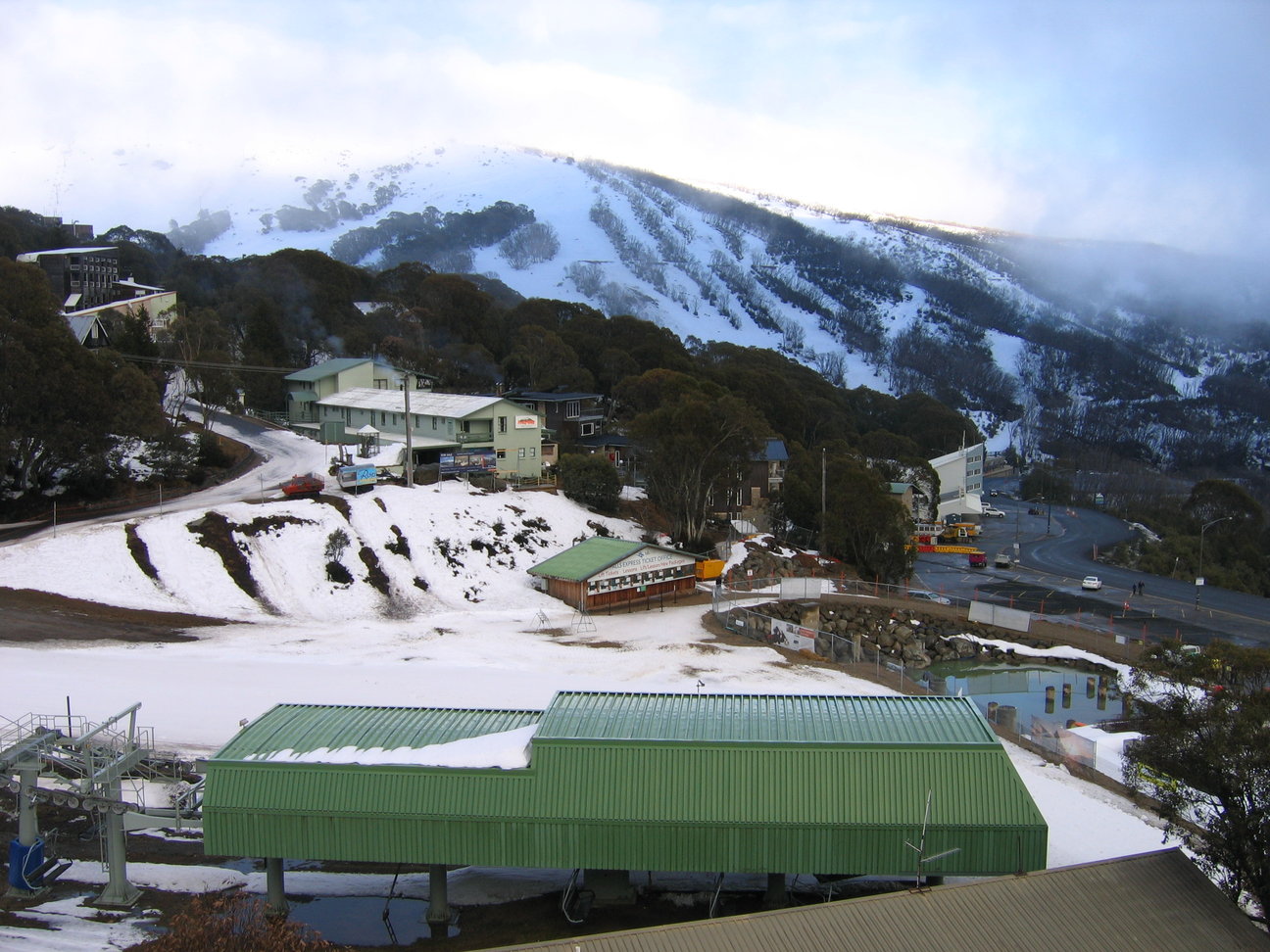
In Victoria, there are the usual snow making investment announcements and continued diversification of activities. At Falls Creek, the final stage of the Slalom Plaza redevelopment has been opened. Apparently Falls also has new aerial walkways, which take pedestrians through the village via a network of elevated stairways. At Hotham, in contrast, the main new announcement is some extra investment in snow making.
Mt Buller has put another $1 million into new snow guns and the snow grooming fleet.
However, on the environment front, I doubt I have ever seen such an un-inspiring effort.
In a rather bizarre move, some reports say that Buller now has a heated walkway from the Village Square up to the Ski and Snowboard School and the Buller Kids Centre. This would be great if Buller was pitching itself as a nudist colony, but most of us wear boots in the snow, and it seems like they must have money (and carbon) to burn if they think using energy to heat an outdoor pathway is a good idea.
Hotham is pushing air travel to get to the snow. Falls and Hotham continue to push the gas guzzling obscenity that is the 6 minute heli link ride so you can ski two mountains. Great for people with no values but a healthy credit card limit. Hotham runs kids snowmobile operations. Mention of environmental initiatives seems to have disappeared almost completely from resort promotional material in 2011 (for instance, there is a one paragraph mention of environmental practise in this years 50 page booklet from Hotham).
Meanwhile, Falls has announced that 10 ‘brand new luxury Snowmobiles’ have been added to the tours fleet, allowing guests to ride or pillion on their own snowmobile into the ‘pristine backcountry’ of Falls Creek.
Not content with imposing their operations on ‘pristine’ areas within the resort boundary with last years tours run by Steve Lee, they appear to be wanting to increase their noise and carbon footprint with these new skidoos.
On the positive side, Falls has made access to their many groomed cross country trails free. Perhaps encouraging more people to get away from the resort will balance out some of the increased carbon footprint that comes with putting a bunch of new snowmobiles into the backcountry.
Lake Mountain has substantial new building infrastructure and snow making and needs support as it recovers from the devastating fires of 2009. Baw Baw stands out amongst the Victorian resorts because it continues to focus on its ‘green’ image.
Just a few years ago, environmental initiatives were reasonably prominent in a number of the main resorts. From actively spruiking the Keep Winter Cool behaviour change program to buying green power to run some of their tows, resorts seemed serious about reducing their ecological footprint. Sadly, that all seems to have evaporated this year. Rather than acting decisively to reduce their greenhouse footprint, most have gone all out to re-badge themselves as ‘year round’ resorts. That’s where the money has gone, into mountain bike trails and many out of season festivals and events. All of that is great, and a common sense way of stretching use of existing infrastructure. But the loss of responsible activity and leadership by resort management on the environmental front is deeply disappointing.
A Leitwind turbine at Grouse Mountain, British Columbia. Image: New West snow blog.
This article, by Kristen Lummis writing on the New West snow blog, has a number of salient points for people interested in local renewable energy. Unlike in Australia, a growing number of resorts in North America and elsewhere are moving down the path of producing their own energy to run their operations. Many of them are using turbines. And the turbines are proving to be tourist draw cards.
Maybe we could start thinking outside the box when it comes to reducing the environmental footprint of our resorts while also driving greater decentralisation of energy supply? Having a turbine in the background is a good reminder that the energy running the lifts and buildings (and possibly making snow) has to come from somewhere, so it’s better if its environmentally benign.
A small but growing trend amongst snow resorts in North America is the development of renewable energy within the resort area. Given the high visual impact of existing infrastructure within resorts from chairlift and snow making infrastructure, there could be a strong argument for the inclusion of at least a few wind turbines in each Australian resort.
Image: Snowboard Green
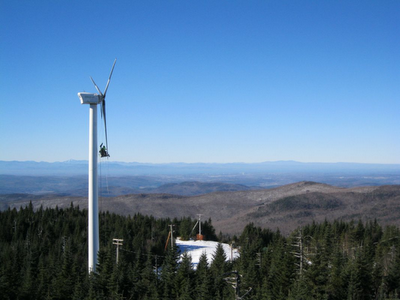
One recent example of this trend overseas comes from Bolton Valley Resort, a locally owned and operated family ski and snowboard area, has constructed the first wind turbine at a Vermont ski area.
The turbine is located near the top of a Quad lift in an existing clearing adjacent to the ski patrol hut. It produces in excess of 300,000 kilowatts of power annually, the equivalent of electricity consumed by 40-to-45 Vermont households.
The turbine, a Northwind 100 manufactured by Northern Power Systems of Barre, VT measures 121 feet in height from the ground to the top of the tower. The distance from ground to the top of the blade is 156 feet. Each blade is coated with Teflon to protect against icing. It is the same process used on turbines in the Bering Sea. The turbine will not be obviously visible from beyond five miles away from the site.
The turbine will be set up to feed excess power that is not consumed by Bolton Valley into the grid through the Vermont net metering program. It is the first turbine at a Vermont ski area and just the second at a ski area in the United States.
Hopefully more ski resorts in the US and around the world will follow suit!
As a growing number of Australian ski resorts bill them selves as being ‘green’, there are some developmemts in the Northern hemisphere that show how much further we could go if we want to take our attempts to reduce environmental impacts seriously.
Image: Mt. Abram
Obviously energy use (for lifts and snow making operations) is a major environmental issue for all resorts in that it will be a major component of the resorts overall greenhouse emissions. Some Australian resorts have sought to reduce their environmental footprint through purchasing ‘green’ power, at least for some of their tows.
One problem with this is that if they are buying hydro power – generally the cheapest form of commercial renewable energy – they are in effect buying ‘old’ energy – that is, renewable power that has been in production for years and therefore does not actually displace coal and hence reduce greenhouse emissions. For instance, the major hydroschemes on mainland Australia were built decades ago. The Kiewa Hydroelectric Scheme in north eastern Victoria was originally constructed between 1938 and 1961. The one exception would probably be where resorts purchase RECs (Renewable Energy Certificates) from the Bogong power station in north east Victoria, which has recently increased its energy production substantially. It was opened in late 2009. Hence RECs from Bogong could constitute ‘new’ green energy which potentially is displacing coal from energy production. The main reservoir for the scheme is the Rocky Valley Dam, on the Bogong High Plains. Check here for some information on the recent expansion of the Bogong plant.
But a small resort in the USA has gone much further – it has decided to produce its own energy. Mt Abram, located outside of Bethel, Maine, is in the permitting stage of a plan to install 3,190 solar panels spread over an area of 2 acres. When completed, the ski area is poised to become North America’s first net negative ski area when it comes to energy production.
Mt Abram plans to sell their excessive power back to the Central Maine Power Company grid.
According to writer Shanie Matthews, in addition to producing their own power, the ski area has been taking steps to reduce their demands for electricity. In April 2010, they received a $40,000 grant from the National Ski Areas Association (NSAA) to be used for 10 high efficiency snowmaking guns. Mt Abram will purchase 50 more guns as well. The new guns can reduce energy consumption by as much as 75%. NSAA reports that snowmaking costs account for an average of 67% of electrical costs in a resort.
Mt Abram owner Matt Hancock says the solar panels will be paid for by energy savings as well as the revenues from selling their unused energy back to local utility company.
The resort bills itself as a “friendly winter resort” and is located near Bethel, Maine, in the New England region of the north eastern USA. Mt. Abram offers a variety of terrain from beginner’s to ungroomed expert glade runs and race courses, and is serviced by five lifts and has 44 trails.
Near Mt McKay, heading to Pretty Valley, Bogong High Plains, VIC
If you’re an Australian skier or boarder, and unless you’ve been living under a log these past few months, you will know that ski legend Steve Lee has been running commercial backcountry ski tours out of Falls Creek resort this winter.
This is great. Getting people out of resorts and into the backcountry is to be supported and encouraged.
What is less great is the emphasis on the use of snowmobiles to get people out there. His tours are geared towards ‘strong’ intermediate skiers and boarders. So if people are fit enough to ski/ board hard terrain, then surely they are fit enough to get on some skis to actually get out there.
In my opinion, this ‘cheap grace’ approach to getting backcountry is a sad development in Victoria. Certainly, the tours are confined to the alpine resort area (even though this is ecologically part of the Bogong High Plains). However, they come with a high annoyance cost to people who are out there under their own steam. It is not clear what ecological assessment, if any, has been made of the tours – for instance, is there an impact on endangered species or vegetation? There is also a bigger picture here: there is the fact that these tours could be a precedent for future snowmobile based developments elsewhere in the alps.
Anyone who has skied backcountry in North America will know the many problems that come with rampant and often uncontrolled snowmobile use. While here in Australia recreational use of snowmobiles is supposedly controlled or banned (for instance in national parks), how often is this actually enforced? As one example, there is growing use within the Alpine national park in the area between Dinner Plain and Mt Hotham and around Dinner Plain village with apparently no intervention from land managers.
Snowmobiles are essential tools in resort management and search and rescue operations. However, the blanket endorsement of commercial use of snowmobiles in the backcountry in almost all Falls Creek promotional materials this winter shows that resorts ‘commitment’ to the environment as being shallow at best and probably a form of green wash.
We should be very cautious about the further introduction of a potentially destructive development in our alpine areas, which appears to have jumped all the approvals ‘hoops’ simply because the proponent of the development is an alpine ‘personality’.
Falls Creek Resort says that it is deeply concerned about good environmental management:
“We are extremely proud of Falls Creek’s reputation as an industry leader in the field of sustainable alpine tourism and development. Our environmental programs reduce our impact on the local environment and acknowledge the importance of maintaining a healthy world beyond our boundary”.
Further information on their approach to the environment is here.
If you have an opinion about the expansion of snowmobiles into the backcountry you may wish to let the resort management know about them.
fcrm@fallscreek.com.au
 I normally do a quick pre season assessment of developments around the resorts when it comes to environmental initatives, but given the lack of new initatives, it hardly seemed worthwhile this year.



 Mountain Journal
Recent Comments