Search

Mountain Journal

Environment, news, culture from the Australian Alps

Tag

snow

Skiing in the Pyrocene

Back in 2022, I helped host an event at Mt Hotham called Climate change, fire and the Alps. I remember being struck by something that was said by one of the speakers. Craig Hore, who at that point was a Ranger in Charge of Fire and Emergency Operations North East District, at Parks Victoria, reflected on his long connection to the mountains. Fire regimes in the high country have changed in the last quarter century, with more frequent and intense fires.

Craig reflected on the fact that since the fires of 2002/3, the mountains have been transformed. With ever more frequent fire and drier conditions, he doesn’t think that we can go back to what the Alps used to be like. In his early days as a Ranger he could drive through older forests for hours. But now so much of the park has been badly impacted by fires. “I doubt we will ever see those old forests again.”

Continue reading “Skiing in the Pyrocene”

Winter 2025

Many of us were shocked last winter when the season basically stopped in August. While bad winters will become more common under climate change scenarios, and yes – we have always had good and bad seasons, the abrupt end was hard for people who were planning trips later in the season (and of course terrible for local and on-mountain businesses and staff).

This winter has been so much better – more like a ‘normal’ winter although with obviously less snow at lower elevations. It certainly delivered the snow we all needed after several grim seasons.

Continue reading “Winter 2025”

Winter 2025: was it good, average, or an exception?

We’re getting close to October and there is still excellent snow cover across the higher elevations of the Australian high country. After several ‘ordinary’ winters, we really needed this one. Businesses were struggling, workers were facing short seasons and snow lovers were generally depressed. So, 2025 has been the boost we all needed.

I have raved a lot on the website about what a great winter it has been and the snow media has wheeled out the superlatives to describe good snow falls and solid snow pack. Its been truly fantastic.

However, we do also need to remember an important fact. 2025 was not spectacular. It was an average version of what winter should be in the Australian mountains. And sadly, it was an increasingly rare winter – one that started early and maintained good snow pack across higher elevation through to the ‘formal’ end of the season – but which is rapidly becoming unusual, rather than regular.

Continue reading “Winter 2025: was it good, average, or an exception?”

In search of Australia’s longest snow depth record

Phil Campbell has written a short story on the length of the snow record in Australia.

Ask anyone interested in Australia’s snow country where the longest record of snow depth is located, and you’ll almost certainly be told it is at Spencers Creek, in the New South Wales Snowy Mountains.

Snow depth and density measurements have been recorded continuously at the Spencer’s Creek site by Snowy Hydro for the past seven decades, commencing in the early years of the Snowy Mountains Scheme in 1954. The site consists of a series of seven poles at a mean elevation of 1830 metres and is one of three ‘index’ sites maintained by Snowy Hydro for snowpack and runoff modelling, along with two other sites at Deep Creek and Three Mile Dam. Numerous lesser known sites exist scattered at different elevations across the Snowy Mountains, many monitored for a few brief years to fit operational needs at the time, with a handful still monitored to this day.

Continue reading “In search of Australia’s longest snow depth record”

Dark Days while we wait for the White

I love my backcountry trips and my traditions of getting into the Big Wild. The annual multi day walk in lutruwita/ Tasmania with some mates, the new years eve wander and camp out on Mt Stirling, the road trip to the Snowy Mountains in May. I notice sometimes that half the enjoyment comes from planning and then reflecting on the trip (especially when the actual trip ends up being Type 2 fun).

But this year has been different. After two grim winters, I’ve been obsessing over the forecasts for this season. And as we know they aren’t great. I know that we will get a break at some point, that we will continue to get good and bad winters. But as we pass through another warm autumn, it really does feel like we have crossed some invisible tipping point. As happened with bushfires in the mountains, which suddenly did a ‘step change’ in intensity in the early 2000s, you have to wonder if we have stepped over into a new world where, in Australia at least, our snow pack resembles the boom and bust cycles that have long dominated mountain snow in Tasmania, and less like the consistent snow pack we have generally relied on here on the mainland.

Continue reading “Dark Days while we wait for the White”

Late start to winter expected

As we wait for winter snows, every skier, rider and winter enthusiast is scanning the weather and reading the pre season forecasts.

As was reported recently on Weatherzone here April was exactly 1°C warmer than the long-term average across Australia, but the warmth was even more pronounced in Victoria, where temperatures were 2.37°C higher than the long-term average.

That made it Victoria’s warmest April since national record-keeping commenced in 1910, while for Australia as a whole it was the 14th-warmest.

With sustained warm weather and clear skies, no one is really banking on a great season. But after two dire winters, we all need a break, especially the businesses who rely on good snowfalls and a long season.

Continue reading “Late start to winter expected”

Above the Snow Line

Sarah Lynch is an artist based in Naarm (Melbourne) and works primarily in photography, video, and installation. Lynch’s most recent work examines the diversity of the botanical world and the relationship between plants, people, and the ecosystems they inhabit.

Sarah will be presenting at the snow gum summit, which will happen at Dinner Plain from February 14 – 16, 2025.

Continue reading “Above the Snow Line”

We know how this story goes. But we could decide to change the ending.

We know that climate change is reducing the overall amount of snow we receive in Australia. The snow pack has been in decline since at least 1957. We also know that the loss of snow is being felt especially at lower elevations.

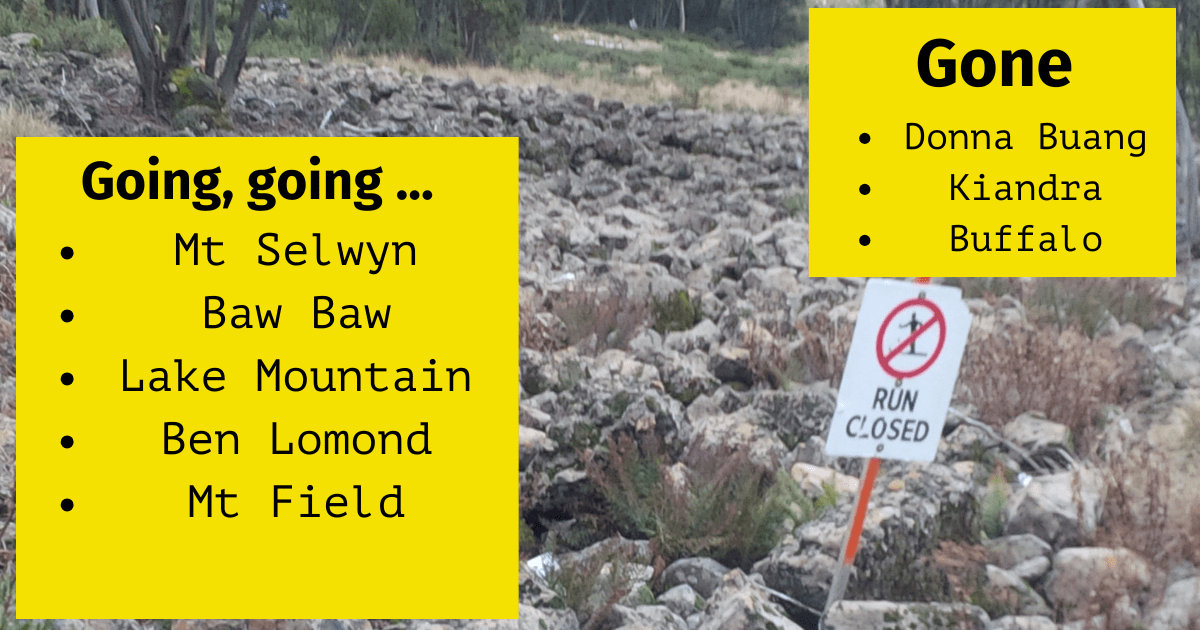
We also know that as snow pack dwindles and the snow line climbs up the mountains that we have already lost a number of previous centres of snow culture – like at Mt Buffalo where there used to be a small resort with ski runs, and people would ice skate on Lake Catani, while the famous Buffalo chalet provided great holidays in the snow in a beautiful setting. The old ski lifts at Buffalo have now been dismantled.

In the 1920s and 1930s people could ice skate on the lakes in Mt Field national park in lutruwita/ Tasmania, including at the famous Twilight Tarn and there was even a small outdoors ice rink on the summit of kunanyi/ Mt Wellington, above Hobart.

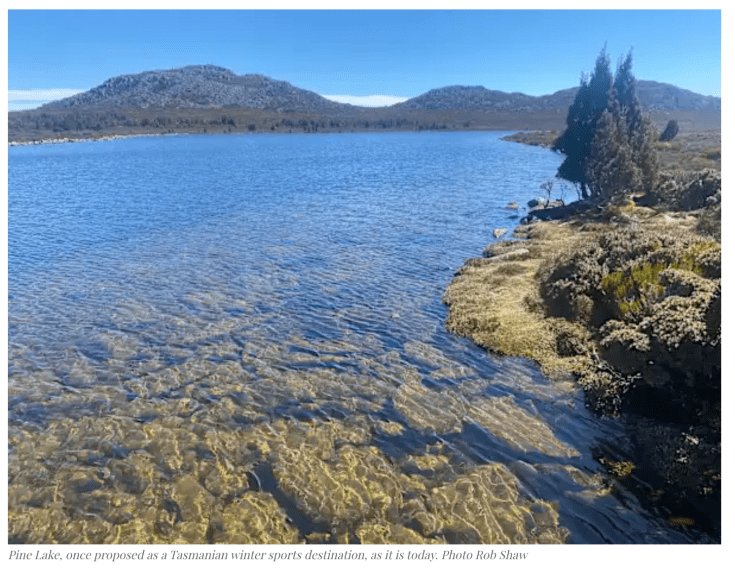
In the early 1900s, a popular ice-skating venue at the time, Pine Lake on the Central Plateau in Tasmania was chosen for the intention of establishing Tasmania as “the Switzerland of Australia” by establishing a “Ice yachting” venue (where specially built yachts could skim across the top of the frozen lake). Source.

The small resorts at Mt Mawson (Mt Field national park) and at Ben Lomond in the north east of the state really struggle to get enough snow cover to justify opening the ski tows.

Spring skiing in the mountains of lutruwita/ Tasmania was a thing up until the 1990s. Now good snow pack in the spring months is a rarity that must be grabbed if you have the chance.

Kiandra in the Snowy Mountains was the birthplace of skiing in Australia (as pointed out in this recent podcast from Protect Our Winters). Australia’s first T-bar lift had been installed on Township Hill near Kiandra in 1957. Now the valleys and hills around the old settlement rarely hold skiable snow for long.

Continue reading “We know how this story goes. But we could decide to change the ending.”

What does the ‘State of the Climate’ report mean for mountain environments?

The biennial State of the Climate Report, which is produced by the CSIRO and BOM has now been released. The report draws on the latest national and international climate research, monitoring, science and projection information to describe changes and long-term trends in Australia’s climate.

Among a vast amount of information, there are some clear details relevant to mountain environments.

Continue reading “What does the ‘State of the Climate’ report mean for mountain environments?”

Letter home from the Arctic: when will we miss winter?

A reflection from Anna Langford, currently in the Arctic Circle region of Norway.


People keep asking me why I have come to spend three months in the Arctic Circle. They need a beat of stunned silence to comprehend my answer, ‘to be cold’.

I’m well-practiced at riding out the response – the loss of words, usually followed by a guffaw of laughter and a light-hearted insult. And sometimes a nervous flicker in the eyes, as though I’ve just given myself away as a ghoulish creature who flinches at the touch of sunlight.

I have been travelling since January, when I chose to bail on an Australian summer in favour of an English winter. ‘What are you doing here?!’ people would splutter, upon finding out where I had come from. Had I accidentally stumbled into Melbourne airport and onto a flight to London while on my way to the beach?

Continue reading “Letter home from the Arctic: when will we miss winter?”

Winter 2024 – the washup

If you were in the Victorian mountains during that amazing storm that passed through in the third week of July, you will have experienced winter at its best. In the Victorian backcountry we had already lost much of the base and the fresh snow was unconsolidated, but it didn’t really matter because there was so much of it. That wonderful and particular sound of fresh dry powder creaking underfoot as you weave through the trees on the uphill and that weightlessness as you head back down truly is magic (it always reminds me of that opening scene in the Valhalla film from Sweetgrass – When you’ve seen the season’s first great snow through the eyes of a child—you’ve known true happiness).

Then the blow drier was turned on, and we all know what happened next. Despite the amazing efforts of the resort groomers, the resorts started to close – the lower elevation ones like Mt Selwyn went first (consistent with what we expect from climate change). As of September 8 there is still cover in the Main Range and a few lifts are still going in places like Falls Creek. But basically the season is done – a whole month early.

This is obviously a huge blow for the businesses who are on their second short winter and everyone who was reliant on a full winter working in a resort or valley town. And, of course, it’s a drag for everyone who just wants to go skiing or riding.

Continue reading “Winter 2024 – the washup”

Protect Our Winters report: Our Changing Snowscapes

We have known for years that climate change is reducing the overall amount of snow we receive in Australia. The snow pack has been in decline since at least 1957. We also know that the loss of snow is being felt especially at lower elevations and will have enormous impacts on the local economies that have developed around the mountains.

Today Protect Our Winters (POW) have released a comprehensive update on the threats posed by climate change – to snow pack, the mountain environment and animals who rely on a thriving ecosystem, and downstream rivers, and also the impacts on the local economies that rely on good snowfalls.

Continue reading “Protect Our Winters report: Our Changing Snowscapes”

Blog at WordPress.com.

Up ↑