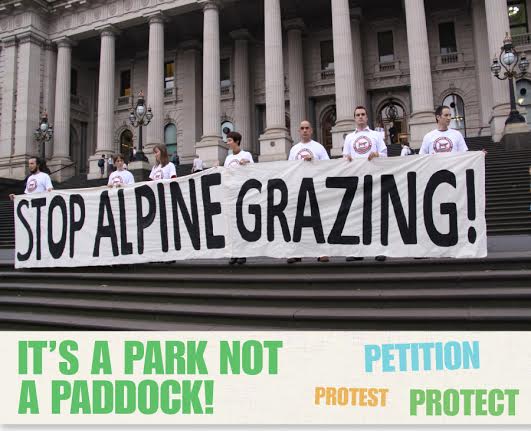
Rob Harris provides an update on the alpine grazing proposal in the Weekly Times.
You will be pleased to know you have a full 10 days to provide input on more than 20 documents. The paperwork is available here.
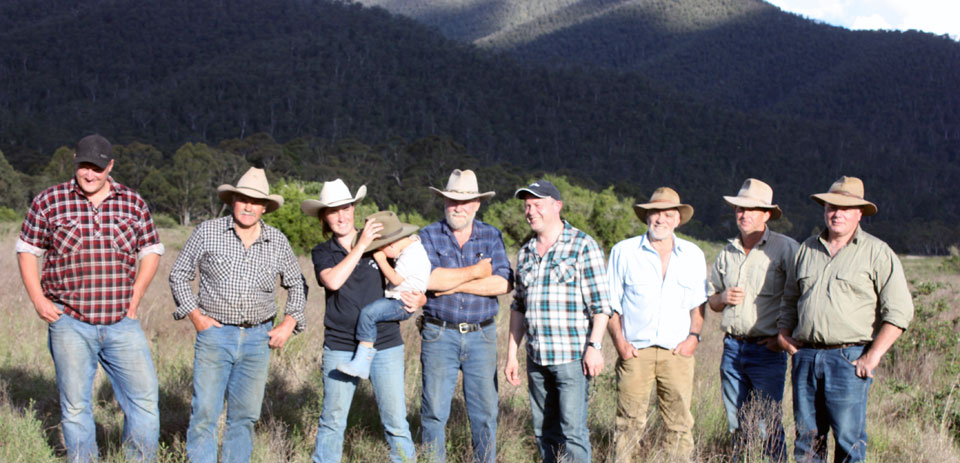
Environment Minister Ryan Smith with mountain cattle graziers, Wonnangatta Valley. source: MCAV
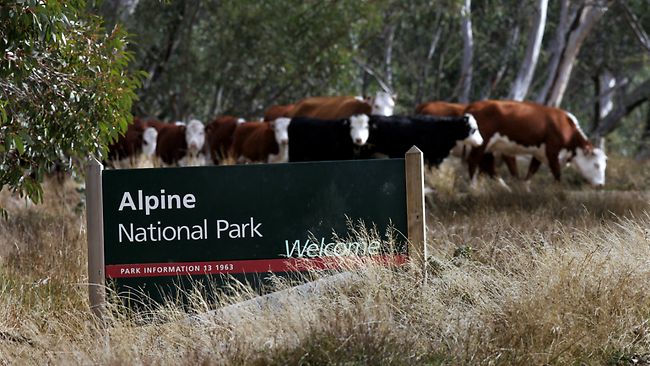
Cattle grazing in the Alpine National Park could return after a full assessment of a proposed grazing trial
CATTLE could graze again in the Alpine National Park before winter after the Commonwealth agreed to a full assessment of a proposed trial.
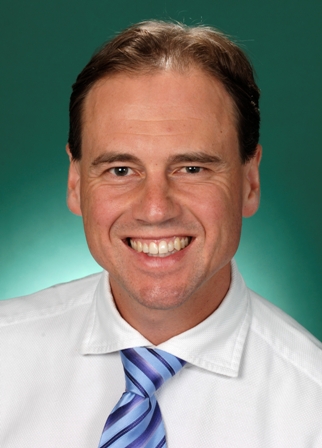
Environment Minister Greg Hunt last week opened a 10-day consultation period.
Mountain Cattlemen’s Association of Victorian president Charlie Lovick said the decision for a “full federal environmental assessment” made sense.
“No doubt it’s a polarising issue and it’s going to continue to be, but this takes some of the politics out of it and now the worthiness of a trial can be accessed,” Mr Lovick said.
“The 10-day period and assessment means we could still get up there by late March and a short trial this year before returning next year could certainly be advantageous.”
The proposed three-year grazing trial of 60 cattle would take place in the remote Wonnangatta Valley.
Projects deemed by the Commonwealth likely to have a “significant impact” on nationally protected areas requires federal approval.
The process requires the State Government to publish assessments that “clearly articulates any impacts” and will also take into account expert scientific advice and public submissions.
A decision is expected by the end of next month.
Victorian Environment Minister Ryan Smith was asked to submit more information about the trial – particularly a survey of native flora – to the Commonwealth last month.
Grazing in the national park was banned by the Bracks government in 2005.
Mr Smith said the Coalition Government believed there was a “clear need to investigate”.
Past scientific studies, including one by the CSIRO, have ruled grazing did not reduce the risk of fire in Alpine areas.
The Victorian National Parks Association criticised plans to return cattle as “a back door way of getting cheap grazing for their mates” while the Australian Society of Native Orchids has written to the federal minister opposing the return of cattle.
The following comes from Rob Harris at The Weekly Times. It is interesting to note that this trial is ostensibly about whether cattle grazing can reduce fuel load, yet the Mountain Cattleman rep keeps talking about invasive species in the valley.
Given that cattle introduced most of the invasive species in the first place it seems to be an ‘own goal’ type argument to run if you want to see cattle brought back.
As with the earlier attempt to get cattle into the Alpine Park, it would appear that the Victorian government has done a poor job of compiling the information that the federal minister needs to make an informed decision on the trial. Given that the Wonnangatta trial has been a concept endorsed by the environment minister for at least a year, it is hard to fathom why this second application has been managed so badly.
Fears for native orchid put high country cattle trial on hold
A THREATENED native orchid could prove the latest hurdle to returning cattle to the high country.
The Victorian Government’s push to begin a three-year trial in the Wonnangatta Valley this month has been put on hold after the Commonwealth sought more information about the habitat.
The Australasian Native Orchid Society of Victoria is the latest conservation group to raise concerns about a return to alpine grazing, after it was reported a survey of rare and threatened plants in the area was not included in Victoria’s application to the Commonwealth.
The Wonnangatta Valley is home to one of two known populations of the native orchid diuris ochroma, or pale golden moth.
Society member Richard Thomson said the group had written to federal Environment Minister Greg Hunt seeking protection for the native flower.
“Having chosen this venue virtually in the middle of the park – where there is plenty of state forest which would have been equally as suitable and wouldn’t run the same risks to the environment – just seems totally weird to me,” Mr Thomson said.
Mr Thomson said it was “ridiculous” the Victorian Government would put the native flower at risk.
If the trial is approved by the Commonwealth, 60 cattle will be released into the Valley for a three-year trial.
A spokesman said Mr Hunt was awaiting information from his Victorian counterpart that would allow the department to make a “fully-informed decision”.
A spokeswoman for Victorian Environment Minister Ryan Smith said an updated survey of the native habitat would be provided to the Commonwealth. She said the “experience and expertise gathered over 170 years” should be included in land management.
The mountain cattlemen, removed from the park in 2005 by the Bracks Labor Government, will this weekend hold their annual high country “get together” on the Omeo High Plains.
Mountain Cattlemen’s Association of Victoria president Charlie Lovick said the decision to stop grazing Wonnangatta had grown into a fire trap “infested with invasive species”.
The political rumour mill is suggesting that federal environment minister Greg Hunt won’t give approval to the Victorian government’s grazing trial before Christmas. The Victorian government proposes putting cattle back into a section of the Alpine National Park to see if it can reduce fuel loads in the Wonnangatta valley.
However, the proposal has been undermined by the fact that only limited information has been presented about how the trial would be managed. In a worrying development, it would seem that the state government has also withheld significant information from the federal environment department, about possible impacts of the project.
Refusing to fast-track approval of this project would be prudent for a minister who is already under fire for signing off on a growing number of environmentally destructive projects.
Lets hope common sense prevails and the federal government requires considerably more information than a desk top study to decide if this is actually a scientifically robust proposal.
Or will he do the reasonable thing and allow additional time for his department to consider the information that the state government withheld from him?
Recently, Mr Hunt approved major coal and gas facilities adjacent to the Great Barrier Reef. Refusing a poorly developed ‘scientific whaling’ (sorry, ‘scientific’ grazing project) would help re-build some of his reputation as the minister for the environment.
Victoria’s leading scientific society has called on the state and federal governments to abandon plans for a cattle grazing trial in the Alpine National Park, saying peer-reviewed evidence shows it would fail to cut fire risk.
In a letter to state Environment Minister Ryan Smith, the normally conservative Royal Society of Victoria has questioned the merits and scientific basis of a trial to test whether cattle grazing decreases the risk of bushfires by reducing fuel loads. About 60 cattle would be released into the Wonnangatta Valley for three years if the trial is approved by the Commonwealth.
In the letter, society president Dr Bill Birch says the trial ignores published evidence that cattle grazing has no measurable effect on fuel reduction, but has serious impacts on the diversity of species in the local area.
”The plan for the proposed trial is not clear and shows little evidence of sound scientific structure,” Dr Birch writes.
Dr Birch says among the trial’s failings are that the vegetation in the Wonnangatta Valley represents only a proportion of that found throughout the Alpine park, meaning the results could not automatically be applied to the entire region. He also said wildfires burn more intensely and move differently to controlled burns, which would be used in the trial, meaning any effect on fuel reduction by cattle would not be measurable.
”The Royal Society considers the proposed trial as another example of so-called scientific study, undertaken without adequate appreciation or even demonstrated knowledge of the literature and which is characterised by inadequate planning and inadequate scientific rigor,” Dr Birch writes. ”We suggest that the trial be abandoned.”
Executive officer of the Mountain Cattlemen’s Association, Graeme Stoney said: ”There is no doubt grazing reduces fuel in the grazing areas.”
The following information comes from the Victorian National Parks Association. A number of significant environmental decisions will be made by the federal environment minister before Christmas, with the danger that they will slip through relatively unnoticed and unreported.
If approved, it can be expected that cattle will be introduced over summer. Last time the Victorian Coalition government introduced cattle to the Alpine Park, they did so without setting in place adequate scientific frameworks to the trial. They had been clearly told that grazing would not be useful in reducing fire risk, yet proceeded to implement their policy.
The fact that the government has withheld information from the federal minister in their current attempt to reintroduce cattle is hardly the basis for assuming this trial will be any more scientifically robust.
Over the next few days Australia’s environment minister Greg Hunt must decide whether or not he will let the Victorian Government put cattle back into the Alpine National Park.
After failing to return cattle to the Alps in both 2010 and 2011 the Napthine Government is again asking the federal government to approve a new cattle grazing trial in the Alpine National Park.
They plan to bring 60 cattle into the remote Wonnangatta Valley, a beautiful river flat that sits below the Howitt High Plains and has been ungrazed by cattle since 1988.
We need your help. Please take action today or as soon as possible:
We cannot allow this grazing trial to go ahead.
The Victorian Government wants to put cattle into the park simply because of a promise it made to some graziers that once held privileged grazing licences.
Their new attempt comes on the back of repeated attacks by the Napthine Government on the integrity of national parks including changing legislation to allow 99 year leases for private development, expanding areas for fossicking and prospecting and making significant cuts to park budgets.
We have also uncovered many serious flaws in the proposed trial:
There is no scientific design for the trial, and apparently no scientists are involved.
There has been no consideration of a location outside of the national park, even though there are many areas where such a trial could be conducted.
The application ignores the considerable evidence that cattle grazing does not significantly reduce alpine fires. There are far more important bushfire research projects on which to spend scarce research funds.
More than 60 years of research shows cattle damage alpine wetlands and the headwaters of many rivers, threaten nationally-listed rare plants and animals, and bring weeds into the National Heritage-listed Alpine National Park.
National parks are the cornerstone of our efforts to protect nature – not cow paddocks or private resorts.
When I went through the paperwork attached to the state government’s proposal to put cattle back into the Alpine National Park, one of the things that struck me was the fact that there was no data from the field about possible threatened plants or animals that may be impacted by the proposal.
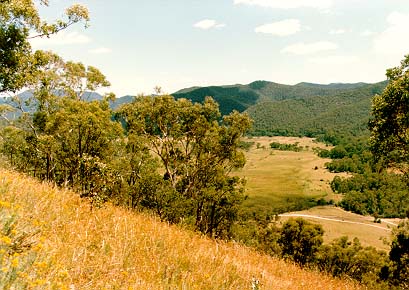
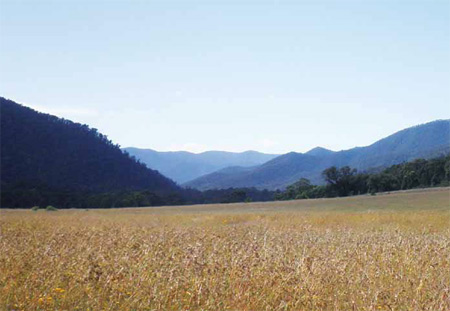
in the Wonnangatta, looking north
The Wonnangatta is not the easiest place to get to in Victoria. Yet the Environment Minister has visited there on at least two occasions. Clearly this project is important to the minister. So it would be reasonable to assume that he would have ensured that some staff were sent to the Valley to investigate possible impacts on endangered species.
Yet in their proposal, the government relies only on desk top data searches of federal government information. Given that the government was roundly criticised for its poorly framed research methodology last time they attempted to put cattle back into the park, you would think they would at least make an effort to make the scientific case more robust this time.
But now, according to The Age, this lack of firsthand data isn’t just because of sloppy project design. It would appear that the government has deliberately withheld key information.
The state government has withheld from the Commonwealth a survey of rare and threatened plants of an area of the Alpine National Park earmarked for a cattle grazing trial.
It is believed scientists at the state’s biodiversity research body – the Arthur Rylah Institute – were asked to look for rare and threatened plants in different parts of the alpine park as part of research for the high country grazing project. Their results were outlined in an unreleased report from May 2012. But the survey was not included in a recent application by Victoria to the federal government for environmental approval of a grazing trial.
Instead an older desktop study – drawing on previously recorded data – was used to identify the extent of endangered species in the low-lying Wonnangatta Valley, where the latest trial is planned.
The unreleased 2012 plant survey found one nationally protected species of orchid known as pale golden moths and a small patch of endangered alpine bog and wetland in the valley. A large area of rare grassland and a rare plant known as spreading knawel were also found across the trial region.
The report suggests that fencing to protect the orchids, grassland and spreading knawel would be impractical and would not mitigate against the impacts of grazing.
No government is perfect. But deliberately withholding information in order to get an outcome you want is incredibly bad form. It begs the question: if this has happened in this case, how do we know it doesn’t happen routinely in attempts to introduce other aspects of environmental policy in Victoria?
In January 2013, it was reported that the Mountain Cattlemen’s Association (MCAV) was lobbying the state environment minister Ryan Smith to seek permission to reintroduce cattle to the area around the Wonnangatta station.
While spokespeople for the minister have been quoted in the media, there has been no formal statement by Ryan Smith and details on the trial have not been released to the public by the Victorian government.
“But it was the state of the park, the threat of high intensity fires from high fuel loads and the impact this could have on its ecology – particularly snow gums – and the infestation of weeds and feral animals that were most pressing on the minds of the cattlemen”.
Media reports have mentioned the ability of cattle grazing to reduce weeds in the Wonnangatta, however, the application only talks about the possibility of it reducing fuel loads. There is no mention of any strategies to ensure the reintroduction of cattle doesn’t bring a new set of weeds into the Wonnangatta. Does this shift from dealing with weeds and fire to just fuel reduction show that there is an admission that cattle make weed infestation worse?
The application says that the traditional owner group was consulted, and of course the MCAV was. What is strange is the claim that environment groups were consulted. Really?
Some observations about the proposed trial
Given that the government has identified fuel loads as a problem, it has not sought to find other ways to reduce fuel loads without a grazing trial.
The impact of weed spread due to grazing (one of the reasons cattle were excluded from the national park in the first case) is not specifically addressed in the proposal.
There is not yet an Environmental Management Plan (EMP) for the project. Given the experience in early 2011, when the Coalition secretly let cattle back into the High Country without a proper framework for how the trial would be managed, one has to wonder if the same thing will happen this time. The documentation says that the EMP will consider issues such as ‘pest plant and animal controls’: so let’s hope the EMP is produced before the cattle are introduced.
The study area covers around 2,200 hectares of land, with 4 ‘treatments’ to be carried out over different parcels of land: a control area, some areas being grazed, some areas grazed and burned, and some areas just burned. The documentation identified 10 ecological vegetation classes (EVCs) within the research trial area. It is not yet clear whether the 4 treatments will be carried out in each EVC.
Lack of consultation. Given that this proposal has been foisted onto the community without any attempt to explain the project beyond a couple of media grabs, it hasn’t got off to a great start if the government hopes to generate widespread support for the trial. The documentation says a ‘communications strategy’ will be created, with the development of ‘key messages’ that will inform the community on the progress of the trial. Note that consultation is a very different thing to communication.
Threats to nationally listed species. The application says the government only carried out desk top assessments of possible federally listed species in the research area. As is widely noted, animal and plant data for the region is not huge, but the government was happy to rely on what information was currently held by the federal government rather than sending a team to check the actual site. Mitigation measures, aimed to deal with any impacts on federally listed species that may be subsequently identified, will be dealt with via the EMP.
Traditional Owner (TO) attitudes to fire. One valuable aspect of the project documentation was a consultant’s report and ‘conceptual model’ of TO understandings of the role of fire in managing land in the High Country. The government is to be congratulated for commissioning this research.
So, we are a little bit closer to gaining an understanding of what is planned with the trial, although there are a significant number of areas where there is no clarity about what the government intentions are and big gaps in understanding how the project will be managed.
The federal minister is currently considering the application and will probably make a decision shortly.
In a nicely orchestrated media piece, it has been announced via The Australian newspaper that the Victorian government will propose a three year cattle grazing trial in the Wonnangatta Valley, within the Alpine national park.
The paper reports that the government is supporting a three-year trial of cattle grazing in the Wonnangatta Valley, one of the main south flowing river systems in the central Alps.
“Victorian Environment Minister Ryan Smith will refer the issue to the Abbott government on Monday, backing a scientific study during the summer months of about 60 head of hereford and angus cattle”. The Victorian government has not yet issued a statement on the trials.
While previous attempts by the Coalition have been soundly attacked by scientists for the poor basis of the research framework, apparently this new trial will be “part of a scientific investigation of bushfire prevention options across 2200 hectares.”
Mountain cattleman Charlie Lovick is reported as saying he hopes this trial will re open access for grazing to a broader area.
The report says that the “preservation of Australian bush heritage will be crucial to the application” that will go to the federal environment minister, Greg Hunt, for approval.
The Wonnangatta was settled by Europeans in the 1860’s and incorporated into the national park in 1988. It is a lowland area compared with the previous attempt by the Victorian government to re-introduce grazing. One has to assume that should this trial be a success at reducing fuel load and weeds, then there would be an attempt to introduce it at higher elevations, where the science clearly shows that ‘grazing does not reduce blazing’.
The Victorian environment minister Ryan Smith (who is a member of the far right Institute of Public Affairs, well known for its anti –environment agenda) said “it’s not an ideological position, it’s a land-management issue.”
Assuming Greg Hunt approves the ‘scientific survey’, grazing could start as early as January 2014.
A spokesman for Mr Hunt said yesterday the government would assess the referral when it was received in accordance with Environment Protection and Biodiversity Conservation Act.
take action
If the prospect of grazing in the park troubles you, please contact the Minister for the Environment, Greg Hunt, making it clear you would not support such a move.
'keep it cool. Stop climate change'. Dinner Plain, June 2011
Ben Laycock is a “painter and occasional sculptor” from Castlemaine in Central Victoria. His wonderfully vivid paintings are his interpretation of the essence of the landscapes he visits and works in. He is turning his hand to writing and we will feature some of his work on the site in coming months.
His first installment, ‘greetings from the Wonnangatta’, is now on the site. It involves reflections from a week picking walnuts on the Wonnangatta River near Dargo.
Recent Comments