
For the last few years, Friends of the Earth has been hosting guided walks in the high country to show people areas at risk from logging. These have included Mt Stirling, the upper Little Dargo River, and the stronghold of older snow gums that exists at Mt Wills and which would have been put at risk by logging that had been planned for Alpine Ash forests on the mountain.
With the government announcing an end to logging on public lands in the east of the state in early 2024, we shifted the focus of our walks onto snow gum woodlands, which are increasingly being impacted by climate change driven fire regimes and dieback caused by a native beetle.
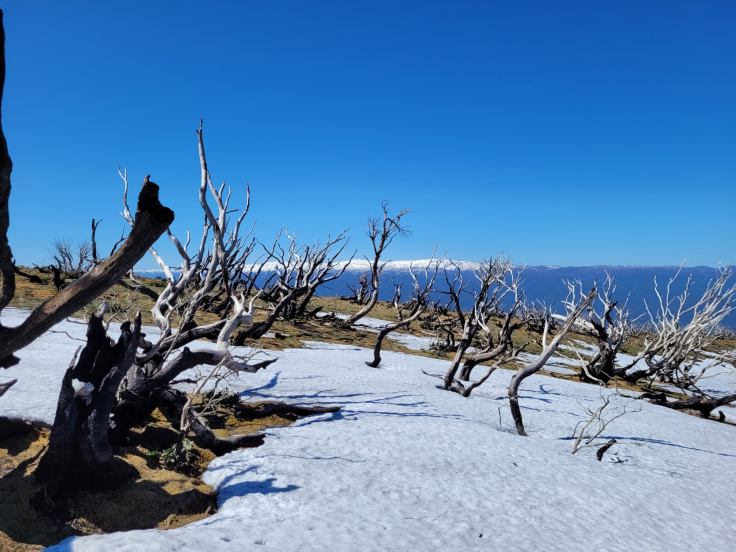
In early 2024 we led a walk to visit what we called the ‘ghost forests’ of the high ridge between the Tawonga huts and Mt Fainter on the north western edge of the Bogong High Plains.
While there is vigorous regrowth in the areas that have been devastated by intense fires, it is still a sad and sobering experience to walk through mile after mile of grey dead tree trunks, with almost all the original forest gone, replaced by thick fire prone regrowth. These scenes are everywhere across the high country. If you head down the slopes into the headwaters of the river systems, the dead grey trunks of Alpine Ash take over. Once you see these walls of dead trees you cannot forget them. On a landscape scale we are seeing the loss of the old forests and an existential threat to the whole ecosystem as the climate goes out of balance with hotter and drier conditions leading to ever more intense wild fires.

Climate grief
Walking out to the ghost forests got us talking about climate grief and how to properly mourn the loss of these incredible forests. Facing the prospect of ecological collapse, the future does look grim for these trees which have thrived in the high country for hundreds of thousands of years.
Any form of grief can be immobilising. How might we acknowledge loss in a meaningful way? How do we use our grief to drive more effective action for the places we love?
No matter what ecosystem you love, the impacts of climate change can be seen and felt if you pay attention. It poses an existential threat to the coral reefs, the mangroves, the tropical forests. And the mountains of the south east, including the snow gums and alpine ash. As ‘practical’ people who look to science for answers, how do we reach into the emotional realm to acknowledge loss, grief, sadness and fear?
There are, of course, traditions for this even in the western world. Like the Deep Ecology workshops developed by people like John Seed, and the Despair and Empowerment and Active Hope work pioneered by Joanna Macey. There is now a heightened awareness of climate grief and Solastalgia: the distress caused by environmental change and environmental destruction, and more discussion about how to avoid activist burnout. But grief is still not really talked about widely and remains something that many people attempt to deal with on their own. This is probably a big part of the problem.
Grief can be incredibly isolating. I am reminded of the famous quote from land ecologist Aldo Leopold who once said ‘one of the penalties of an ecological education is that one lives alone in a world of wounds’. Once you see the tear in the fabric, the scribbling of the dieback on the tree trunk, the endless lines of grey dead trunks, there is no going back to being oblivious to the reality of the collapse happening around us. But the mainstream world continues to ignore the damage, largely pretending that – as the meme of the dog in the burning room says – ‘this is fine’. Many are openly hostile to any expression of fear or loss due to climate change, even in the outdoors community. This further shuts down the conversations we need to have.

However, try as we may, the unravelling continues. Timothy Hull, a musician from the Pacific North West wrote some of the truest words I have ever heard in a song: reflecting on forest activism, he says ‘everything we do is not enough’. This is a harsh truth that is hard to accept. Yet trying is always better than giving up. Billy Bragg put it nicely: ‘cynicism is such a cop out’.
The solution is personal and collective
Grief can also become addictive and habitual and demoralising, pulling us away from activism and the external world into the inner realms. Often ‘self development’ becomes a personal mission rather than something based in community. If we can truly confront, and then process, our grief we will be better prepared to meet the challenges that we face. This means engaging in effective activism to bring about change while also looking after our own emotions and mental health and our broader human and non human community. As legendary labour organiser Mary “Mother” Jones said in the early 1900s, ‘Mourn the Dead, and Fight Like Hell for the Living’.
I feel like we need to develop some collective ways to hold and share our grief. I don’t know what that looks like, but to be transformative I do think it needs to be shared with others. I was intrigued to read recently about the process of Sala in the Watershed Sentinel:
Sala: Mourning, Fighting, Healing
On August 26, an historic, unprecedented Sała (mourning ceremony) was held in Kwagu’ł territory, on north Vancouver Island. This is the first time, ever, that a Sała has been held to mourn non-human kin – our forest and all the life that depends on it.
Normally held at the beginning of potlatch days, the ceremony serves to lift grief and remove negativity, in order to do community work in a good way.
The ceremony was held in a massive clear cut.
It has some important lessons: “Showing your heart by mourning is an important step for healing.” That is – don’t bottle it up. Talk about it.
One person involved in the ceremony says art can communicate to hearts when science does not. “We do not need more data, honestly” says Kelly Richardson. “We’re past that point. It’s a matter of inspiring action, even if it’s just reevaluating what you exist in this world for.” She understands “how scared people are and (that) they don’t know what to do. Some of them feel like they don’t actually have a future, which is really hard to hear.”
Her response is that there are “really good people fighting for that future.”
This ceremony also reminds us that, on a colonised continent, grief is connected to the reality of invasion. Working through grief requires us to address where we are, whose land we are on, and how we might collectively reach a just settlement that will allow us all to live here in the long term. Without settlement, land justice, and a commitment to life long solidarity, there is no way colonisers can truly understand our grief or find a way back to balance.
As is stated in Watershed Sentinel, “Until land is actually given back, when we can begin to heal and actually do the work, there is no reconciliation.”

The antidote is always action
The Simpson meme tells the truth: we are locked into a lifetime of climate change. In fact several generations of it. But every action now reduces the impact later on – on us, our children, and the earth that we share. Understanding that can give us the beginning of a pathway to encounter, process, and ultimately manage our grief so that we can be effective in our work and at peace with ourselves. There is no ‘cure’ for this grief (only the false option of denial). But turning our grief work into a part of our activism offers a pathway to be effective in our actions and more at peace within ourselves.
As always, action is the antidote to despair. Here are some ideas on getting active.
And here is our rescue plan for the snow gums.




 Mountain Journal
October 11, 2024 at 10:07 am
0h my