Mountain Journal has run hundreds of articles on the impacts of climate change on wild places in the mountains of south eastern Australia and lutruwita/ Tasmania. Sadly, these impacts are being felt in parks around the continent.
This piece from Madoc Sheehan (originally published here) looks at the environmental and economic impacts of high intensity rainfall events in Paluma Range national park over January/February 2025 and similar climate impacts in the Blue Mountains and Boodjamulla national parks.
Science Opinion.
Australian’s love their national parks and millions of us visit them every year. They give us solitude, adventure, good health, and we are inspired and captivated by their beauty. But as the climate continues to heat, the health of our parks and reserves diminishes and our capacity to visit and care for them is curtailed.

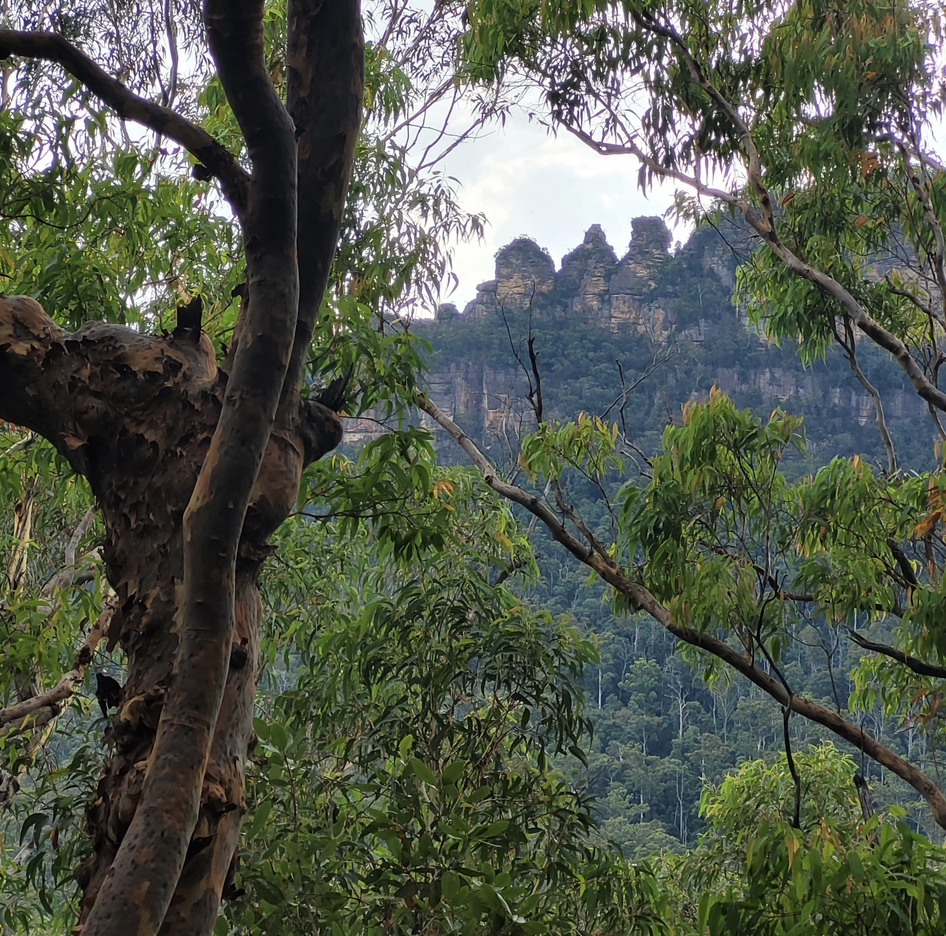
The Three Sisters in the Blue Mountains National Park. Visiting and bushwalking in such locations helps people to develop a personal connection to the natural environment, instilling a desire to protect it.
Our national parks are a key attraction for tourists. It’s hard to think of Australian tourism without the Three Sisters in the Blue Mountains National Park, or without Uluru in the Uluṟu-Kata Tjuṯa National Park or the Three Capes Walk in the Tasman National Park. Such breathtaking natural attractions cost us nothing, deliver value to our tourism industry and economy, improve our health with every visit, and inspire many of us who visit them. But are such locations and the value they provide to Australians under threat from climate heating?
As we race past 1.5oC of climate heating there is little sign of any serious turnaround in policy or action from Australia’s major political parties, who both support expansion of the coal and gas industry. Unfortunately, without major political change in Australia and across the world the only certainty we face is a steady increase in both emissions and the costs of inaction.
Many Australians are intimately familiar with the impacts of fossil fuel driven climate heating. We’ve all coughed our way through mega-fires that have destroyed lives and livelihoods and killed billions of animals. We’ve seen our insurance costs multiply out of sight, and parts of Australia (and elsewhere) are becoming uninsurable, posing a wicked threat to our economic system. We’ve all experienced the increased intensity and duration of heat waves that have forced us inside and raised our power bills, as those of us who can, turn up the air-con. Moreover, heat kills more Australians than any other type of natural disaster.
But what about our national parks and the values they provide? Have they been suffering the impacts of climate heating as well?
Heat waves have an obvious and significant impact on our wildlife, driving some toward extinction and severely impacting on others – wildlife doesn’t have an air-con option. However, much of this impact lies under the canopy, unseen and often unrealized.
There are other climate heating impacts; such as the increasing intensity of rain events and resultant flash flooding. The community of Harvey Bay in Queensland recently experienced one of these events, with locals noting the intensity of rain and flooding being like nothing they’ve seen before. Such events are well-recognized to be a consequence of dangerous climate heating. They are driven by fundamental thermodynamics; the hotter the temperature, the higher the amount of water that can be stored in – and released from – the atmosphere. Regrettably, there’s no escape from the laws of physics. Just one degree of temperature increase leads to 6% more water in the air.
Recent high intensity rain events and flooding have played havoc with our beloved national parks. First-hand experience of such climate impacts at three iconic national parks illustrates the devastating impacts of our fossil fuel addiction on both parks and people, in: Boodjamulla National Park QLD; Blue Mountains National Park NSW; and Paluma Range National Park QLD.

One of many landslips throughout the Paluma Range National Park in North Queensland.
Boodjamulla National Park (formerly Lawn Hill NP) has long been loved for the ethereal beauty of Lawn Hill Creek’s crystal clear water as it flows through deep red sandstone gorges. The Waanyi people have deep spiritual connections in this area, knowing it as Rainbow Serpent (Bujimala) country. Lush ferns lined its gorge’s walls, creeks resplendent with drooping pandanus trees and groves of cabbage tree palms. Diverse animal, fish and bird life have depended on this oasis, as it snakes its way through the dry and harsh savannah land of the Queensland Gulf Country. People have long flocked to Boodjamulla and its adjacent tourist ventures to camp, bushwalk, canoe, and nurture their own spiritual connection to country.
In March 2023, an intense Gulf rain event sent vast amounts of flood water down Boodjamulla National Park’s narrow gorges. Flooding reached 30 metres high in the gorge and 18m high in the nearby Gregory River, with the latter being seven metres higher than any previously recorded rain event. This event completely stripped the delicate vegetation from its creek banks and gorges, washed away national parks infrastructure, and piled up a biblical mass of rubbish and downed trees for kilometers downstream. The environment has been irreversibly altered – in fact, destroyed – and the Park has remained closed ever since.
For two years there has been no canoeing and no camping in the park, and any hopes of returning to a past vibrant tourism industry and its various employment offerings appear abandoned.


Boodjamulla/Lawn Hill Gorge before the flood (top left) and after the flood (top right and bottom).

The Blue Mountains National Park is one of Australia’s oldest and most loved national parks, iconic for its orange sandstone walls, deep ravines and gorges, and delicate rain-forested creeks and gulleys. Hundreds of kilometres of hand-crafted bushwalking trails snake their way through the landscape, with some tracks being as old as 100 years.
Sydneysiders have long made the pilgrimage up the Mountains for fresh air, pure mountain water and rejuvenating walks. Businesses in towns such as Blackheath, Katoomba and Leura are completely dependent on such nature-based tourism.
In 2024 another intense rain event sent floodwater down a delicate fern-lined gulley called the Fern Bower, in Leura. This was also the site of a popular walking track with the same name. A trip down the Fern Bower was like a trip to the best outdoor gym imaginable – hundreds of steps, beautiful scenery, plus natural air-conditioning. The intense rain event stripped the gulley of trees and ferns and wiped out sections of the track, which remains closed. It is hard to foresee the track opening any time soon; it’s delicate and beautiful ecosystem, loved by many, has been severely damaged.


The Fern Bower before the flash flood (left) after the flash flood (right).
The Paluma Range National Park in North Queensland is another well-loved national park, characterized by beautiful rainforest, spectacular waterfalls and extensive bushwalking trails. It’s been the site of early settler development, tin mining camps, logging and now outdoor and adventure tourism. You stand a good chance of spotting a cassowary in this National Park. Dependent businesses include cafes, accommodation and outdoor adventure camps. The Park is popular with school kids from the nearby city of Townsville participating in outdoor-education camps.
In early 2025, over a matter of just a couple of weeks, Paluma Range National Park received almost 5 meters of rain. This intense rainfall event caused numerous landslides throughout the range. The only road up the range to Paluma Village was smashed by slides and remains closed, with no opening date in sight. One of Townsville’s water supply stations is now completely inaccessible; key infrastructure, just washed away. Every national park within 100km of Townsville was closed. Paluma village was completely isolated and without power for many weeks. Most creek lines have been stripped of vegetation as landslide debris and floodwater forced its way to the ocean.


Crystal Creek in Paluma Range National Park; before the flooding (left) and after the flooding (right).
The impacts of climate heating are a threat to our natural ecosystems, especially our beloved National Parks and the tourism and communities that depend on them. Closed parks and closed trails increase Australia’s mental health burden.
Park’s bureaucracy tends to hide climate impacts from the general public; immediately rolling out access restrictions, justified by a simplistic and exclusionary retreat underneath a “public safety” blanket. It’s become a case of out-of-sight, out-of-mind. Admittedly, Parks ignoring or hiding away the realities of climate heating is understandable, especially when the impacts are so devastatingly evident in your own workplace. Unfortunately hiding the impacts, ignoring the urgency, and failing to advocate for the necessary actions (such as reducing emissions), does nothing to protect our parks from their most significant threat.
Over my 35 years of bushwalking such landslides and flash floods have been a rarity, but regrettably, they are now becoming a recurring feature of the landscape. Without change, climate impacts on both people and parks will only get worse, and more frequent. There has never been a more important time to stand up for our National Parks, before more of our treasured natural world is lost.




 Mountain Journal
Leave a comment