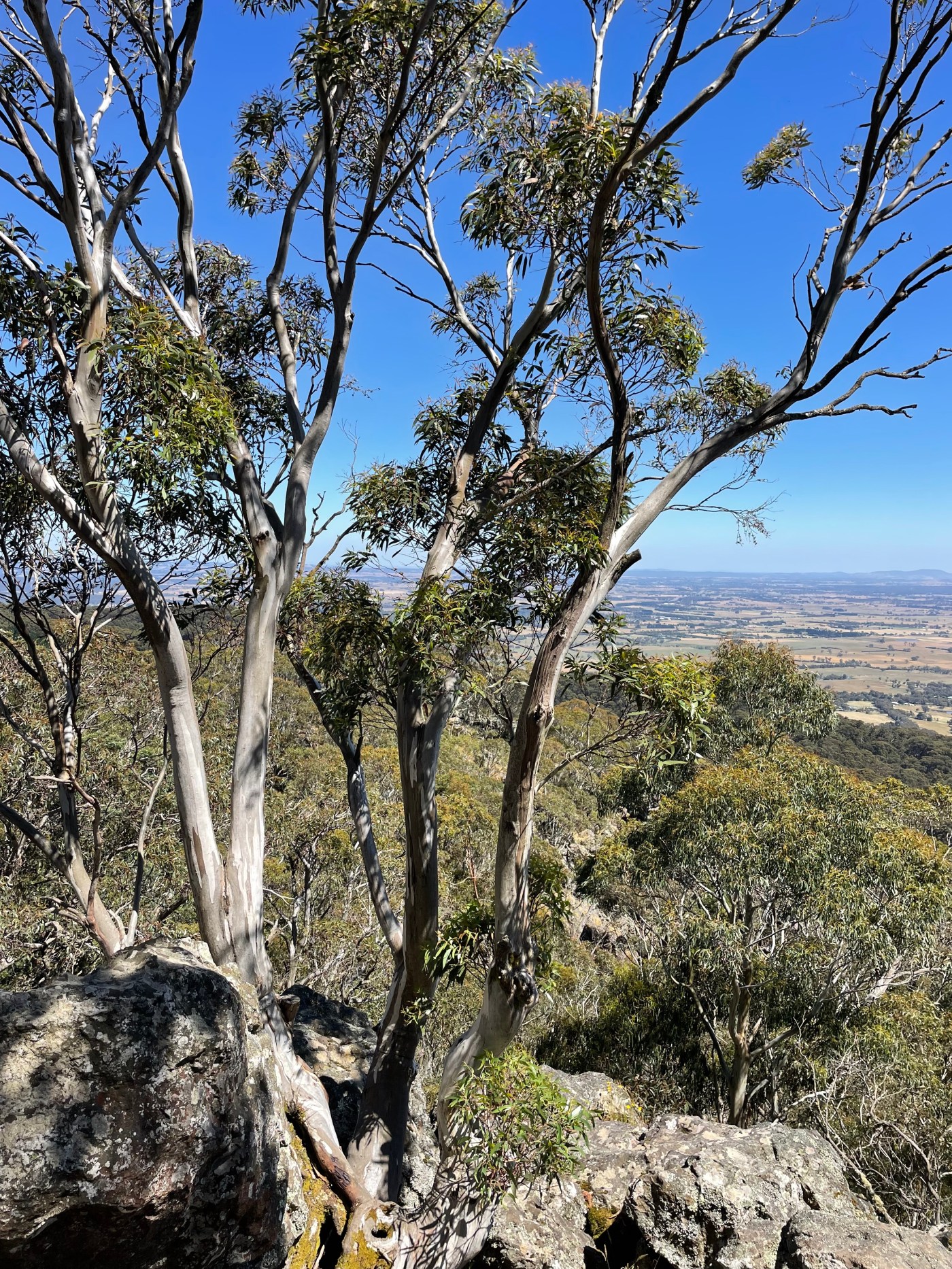
As you know snow gum communities across the high country face an existential threat from the combined impacts of dieback and more frequent and intense fire seasons. Sadly the isolated pockets of snow gums away from the higher mountains face similar threats, like in the Mt Cole ranges where the Bayindeen fire damaged sections of remnant snow gum forest.
There is currently a sustained threat to the wonderful snow gum forests on Mt Macedon and I am asking you to take a few moments to contact two MPs and urge them to stop proposed tree felling operations.
This information comes from our friends at the Victorian National Parks Association who are leading the campaign to protect these trees.
Background
Community outrage is growing over a proposal by the Macedon Memorial Cross Committee that would see between 100 and 120 trees, including the locally significant Snow Gums cut down on Mount Macedon. The works would clear almost 0.8 hectares of a nationally significant and highly threatened ecosystem – Montane Grassy Woodland.
Why these Snow Gums matter
- Rare and irreplaceable ecosystem: The Snow Gum woodlands on Mount Macedon are part of the Montane Grassy Woodland Ecological Vegetation Class. Just 21 hectares remain in central and western Victoria, confined to two places – Mount Macedon and one peak in the Grampians.
- Critical biodiversity refuge: These Snow Gums support a unique mix of plants, fungi, mosses, insects and birds that cannot simply be replanted elsewhere.
- Ancient survivors: Many of these Snow Gums are more than a century old, providing hollows and nectar vital for native birds, mammals and insects. While they were devastated by the Ash Wednesday fires many have sprouted from lignotubers and existing seed bank and are now 42 years old. The Southern aspect that is proposed to be impacted provides a cooler sheltered environment and protects the existing Snow gums from the effects of climate change.
- Healthy and regenerating: A 2021 – 22 assessment recorded over 2,000 Snow Gums across Macedon Ranges, with strong evidence of natural regeneration and resilience – even after fires and storms.
What is proposed
The Memorial Cross Committee is pushing to cut down Snow Gums to “restore” historic views of Melbourne from the Cross. This would destroy a rare and recovering ecosystem simply for aesthetics. The proposal was rejected by Macedon Ranges Shire Council in 2023, after strong community opposition.
Why this must be stopped
- False offsets: Suggestions that planting Snow Gums in former pine plantations could “replace” what’s destroyed show a lack of ecological understanding. The complex web of species in Montane Grassy Woodland cannot be recreated. Normal native vegetation laws do not apply and instead use the opaque Crown Land Procedure: https://www.environment.vic.gov.au/__data/assets/pdf_file/0024/521628/CrownLandReport20192020.pdf
- Climate pressures: With Snow Gum habitat already at risk from climate change, every mature stand is vital for resilience. Cutting down these trees undermines their survival. A significant number of trees were removed on the North face by Parks Victoria in 2014 for the café view scape.
- Community values: The Macedon Memorial Cross was created to honour those lost in war. Damaging living memorials of nature undermines the very spirit of remembrance and peaceful contemplation.
Take action: What the community can do
- contact the local MP: Maryanne Thomas. E: mary-anne.thomas@parliament.vic.gov.au
- contact the State Environment Minister: Steve.Dimopoulos@parliament.vic.gov.au
- Spread the word: Share stories and images of Macedon’s Snow Gums on social media using #SaveMacedonSnowGums.
HEADER IMAGE: Snow gums at Mt Macedon. Credit – Tanya Loos
Extra information you may want to use in your email
Based on the 2021–22 survey of Snow Gums (Eucalyptus pauciflora ssp. pauciflora) in the Macedon Ranges Shire:
Across the Shire:
- A total of 2,277 individual Snow Gum trees were formally recorded and assessed, spread over about 900 km² from Riddells Creek to Tylden.
- An additional ~50 trees were later reported by the community, bringing the known total to around 2,300+ trees.
On Mount Macedon specifically:
- Two major sub-populations were surveyed – near the summit and around Camel’s Hump.
- Surveyors assessed 215 trees at the summit and 107 trees at Camel’s Hump.
- Importantly, these were only samples (10–20% of each stand), so the actual number of trees is estimated to be several thousand across Mount Macedon.
Conservation significance:
The Mount Macedon stands are among the largest populations of Snow Gum outside eastern Victoria and are considered highly significant. Despite the effects of past fires (notably Ash Wednesday 1983), recruitment is still occurring, and overall population health is rated “good to very good”
- Subspecies and Distribution
- The Macedon Ranges report confirms that the Snow Gums on Mount Macedon are Eucalyptus pauciflora ssp. pauciflora, the same taxon as the lowland stands.
- However, within Victoria there are six recognised subspecies of Snow Gum, most of them restricted to high-altitude environments (with snow cover), and one (ssp. parvifructa) restricted to the Grampians.
- The Macedon summit population occurs at 900–1,000 m elevation, much higher than the surrounding lowland populations (generally 450–700 m). This geographic and ecological separation sets the stage for genetic divergence.
- Evidence from the 2021–22 Survey
- The report notes that no Snow Gum populations exist in the “mid-band” altitudes between the summit (near 1,000 m) and the lowlands (below 600 m). This gap suggests long-term isolation between the two groups.
- Isolation typically results in limited genetic exchange, allowing unique adaptations to develop over time.
- Distinct Ecology
- The Mount Macedon Snow Gums are found with Alpine Ash and rare montane flora not seen in the lowland stands, including threatened species such as Purple Eyebright (Euphrasia collina ssp. trichocalycina).
- This indicates a different ecological niche, which would reinforce genetic differentiation.
- Broader Scientific Context
- Snow Gums across Victoria have shown local genetic structuring due to isolation in “ice-age refugia.” Populations on higher peaks and rocky outcrops often have distinct genetic profiles compared to lowland remnants.
- While the Macedon Ranges report did not include genetic testing, it explicitly treats the Mount Macedon populations as ecologically and demographically distinct from the lowland groups, and their separation makes it very likely they are genetically differentiated as well.
Further reading:




 Mountain Journal
Leave a comment