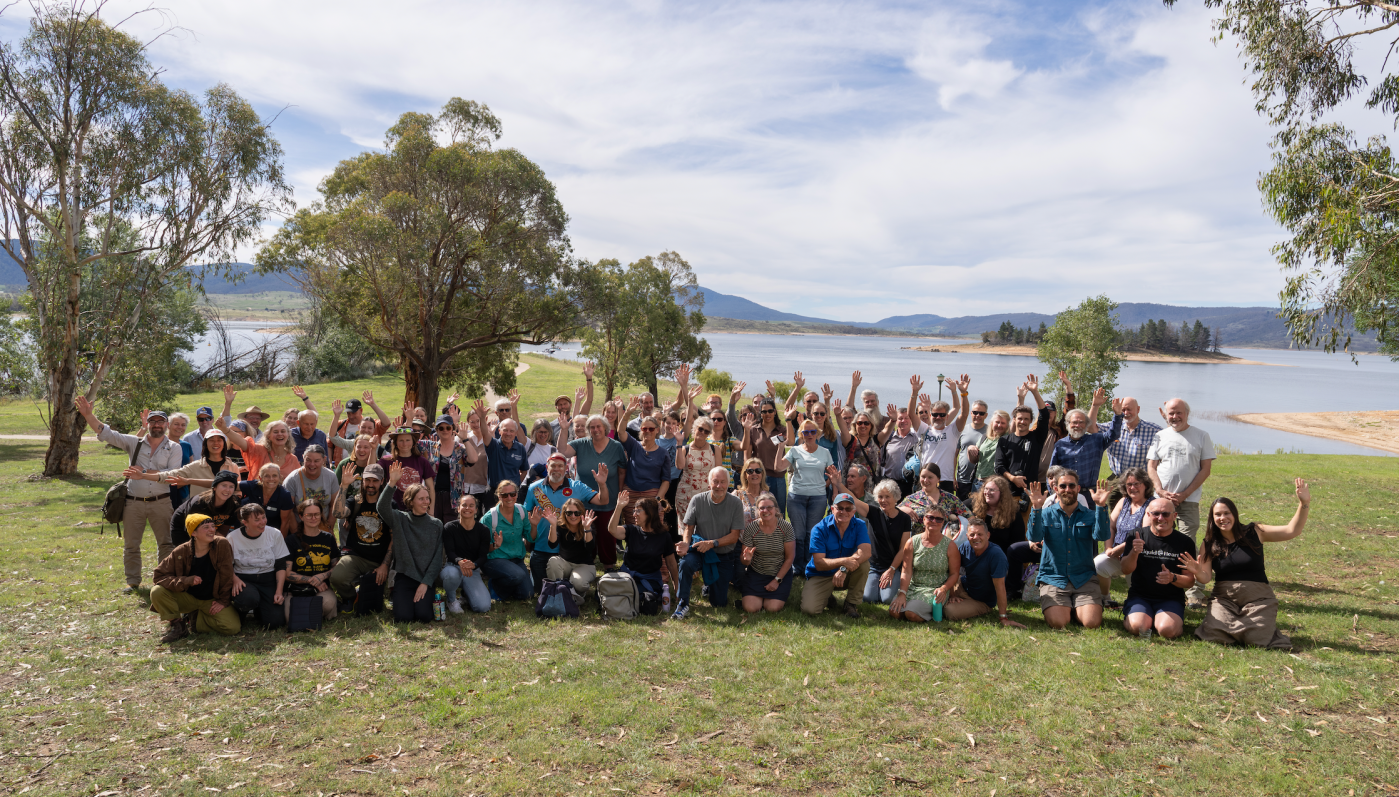
Friends of the Earth recently hosted the second ‘snow gum summit’. It was held in Jindabyne and around 120 people gathered to hear from experts in the fields of snow gum die back and the threats of more frequent and intense wild fire.
There was a strong First Nation presence at the forum, which is reflected in the summit statement, reprinted below.
Snow Gum Summit Declaration 2026
We gather at the place where the stars come from.
‘Jinda’ means ‘star’ in Ngarigo language – and Jinabyne, where glittering constellations emerge from the surrounding ranges, is the location of the Snow Gum Summit.
This is mountain Country, where winter snow and the quartz rocks of the snowy river shimmer like the starry skyline. It’s where Ngarigo professor, linguist and sociologist, Jakelin Troy, can trace her ancestors’ occupation of the land for at least 20,000 years. Jakelin’s daughter, Lara Troy-O’Leary, is currently researching snow gums at Australian National University. It is the plight of the Snow Gum that has brought 20 academics from leading scientific institutions, as well as land managers from across the Alpine bioregion (the ACT, NSW, and Victoria) to the High Country.
Snow Gums (Eucalyptus Pauciflora, or ‘Warragung’ in Ngarigo language) are at risk of disappearing, rendering Australia’s unique Alpine environment unrecognisable. Climate change is responsible for increased bushfire events and the changing behaviour of a native beetle, which is causing the widespread death of snow gums. The Snow Gum Summit: Next Ascent, convened by Friends of the Earth, is the second convergence to respond to this problem since 2025. The Summit 2026 brings First Peoples, academics, state land managers, Landcare groups, school teachers, outdoor education groups, and everyday people who care deeply about Alpine landscapes to progress dialogue about how to save this iconic tree that characterises the Australian Alps.
Beyond their cultural, heritage and ecological value, the decline of snow gums has severe repercussions for water security and the integrity of other ecosystems throughout south-eastern Australia. As Dr Leah Moore describes, when snow gum woodlands are degraded, hydrological processes are disrupted: soils become less stable and water is shed more quickly, impacting downstream systems, including the Murray Darling Basin. Healthy Alpine landscapes function as a water tower, safeguarding water resources that currently sustain millions of people.
A sobering presentation on snow gum die-back from Dr Matthew Brookhouse highlights the scale of the phenomenon, which is driven by a complex interplay of climate stressors, across vast areas of the Alpine bioregion. Dr Brookhouse warns that climate-driven die-back could become an ecological threat across the continent, as rising temperatures alter the “operating conditions” for people interacting with landscapes. He is investigating how other species in an ecosystem might help us respond to the scale and complexity of the problem.
Experts from Tasmania to the ACT at the Summit called for the proactive protection of snow gum refugia as ecological assets (alongside people and property) and long term flora and fauna monitoring during extensive discussions about bushfire mitigation in increasingly extreme climate conditions. Dr Steve Leonard draws on operational experience from recent fire seasons in Tasmania, offering valuable insights on the advantages of strategic landscape planning, the targeted protection of identified ecological assets (using sprinklers and other reinforcements), and rapidly responding to new bushfire ignitions using solar-powered remote detection cameras and remote area firefighting.
Protect Our Winters, an advocacy organisation for the outdoor community, delivers a powerful reminder that fossil fuel giants are responsible for the decline of snow gum woodlands – urging governments to do everything in their power to reduce emissions.
Solutions-focused discussions highlight the value of integrated, landscape-scale solutions that can be expanded across state boundaries to combat both dieback and bushfire impacts. Consensus at the Summit is that significant resources must be allocated to researchers and land managers to enable two-way knowledge approaches and ‘Resist, Accept, Direct’ frameworks. While specific techniques may differ between local regions, the underlying principles of early action, generative partnerships, and coordinated response provide a framework for stewarding biodiversity – and the essential ‘ecosystem services’ these landscapes provide to Australian populations – through a changing climate.
Despite the gravity of the topic, the Summit is defined by a strong sense of solidarity and connection. The gathering creates space for honest conversations about the challenges ahead, but also for inspiration and renewed purpose. Even in the face of unprecedented pressures, there is hope in the knowledge shared and partnerships strengthened at the Summit. There is a shared energy in the room – and a clear commitment to turn concern into meaningful action.
By bringing together the most recent scientific evidence, First Peoples’ cultural knowledge, and on-ground management experience from across the Alpine bioregion, it’s clear that the challenges facing snow gum ecosystems are both urgent and solvable – if met with sustained action. The evidence of snow gum decline presented at the Summit clearly demands more action than continued observation: the situation calls for adequate resourcing and policy settings to enable long-term planning over short-term response. Governments, agencies, and decision-makers at all levels must work in genuine partnership to protect the hydrological and ecological systems that are fundamental to life in south-east Australia.
The Alpine landscape holds deep-time memory and meaning. It’s a place of connection, reflection, recreation and belonging for millions of people. Harsh alpine winds have shaped this Country over millennia. The future of the Australian Alps will be shaped by our choices now.
Hope lives in collaboration. It lives in the willingness to listen across disciplines and cultures – and in the shared determination to protect what remains and restore ecological balance. If we act decisively and together, the Alps is still a landscape with a future. We stand together for a future where snow gums stand like sentinels through the shifting seasons, rivers continue to flow from Alpine peaks to the lowlands, and future generations can come to know and love the mountains, just as we do today.




 Mountain Journal
Leave a comment