Search

Mountain Journal

Environment, news, culture from the Australian Alps

Author

Cam Walker

I work with Friends of the Earth, and live in Castlemaine in Central Victoria, Australia. Activist, mountain enthusiast, telemark skier, volunteer firefighter.

long term tree-sit established in Toolangi forest

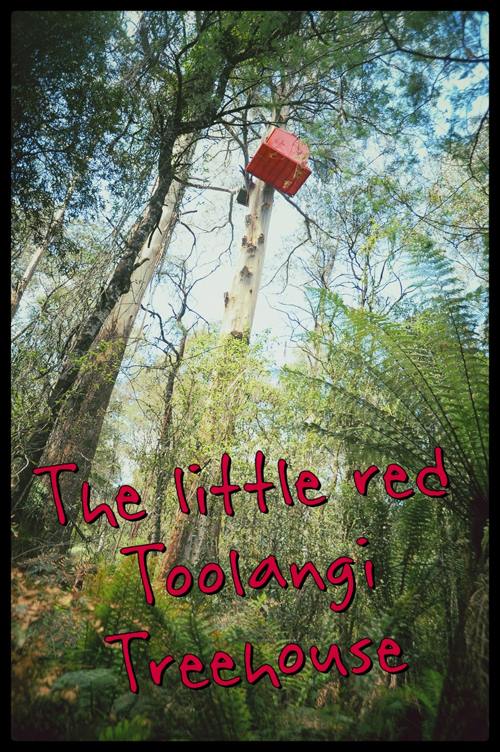
On sunday 10 November, 2013, a young activist called Hannah Patchett launched the beginning of what is intended to be a long term tree sit to highlight the immediate threats to the Leadbeaters Possum through continued destruction of its habitat.

969385_10151799133659001_829810885_nKeep up to date via the treehouse facebook page.

Check here for background information on this long running campaign.

Friends of the Earth – Media Release

Saturday 9 November 2013

Tomorrow at 12 noon Hannah Patchett will formally launch her time dwelling in Toolangi’s treetops.

The Little Red Toolangi Treehouse has been built 50 metres up into the canopy of an area of forest habitat for the critically endangered Leadbeater’s Possum.

“I’ve chosen to stay in the Little Red Toolangi Treehouse because I want to see real action taken to save the Leadbeater’s Possum from extinction,” says Hannah Patchett.

“Removing clearfell logging from these forests is the first step.”

Logging of the remaining unburnt forest area following the 2009 bush fires has become increasingly controversial, and the subject of extensive community opposition.

Today the Toolangi forest continues to be logged, mostly for pulp for paper.

Leading expert on the Leadbeater’s Possum, Professor David Lindenmayer, has called for an end to clearfell logging by the end of 2013.

“The Little Red Toolangi Treehouse is a vital and brave initiative to protect the Leadbeater’s Possum habitat that the Napthine state government continues to log against expert recommendations,” says spokesperson for Friends of the Earth, Lauren Caulfield.

“Friends of the Earth support Hannah’s efforts because like her, our organisation and our supporters want implementation of management changes our forests so desperately need,” says Lauren.

“As it stands current industrial scale clearfelling will see our wildlife emblem managed into extinction’,” says Lauren.

“Real and urgent action must be taken to protect the Leadbeater’s Possum and its forest habitat from logging.”

“Forestry Minister Peter Walsh and environment Minister Ryan Smith must ensure the new management recommendations laid out by Professor Lindenmayer are implemented if the Leadbeater’s Possum is to stand a chance,” concludes Lauren.

What: Launch of the Little Red Toolangi Treehouse
Photo opportunity: Little Red Toolangi Treehouse from the ground, or assisted ascend to tree platform
When: From 12 noon, Sunday 10 November
Where: Toolangi State Forest – contact Amelia Young for directions 0404 074 577

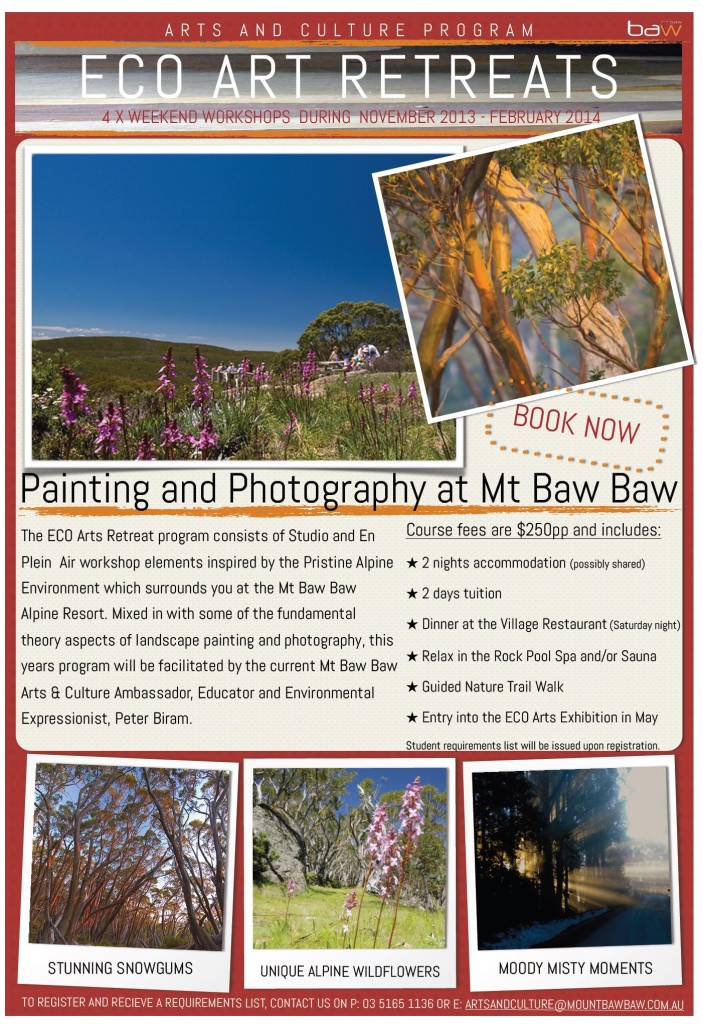
eco arts retreats at Baw Baw

This comes from Baw Baw resort. A nice bit of low impact value adding to the resort.

eco_arts_retreats-703x1024The ECO Arts Retreat program consists of Studio and En Plein Air workshop elements inspired by the Pristine Alpine Environment which surrounds you at the Mt Baw Baw Alpine Resort. Mixed in with some of the fundamental theory aspects of landscape painting and photography, this years program will be facilitated by the current Mt Baw Baw Arts & Culture Ambassador, Educator and Environmental Expressionist, Peter Biram.

A series of Photography and Painting retreats will be available during summer on the mountain:
9/10 November 2013 : Eco Arts Retreat #1 : Painting
14/15 December 2013 : Eco Arts Retreat #2 : Photography
11/12 January 2014 : Eco Arts Retreat #3 : Painting
1/2 February 2014 : Eco Arts Retreat #4 : Photography

For further information contact:
Caroline Hammond, Mt Baw Baw Arts and Culture Manager on 5165 1136
or email artsandculture@mountbawbaw.com.au

Private development push threatens Victoria’s national parks

The following comes from the Victorian National Parks Association.

IMGP5971The Victorian Government’s decision to open up the state’s national parks to development and private investment sets a dangerous new direction for our conservation reserves.

The policy essentially puts a ‘for sale’ sign on two thirds of Victoria’s national parks estate.

National parks and other conservation reserves protect our already depleted natural areas. They do not exist as money-making ventures for private hoteliers and or proponents of large-scale tourist accommodation.

National parks are the jewel in the crown of Victoria’s tourism industry, but we need to be careful that we don’t kill the goose that lays the golden egg.

Exposing our parks to tourism development could lead to irreversible damage to some of our most precious natural areas and undermine the integrity of our magnificent system of parks and reserves.

The primary role of national parks is the conservation of nature on behalf of all Victorians. Our parks were not created to end up as building sites for hotels and large-scale infrastructure that can only be used by a privileged few who can afford it.

Now, a group of 21 eminent Victorians including a former state governor, Nobel prize winner and leading academics have written an open letter to Victorian Premier Denis Napthine, describing the privatisation of our national parks as a betrayal of public trust.

What can you do

Sign the petition: By signing the petition you will be joining the fight to protect Victoria’s national parks. Your name will be listed among thousands of others who stand together to win the campaign.

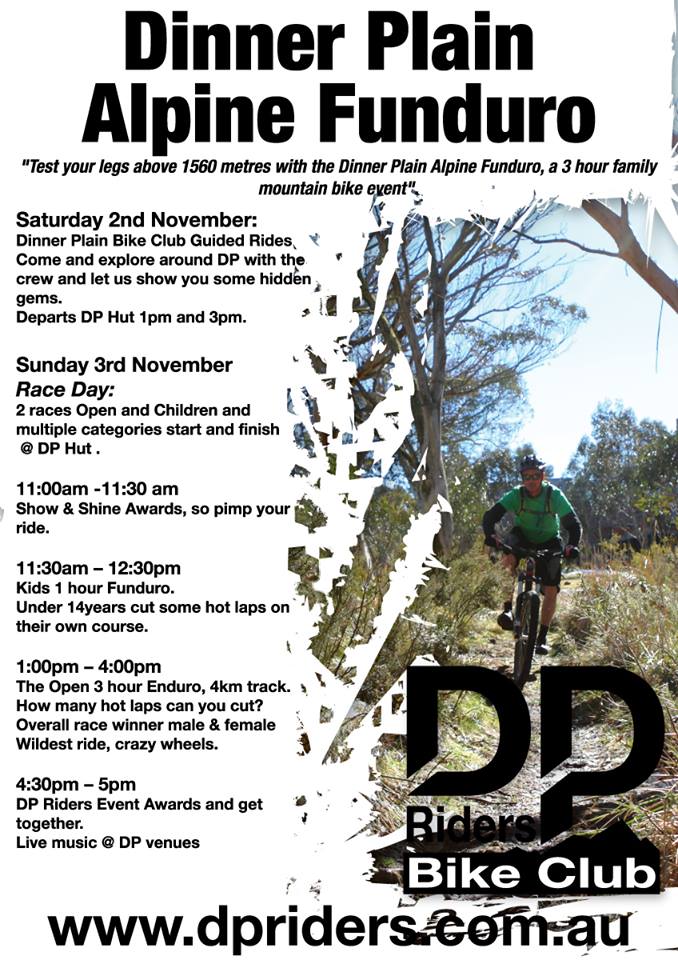
Dinner Plain Alpine Funduro

1378040_678070452218125_1833954454_nThis is the first year of the family focused 3 hour funduro riding in and around Dinner Plain Alpine Village. A unique accessible enduro focused on fun and participation, race through houses, back onto bush tracks, fire roads and some sneaky single track, weaving in and around the alpine village of Dinner Plain which is nestled amongst the Alpine National Park and sitting 1560m above sea level, so come on, test your legs!

details

 Saturday 2nd November:

Dinner Plain Bike Club Guided Rides
Come and explore around DP with the crew and let us show you some hidden gems.
Departs DP Hut 1pm and 3pm.
Live music @ DP venues

Sunday 3rd November is Race Day:

Two races: Open and Children with multiple categories.
Start and finish @ DP Hut & BBQ

11:00am -11:30 am

Show & Shine Awards, so pimp your ride.

11:30am – 12:30pm

Kids 1 hour Funduro
Under 14years cut some hot laps on their own course

1:00pm – 4:00pm

The Open 3 hour Enduro, 4km track. How many hot laps can you cut?
Overall race winner male & female
Wildest ride, crazy wheels.

4:30pm – 5pm

DP Riders Event Awards and get together.
Live music @ DP venues

Find out more here.

Entries Close: Midnight Wednesday 30 October

Register here.

new fees for staying in National Parks

snowy mountains 052The Victorian government has announced that it is intending to introduce charges for overnight hiking and camping in more than 100 of our state and national parks.

In addition to increasing existing fees at car camping spots that have basic services, there is a proposal to introduce “overnight walking” fees for Alpine NP, Baw Baw NP, Grampians NP, and the Great Ocean Walk. This would mean for instance you will need a permit for hiking and camping within the Alpine National Park. For example, it will cost $30 to walk from Hotham to Falls, plus a $10 admin fee.

The Government has prepared a regulatory impact statement (RIS) to assess the impact of introducing a user pays approach to camping fees for all parks and reserves managed by Parks Victoria. It says ‘this is part of the Government’s efforts to make sure that Victorians continue to have access to these beautiful places and that the costs of providing safe, visitor-friendly facilities and services are sustainable and affordable’ and ‘these changes will provide longer-term financial sustainability for these special places’.

The new approach is expected to be introduced in Victoria’s parks and reserves from 1 March 2014.

People are invited to provide feedback on the RIS, which is available here.

Written submissions should be forwarded by 5:00pm Friday 22 November 2013 via either of the following:

Post

Camping and Accommodation Fees
Land Management Policy Division
Department of Environment and Primary Industries
Level 3, 8 Nicholson Street
EAST MELBOURNE VIC 3002

Online

Email: camping.RIS@depi.vic.gov.au

What do you think?

Please feel free to leave a comment below or on the Mountain Journal facebook page.

Some thoughts on the proposed changes

In considering how much to increase camping fees, the Department of Environment and Primary industry created a weighting system, based on a mix of considerations: efficency, equity, and effectiveness. After considering the implications of these 3 categories on possible fee increases, they suggested 3 options:

·         Full cost recovery

·         A system equivalent to rates charged by private operators outside parks

·         One based on improved revenue yield (which is the preferred option, called option 3)

Option 3 is expected to generate $15.3 million per year (camping fees at present generate around $6.5m, and the system is estimated to cost $17.8m to run on an annual basis). Implementing option 3 would mean there is a shortfall of $2.5m per year –  at present the annual shortfall is $11.3m).

The supporting documents make it clear that the funds generated from camping fees will go into managing the parks rather than consolidated revenue, so in that sense I would support the proposal.

However, if the government will now receive an estimated additional $8.8m a year in camping fees, a key question is whether they will commit to using the money they have now saved in other Parks related activity, or will it just get subsumed into the state budget?

It rates camping sites according to the type of facilities offered and has a sliding scale of fees proposed. For car camping style sites, these are mostly based on sites of 6 or 8 people, making them very expensive if travelling as a couple or family. I would argue they should have a basic per person fee for smaller groups

It proposes the creation of an annual camping pass for hikers and bike riders. This would mean that remote and backcountry camping will require a fee for the first time.

Some suggestions on what you might like to say in your feedback

·         The money saved from existing state budget by new camping fees should be re-invested into Park management, not subsumed into the state budget. Eg interpretive services, weed management, restoration activity, management of threatened species, etc

·         The system should consider a concession for card holders (students, unemployed, pensioners, etc)

·         The per person fee for remote camping (called Overnight hiker permits) is quite high. Overnight hiker permits in places like the Alpine National Park will be $10 per person per night, with a $10 booking fee per booking. It will be higher for Mt Buffalo and Wilsons Prom ($12.50 per person) and for the ‘Hotham to Falls Creek Crossing’ ($30 per site- with per person option not available). This could become very costly for people, especially given this is generally decentralised and non designated camping with low impact. A lower rate should be considered for camping in remote, unserviced sites.

·         There is no per person option for high quality sites, making camping very expensive for single people, couples and small families. A per person option should be introduced.

·         There should be some assessment of whether these changes will impact on the economy of regional centres and towns in areas around the key national parks

Parks where it is proposed that fees for camping would change from 1 March 2014:

  • Wilsons Promontory National Park
  • Cape Conan Coastal Park
  • Mount Buffalo National Park
  • Grampians National Park
  • Great Otway National Park (Western)
  • Gippsland Lakes Coastal Park
  • Buchan Caves Reserve
  • Croajingolong National Park, Peachtree Reserve
  • Lower Glenelg National Park
  • Mt Eccles
  • Discovery Bay
  • Lake Eldon National Park
  • Mount Arapiles-Tooan State Parks
  • Cathedral Range State Park
  • Hattah Kulkyne National Park
  • Wyperfeld National Park
  • Upper Yarra Reservoir
  • Little Desert National Park
  • The Lakes National Park
  • Plenty Gorge Parklands
  • Ewing Morass W.R/Orbost
  • Yarra Valley Parklands
  • Kinglake National Park
  • Brisbane Ranges National Park

Parks where it is proposed that fees for roofed accommodation would change from 1 March 2014:

  • Buchan Caves Reserve
  • Cape Conran Coastal Park
  • Gabo Island Reserve
  • Murray Sunset National Park
  • Plenty Gorge Parklands Nioka Bush Camp
  • Wilsons Promontory National Park

Parks where it is proposed that fees for camping would be introduced from 1 March 2014:

  • Alpine National Park
  • Baw Baw National Park
  • Bunyip State Park
  • Broken Boosey State Park
  • Cape Liptrap Coastal Park
  • Cobboboonee National Park
  • French Island National Park
  • Lerderderg State Park
  • Mornington Peninsula National Park
  • Mount Samaria State Park
  • Mt Buangor State Park

The supporting documentation says “it is Victorian Government policy to specifically consider the impact of proposed amendments to legislative proposals on small business in RISs. However, in this case, the proposed Determination primarily imposes costs on individual visitors rather than on businesses. The businesses likely to be affected by the proposed fees are private providers of camping grounds and some licence tour operators who utilise camping and accommodation in parks”.

This seems to miss the point that there may be economic impacts on business operators outside the parks who may be adversely impacted by any change in people travelling through their region/ town on their way to national parks.
 

review: Valhalla

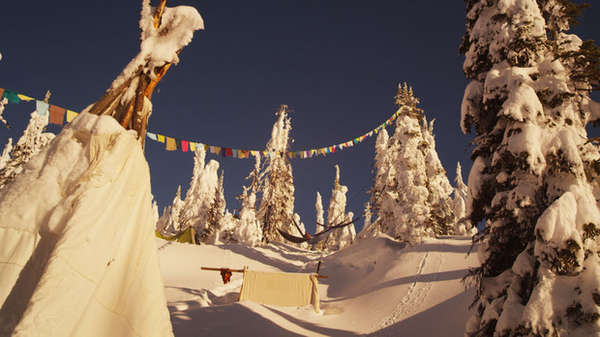
the camp
the camp

This is the 4th backcountry ski film from Sweetgrass Productions.

Two years in the making, Valhalla is way beyond your normal ski film and its almost as if the usual eye candy of skiing/ boarding big lines is used to entice you in, and covers a deeper story. The premise of the film is that as we get older we lose our passion for life, that sense of wonder we have as a child, but can look for it again.

‘Valhalla is the tale of one man’s search to rediscover the freedom of his youth. Feeling the distant heat of it’s fire still burning in the mountains of the frozen north, he goes in search of those tending the flame—the untamed, the wild, and the outcast dwelling on the fringe’.

The following is a fairly rambling review.

7 peaks Alpine Ascent Challenge

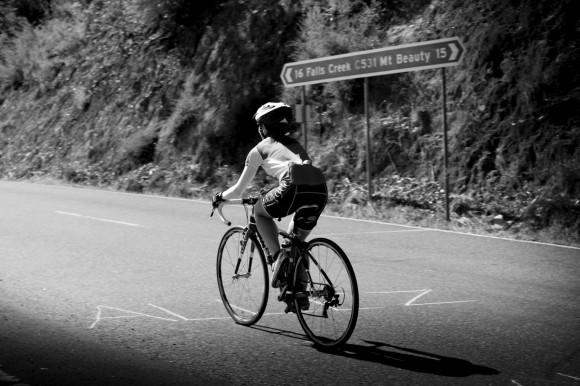
Image: http://theclimbingcyclist.com/7-peaks-domestique-series-ride-5-falls-creek/

Victoria’s 7 peaks Alpine Ascent Challenge is an at-your-own pace cycling challenge which takes in all of Victoria’s Alpine Resorts.

The ‘riding season’ is now open. You can tackle the 7 Peaks (Mt Baw Baw, Mt Buffalo, Mt Buller, Dinner Plain, Falls Creek, Hotham, Lake Mountain) anytime from October 18 2013 to March 31 2014.

The challenge is for people – over the next five months – to ride each mountain at a time that suits them.

The organisers say:
‘The 7 Peaks passport will be the proof of your cycling toughness, stamping it along the way for every summit you successfully ride. Once you have completed your peaks and submitted your stamped passport, you will go into the draw to win some amazing prizes. Ride four peaks or more and you get the chance to win this year’s major prize. There’s also 7 amazing alpine winter experiences to be won’.

Further information available here.

Join the 2013/2014 Falls Creek Hawkweed Volunteer Program

The 2013/2014 summer season of the Falls Creek Volunteer Hawkweed Survey, is now open for volunteer recruitment.

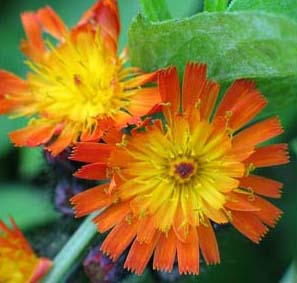
orange_hawkweedNative to Europe, Hawkweeds have recently become naturalised on mainland Australia. It is highly invasive and spreads quickly via runners and root, forming dense mats inhibiting and outcompeting native vegetation. Hawkweeds can cause major environmental damage in alpine & sub alpine areas and are considered a significant threat to the Victorian Alps.

Participating in the volunteer surveys are a great way to help save the Victorian Alps from this dangerous weed, as well as a fantastic opportunity to enjoy the magnificent alpine environment during the green summer months.

Accommodation has kindly been provided by Falls Creek Resort Management.  Breakfast, morning & afternoon tea will be provided each day.

Session 1: Monday 16th – Friday 20th December 2013 (Full, but you can be added to the waitlist)
Session 2: Friday 27th – Monday 30th December 2013 (Full, but you can be added to the waitlist)
Session 3: Monday 6th – Friday 10th January 2014 (Places available)
Session 4: Monday 13th – Friday 17th of January 2014 (Places available)
Session 5: Monday 20th – Friday 24th of January 2014 (Places available)

If you, your friends, family or colleagues would like to attend, please contact me to book a place and provide the number of participants attending with you, their names and emails as soon as possible.

To express your interest in the program please contact:
The Hawkweed Team, Parks Victoria
Mt Beauty Parks Victoria Office
P: (03) 5754 4693 E: hawkweed@parks.vic.gov.au

Australia’s wilderness ‘risks being loved to death’

The following is a media release from National Environmental Research Program’s (NERP) Environmental Decisions Hub and The University of Melbourne, October 14, 2013.

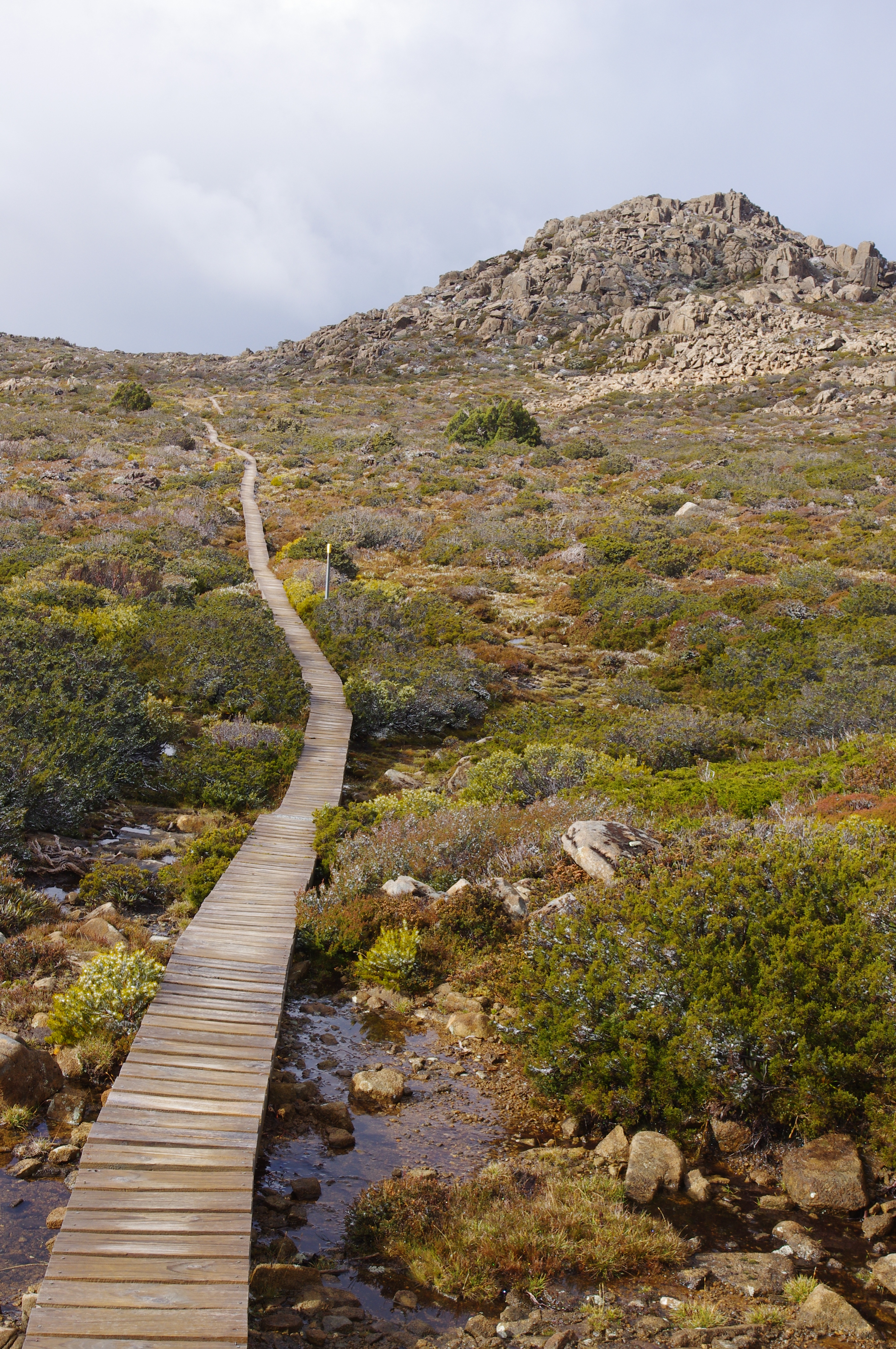
Mt Field national park, TAS

With 28 million visitors camping, tramping, biking, 4W driving, riding and picnicking in them every year, Australia’s iconic nature areas are at risk of being loved to death.

The love affair of urban Australians and foreign visitors with our spectacular wilderness is challenging conservation managers with a new set of problems and tricky decisions, says Dr Kelly Hunt de Bie of The National Environmental Research Program’s (NERP) Environmental Decisions Hub and The University of Melbourne.

“The trend towards nature tourism is increasing year by year. There are more people, doing more travel and an urban culture that is keen to re-establish its links with nature,” says Dr Hunt de Bie. “This all adds up to growing visitor pressure on our wild places, both managed and unmanaged, and the inevitable degradation of some of them.”

“National parks are established with the aim of conserving environmental assets while also providing quality, sustainable recreational experiences. But what if the recreational experiences result in the damaging of environmental assets? Activities of visitors can have significant negative impacts on the natural values of parks, both at the site and landscape scale,” she says.

Typically these include soil compaction and erosion, tree and vegetation damage, waste disposal issues and increasing visitor pressure in areas containing rare and endangered species, or where efforts are being made to re-establish lost species. Visitor safety in the bush is also a factor.

As a result, Dr Hunt de Bie and her colleagues are working on novel ways to help park and wildlife managers navigate the tricky path between meeting the expectations of nature tourists, and keeping the natural wilderness intact for future generations. The work is co-funded through Parks Victoria.

Using Victoria’s famous Grampians National Park and the inter tidal zone walking trails of Port Phillip Heads Marine National Park as case studies, the researchers are investigating ways to help park managers to ease the pressure on wild places of high conservation value – without diminishing the experience that visitors gain from them.

“Managers of the environment are routinely faced with making complex decisions with little information and high levels of uncertainty. It’s a tough ask, but that’s their job. When decisions have to be made regardless of these constraints, structured decision making (often simply referred to as SDM) is a useful tool for guiding managers through the decision process,” she says.

The team is testing a six-step decision process that involves defining the conservation goals and performance measures, developing alternatives and predicting the consequences of each, making a decision – and keeping a careful eye on its results.

“When it comes to making a decision about an area that is getting over-visited, there are basically several alternatives – do nothing, relocate visitors to another area so it can recover or limit visitation in time or space. You can also build permanent features that reduce its vulnerability.

“We are now working on what each of these does for the sustainability of the site in question – and also speaking to visitors to see what they are willing to accept.”

At Port Phillip Heads, for example, the famous visitor walk round the heads at low tide crosses areas covered with the brown seaweed Hormosira banksii, which is a haven for wildlife. “Parks Victoria has identified that a key threat to intertidal reef communities is trampling by humans – which may increase in future,” says Dr Hunt de Bie’s colleague, PhD researcher Prue Addison.

Options range from using rangers and signage to educate visitors, to diverting the route of the walk to less sensitive areas, to opening and closing sections, to building boardwalks over key reef areas. Using the SDM approach, the researchers enabled park managers to score the various options and so choose the most appropriate at the time.

“It is clear that managing our national parks and wildlife reserves is a never-ending task – and that it also includes managing the pressures imposed by visitor numbers which are growing at a steady 3 per cent a year,” Dr Hunt de Bie says.

“Nature tourism brings more than $20 million in from overseas each year, so it is clearly a vital part of the Australian experience, which we don’t want to diminish in any way. At the same time we need to be sure the experience itself does not deteriorate through over-use. These decision making systems can help to achieve that,” she says.

Details of the research appear in the latest issue of the journal Decision Point: http://www.decision-point.com.au/

The Environmental Decisions Hub is funded by the Australian Government’s National Environmental Research Program (NERP). The Hub’s research aims to assist Australian governments in their environmental management and decision making.

on walking

on the Razorback, VIC

I recently heard a great Radio National program featuring English travel writer Robert Macfarlane.

His new book The Old Ways: A Journey on Foot is the third in a trilogy about “landscape and the human heart”.

As mentioned on RN, “in it, Robert Macfarlane travels the ancient walking tracks of Britain” and he spoke of the many deep experiences he has had while travelling on foot.

I have always been a big fan of walking, for commuting and recreation. It has all manner of benefits, and in bioregional terms, is a necessary part of getting to know your place and region. But lately I have been getting more influenced by the thought that walking can have a spiritual benefit as well.

Partly this is just formed from many hours sitting on trams and trains, aware of everyone around me fiddling with their electronic gadgets. I love and appreciate the internet as much as anyone and have the need to be plugged in. But as our minds become ever more crowded with huge volumes of data and (often quite shallow) information, and as we get ever more dependent on electronic gadgets, many of us are becoming obsessive in our need to be online and ‘connected’.

To have what has been described as a ‘considered’ life, you need time for reflection. This means time simply being with yourself. Whether you have religious or spiritual beliefs or not is irrelevant to this observation. It strikes me as being obvious that people need time for inward reflection – as opposed to the external ‘reflection’ that happens on social media and ‘reality’ TV, which is essentially something crafted for consumption by others. If you cannot bear to just sit with yourself, then there is something wrong in your life.

But in this hyper consumerist world, few of us are encouraged to make that time just to be.

Having some quiet time in the day means we can think about life, and how we are going in our relationships: with ourselves, our loved ones, and our community. Walking brings this opportunity to me. You don’t need any fancy gear to actually do it, just a few minutes in your day, wherever and whenever you can fit it in.

The global connections available to us via the internet are amazing. And more and more this opportunity is spreading to the majority world. But this engagement is very much ‘front of brain’ interaction, generally not deep or reflective.

And while I love my bike, walking gets you to a different place, because you can get into the rhythm of walking rather than maintaining the need to be constantly scanning for danger, which is a requirement of riding a bike at any speed.

Walking clears my head. It lets me plan for my day and then to unpack whatever happened at work.   Sometimes it just connects me to place, as I wander neighbourhoods and see how people live and interact. My life feels richer as I get to know the places around me, human and non-human, as you see a level of detail that cannot be discovered even from a push bike or car.

Then there is the deeper level. Sometimes I think its good to have an open mind as you walk. To consciously not think or plan, just to be open to what presents itself on that particular day. Some of my deepest revelations and connections have happened as I practise open mind walking, there is something to the movement of walking – a defining characteristic for humanity through the entirety of our existence – that takes me far further than sitting meditation has ever done. Being propelled through a landscape, the weather, our immediate surroundings, at the pace of the human body is inherently spiritual.

Yes, walking can be a drag, when you’re tired and want to get home, when its too hot or too wet or your destination is simply too far away. When you’re sick or tired or simply weary with life. But mostly its something that enriches our lives and gives authentic experience that is not gained from being plugged in or otherwise distracted in our lives.

To finish, I like this quote from Timothy Hull. His ‘companions’, transcendentalist poet uncle Walt Whitman and nature writer Mary Oliver may not resonate for us all. But the notion of walking out from home, into a rich landscape – busy or empty – flat or hilly – urban or rural – is something that we can all do. Who knows what we might find and who we might meet on the way.

Lets go walk out beyond the Wall
Across the land in the bright Fall
With the leaves fiery jewels
With Uncle Walt on the open road
Mary Oliver,
Dreaming souls
Wonderful companions bright and clear

[originally posted on an appreciation of the Bogong bioregion]

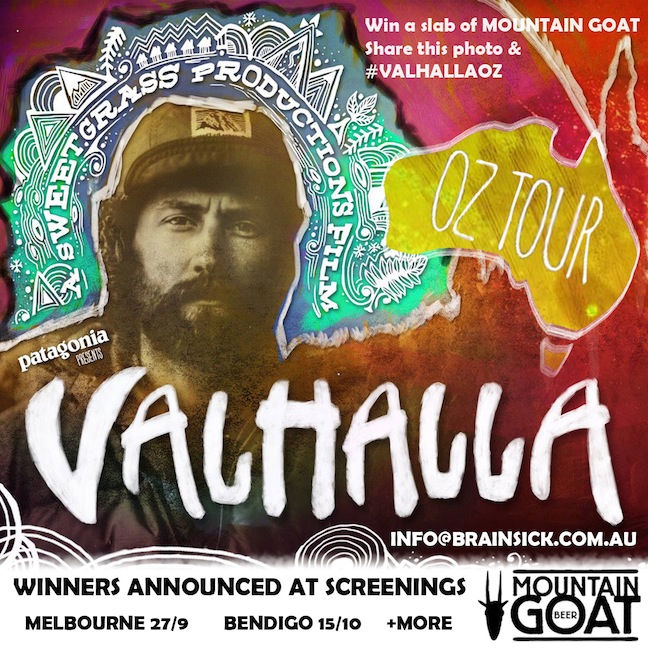
VALHALLA film showing in Australia

INSTAGRAM PROMOThe weightlessness of youth: every breath radiates opportunity and hope; every sense thrives on the wealth of the present; everything whispers of brilliance and awe. When you’ve seen the season’s first great snow through the eyes of a child—you’ve known true happiness. But what happened to that simple joy? Where do we find the freedom that time and wisdom stole away?

Valhalla, Sweetgrass Productions’ fourth feature film, is the tale of one man’s search to rediscover the freedom of his youth. Feeling the distant heat of it’s fire still burning in the mountains of the frozen north, he goes in search of those tending the flame—the untamed, the wild, and the outcast dwelling on the fringe. Weaving narrative-driven style with award-winning, face-melting backcountry ski and snowboard cinematography; Valhalla is a vivid explosion of colour, character, snow, and nostalgic soul.

Starring: Cody Barnhill, Sierra Quitiquit, Alex Monot, Pep Fujas, Eric Hjorleifson, Kazushi Yamauchi, Zack Giffin and Molly Baker

Presented by: Brainsick

Sponsored by: Patagonia and Mountain Goat

Where/When:

Bendigo: 15/10 – 6pm
Star Cinema
1 Peg Leg Rd, Eaglehawk
$10 on the door (cash only)

Sydney: TBA
Patagonia Retail Shop
93 Bathurst St, Sydney
TBA
Entertainment: Mountain Goat beers and live entertainment at some events. Door prices at all events.

More info: info@brainsick.com.au
http://www.facebook.com/BrainsickProductions

Read more: http://www.mountainwatch.com/snow-news/21692883/Sweetgrass-Production%27s-Valhalla-to-premiere-in-Melbourne#ixzz2hPImgLq7

mountain goodness – your daily pic from the hills

april 2009 147Mountain Journal is on Facebook and has a daily photo from the mountains of TAS, NSW and VIC.

Please feel free to add your own.

You can never have enough mountain goodness, especially at the start of what is likely to be a long, hot, and fire-prone summer.

Daily photos available here.

Blog at WordPress.com.

Up ↑