I work with Friends of the Earth, and live in Castlemaine in Central Victoria, Australia. Activist, mountain enthusiast, telemark skier, volunteer firefighter.
In his second installment of writing from the Victorian Alps, artist Ben Laycock sends his greetings from the exclusive enclave of ‘Dinner Plane’.
“Dinner Plain, for all you poor folks that have never been there, is on the road from Mount Hotham to Omeo, just past Picnic Point and way before Breakfast Creek. Mythology has it that Dinner Plain was named after the humble repast, (horse and damper) eaten there week in and week out by The Man from Snowy River, Clancy himself no less, during the long and fruitless search for The Wild Brumby”.
He adds the warning that some images are ‘gruesome’.
The following is an excert from a longer article written by Gus Hearl and Peter Southwell-Kealy.
Etheridge Ridge, Snowy Mountains
On Saturday 2 July, 2011 the cross country skiing community was devastated to learn of the death of Ross Martin in a cycling accident. Anybody who came into contact with Ross would have found him to be at times, a charming, and at other times, a challenging companion. He was, however, always interesting and always happy to share his opinions with whoever was prepared to listen.
He was, for many people, the embodiment of cross country skiing in this country. Indeed, Ross was such a larger-than-life character that, even though his on snow feats have been surpassed by many skiers, his standing as one of the great cross country skiers produced by this country remains undiminished. If anyone was a legend and an elder statesman in cross-country skiing in Australia, it was Ross.
Ross’ uncle, the late Bruce Haslingden, competed in the 1952 Oslo Winter Olympics and seems to have been the catalyst for Ross’ interest in cross country skiing. Ross worked for Bruce as a jackaroo for a while after leaving school and, through Bruce, established a lifelong association with both Kosciusko Alpine Club and Cooma Ski Club. He is rightly recognised as a legend of both those esteemed organisations and the active members of each of those clubs could dine out for years to come on Ross Martin stories (some of which are actually true).
Ross joined KAC as a junior member in 1956 and also became a member of Cooma Ski Club at about the same time. He had skied in cross-country races every year since 1961. It was his idea to start the KAC Martini Cross Cross-Country Classic in 1972 and he competed in every one of those races until 2010, one of only three people to achieve that milestone. In recent times he had also been actively involved in re-invigorating the Charlotte Pass Open
Ross was very fortunate in that he started his racing career in the early 1960’s, when the local sport was dominated by Robbie Kilpinnen from Finland, Kore Grunnsund from Norway and Otto Pinkas from Austria. They took Ross under their wings, as it were, and he learnt much from them: not just skiing technique but toughness, a love of the mountains and a sense that nothing which came easy in life was necessarily worthwhile. Often they would use the Jagungal Wilderness between Kiandra and Grey Mare Hut as their training ground, skiing in the winter and running in the summer.
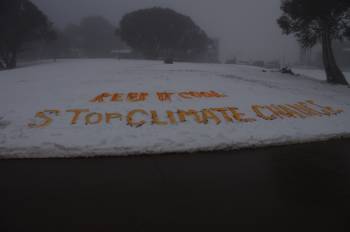
'keep it cool. Stop climate change'. Dinner Plain, June 2011
Ben Laycock is a “painter and occasional sculptor” from Castlemaine in Central Victoria. His wonderfully vivid paintings are his interpretation of the essence of the landscapes he visits and works in. He is turning his hand to writing and we will feature some of his work on the site in coming months.
His first installment, ‘greetings from the Wonnangatta’, is now on the site. It involves reflections from a week picking walnuts on the Wonnangatta River near Dargo.
This is a nice little video about sustainable practises when you’re in the snow. It comes from a European group called Respect the mountains
image: respect the mountains
, which is undertaking a grassroots awareness raising initiative for visitors in the Alps.
Their blurb: ‘Many tourists visit the Alps every year, especially during the winter season. The damages are severe. Respect the Mountains is designed to make people aware of the uniqueness and importance of mountain areas and the simple measures you can take to reduce the negative impact. This to make sure that future generations can enjoy the mountains too, that nature is preserved and the economical situation can be secured’.
On June 16th, activists locked down to equipment used to construct a pipeline at Snowbowl, the ski area on the San Francisco peaks outside of Flagstaff, AZ.
The peaks are sacred to 13 Indigenous nations and play a central role in the creation stories of the Dineh, as well as serving as markers of the borders of Dinetah (Dineh land). The pipeline is meant to carry sewage water that will be used as fake snow for the ski area. Spraying sewage on this sacred place, beyond being profoundly disrespectful and insulting, will destroy a fragile and unique ecosystem in which medicine people gather plants for healing and ceremonies.
Please, support these activists! Six have been arrested, four of whom are Native. They are being held at the county jail and their bond is set at $238 each. If you are in a position to help financially, if you have legal skills that could be of service, or if you’re an independent journalist who can cover this story, please contact: Beth Lavely
Tel: 928.254.1064
Email: protectpeaks@gmail.com
Here is some more background info on the action:
PROTECT THE PEAKS – STOP DESTRUCTION & DESECRATION NOW!
Today we take direct action to stop further desecration and destruction of the Holy San Francisco Peaks. We stand with our ancestors, with allies and with those who also choose to embrace diverse tactics to safeguard Indigenous People’s cultural survival, our community’s health, and this sensitive mountain ecosystem.
On May 25th 2011, sanctioned by the US Forest Service, owners of Arizona Snowbowl began further destruction and desecration of the Holy San Francisco Peaks. Snowbowl’s hired work crews have laid over a mile and a half of the planned 14.8 mile wastewater pipeline. They have cut a six foot wide and six foot deep gash into the Holy Mountain.
Although a current legal battle is under appeal, Snowbowl owners have chosen to undermine judicial process by rushing to construct the pipeline.
Four weeks of desecration has already occurred. Too much has already been taken. Today, tomorrow and for a healthy future, we say “enough!”
As we take action, we look to the East and see Bear Butte facing desecration, Mt. Taylor facing further uranium mining; to the South, Mt. Graham desecrated, South Mountain threatened, the US/Mexico border severing Indigenous communities from sacred places; to the West, inspiring resistance at Sogorea Te, Moana Keya facing desecration; to the North, Mt. Tenabo, Grand Canyon, Black Mesa, and so many more… our homelands and our culture under assault.
We thought that the USDA, heads of the Forest Service, had meant it when they initiated nationwide listening sessions to protect sacred places. If the process was meaningful, we would not have to take action today.
We continue today resisting Snowbowl’s plan to spray millions of gallons of wastewater snow, which is filled with cancer causing and other harmful contaminants, as well as clear-cut over 30,000 trees. The Peaks are a pristine and beautiful place, a fragile ecosystem, and home to rare and endangered species of plants and animals.
Our action is a prayer.
There is a Facebook page here and extra info from Indigenous Action Media here.
The following comes from the Mountain Watch website:
So you might have heard that yesterday the resorts copped a little bit of a soaking? Don’t panic! It is completely normal! Here at Mountainwatch we consulted our resident meteorology sensei “The Grasshopper” for a few words about the weather of the last few days.
“It’s a real shame to see all of that beautiful early season snow washed away, but unfortunately rain like we’ve just witnessed was always a strong possibility,” the Grasshopper said.
The weather pattern of the last few weeks has been a strong indicator of a great season ahead. The typical pattern in early to mid May in the last few seasons has seen the mid latitude band of high pressure systems become well established over SA, pushing a lot of the cold moist weather south of the continent. Luckily this year these ‘blocking highs’ haven’t become properly established, letting the cold fronts push north and bringing with them cold moist winds.
The following report comes from the NSW Office of Environment and Heritage. ‘Diversity – beyond the boundaries’
An exceptional seventh annual Alpine Resorts Sustainability Forum was hosted by the NSW Office of Environment & Heritage (OEH) and held 9-10 May 2011 at Lake Crackenback Resortexternal link, Jindabyne NSW. This years forum theme was ‘Diversity – beyond the boundaries’.
The forum was officially opened by Bob Conroy, Executive Director Park Management Division, OEH. Mr Conroy emphasised the NSW government would not forsake environmental responsibility in the pursuit of being economically competitive. He also spoke about the challenge that the Australian alpine resort industry faces on a daily basis while managing businesses in Australia’s fragile alpine environment. Mr Conroy announced that in 2011 NSW National Parks & Wildlife Service will be publishing the inaugural annual NSW alpine resorts environmental performance report covering Kosciuszko National Park.
Three outstanding keynote speakers: Professor Mike Archer a vertebrate palaeontologist and mammalogist; Rachael Oakes-Ash, social media commentator and ski journalist; and the futurist Mark Pesce delivered thought-provoking presentations. The remainder of the program included presenters, workshop facilitators and field trips. The other presenters challenged people’s thinking when they spoke on a broad range of topics including improved initiatives in sustainable use and management of alpine resorts including better use of technology, social networking sites, sustainable tourism and marketing and environmental reporting as well as the development of improved snowmobiles.
Delegates had wonderful networking opportunities throughout the forum, particularly at the opening dinner and at one of four workshops or fieldtrips: ‘Thredbo EMS: the Challenge of the EMS in an Alpine Environment’; ‘Climbing the Social Media Ladder’; ‘Keys to Successful Rehabilitation in the Alps’; and a guided mountain bike ride On the Tourism Track in Thredbo Valley’.
A walker has been found near Mt Skene in the Victorian Alps after an overnight search.
The man, 30, was walking from Walhalla to Canberra on the Alpine Walking Track (AWT) when he activated his emergency position-indicating radio beacon on thursday May 12. He was found the next morning, appears to be in good health, and is walking out with police and the search and rescue team.
A police spokeswoman said crews had been searching Mt Skene for the Alphington man on the east side of the Jamieson Licola Rd. There had been substantial snow falls across the Alps over the last few days and conditions have been below zero.
It is understood from media reports that the man was taking six weeks to do the AWT from Walhalla to Canberra.
Past Cooma, on the edge of the Southern Highlands, an innovative project is underway.
Farmers are taking part in workshops which is teaching them Indigenous land management techniques.
It’s hoped that owners will not only gain an appreciation of the methods, but also use them on their own properties.
And as part of the lessons, we’re learning about one of the oldest form of land management: fire.
Before the tractor was king, much of Australia was controlled by fire, and it’s a technique that Indigenous elder Rob Mason believes should be used more on Australian farms.
“We’re trying to do it in a way so that local landowners can have a bit more vision on their local resources,” he said.
“A farmer will look out on his area and might say, okay, I think that might a suitable area for growing peas or it might be a suitable area to put my sheep.
“Same with Aboriginal people. We look out into the areas and we actually know by animal indications that suitable areas are where they are.
“We tend to think of ideas or management plans like that for the areas, such as burning practices. That’s quite an old technique of land management, and I believe that’s totally missing from this important area here.”
Geoff Robertson owns a 270 hectare property outside of Nimmitabel, half an hour south of Cooma, and is hosting this unique workshop as part of a cultural heritage agreement he signed with the Murrumbidgee Catchment Management Authority.
“Some years back we signed up to a stewardship agreement for biodiversity,” he said.
“And when we did that we were contacted by their Indigenous unit, and we were very interested in that for all sorts of personal reasons.
“So we signed this agreement, and part of that was sharing of knowledge of traditional Aboriginal knowledge through Friends of Grasslands.”
Geoff, who has been involved for many years with Friends of Grasslands, says he wasn’t concerned that that signing the agreement would take away control over his property.
“But there was nervousness about opening oneself up to a different way of thinking, because I guess us White Australians have this side of our history that we’re not too proud of or don’t want to know about, so I guess confronting that, that’s scary,” he said.
“Since my early 20s, I’ve taken a lot of interest in Aboriginal communities.
“My first wife and I actually adopted a Torres Strait Islander child who’s now very much an adult, so we have personally within our family Indigenous people, so every day in some sense we deal with that issue of being Indigenous and not being Indigenous.”
Geoff’s property was formerly used for grazing, and he says that the Indigenous farming techniques wouldn’t interfere if the property were to return to that practice.
“In lots of properties in this area, they’re not too different to this one, so there’s nothing that would prevent what we’re doing here from happening in other parts of the country.”
But how feasible is this kind of management as an alternative, or even addition, to modern farming techniques? Monaro grazier Charlie Massy was excited by the workshop he attended at Nimmitabel.
“There is some really exciting holistic land management grazing going on in this country,” he said.
“Whilst we didn’t have ruminant herbivores in the past, Tim Flannery and others are talking about what the megafauna might have been doing and that new types of grazing might be starting to emulate that and stimulate landscape function.”Indigenous land management on farms in the Monaro
As a sub division within a snow gum woodland, developers at Dinner Plain, near Mt Hotham in the Victorian Alps, have done a good job of keeping as many mature trees as possible, whilst building houses and businesses quite densely. The ‘green’ aspect within the village is aided by the small bushland reserves that break up the housing.
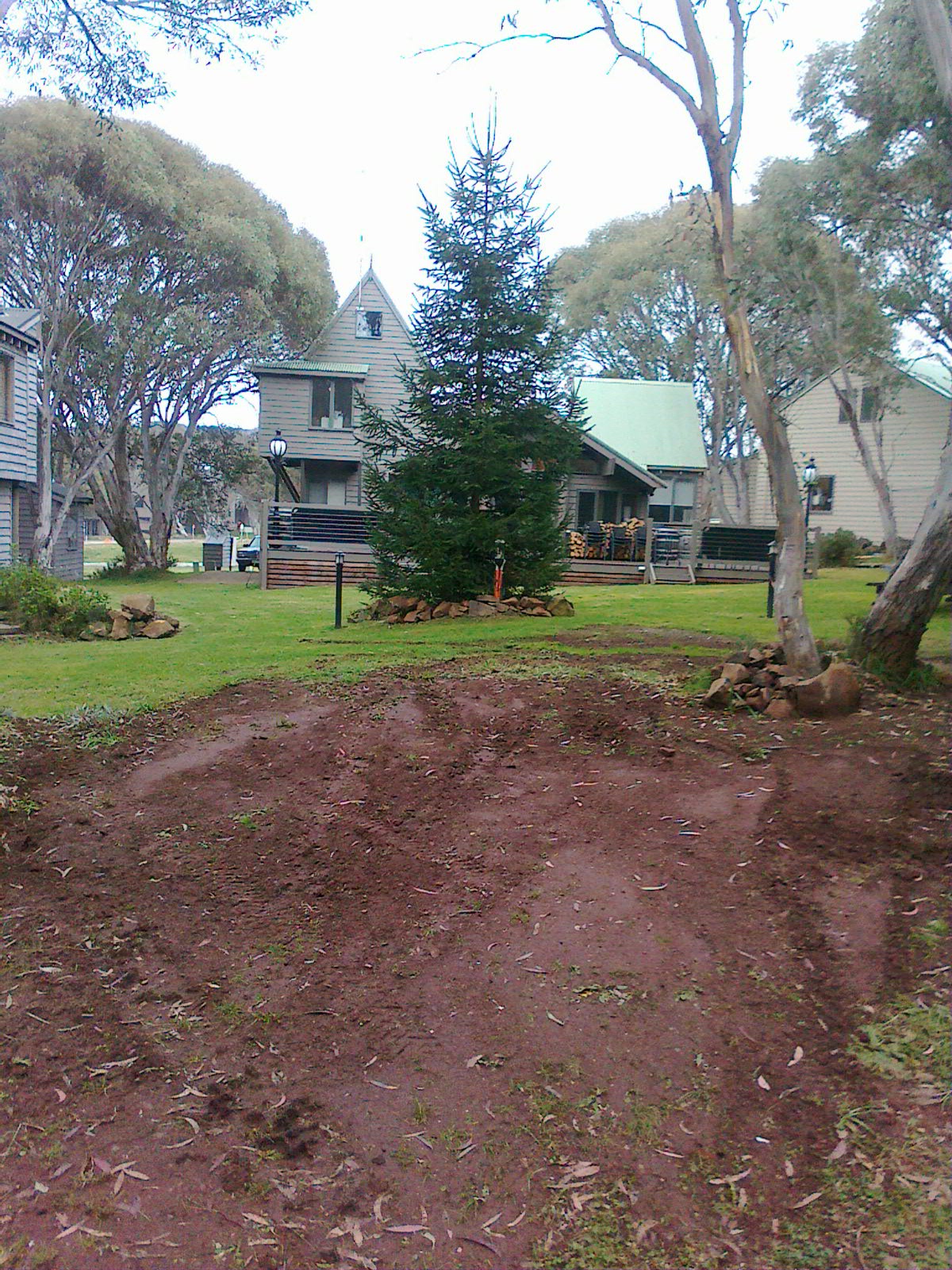
Alphutte at Dinner Plain: bare earth where native veg existed. Introduced tree in background.
Guidelines require people to use indigenous species where they are putting in plants (Council guidelines say ‘only indigenous plant material can be used at Dinner Plain’), and lack of fencing has meant that small pockets of remnant understory also exist between houses. This enhances the feeling of still being in a forest.
However, Dinner Plain could be a very different place in coming years.
There is a disturbing ‘suburban creep’ that is evident, with a reasonable number of land owners now opting to destroy their remnant ground storey species and replace them with lawns.
In one obvious example of this, the people who run the Alphutte pizza restaurant recently completely removed all the remaining remnant understorey at the back of their block.
In spite of the fact that local indigenous species are meant to be planted at DP, Alphutte flout this law and have a large conifer growing as well.
While this was just a small patch of shrubs and flowers, if everyone at Dinner Plain destroyed their remnant vegetation and replaced it with lawn, and planted exotic (and potentially invasive) species on their land, the place would look profoundly different. There would also be substantial loss of biodiversity within the village itself. Dinner Plain is a small enclave of private housing within the Alpine National park, and weed invasion into the park is an obvious and, sadly, growing problem.
Often, these people retain most of the older snow gums on their properties yet don’t seem to understand (or care) that mature trees have to come from seedlings, meaning young trees must be put in to allow them to replace older trees when they do eventually die. The ‘clear the scrub and plant grass’ mentality and absence of new trees being planted will see a profoundly different village in coming years.
If poor environmental management upsets you, you may want to avoid Alphutte the next time you’re in Dinner Plain.
You might want to support Mountain Kitchen, which stocks local indigenous plant species.
Thankfully, the majority of people do seem to appreciate the remarkable landscape they are staying or living in, and do the right thing at Dinner Plain, by protecting or even replacing indigenous species.
 In his second installment of writing from the Victorian Alps, artist Ben Laycock sends his greetings from the exclusive enclave of ‘Dinner Plane’.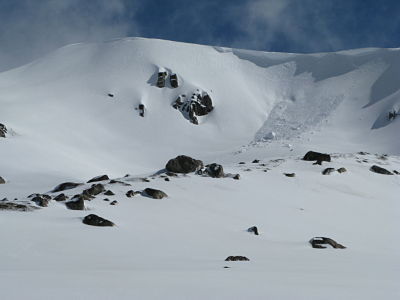




Recent Comments