Search

Mountain Journal

Environment, news, culture from the Australian Alps

Housing development in Bright facing strong community opposition

Many regional areas are in danger of being ‘developed to death’ as people move from major cities, seeking a Tree or Sea Change. From coastal areas like the Bellarine Peninsula to the Otways, to valley towns in north eastern Victoria, people are flocking to regional centres close to attractive places. The covid lockdowns allowed many people to transition to online work, which has further driven the trend towards relocating in regional areas. This is, of course, causing many problems as farmland and remnant vegetation is swallowed up (usually by low density sprawl), with growing demands for water supplies and waste treatment, and growing impacts on local community services like healthcare and schools.

This is playing out in many areas, including Bright in north eastern Victoria.

Continue reading “Housing development in Bright facing strong community opposition”

What are your mountain icons?

Recently I was enjoying an evening hanging out at Bluff Spur hut on Mt Stirling. The 9 folks there had long and interesting yarns and, as is usual in a backcountry hut, many of the chats often focused on the adventures we have enjoyed in the mountains.

A common theme was favourite places, and favourite people and at some point Bill Barker, head of ski patrol at Mt Hotham, came up and we agreed he was a living legend. We discussed our favourite huts (King Saddle, Cleve Cole and Vallejo Ganter), favourite mountains (Feathertop, Bogong), and favourite camping spots (well that would have to be a secret).

I got an idea for Mountain Journal magazine #4. What are the icons of the mountains we love? What people, what places, what forests, what institutions? I am hoping you will feel inspired to write a brief piece on your favourite mountain icon, for publishing on the website and (later on) in the next edition of the magazine.

An Icon is

‘A person or thing widely admired especially for having great influence or significance in a particular sphere’.

It might be a person who inspires you, a place, a mountain hut, a river, a business or other institution.

Continue reading “What are your mountain icons?”

POW highlights threat to climate data

Anyone who is paying attention to the state of our winters knows that they are getting more erratic. Often they start later (it’s now a rare thing to ski on natural snow on opening weekend) and winter snow is subject to more rain events, with big impacts on snow pack. While our climatic patterns go through natural wetter and drier cycles, climate science tells us that these patterns will become more extreme, with less overall snow and shorter seasons over time.

While all resorts track snowfall, the benchmark of snowfall in Australia over time comes from Spencers Creek, at a site at 1,800 metres above sea level, in the Main Range of the Snowy Mountains.

The area is midway between Perisher Valley and Thredbo, and has been visited by weather observers every week during winter since the mid-1950s, when the Snowy Hydro scheme was being constructed. The information collected by Snowy Hydro provides our best snapshot of snow pack over time. Sadly the data shows that snowpack has been in decline since 1957.

Now Protect our Winters (POW) has discovered that the frequency of data collection at Spencers Creek has decreased in recent years.

Continue reading “POW highlights threat to climate data”

Treeline rising in the alpine zones due to climate change

If you are a regular reader of Mountain Journal, you will know that I bang on endlessly about climate change impacts on the mountains: more intense fire regimes impacting snow gums and alpine ash forests, declining snow pack, longer droughts and all the rest of it. I probably don’t spend enough time looking at what is happening in the true alpine zones above the tree line.

New research from Griffith University researchers outlines how alpine habitat is responding to climate change and bushfires.

Griffith Environmental Futures Institute Research Fellow Dr Brodie Verrall said the alpine area in the Main Range of the Snowy Mountains was mapped to observe and analyse the changes resulting from the warming climate between 1990 to 2000, 2010, and 2020.

“Ultimately, warmer temperatures, longer growing seasons, declining snow cover and variable precipitation regimes have resulted in the rapid expansion of the woody vegetation,” Dr Verrall said.

Continue reading “Treeline rising in the alpine zones due to climate change”

Gunaikurnai to jointly manage Baw Baw, Alpine and other high country parks

On 26 October 2018 the Victorian Government, the Taungurung Land and Waters Council Aboriginal Corporation (TLaWCAC), and the Taungurung Traditional Owner group signed a number of agreements under the Traditional Owner Settlement Act 2010 (Vic), which means that ownership of nine Victorian parks and reserves, including Mt Buffalo National Park and a section of the Alpine National Park, and up to five ‘surplus’ public land parcels have been transferred to the Taungurung Traditional Owner Group.

It should be noted that there is an ongoing territorial dispute between the Taungurung people and clans that identify as Ngurai Illum Wurrung, Waywurru and Dhudhuroa, and has the potential to affect the state’s treaty negotiations. This impacts the agreement in the east of the area, which includes Mt Buffalo and the Alpine national park.

It has now been announced that Gunaikurnai Land and Waters Aboriginal Corporation (GLaWAC) has been ‘re-negotiat(ing) the Gunaikurnai Recognition Settlement Agreement with the State of Victoria’, and ‘we’re excited by the addition of four new joint managed parks as part of our Early Outcomes package’.

Continue reading “Gunaikurnai to jointly manage Baw Baw, Alpine and other high country parks”

Last minute threat to the Little Dargo, Mt Wills and other mountain forests

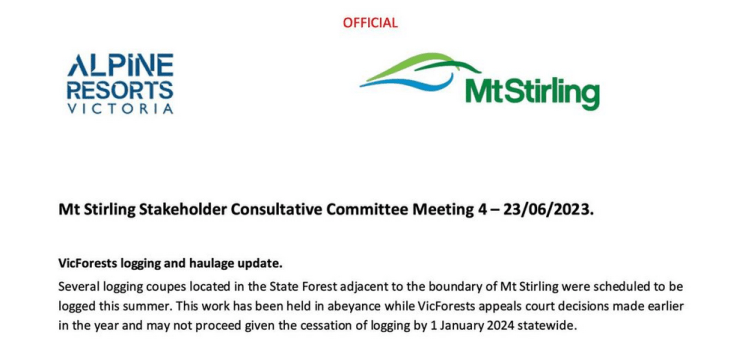
The recent announcement that native forest logging will end in eastern Victoria on January 1, 2024 is great news for the forests of the high country.

We wrote a brief piece explaining the implications of the announcement here.

As we noted in that story, this means the state will be spared another six years of intensive logging and allow us to start the generations long work of restoring a landscape that has been deeply impacted by intensive logging and repeat fires in recent decades.

However, the state logging agency VicForests has just released an updated Timber Release Plan (TRP) which has many coupes in the high country and north east which could be logged before the January 1 cutoff date.

Continue reading “Last minute threat to the Little Dargo, Mt Wills and other mountain forests”

“Ecological collapse is likely to start sooner than previously expected”

The Guardian recently reported that ecological collapse is likely to start sooner than previously expected, according to a new study that models how tipping points can amplify and accelerate one another.

Based on these findings, the authors warn that more than a fifth of ecosystems worldwide, including the Amazon rainforest, are at risk of a catastrophic breakdown within a human lifetime.

“It could happen very soon,” said Prof Simon Willcock of Rothamsted Research, who co-led the study. “We could realistically be the last generation to see the Amazon.”

The research was published on Thursday in Nature Sustainability.

Here in Australia we are starting to witness tipping points, where specific ecosystems are being pushed beyond their capacity to recover from impacts like fire, then experiencing ecological collapse whereby an existing system – for instance an alpine ash forest – collapses and is replaced by something else (in the case of alpine ash it might be a mix of grass and shrubs).

Continue reading ““Ecological collapse is likely to start sooner than previously expected””

Swiss approve net-zero climate law

Switzerland’s famed mountains are at extreme risk from climate change. Just in the last week, a ‘huge chunk’ of the summit of Fluchthorn (also known as Piz Fenga) collapsed. The 3,399m mountain lies in the Silvretta Alps on the border between Austria and Switzerland. Thousands of tons of rock fell because of thawing permafrost.

Now, Swiss voters have backed a new law that seeks to accelerate the country’s shift from fossil fuels to renewable energies and reach zero emissions by 2050. In all, 59.1% of voters approved the government’s Climate and Innovation law.

Continue reading “Swiss approve net-zero climate law”

A zip line on kunanyi/ Mt Wellington?

Tasmania/ lutruwita is blessed with hundreds of mountains and mountain ranges (the ‘Abels’). Although generally lower than the high country of south eastern Australia, they tend towards the rocky and sheer, and many have wonderful summits. Some, like Frenchmans Cap, Federation Peak and Mt Geryon, are impressive rocky mountains. But sadly, successive state governments and developers have spent years obsessing over building things on many mountain tops.

From the long campaign to halt a cable car up the main face of kunanyi/ Mt Wellington, to the proposal for a Gondola up along Cradle Valley to Dove Lake and the short lived idea of constructing a cable car up Mt Roland, the mountaintops have long been an allure to those who want to convert beauty into profit. There are even plans for a cable car up Mt Owen, on the west coast.

Now, a tourism ‘entrepreneur’ wants to build what he says would be “the longest, fastest and highest zip-line in the Asia-Pacific” on the mid slopes of kunanyi/ Mt Wellington. 

Continue reading “A zip line on kunanyi/ Mt Wellington?”

Winter Kick-Off with ‘Steep Reflections’

There will be a series of screenings of the new Australian backcountry film STEEP REFLECTIONS, happening across a number of towns and resorts in June.

With a warming climate, there is growing concern for the future of snowsports in the Kosciuszko National Park. STEEP REFLECTIONS aims to change your perspective on the Australian backcountry, and create greater awareness around the importance of both mountain safety and our environmental footprint. Follow local guides and freeriders as they showcase the hidden beauty of the Snowy Mountains, taking you to the highest peaks and the steepest slopes, whilst uncovering the harsh reality our winters face if we don’t act now.

Continue reading “Winter Kick-Off with ‘Steep Reflections’”

Road tripping close to home

I spent May on a slow roadtrip from the northern Snowy Mountains to Mt Hotham. Lots of days out of the car – camping, walking, doing a few overnighters – including a quick trip into Mt Jagungal. I arrived in the mountains as the early May snowfalls started to settle and was blessed with more than 2 weeks of bluebird skies, with remnant snow on the higher peaks, frosty mornings (-4 to -8oC in the northern Snowies) and absolute silence. I think in the first week I spoke with three people, and had most campsites to myself.

It was wonderful to get reacquainted with the long, glorious snow plains and intact forests of the northern Snowies, the wonderful higher alpine zones of the central Snowies (that area from Kiandra to the Schlink Pass) and back in my usual stomping grounds of the Main Range (with the obligatory camp at Island Bend).

Continue reading “Road tripping close to home”

Extreme logging in the Upper Ovens

In March, Friends of the Earth (FoE) campaigners visited north eastern Victoria as part of a longer trip highlighting threats to the landscapes of the high country. While we were focused on the threat posed to native forests by logging, locals in the Upper Ovens wanted to show us some of the current harvesting of pine plantations in the area.

While pine (Pinus radiata) plantations have been located across the north east for decades, and provide valuable timber and local employment, the logging practices in many instances are appalling. This led to FoE making a series of recommendations to the land manager, Hancocks Plantations Victoria (HVP), about how to reduce the environmental impacts of future harvesting.

Continue reading “Extreme logging in the Upper Ovens”

Blog at WordPress.com.

Up ↑