Search

Mountain Journal

Environment, news, culture from the Australian Alps

Increased bushfire risk the New Normal

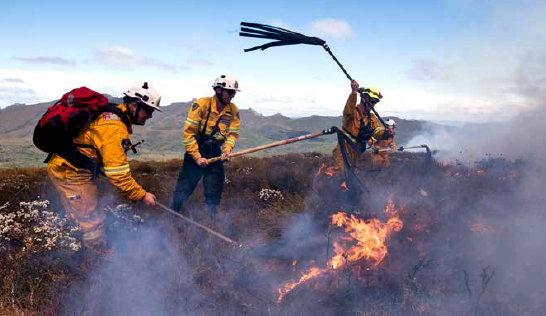
Australian summers are getting drier and hotter as the Earth’s temperature rises and this is leading to longer and more intense bushfire seasons. On the mainland, we are seeing more frequent fires in the mountains – for instance, in the Mt Hotham area we have seen three serious fires in less than 15 years, which has devastated huge areas of snow gum and alpine ash forests. Snow gum forests are changing under the onslaught of more frequent fire regimes.

In Tasmania, huge fires burnt across Tasmania for months last summer, threatening fire sensitive communities. More than 100,000 hectares were burnt in Victoria. As is becoming increasingly obvious, this is the ‘new normal’. This has implications for landscapes and water supplies, how we manage fires, and how we live in the landscape. This is happening in forests around the world, and people who have traditionally lived in forested areas are having to re-assess how they can do this safely in a time of heightened fire risk.

Continue reading “Increased bushfire risk the New Normal”

High Plains Festival

Falls Creek Cross Country are excited to announce the first High Plains Festival!

It will happen over the weekend of August 31/ September 1, operating from the Centre at Windy Corner in Falls Creek resort.

LEARN NEW SKILLS – TOUR – MAKE TURNS

Continue reading “High Plains Festival”

NSW fails to remove horses from Kosciuszko National Park (again)

Like climate change, conservatives are using land management policy as another proxy battlefield in the Culture War.

This is amply demonstrated by the decision by the NSW government to legislate to protect wild horses, a feral species that causes immense damage to the High Country, on the basis of their ‘cultural’ significance. As expected, horse numbers continue to grow in the Kosciuszko National Park and threaten the ecological values of the park. While there had been high hopes that common sense would prevail when Matt Kean, was appointed as the NSW Energy and Environment Minister, attempts to reduce numbers through relocation have failed to be enacted by the state government.

Peter Hannam, writing in the Sydney Morning Herald, provides an update on the situation.

Continue reading “NSW fails to remove horses from Kosciuszko National Park (again)”

The Australian Alps Walking Track in winter

Mark Oates has made some great backcountry films. The following is an update about his most recent winter traverse of the Australian Alps Walking Track, which he did with his brother last winter. He will be uploading a ‘snap shot’ video of each day of the trip, starting today. Check the link for a daily update of mountain goodness.

Continue reading “The Australian Alps Walking Track in winter”

Climate change threatens Melbourne’s water and mountain ash forests

The Central Highlands to the east of Melbourne are home to incredible stands of Mountain Ash (Eucalyptus regnans). They are valuable in their own right and also offer space, quiet, recreation, and are a home to a wealth of animal species. The catchments of the Central Highlands also provide much of Melbourne’s drinking water.

According to new research, Melbourne faces a rising threat to it’s water supplies from climate change as higher temperatures diminish inflows while pushing up demand.

A paper published by Environment Research Letters shows a “substantially” amplified risk for Melbourne’s water availability if global temperatures rise 2 degrees above pre-industrial levels rather than the 1.5-degree target set by the Paris climate agreement.

Continue reading “Climate change threatens Melbourne’s water and mountain ash forests”

Victorian public wants to see forests protected

Results of a public survey conducted by the Victorian government show overwhelming support for protecting native forests from logging, and provide the Andrews Labor government with a strong platform to protect forests and transition jobs out of the native forest logging sector, say environment groups.

The survey shows that:

  • The public think that the future of industry is in plantations
  • Victorians support protecting forests and improved forest recreation opportunities
  • Results show no need to continue with the failed Regional Forest Agreements

Continue reading “Victorian public wants to see forests protected”

How has Tasmania’s climate changed?

Climate change is already affecting the landscape of Tasmania through more intense fire seasons. This threatens species like the Pencil Pine. In the last few decades, there has been an increase in fires caused by dry lightning strikes, and this has been impacting on vegetation types that are not fire adapted.

A recent review of how much climate change has already impacted on Tasmania highlights how broad these effects are on the landscape.

Erin Cooper, writing for the ABC, identified the following impacts that are being felt in mountain areas.

Continue reading “How has Tasmania’s climate changed?”

The ultimate backcountry festival guide

The second Victorian backcountry festival will happen at Mt Hotham over the weekend of September 7 and 8.

Here is a summary of what’s happening:

Highlights of the program

  • Meet at 8.30am on Saturday morning, upstairs at The General Store (just next to the Big D lift) for the festival opening.
  • Most tours start Saturday am.
  • Speaker’s program will run Upstairs at The General Store from 12 noon – 4pm. Great line up of speakers.
  • The outdoor bar will happen from 4 – 6pm on the Saturday, straight after the conclusion of the speakers program.
  • Kick on Saturday night at Blizzard Brewery at Dinner Plain.
  • Tours continue on Sunday.
  • Finish the weekend with a Protect Our Winters info night and films at The Bird in Hotham Central on sunday night.

[Full details are in the program, see below]

For details on tours that have just been offered, please check here.

Continue reading “The ultimate backcountry festival guide”

In praise of the Home Range


We all know that air travel has a huge environmental impact. Taking a long-haul flight generates more carbon emissions than the average person in dozens of countries around the world produces in a whole year. As a keen skier and walker I love an overseas adventure as much as the next addict. But having done lots of overseas trips I figure I’ve consumed well beyond a fair share of carbon, and try to stick close to home for my adventures nowadays (despite falling off the wagon and visiting Colorado a couple of times in recent years).

There is, of course, the allure of skiing new mountains (and the fantastic snow that comes with higher altitude and latitude, and grander terrain) but there is also the allure of staying at home, of deepening connection with the local hills and valleys. Even here in the south east, there is lifetimes worth of terrain to walk and big patches to ski and ride. Factor in Tasmania, and you have several lifetimes worth. I’m still yet to make it into the Cobberas in winter, am long overdue for another visit to the ‘interior’ ranges of the Howitt Plains and Mt Clear in the central Victorian Alps, or walk the Overland Track in peak snow conditions.

Continue reading “In praise of the Home Range”

New ‘iconic’ walk with private huts planned for Tasmania’s Tyndall Range

Tasmanian premier Will Hodgman has announced that ‘Tasmania’s wild West Coast has been chosen as the preferred location for our Next Iconic Walk’.

The area selected is the remote and wild Tyndall Range. This ‘iconic walk’ will be similar to the Overland and Three Capes Tracks, where private hut networks have been built. The Range is known for its rock climbing on conglomerate cliffs up to 300m in height, glacial lakes and alpine areas and ‘out of the way’ nature.

The government says “A signature Liberal election commitment, up to $20 million will be invested to deliver our next iconic multi-day, hut-based walk which will enhance the visitor economy throughout the entire region”. According to the proponent, the proposal includes the option of “a private walking company .. investing in the development of private lodges similar to that of Three Capes Track”.

Continue reading “New ‘iconic’ walk with private huts planned for Tasmania’s Tyndall Range”

Snow gum die back linked to climate change

Many people know the story of the Pine beetle which has been devastating huge areas of forest across North America because of climate change.

In brief, the mountain pine beetle’s ability to survive and multiply rapidly is highly sensitive to temperature and precipitation. Warmer average temperatures allow pine beetles to complete their life cycle in just one year instead of two. Rising minimum temperatures in the Colorado Rockies have allowed more beetles to survive the winter and from 2009 to 2010, mountain pine beetle activity increased more than 10-fold, infesting 200,000 acres (80,000 hectares) on the Front Range, and killing off millions of hectares of trees in North America.

There is a similar scenario emerging in Australia’s mountain forests, although it is much less known.

Snow gums are experiencing dieback in Kosciuszko National Park, largely because of the impacts of the native longicorn (or ‘longhorn’) beetle. These beetles prefer to lay their eggs on moisture-stressed trees and, in warmer weather, the longicorn beetle can hatch and grow up to 75% faster.

According to work published in the Resort Roundup winter 2019 edition (produced by the NSW government), ‘reduced snowfall, high summer temperatures such as January 2019 where temperatures at Thredbo top station were 4.4oC above average, and a reduction in autumn rainfall mean that snow gums are under much greater moisture stress than in the past.’ This means that larger beetle populations are causing more frequent dieback of some snow gum trees.

So far, impacts seem to be limited to areas in the Snowy Mountains among two distinct subspecies of snow gum – in the Guthega and Perisher areas and parts of Thredbo. The main species affected is Eucalyptus niphophila. Additionally, the population of Weeping snow gum Eucalyptus lacrimans in the Long Plain area appears to be significantly impacted by longicorn beetle. At this point it does not seem that the infestation is affecting the widespread E. pauciflora subsp. pauciflora.

Apart from the visual and ecological impacts of losing these important trees, increased dieback will lead to an increase in fire risk in alpine resorts and other areas within Kosciuszko National Park. With increasing climate change, it is expected that the longhorn beetle will continue to increase in numbers and therefore its associated impacts on snow gums will also become more extensive.

This is yet another compelling reason for us to be taking serious action to respond to climate change!

Continue reading “Snow gum die back linked to climate change”

Photographs by David Rosendale

Photographer David Rosendale returns to exhibit at Falls Creek with selected prints from his year long study of seasonal change, “The Fall”, with new and unreleased works spanning the years 2016 – 2019.

This Exhibition represents work produced whilst Artist in Residence at Falls Creek in 2017 and beyond, a perpetual commitment and study of the Victorian Alpine landscape.

The exhibition runs from 23 – 25 August 2019.

Continue reading “Photographs by David Rosendale”

Blog at WordPress.com.

Up ↑