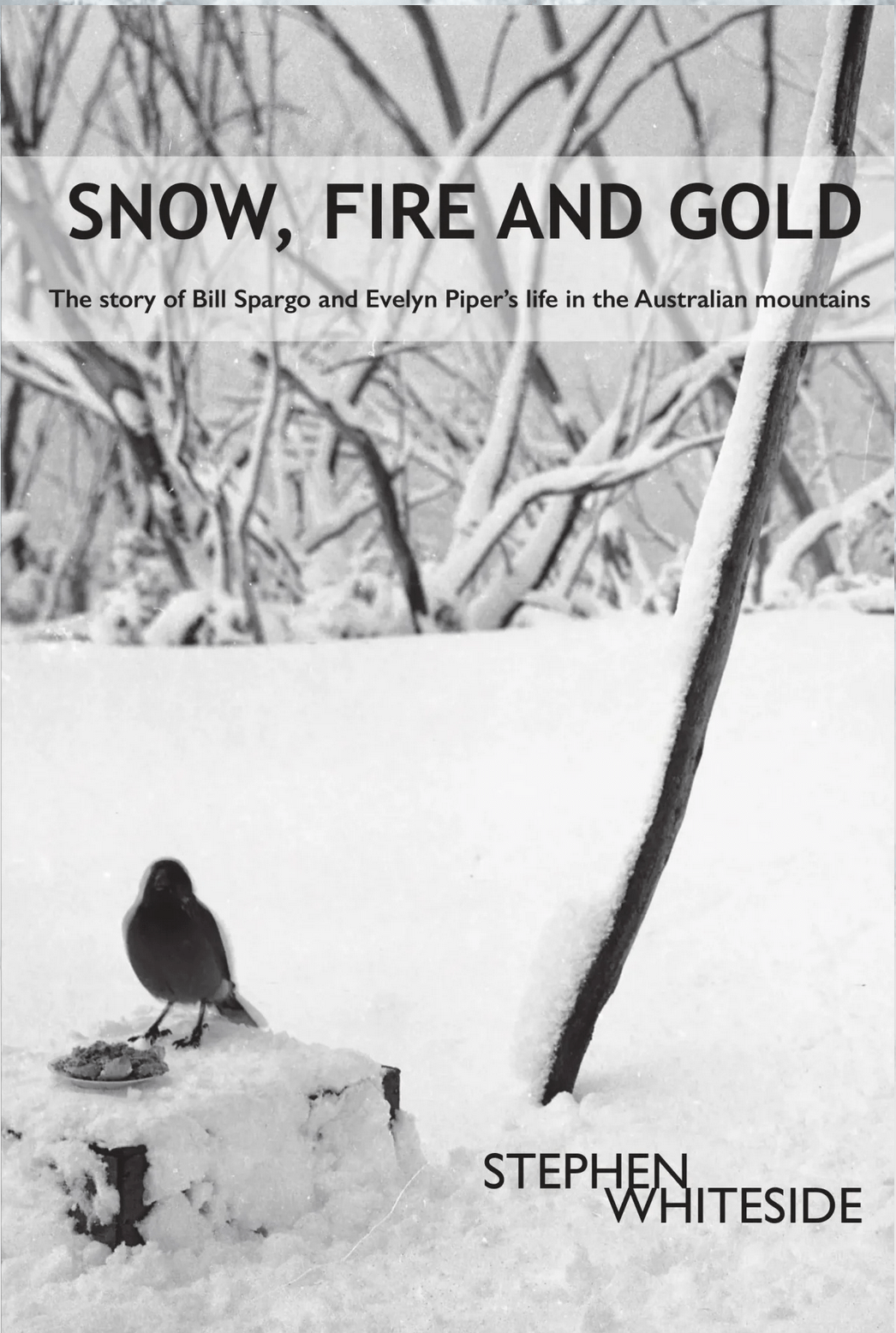
We often see mountain environments as being wilderness: remote and wild country with few signs of human impact or habitation. But, of course, the mountains are a peopled landscape, rich in memory, history and personal stories. Many First Nations stories are now gone, lost with the people who were murdered or displaced. The cattle grazing families who followed occupation tend to dominate popular culture when it comes to the mountains, and most of the others barely get a mention. But there were generations of explorers, miners, loggers, skiers and hikers, hydro workers and road builders, people who built the ski resorts or managed to farm in the higher areas who have also left rich stories. Snow, Fire and Gold is a wonderful book about Bill Spargo and Evelyn Piper and their long connection to each other and the mountains around Hotham.
One obvious sign of the human story of the Alps are the huts that dot the landscape. These include old cattle family huts, cabins attached to fire towers, huts connected with government agencies, the hydro schemes, recreation groups, or public infrastructure. They all tell a story of what happened before, or about our enduring connection to place. A rare few hold cultural treasures that speak to other times – the informal museum in the hut at Twilight Tarn in Mt Field national park in lutruwita/ Tasmania is one that comes to mind. Most of these huts were seasonal residences or provided short term shelter for workers or travellers. A rare few were long term homes for people. Spargos is one of these.
Spargos hut survives and has a strong resonance for the Mt Hotham community. You can see it from parts of the ski village and it is just enough of a walk from the road to be considered a ‘destination’, as opposed to huts like the one at JB Plain or Diamantina, which are easily visited due to the proximity to a road. It is much loved, accessible via walking tracks that give a nod to the now forgotten mining days around Hotham, or the more recent pole lines that mark the non commercial era of walking and cross country skiing.
The hut sits on an open plain, which sits on a bench like spur, protected from some weather by the higher mountains to the south west. But it can still be a wild, wind-swept and lonely place. It is hard to believe that this was not just a hut that saw seasonal use. Rather it was a home built to support mining activities, and was the abode of Bill Spargo for many years.
We have a small but significant genre of mountain literature here in Australia, and the book Snow, Fire and Gold by Stephen Whiteside is a good addition to this library.
Obviously a labour of love by the author, Stephen Whiteside, the book delves into the backstory of Bill and his long term friend and companion Evelyn Piper. Bill managed the Hotham Heights Chalet during the early days of skiing in Victoria, and hosted the first National Skiing races and he created the Varsity Drag ski run. Evelyn, who had found herself far from her home in England following the death of her husband from wounds he sustained in the First World War, was offered a job at the Chalet. Bill became a well known figure in Victoria because of his deep connection to Hotham as skiing developed as a popular new sport, and his photos and stories which were published in the Sun (and then Herald) newspapers because of his friendship with Keith Murdoch.
In those days the Victorian Railways wanted to control the skiing industry (they ran the famous chalet on the Buffalo Plateau for many years). And after a falling out over the management of the lodge, and a failed attempt in 1932 to acquire a parcel of land by Swindlers Creek below Hotham, he set his sights on the possibility of mining on the Little Plains and hence the need for a hut out there. Built by hand this became the famed Spargos hut. Roofing iron and other materials that couldn’t be built on site were brought in from Hotham via horse and then on foot. He hoped that the Brandy Creek lead, which contained gold, continued into the area of Little Plain. He tried to grow food up there, experimented with indigenous plants to see what ones were edible, and endlessly plodded away in the hope of finding that elusive gold. Eventually he got lucky over at the Red Robin mine.
After he had left, the Chalet burnt down in the fires of 1939. As the fire made a run at him while he was out prospecting on Little Plain, Bill spotted a gap in the flames and ran through onto blackened ground. He then returned to his hut and managed to stop if from burning, largely due to the water available from the nearby spring. After the fire, Bill was the only resident remaining in the Hotham area, and as Bill put it, the landscape looked more like ‘Arabia than the Australian Alps’.
Bill was an enigmatic character, a loner who clearly loved the freedom of the mountains, and a man with deep pride and a sense of self reliance. Eventually he and Evelyn were invited back by the people who were managing the Hotham Chalet (the Goldsworthys) because they were so skilled at running the place and knew the area so well. This was during the hard years of the Depression when work was scarce. Life must have been incredibly hard. When a boiler at the Chalet that warmed the water broke, a replacement had to be brought in from Cobungra. They hauled it up the mountain until the snow became too deep for the horses, and the boiler was then transferred onto a sled and then dragged to the Chalet by a group of men.
Originally from Brunswick in Melbourne, Bill’s yearning for a wilder life led him to the mountains around Hotham. Evelyn had sent her son Stephen back to England to be raised by her parents, and they were reunited six years later. She returned to England but in 1946 she came back to Australia and her and Bill were married in West Melbourne before retreating back to the mountains. It is hard to imagine how slow and deliberate, and how hard their lives must have been, high up in one the most beautiful landscapes in Australia.
—
You can purchase the book from this website. There are many wonderful photos from Bill and Evelyn’s life in the mountains and a wealth of research materials on the website.
https://snowfireandgold.com.au/
Stephen Whiteside (2024), Snow, Fire and Gold. The story of Bill Spargo and Evelyn Piper’s life in the Australian Mountains. Busybird Publishing.




 Mountain Journal
Recent Comments