Search

Mountain Journal

Environment, news, culture from the Australian Alps

Tag

national parks

Alpine Researchers honoured for contributions to parks

This is from a few weeks ago, but is good acknowledgement of the efforts of researchers working to remove Hawkweed and control willows on the Bogong High Plains. Thanks to David Turner for spotting this one.

The release below is from Parks Victoria.
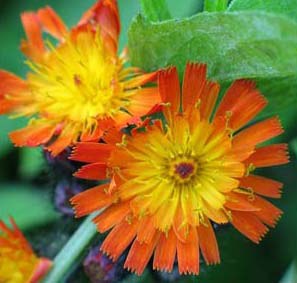
orange_hawkweedTwo Victorian researchers have been recognised for their outstanding contribution to managing highly invasive weeds in Victoria’s Alpine National Park.

Parks Victoria Chief Executive Dr Bill Jackson today acknowledged The University of Melbourne’s Dr Nick Williams, and Dr Joslin Moore from Monash University, as joint recipients of Parks Victoria’s inaugural Nancy Millis Science in Parks Award.

Dr Jackson said the award was being presented to the two researchers for their outstanding contribution to fostering excellence in applied science for the benefit of park management.

“Both projects demonstrated the researchers’ strong willingness to work closely with park managers to understand the extent and challenge of the weed problems. They also demonstrated leading edge science in solving difficult problems.”

“The work of Dr Williams and his team from The University of Melbourne has helped to protect the Alpine National Park’s biodiversity and transformed hawkweed control into a cutting edge and targeted program. This research partnership between Parks Victoria and Department of Environment and Primary Industries staff has significantly reduced Hawkweeds in the Alpine National Park, and the goal of eradicating it altogether is now a real possibility.”

“Dr William’s research and the work being done by all the partners on this project also benefits private landowners as hawkweeds have the potential to invade agricultural land and significantly affect agricultural production.”

Dr Jackson said Dr Joslin Moore and her team had achieved great results in controlling willow on the Bogong High Plains and as a result has had a major impact in protecting the Bogong High Plains environment.

“Willows are highly invasive and following the 2003 fires began germinating in large numbers. This posed a significant threat to an area within the Alpine National Park that is particularly important for its high biodiversity and landscape environment.

“As a result of a 7 year partnership with Parks Victoria, local Catchment Management Authorities and Falls Creek and Mt Hotham resorts, Dr Moore’s work has been fundamental in improving efforts to control willows on Bogong High Plains.”

Dr Jackson said both researchers had extensively documented their research in scientific publications, adding to the international body of work on effective methods of managing these extremely invasive weeds.

“I warmly congratulate Dr Williams and Dr Moore, and their teams who have contributed to this work, on making a real difference to managing invasive weeds in Victoria’s iconic Alpine landscapes.

“Caring for our parks is a complex task that involves many challenges including climate change, population increases and threats such as invasive pest plants and animals.

“We need innovative solutions and a good scientific understanding of how best to tackle these issues and how best to care for these important natural environments. Dr Williams and Dr Moore’s projects are part of Parks Victoria’s Research Partners Program that fosters collaborative applied research with universities and other research organisations.

The Nancy Millis Science in Parks Award

This award presented by Parks Victoria honours the late Professor Nancy Millis who was Chair of Parks Victoria’s Science and Management Effectiveness Advisory Committee since its inception 1997 and a member of Parks Victoria Board’s sub-committee on Environment.

more private development in Tasmanian World Heritage Area ?

As the Tasmanian and federal governments are being internationally criticised at the World Heritage Commission meeting in Doha over their attempt to de-list 74,000 hectares of forest from the Tasmanian World Heritage Area, a new threat to the integrity of Tasmania’s reserves has come to light.

A Tasmanian government website is calling for Expressions of Interest from investors w ho have “ideas (for development) in the Tasmanian Wilderness World Heritage Area as well as our National Parks and Reserves”.

It says the government wants to “unlock its natural areas to allow exciting new tourism experiences that are complemented by sensitive and appropriate tourism infrastructure”. In other words, more private development in conservation reserves.

Specifically, it says that the Government is looking for “developments which broaden the range of exciting and unique experiences on offer in our state by improving access for tourists while maintaining the integrity of our natural areas”.

It suggests that “sensible and appropriate” developments in the Wilderness World Heritage Area, National Parks and Reserves might include “resort-style accommodation. It might include walking tours, helicopter flights, mountain-bike riding, river cruises, new interpretative experiences or even luxury camping escapes”.

The Government is initially looking for ideas for the Tasmanian Wilderness World Heritage Area as well as our National Parks and Reserves. In the longer term it will consider other protected areas including Crown land and State Forests.

The first round for putting in an EOI is open until 21 November 2014.

With the anti-green agenda of the Tasmanian government it is very hard not to see this as a dangerous development which will undermine the ecological integrity of the reserve system.

The Greens have opposed this process. Greens’ Parks and Tourism spokesperson Nick McKim said in May that “the Liberals have an irrational and ideological desire for development at any cost, and they simply cannot be trusted to safeguard the natural and cultural values of Tasmania’s National Parks.”


challenge to alpine grazing

The following update comes from the Victorian National Parks Association.

Today we lodged papers in the Supreme Court of Victoria challenging the Napthine Government’s reintroduction of cattle grazing to the Alpine National Park.

The whole idea of national parks is to conserve nature for future generations, and for its own sake. These natural environments are irreplaceable – a gift to the present, and a legacy for the future.

But by insisting on putting cattle back into the Alpine National Park the Victorian Government is ignoring the intention of the law that established national parks.

Now that all other avenues of protecting the national park have been thwarted we have been forced to take legal action.

Both the state and federal governments have failed in their duty to protect the Alpine National Park.

This is a legal test case. No one has ever tried it before, so we can’t guarantee we will win.

But in our view there is no other option. We have to take this brave step.

Ensuring the integrity of national parks is an investment in the future. Whether we win or lose this legal test case, the idea and importance of national parks as a haven for people and nature must be defended.

To fight this campaign we need to raise money from visionary people in Victoria. We’re hoping you are one of those people.

This campaign is vital. It’s not just about stopping cattle, it’s also about putting a stop to all the other attempts to exploit and commercialise our national parks in ways that irreversibly damage them for future generations.

We have to take this legal action now.  In March this year, 60 cattle were rushed back into the Wonnangatta Valley, part of the heritage-listed Alpine National Park, by your government as part of a flawed fire management trial.

These ‘cattle grazing trials’ have been roundly criticised as flawed science that will contribute little, if anything, to our understanding of fire management. The evidence speaks for itself, you can read it on our website.

We have to stop them going back in again over the coming 2014-15 summer when more cattle (up to 300) will do even more damage!

The mountain cattlemen have clearly said they want to return cattle to the entire Alpine National Park, and that this ‘trial’ is just the starting point.

With a looming state election, the Napthine Government and the Labor opposition must clarify their policy on these ‘scientific’ cattle grazing trials.

Victorians have a right to know before the next state election if they are voting for a small-scale scientific trial, the full-scale return of cattle grazing to the Alpine National Park or for the exclusion of cattle from the park once and for all.

cattle back in Alpine national park. Ryan Smith’s legacy?

The Age is reporting that:

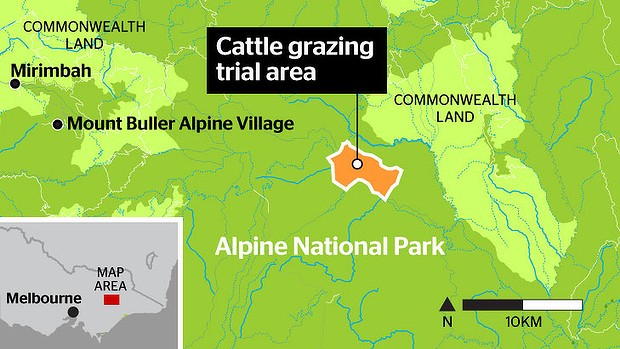
Image from The Age. Graphic: Jamie Brown

Cattle have returned to the Alpine National Park for the first time in three years, with animals released in recent days under the Napthine government’s grazing trial.

It is understood that a little under 60 cows were brought into the park either on Wednesday night or Thursday morning, marking the start of the program.

The move follows the state government getting approval for its grazing plans from federal Environment Minister Greg Hunt earlier this month. The state government says the trial will test whether cattle grazing lowers bushfire risk by reducing fuel loads.

As pointed out by Phil Ingamells of the Victorian National Parks Association:

“the trial was not science, rather a political promise to the cattlemen to protect their privileged grazing rights in the park”.

“Decades of evidence show how much grazing harms the park. But it does nothing to reduce grazing risk,” he said.

Read more in the article by Tom Arup here.

And background on the trial here.

Environmental policy in a time of climate change

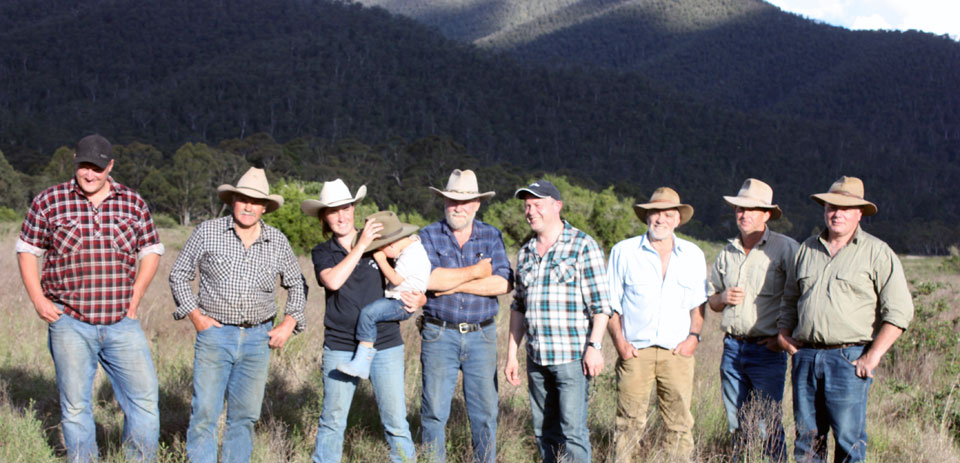
Environment Minister Ryan Smith with mountain cattle graziers, Wonnangatta Valley. source: MCAV

The state government has doggedly pursued this grazing trial since it came to power, and the environment minister Ryan Smith has been closely involved in efforts to get cattle back into the park. The first attempt was knocked back by the previous federal government. The current proposal has recently been approved by Coalition Minister Greg Hunt.

Victoria’s environment is in bad shape. Imagine how things could be improved if Mr Smith put as much effort into reducing Victoria’s contribution to climate change. Or protecting Mallacoota from the destructive development at Bastion Point. Or if he acted to protect the habitat of the endangered Leadbeaters Possum which is threatened by logging. Or … (insert any number of other issues here: for instance or check this list from Environment Victoria).

Sadly, he has instead overseen the demolition of the Victorian Climate Change Act. Development of renewable energy has basically stopped on his watch, which can only give benefit to the fossil fuel industry.

Meanwhile, he has pursued this project, widely described as being more about politics than land management.

Will he be remembered as the minister who turned his back on climate action and habitat protection, whose one legacy was to put cattle back into a national park?

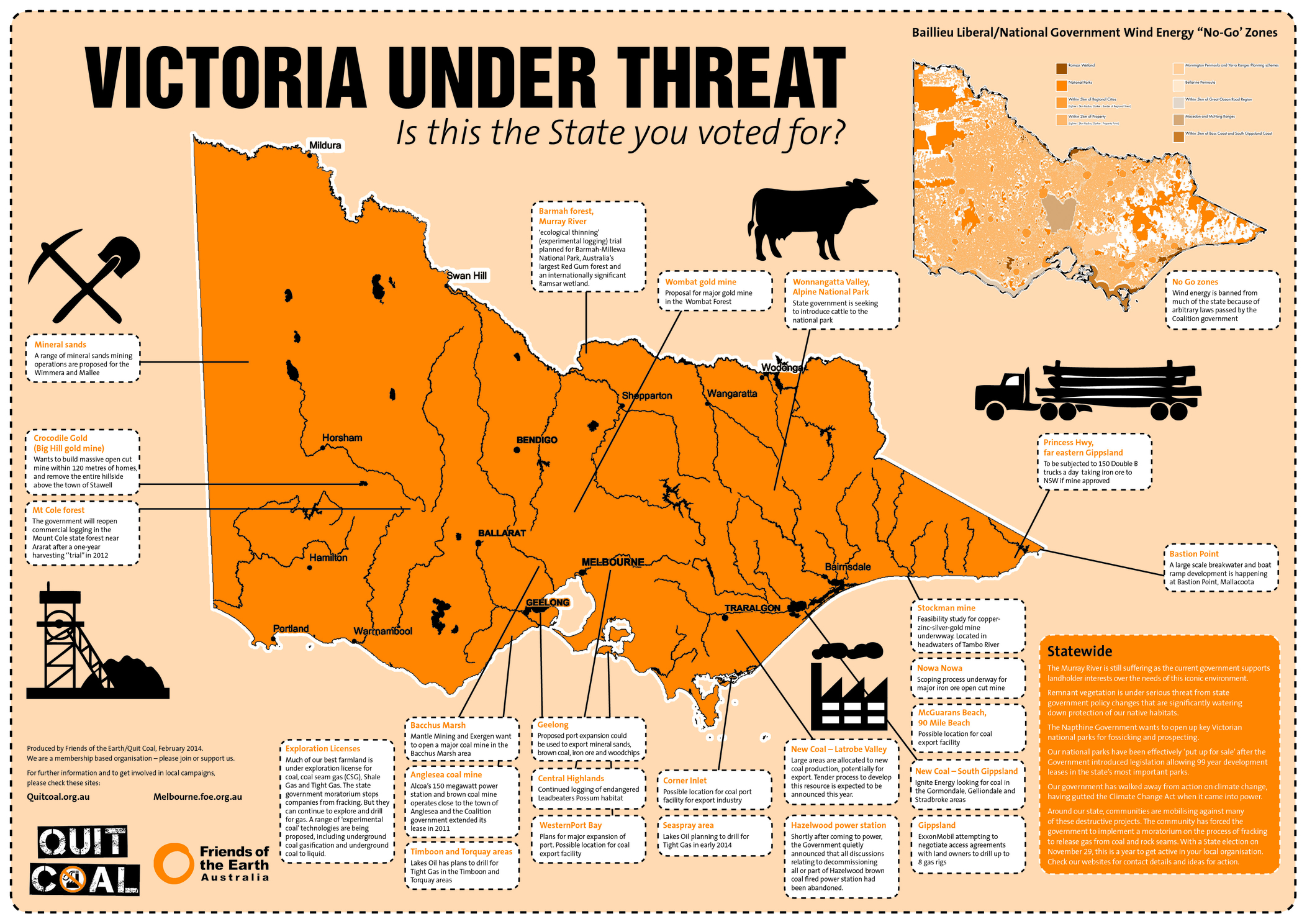
VIC map for web

Alpine grazing trial ‘will be a neat demonstration that cows eat grass’

The following update and call out comes from the Victorian National Parks Association.

There was also an interesting report on Bush Telegraph on ABC, with the following quote:

In a report titled Does Alpine grazing reduce blazing? A landscape test of a widely-held hypothesis. Dr Williams found ‘the use of domestic stock to mitigate fire extent and severity at landscape scale under conditions of extreme fire weather, is not justified on the basis of the current scientific understanding of fire behaviour, livestock behaviour and alpine vegetation dynamics.’

Dr Williams says there is no justification for the current trial.

‘It has no scientific justification and the trial as it is set out has very little scientific credibility… it will be a neat demonstration that cows eat grass.

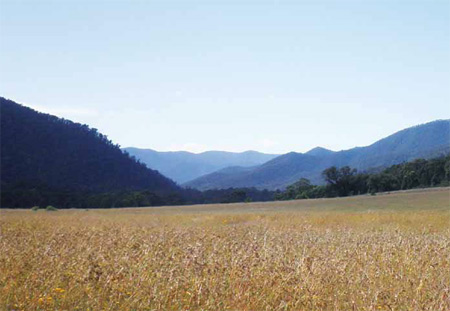
in the Wonnangatta, looking north

Don’t let Abbott & Co trash our parks

Today, Federal Environment Minister Greg Hunt approved the Victorian Government’s application to trial cattle grazing in the Wonnangatta Valley, part of the National Heritage-listed Alpine National Park.
In a needlessly rushed decision the minister has approved the return of 60 cattle for a few weeks before winter sets in as part of a larger three year trial involving up to 300 cattle.
Sixty cattle, grazing for a few weeks, is by no means a scientific experiment. The same thing can be easily done outside the national park, but this option was not even considered.
The VNPA along with many scientists and members of the community made detailed submissions arguing against the cattle grazing trial, but obviously they have all been ignored.
The so-called scientific trial is a farce, here are just some of the reasons why:
  • There is still no peer reviewed scientific design for the trial.
  • There has been no consideration of a location outside of the national park.
  • The application ignores the considerable scientific evidence that cattle grazing does not significantly reduce alpine fires.
  • More than 60 years of research shows cattle damage alpine wetlands and the headwaters of many rivers, threatening nationally-listed rare plants and animals.
  • The rushed decision means there will be no time to carry out on-ground surveys for threatened and rare species that could be affected by cattle grazing.
Wonnangatta Valley has been in the Alpine National Park for more than 20 years. National parks were created for the conservation of nature, not as cow paddocks for graziers who want to regain privileged access to the park.
The Victorian Government has now wasted more than $1 million of taxpayers’ money on this deeply flawed ‘science project’ to appease its cattlemen mates. 
It is three years since the Coalition first promised to get cattle into the Alpine National Park, but we are yet to see a peer-reviewed scientific design for the project, or be told if any scientists have put their name to the ‘scientific trial’.
The Abbott and Napthine governments seem hell bent on trashing national parks, even though they are cherished by most Australians and envied by the rest of the world.
It’s time to stand up and make some noise for national parks! 
You can help by: 
We love national parks – they should provide a safe and secure home for our natural heritage, our native plants and animals. We use them to walk, ride, camp and relax, but never should they be used as cow paddocks!

State decision on future of native forest timber industry expected soon

The following is taken from an article in the Herald Sun newspaper written by James Campbell.

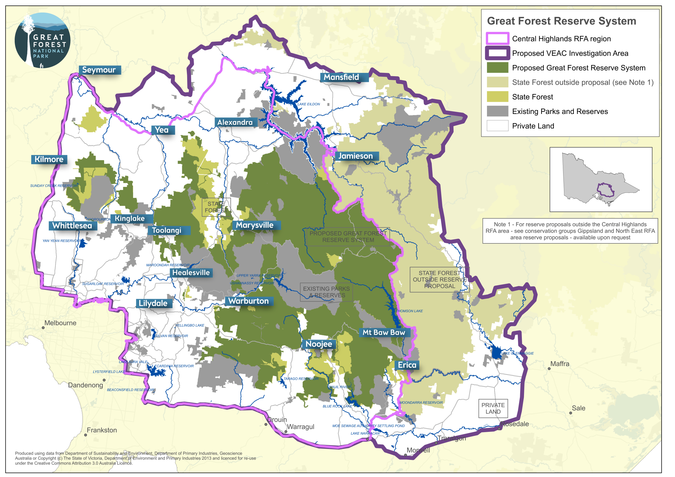
CH-Reserve-Proposal-01_articlefullwidth

In the next few weeks the State Government will make a decision which is likely to seal the fates of leadbeater’s possums and Victoria’s native forest timber industry.

Cabinet will soon consider a report from an advisory group which includes such possum-friendly folk as the boss of the Victorian Association of Forest Industries and representatives of VicForests, established to consider ways it can be saved “while maintaining a sustainable timber industry”. The report has gone to Environment Minister Ryan Smith and Agriculture Minister Peter Walsh. What it says, we’ll have to wait and see.

Government sources say that the two men take a different view of what should be done. Smith is believed to support the creation of a Central Highlands National Park to save the possum, while Walsh is prepared to accept a small area be set aside to save the timber industry. His line of argument with his colleagues is expected to be that this is a jobs issue, which in an election year should trump other considerations. The Government claims the industry employs 2300 people, but it is unclear how many of those jobs depend entirely on native forestry, rather than a mixture of native and plantation timber. The largest employer, with 900 jobs, is the Maryvale paper plant, which has indicated in the past it would be happy to shift to chips from plantations. VicForests itself only employs 114 people.

Normally, the smart money would be on “Walshie” to get his way. The Agriculture Minister has earned a reputation for winning internal battles. In a Smith vs. Walsh fight it would be no contest. The wildcard, though, is Treasurer Michael O’Brien and his department. O’Brien is unlikely to be impressed with an industry whose subsidies are retarding the growth of the private enterprise plantation industry. The possum may yet triumph over the loggers.

The full article can be read here.

For details on the proposed Great Forest National Park, check here.

The Herald Sun has some salient points about the finances around the economics of the native forest industry. Should the tax payer continue to subsidise the logging of our native forests potentially at the risk of losing the Leadbeaters Possum?. The article says:

As for VicForests financial statements, the best that can be said for them is that they are not as bad as they used to be.

(In the last year) its net profit was only $802,000 — which, while pretty dismal, is still better than the $96,000 it lost the year before.

VicForests hasn’t paid a dividend to the Victorian Treasury, i.e. the taxpayers, since 2007.

Indeed, it has only managed to pay a dividend twice since it was established in 2004. Across its eight years of existence it has reported an after-tax profit of only $12.3 million. But even that you can take with a grain of salt, as over the same period it has received government grants of $24.7 million.

VIC government opens more parks to prospecting

Prospectors get green light to search in national parks

The Age has reported that the state government has approved for new national parks. The following is an excert from an article by Tom Arup.

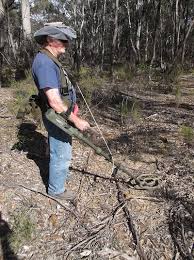
Five parts of the Alpine National Park, one area of the Lake Eildon National Park and two sections of the Lerderderg State Park will now be opened to recreational gold hunters who are often known as prospectors or fossickers.

The use of metal detectors and hand tools will be allowed, but the government has ruled out the use of more elaborate motorised devices sometimes used by prospectors.

A review of the environmental and cultural impact of the decision will occur after one year.

Phil Ingamells from the Victorian National Parks Association said national parks were there for nature, not for digging up.

prospecting”The government acknowledges that prospecting damages natural areas, so it is disappointing that the activity will be allowed in new areas in national parks,” he said.

The decision to open up new areas follows a Victorian Environmental Assessment Council investigation – commissioned by the government – of nine national and state parks to determine which would be most appropriate to allow prospectors access to.

While the council recommended the new areas adopted by the government on Tuesday, it warned in its final report there was clear evidence the practice could damage the natural values of national parks, especially rivers and creeks. It also said prospecting did not sit well with the purposes of national and states parks.

Read the full article by Tom Arup here.

Read background info here.

Job fears in Parks Victoria revamp

The following comes from The Weekly Times, journalist is Chris McLennan.

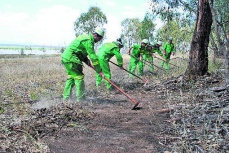
Image: DSE
Image: DSE

With government plans to introduce camping fees for staying in national parks (which will draw on Parks Victoria [PV] resources to manage), allow private development in parks, re introduce cattle into the Alpine national park, you do have to wonder about the common sense of this government. Add to this the threat of ever worse fire seasons, and these cut backs seem short sighted and potentially dangerous. Union officials say that more than 500 people, including firefighters, will be caught up in the proposed changes.

According to the union that represents PV workers,

Parks are slashing 10% of its workforce but exempt senior and managerial positions, and will target Ranger and Field Service Officer employees instead.  Parks will waste $8-$10million paying out retrenched employees trying to save $10-$15million.  It’s completely cost counterproductive.  Parks Victoria (currently) employs 1,100 staff at 100 national, state, marine and urban parks.

Job fears in Parks Victoria revamp

Parks Victoria staff face an anxious summer after a department-wide restructure was announced just before Christmas.

Union officials claim more than 500 people will be caught up in the proposed changes, which may involve some staff pay cuts and others choosing redundancies.

“Many of these people are our frontline firefighters. They already have a lot on their plate,” Community and Public Sector Union federal secretary Karen Batt said.

A consultation period on the proposed changes will end on January 30 and a Parks Victoria spokeswoman said it may not be until March-April that the reorganisation is finalised. Individual staff are yet to be told which positions will be restructured.

Parks Victoria’s acting chief executive Chris Hardman said there would be no net loss of staff from the restructure. He said the proposed model was designed to significantly enhance the organisation’s services for the Victorian community.

“We are looking forward to hearing from staff and unions as to what they think about the proposal and to assist the organisation to put together the best possible operating model.”

More than 120 jobs have been trimmed from Parks Victoria in the past 18 months.

Want to build private huts in a national park? Here’s your chance.

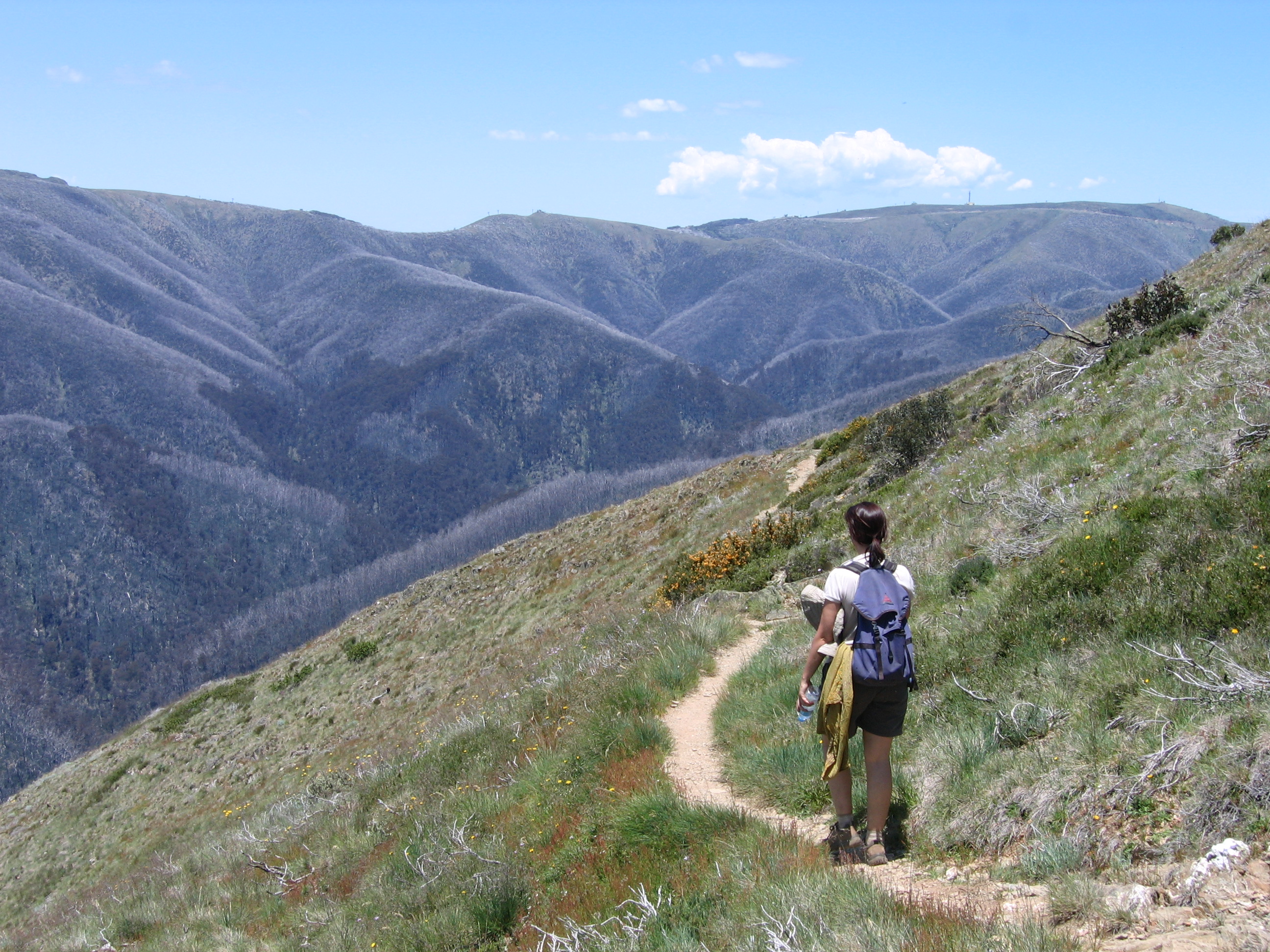
The Razorback
The Razorback

The Victorian government is currently calling for tenders to design the Falls to Hotham Alpine Crossing Master Plan. The plan will define the level of future developments which will occur along the trail – and associated infrastructure like private developments to allow overnight accommodation.

Check here for a background on the recent upgrade of the walk.

It identifies the walk as being part of a bigger program:

Walk Victoria’s Icons is a trademark brand comprising a portfolio of four long distance walks located in iconic regions renowned for their outstanding natural landscapes, wildlife and cultural values across Victoria. With a vision to be compelling, world-class, year round sustainable walking experiences, the Great Ocean Walk, Grampians Peaks Trail, Falls to Hotham Alpine Crossing and Coastal Wilderness Walk represent the quintessential nature-based attributes of the State – from dramatic coastlines to rugged mountain peaks, from remote waterways and inlets to alpine and sub-alpine scenery.

As four distinct walks the Walk Victoria’s Icons walks are designed to capture discerning high yield experience seekers who have a desire to be immersed in exceptional natural beauty that is supported by high quality products and services.

It is seen as being a

guided 2 day walk of 25km, with potential for 4 days, offers an experience that will be as challenging as it will be rewarding.

So far, so good: more people out in the hills….

The Falls to Hotham Alpine Crossing Master Plan will be lead by Parks Victoria in partnership with Tourism North East, Tourism Victoria and Regional Development Victoria.

The preferred route goes from Falls Creek, around Rocky Valley dam to Wallaces hut, then across the High Plains, descending to Dibbins hut, then downstream along the Kiewa to Diamantina spur, up to Feathertop, and out to Hotham along the razorback.

The documents say:

The main driver for this project is the need for a resolved, design-led, strategic master plan and implementation strategy (the master plan) for the FHAC which considers regional tourism and commercial opportunities in the context of recent changes to public land policy, particularly tourism investment in national parks.

That is, the Coalition governments intention to encourage private development within national parks.

The tender documents show that private accommodation is planned to be developed. Included in the brief for the tender is the requirement that the master plan:

Identify settings where opportunities may exist for potential private sector investment in on-walk roofed accommodation and/or services;

Coming soon to a national park near you? Image: Cradle Mountain huts

They use the ‘precedent image’ of private huts along the Overland Track, Tasmania.

A final decision is expected by 2015.

What do you think?

It is great that the government is providing resources to further develop walking tracks to get more people out into parks.

It is orientated towards a market that is happy to pay to have ‘luxeries’ while in the bush, like high quality acommodation, so potentially brings a new group of people into the mountains, who would currently tend to stay in the neighbouring resorts.

However, it could be the thin end of the wedge in terms of developments within parks.

It will probably bring new walking track infrastructure to what is at present a relatively remote area with only a rough trail (the Diamantina spur).

Hotham to Falls walk upgraded, more developments to come?

The much touted ‘Falls to Hotham Alpine Crossing’ has received a substantial injection of funds in order to increase visitation.

The Border Mail reports that

on the Falls to Hotham track, starting the descent to Cobungra Gap

An $800,000 upgrade to the 37-kilometre trek has been completed and Benalla MP Bill Sykes launched it as one of Victoria’s iconic walks at the weekend.

The upgrade includes camping platforms at Cope and Dibbins Hut, signage and track development.

“The camping platforms maintain the vegetation in the area because they are elevated so people can pitch their tents without degradation,” he said.

“It’s also more comfortable for campers because there will be a breeze from below in the summer time and in the event it rains they are not going to get a wet backside.”

Dr Sykes also announced $50,000 of funding from the Victorian Regional Growth Fund to create a master plan for the next stage of the upgrade.

He said it could include looking at accommodation options along the track.

“There are people like me who are very happy to put in the kilometres during the day but would like a comfy bed at night,” he said.

“Some are happy to rough it with a stretcher and a sleeping bag but then there are others who are happy to be out in the elements but have the comforts of home.

“It widens the appeal if you have that option available.”

The master plan will also include route extensions and Dr Sykes said he wanted to encourage people with beginner and advanced routes.

He said the track upgrades were a priority because there was a growing band of people who enjoyed walking and the companionship gained from doing it in groups.

“We’ve got a magnificent scenery and we will be recognised for the beautiful high country and river valleys.”

Dr Sykes said the upgrade and master plan will lead to economic benefits.

“It will be measured in millions and millions of dollars no question about that,” he said.

Guided walking tours is another initiative Dr Sykes believes will boost tourism.

It’s great to encourage people to get out and walking in national parks. But with the pro-development in parks agenda of the current government, we should always be a bit cautious about their motivations.

For instance, what does ‘accommodation options along the track’ mean? Private huts along the route, as is the case in Tasmania?

In March 2013, the Minister for Environment and Climate Change released the Tourism Investment Opportunities of Significance in National Parks Guidelines, an information pack to guide potential investors through the process of gaining approvals and ‘taking their plans to fruition’.

The government has said it will support “sensible and sensitive developments in national parks provided they complement environmental, heritage and other values and generate a net public benefit.”

The government has also announced that it intends to introduce fees for overnight hiking in national parks.

It would appear that doing the ‘Falls to Hotham Alpine Crossing’ will attract a fee of $30, plus a $10 admin fee for the booking.

is there merit in the Alpine park grazing proposal?

Grazing advocates argue that cattle will reduce the impacts of bushfires when they do occur

Since at least 2006, a number of people have called for fuel reduction burns and a re-introduction of grazing to the river flats around Wonnangatta station. This has variously been claimed as being important for protection of visitors should a wild fire break out, for weed control, and ecological recovery.

The state government has now moved to gain approval from the federal government for a grazing trial.

Weeds are an acknowledged problem in the valley, with St Johns Wort, blackberry, Cape Broom, sweet briar and Hawthorn all being significant. In many places, the remnant Themeda (Kangaroo grass) flats are being encroached on by weeds.

It has been reported several times that ‘the poor state of the park is strong evidence of State Government underfunding of Parks Victoria’. So, one option to tackle weeds would be to increase PV’s budget. The current state government is cutting staff at present.

The call for a re-introduction of grazing has been promoted largely by people with connections to grazing.

It is interesting to learn that the current attempt to get cattle back into the Alpine national park by the mountain cattlemen is for a relatively low lying area, the flats around the Wonnangatta station. Previous attempts have been for high country grazing. In contrast, the Wonnangatta station sits at about 500 metres above sea level, in very different vegetation to the high country.

So. Could a grazing operation at this elevation be good for weed management and to reduce fuel loads?

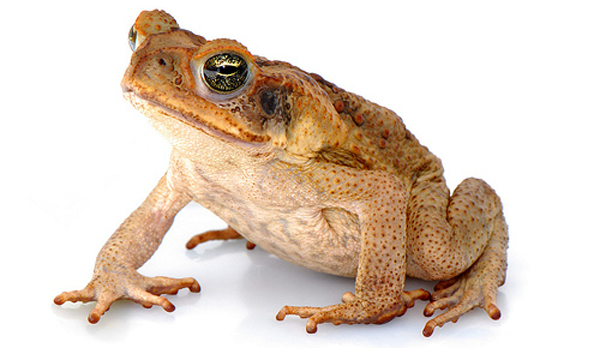
cane toad. Would grazing bring more problems then it solves?

Lets leave aside the fact that many of the problematic weeds in the alpine area were introduced by cattle (hopefully any re-introduction of cattle does not become a solution like the ‘cane toad’ syndrome – where unintended new problems are created in trying to resolve an existing problem).

Lets instead take the cattlemen at face value: that they believe that in this particular location, grazing will reduce fire risk and weed infestation.

Is there a place for grazing by hard hooved and heavy non-indigenous animals in our national parks? And would the proposed grazing trial actually prove if this is the case?

The problem is, we just don’t know. This is because – for whatever reason – the state government has not released any meaningful information about how the grazing trial would work. Given the high level of politics involved in previous attempts to get cattle back into the park, it is hard to trust their motivations unless we have this information.

Media reports say that the trial will be ‘part of a scientific investigation of bushfire prevention options across 2,200 hectares.’ Lets recall that this idea has been discussed with the Environment Minister for at least 10 months before his recent announcement, so its not unreasonable to assume the methodology for the trial is well advanced.

The government could start to resolve the mistrust about their intentions by releasing the outline of their grazing plan. To make an informed decision about whether this is a ‘fair dinkum’ trial, the community needs to know:

  • Who has created the methodology?
  • Who will be responsible for managing it?
  • What scientific evidence is there that grazing will control weeds and fire risk in the way it is claimed?
  • What is the budget for the program, and where does it come from. Does it just draw from existing Parks Vic budget?
  • What assessment will be done of current weed infestation and fuel loads prior to the introduction of cattle?
  • What targets will be set to reduce weed coverage and fuel loads. Different weeds respond in different ways to grazing – what are the strategies for each of the key weeds? And what is the strategy for weeds that are not normally grazed by cattle?
  • Will the 2,200 ha in the project be fenced? Who will pay for it? Would meaningful results be able to be gained from running the trial on a smaller parcel of land?
  • Will the adjacent waterways be fenced to keep cattle out of the river? If not why not. What are the likely public health implications of this? (many thousands of people visit and camp in the Wonnangatta each year).
  • What strategy will be developed to ensure the cattle do not re introduce weeds?
  • Have the relevant traditional owner groups been consulted and involved in the project?
  • What will the cattlemen by paying in agistment fees?

Once this information is in the public domain we can start to have an informed discussion about the merits of such a trial. Until then, we have to assume this is just another attempt to get some benefits for political mates. Hardly the basis for forming good policy over how we manage public lands.

New research shows alpine grazing does not reduce blazing

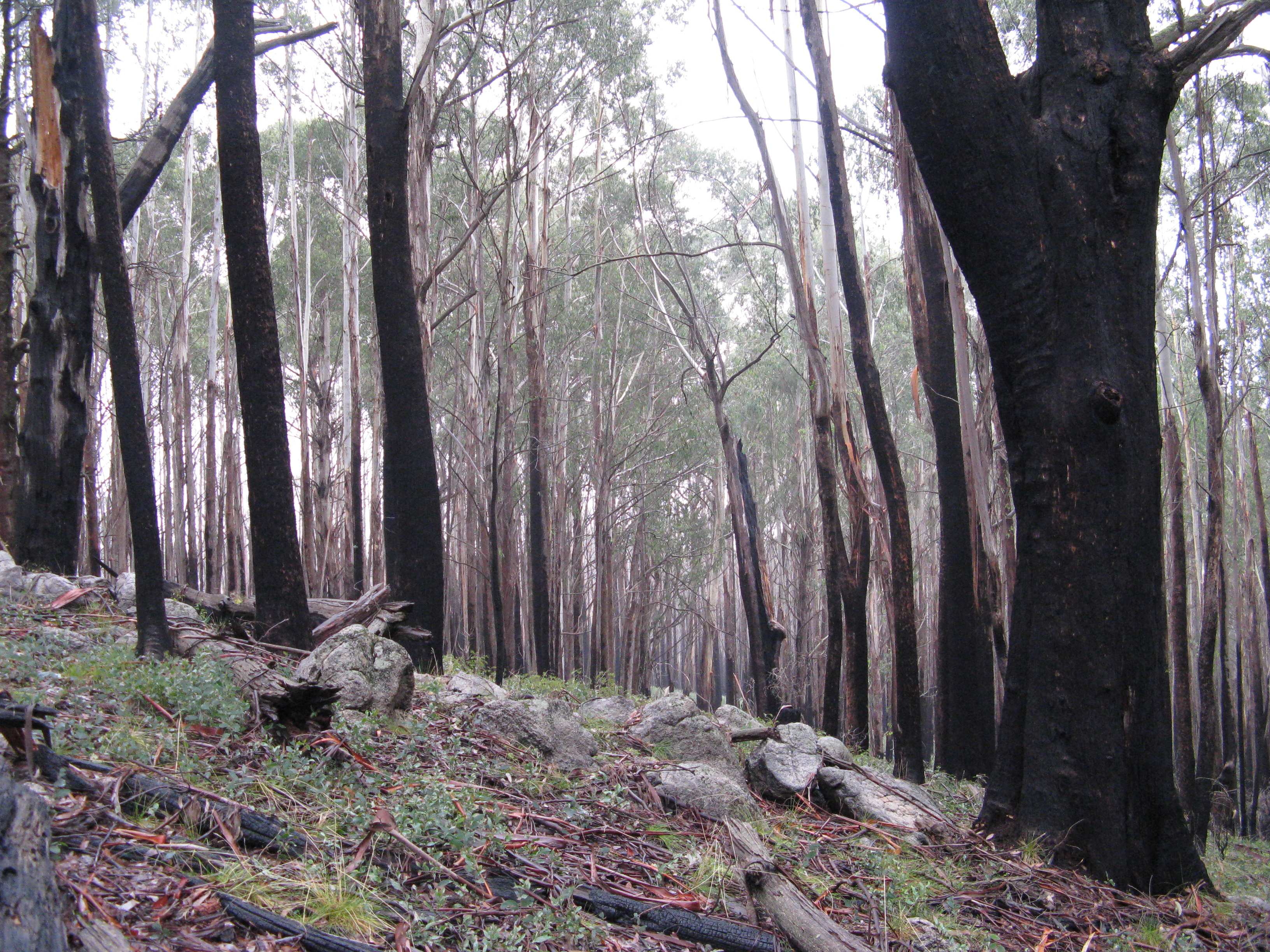
burnt snowgum woodland near Mt Hotham

The following excerts come from a piece by Grant Williamson, Brett Murphy, and David Bowman published in The Conversation. It seems pertinent given the current proposal to re-introduce cattle into a section of the Alpine national park.

Their actual research report can be found here.

This was not an on-ground research project into how grazing might be used as a fuel management tool. Rather, it was based on an assessment of satellite images of the Victorian Alps. They looked at vegetation maps from the past, and compared them with areas after the cessation of grazing, and also the impacts of extensive areas burnt by fires.

“We overlaid maps of crown scorch derived from satellite imagery following large bushfires in 2002/03 and 2006/07 with the location of pastoral leases. Crown scorch is a measure of fire intensity, based on the degree to which flames have reached a height which enables them to burn the forest canopy”.

They summarise their findings in this way:

“Using geospatial statistics we found that cattle grazing had no effect on the likelihood of crown scorch in eucalypt forests and woodlands.

This result is biologically plausible given that cattle are grazing animals, not browsing animals – they do not extensively feed on woody vegetation focusing on grasses instead. Our study is also consistent with previous ground-based studies that have demonstrated the cattle prefer to graze in grassy areas”.

Blog at WordPress.com.

Up ↑