Search

Mountain Journal

Environment, news, culture from the Australian Alps

Author

Cam Walker

I work with Friends of the Earth, and live in Castlemaine in Central Victoria, Australia. Activist, mountain enthusiast, telemark skier, volunteer firefighter.

Backcountry Demo Day in Thredbo

revGWilderness Sports presents first ever Backcountry Demo Day in Thredbo10th of July 2013

From Mountainwatch

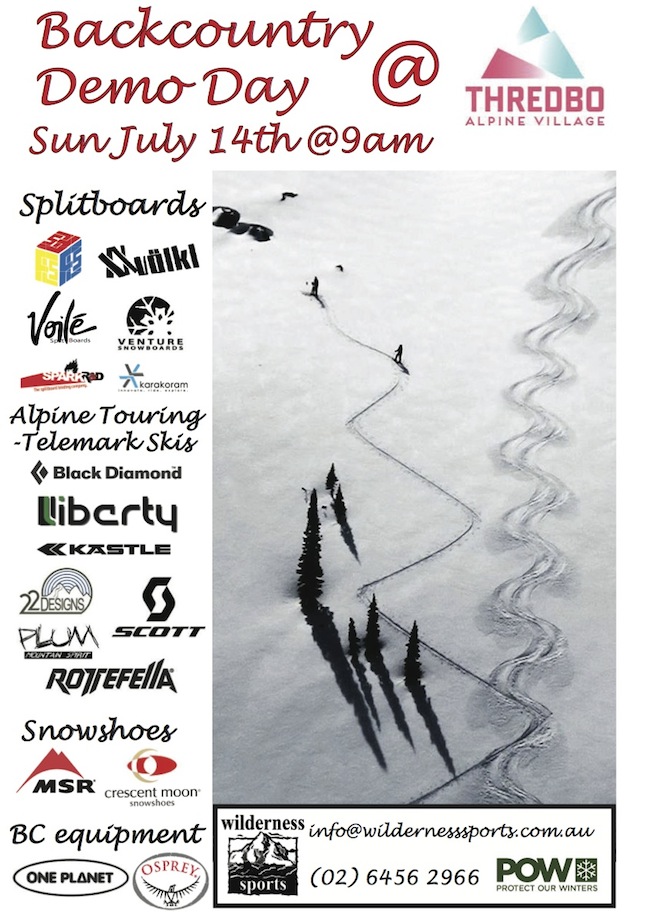
This coming weekend Wilderness Sports will host the First EVER Backcountry Demo Day to be held in Australia @ Thredbo on Sunday July 14 from 9.00am. (Further details shortly and part of a series)

In partnership with Thredbo we will offer an opportunity to try out the latest equipment for free and talk with experienced industry people as well as Wilderness Sports Backcountry guides about enjoying the mountains safely and how to explore more of the rugged and unique Snowy Mountains.

This is a part of a series of Backcountry Events to be hosted by Wilderness Sports and partnering companies such as First Light Snowboards and Protect Our Winters in order to encourage and educate safe and responsibly travel in the backcountry.

The Event will feature Split Boards; Alpine Touring gear; Snowshoe and Telemark Equipment. Clinics as well as backcountry gear for safety and education.

Split Board Brands – Voile; Venture; Volkl;
Alpine Touring Brands – Kastle; Liberty; Black Diamond; PLUM; Scott;
Telemark Brands – 22 Designs; Rottefella; 75mm and NTN;
Snowshoe Brands – Crescent Moon; MSR;
Backcountry Accessories – Black Diamond; One Planet; Osprey

Splitboard festival 2013

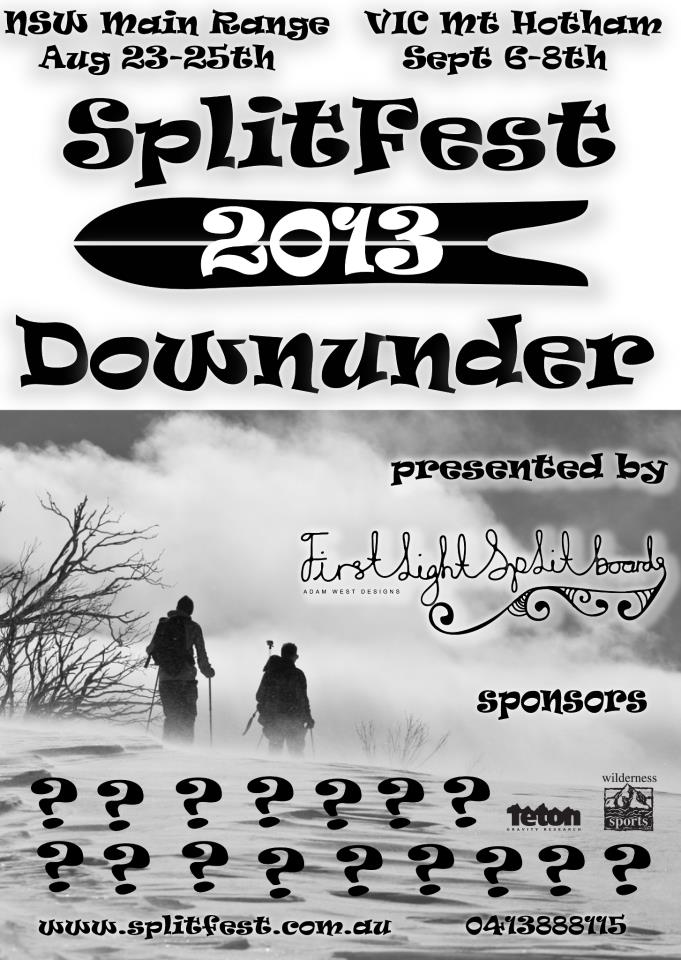
8238024_origFirstLight Boards have organised the second Australian splitboard festival for this winter. This year it will happen in both Victoria and NSW.

A splitboard is a snowboard that can be separated into two ski-like parts, which are used with climbing skins to ascend slopes the same way alpine touring or telemark skis are. The two halves can then be connected to form a regular snowboard for descent. This set up enables snow boarders to get into the backcountry.

NSW

The NSW Splitfest DownUnder will be held on weekend of the 23rd of August in the NSW main range.

We will be holding the Friday night entertainment at the Banjo Paterson Inn Starting @ 6pm
1 Kosciuszko Road Jindabyne Snowy Mountains New South Wales 2627

Please register here.

These are free events, there are no guides, so you must be able to make your own terrain decisions.

VIC

The VIC Splitfest DownUnder will be held on the weekend of the 6th of September at Mt Hotham.

We will be holding the Friday night entertainment will be at “The General” starting @ 6pm
Lot 1 Great Alpine Rd Mt Hotham

Register here.

Helicopters sowing alpine ash forest following Harrietville fire

The following is a media release from the Victorian Environment Minister Ryan Smith.

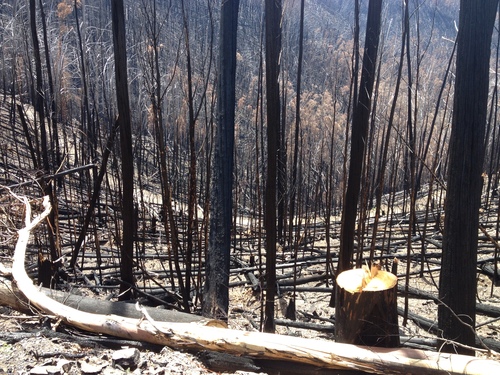
burnt ash near the Great Alpine Road, March 2013

The Victorian Coalition Government has launched an urgent effort to re-seed about 2,000 hectares of Alpine Ash forest that was burnt during the Harrietville fire earlier this year.

Minister for Environment and Climate Change Ryan Smith said a helicopter was being used to spread Alpine Ash seeds across 198 hectares of State Forest and 1,876 hectares of National Park that was burnt in the fires.

“Areas within the Harrietville fire boundary have been burnt several times over the past decade and Department of Environment and Primary Industries and Parks Victoria ecology experts predict about 2,000 hectares will not be able to naturally regenerate due to the nature of Alpine Ash and its response to fire,” Mr Smith said.

“It is also important to re-seed the area to assist with stabilising the fragile soils in the steep terrain to protect water catchments, which supply communities downstream.

“We have already started the aerial re-seeding operation in the State Forest and will continue the work over the next few days if the weather conditions remain suitable.”

Parks Victoria Regional Director East Andrew Marshall said it was important to sow the Ash seeds before other plants regenerate so the Ash seeds can germinate in the spring.

“There will be some follow-up monitoring of some sites within the State Forests but in National Parks areas this is a once off opportunity to regenerate,” Mr Marshall said.

The cost of the re-seeding work is approximately $620,000 and is funded as part of the Victorian Coalition Government’s Harrietville fire recovery program.

The gnarliest runs in Oz

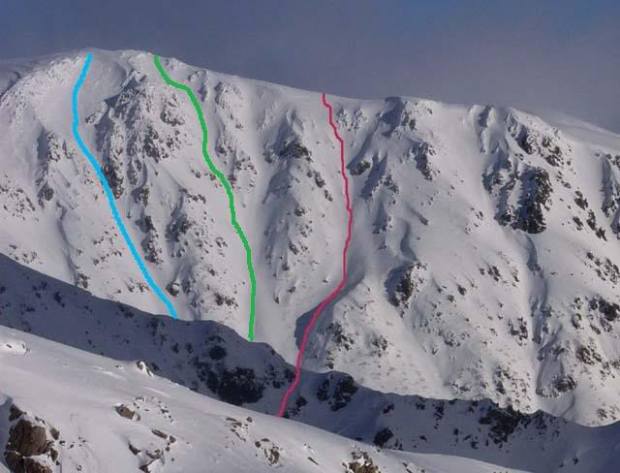
Mt Carruthers. From Huck & Dyno.

This is a great resource: the ‘gnarliest runs in Oz’, from the Huck & Dyno website (in two parts – Victoria and the Main Range in NSW).

The NSW feature has all the obvious things, and Victoria includes excellent coverage of places like Mt Buller, Feathertop and Bogong, and also some gems which are off the beaten track, like Mt Howitt.

A few years ago I put a lot of effort into expanding the ski wiki posts on backcountry skiing in Australia (mostly the VIC and TAS sections) but a big failure with this is the lack of images. In contrast to my effort, James and Sam, who are behind Huck & Dyno, have some gorgeous pictures of the mountains and general terrain, plus many of the actual runs. Visually beautiful.

I like their intro:

When you get down to it, Australia is the flattest driest continent on Earth. By definition, the skiing here is the worst in the world. … So it’s easy to write the place off as a land of sunburnt sweeping plains. Or, if you’re a skier, patchy cover, ice and crud, short shallow runs and snowmaking.

Even the highest mountain, good old Kosciuszko, is a hill with a road to the top… The very first time I ever went XC skiing, we made it to the top! Snowboarders were drinking beer up there! Fun for the whole family!

The enthusiastic might even bother to look over at the ‘Main Range’, hoping to see a craggier peak. But nope, Mount Townsend and Northcote and Lee all look pretty tame over there.

But then one day you’ll bother to climb the second highest peak, Mount Townsend, and have a look from the top of there and, HOLY CRAP, there it is…

So begins our investigation into the gnarliest lines in Oz.

With winter finally bearing down on us, I hope this inspires you. Get out there and enjoy!

Private leases plan for national parks

The following article comes from The Age, journalists are Jason Dowling and Tom Arup.

Check here for the response from the Victorian National Parks Association. Check here for the VNPA Hands off our Parks page.

ta-handsoff-240pxThe Napthine government has introduced sweeping changes to Victoria’s national parks allowing for 99-year private leases – in the same week Canberra is considering expanding its powers over the parks.

The state changes mean the historic Point Nepean Quarantine Station is in effect up for sale, according to activist Kate Baillieu.

The commercial real estate section of The Saturday Age carried an advertisement from real estate agents Jones Lang LaSalle to lease the Quarantine Station. The government has also asked for expressions of interest for private development of the 17-hectare site.

Matt Ruchel, executive director of the Victorian National Parks Association, said the new 99-year leases that will apply in all of Victoria’s national parks, including Wilsons Promontory, were deeply concerning. ”National parks are primarily for conservation, not development,” he said.

Environment Minister Ryan Smith said the 99-year leases would ”give investors greater certainty and a stronger incentive to develop innovative, high-quality proposals in our national parks”.

A spokesman for Mr Ryan said there would be exclusion zones where development would not be allowed in national parks.

In Canberra, the federal government is considering expanding its powers over national parks in response to plans by Coalition-led states to allow cattle grazing, shooting and logging in protected areas.

Environment Minister Tony Burke met as recently as Wednesday with conservation groups who want him to broaden his oversight over parks before the election.

The Australian Conservation Foundation and the Wilderness Society wants a ”trigger” to be legislated, meaning a heavy-impact project in a park would automatically need review under national environment laws, and giving the federal minister scope to block it.

The fate of national parks in Queensland, NSW and Victoria has come to the fore in recent years with cattle grazing, recreational shooting, and possibly logging, among state government proposals for parks. Currently, the federal government can only intervene in a national park if it is heritage-listed, or a protected plant or animal is threatened.

Mr Burke said the community was right to be concerned that places they have been enjoying are under threat. ”I share that concern and I’ll be looking into the ways I can stop these state governments from trashing national parks forever,” he said.

In 2011, Mr Burke proposed listing most of Australia’s 500-odd national parks – the domain of state governments – under federal environment law, which would have given him the power to reject new logging, grazing and mining projects. He later withdrew the proposed regulations after stopping a controversial cattle grazing trial in Victoria’s Alpine National Park using heritage law.

”Since then [the listing withdrawal] state Liberal governments are launching new attacks on national parks every few months. My view is clear, national parks are for families and nature. They are not farms, rifle ranges, mine sites or logging coupes,” Mr Burke said.
Central Plateau Tasmania

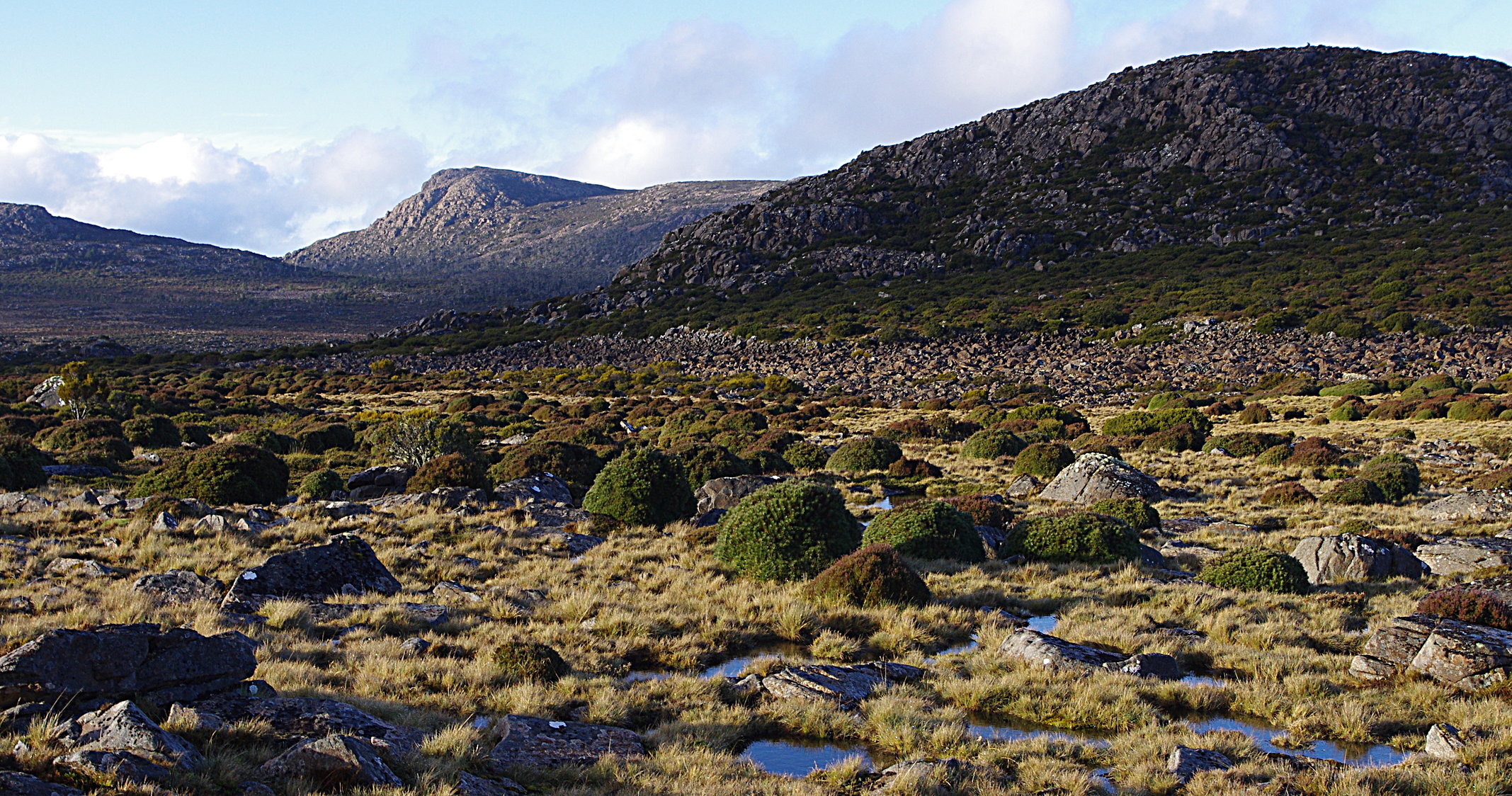
superb country. In the saddle below Forty Lake Peaks, looking towards Mt Ironstone

The north western end of the Central Plateau offers spectacular walking. Easy access to Lake McKenzie gets you into some of the most extensive alpine and sub alpine terrain in the state.

This heavily glaciated country is bounded on the north and west by big escarpments and deep valleys, and stretches off into more forested landscapes to the east and south. Two rough tracks get you into the Plateau proper, and there are endless possibilities for travel through this open and exposed mountain country.

This is a 4 day walk, which takes in the higher ridges of Turrana Heights and Turrana Bluff, through to the Long Tarns and back out via the Higgs Track.

Check here for the notes.

Buffalo Chalet gets $7m for refurbishment

The following news item comes from The Age newspaper, journalist Darren Gray.

Image: SMH
Image: SMH

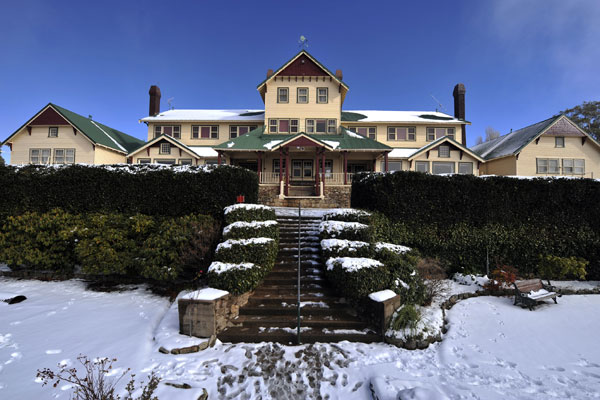
The grand old dame of Victoria’s alpine country, the Mount Buffalo Chalet, will reopen its doors once a $7 million project to refurbish the historic building and establish a day visitor centre and, hopefully, a cafe is complete.

The first clean-up works inside the 103-year-old chalet, closed since January 2007, are expected to start within weeks. But the project is more than a facelift, because outbuildings as well as some rooms that were not part of the original structure are likely to be demolished. Building assessments and recommendations will be carried out soon.

Environment Minister Ryan Smith will announce the project today and say the government is committed to preserving the building for future generations and ensuring ”the site is primed and ready for appropriate future investment.”

In an interview with Fairfax Media on Friday, he said the chalet was ”an icon in the area. It’s a state asset. We need to make sure that we can get people up there. I’m passionate about getting as many people into our parks as possible.”
Advertisement

”We want to make sure it’s useful, rather than just spending taxpayers’ money on maintaining something that’s not actually being used. So I think it’s important that we do get it back to some useable state.”

Mr Smith said the project, expected to take about a year, would pave the way for development, subject to national parks guidelines. Recent research found no private operator was interested in the site in its current state.

In about a year the government would call for expressions of interest for the site. ”Everything’s on the table, as long as it conforms to our guidelines around tourism development in these national parks,” he said.

Asked if the chalet could once again offer accommodation, he said: ”I’d leave it to commercial forces … But I’d look at anything. What I hope is that we get something that’s sustainable. I don’t want to look back in three years or five years or whatever and say ‘That didn’t work’.”

The works will be funded by a $4.7 million insurance payout for bushfire damage on Mount Buffalo and a contribution from the state’s Regional Growth Fund.

Mayor of the Alpine Shire, Peter Roper, said the project was ”absolutely fantastic news” that would be welcomed by locals.

rainforest species in the Alps

The following story comes from the Summit Sun. Its good to know that pockets of Sassafras are hanging on at higher altitudes in  the Snowies.

7457055298_e2b9d0a59d_zEnvironment specialists took to the skies recently to successfully confirm the presence of Southern Sassafras in the Bogong Peaks Wilderness in Kosciuszko National Park. The rugged mountainous country required a survey by helicopter to locate plants in forested gullies that flow towards the Goobragandra River.

Southern Sassafras or Atherosperma moschatum is a fire-sensitive tree. It has long been clouded in mystery regarding its existence in high altitude and cool temperate rainforest pockets like those found in the Bogong Peaks.

The survey was made possible thanks to a generous bequest by Kenneth Milburn to Landcare Australia, who have partnered with Greening Australia and the NSW National Parks and Wildlife Service (NPWS) to identify and map the distribution of the Southern Sassafras rainforest tree.

Shane Norrish, Farming and Major Projects Director at Landcare Australia said, “This is an outstanding opportunity to learn more about the ecology and distribution of high country vegetation communities. It is often difficult to obtain funding for projects such as these, and the generosity of the Milburn bequest will make a significant contribution to the protection of important species such as Southern Sassafras.”

Opportunistic surveys undertaken in 2011 by Greening Australia in the Bogong Peaks Wilderness Area confirmed the presence of Southern Sassafras further north-west than previously thought, but the extent was unknown.

“Identifying and broadening the known population boundaries of Southern Sassafras will have significant benefits for the species survival, and has important implications for park management activities including prescribed burning” said Matt White, NPWS Ranger for the Bogong Ranges.

Up until the time of the 2011 surveys, only a few populations were known to occur between 700-1300m altitude, and were usually found with Alpine Ash in sheltered gullies on the western fall of the main range of Geehi and Leather Barrel Creek, and in the Pilot Wilderness.

Further examination of remote sensing imagery had revealed additional potential occurrences in the Bogong Peaks, but limited access in the rugged terrain meant confirming these locations was almost impossible.

Greening Australia Project Manager, Nicki Taws, said, “The aerial survey enabled us to confirm the presence of Southern Sassafras in many locations that we couldn’t have reached on foot. We are very grateful to Landcare Australia for supporting this critical work.

Looking to the future, Nicki said, “We look forward to continuing our work with NPWS in this area, determining the presence and extent of Southern Sassafras and progressing collaborations to include community engagement in the protection and enhancement of this stunning tree.”

Backcountry film festival 2013 season

from the film Further

The Winter Wildlands Alliance created the Backcountry Film Festival in 2005 to help grassroots and professional filmmakers to show audiences their love of the winter outdoors. Since then, the annual festival has become something of an institution amongst many outdoor communities.

The festival is now a pre winter event here in Australia.
Melbourne show

Wednesday May 15

At The South Melbourne Commons
corner of Bank & Montague St in South Melbourne

Suggested donation: $8 conc/ $12 waged

7pm. Come and grab a drink and catch up
7.30. Films start, the show runs til 10pm (with a 20 minute break in the middle).

Check here for details on how to get to the Commons. Trams and the Light Rail are a few minutes walk away. Lots of parking at night.

Facebook event page here, feel free to invite your friends.

Full details on the films here.

National park boundary redrawn for resort

The following comes from The Age newspaper, Feb 20, 2013.

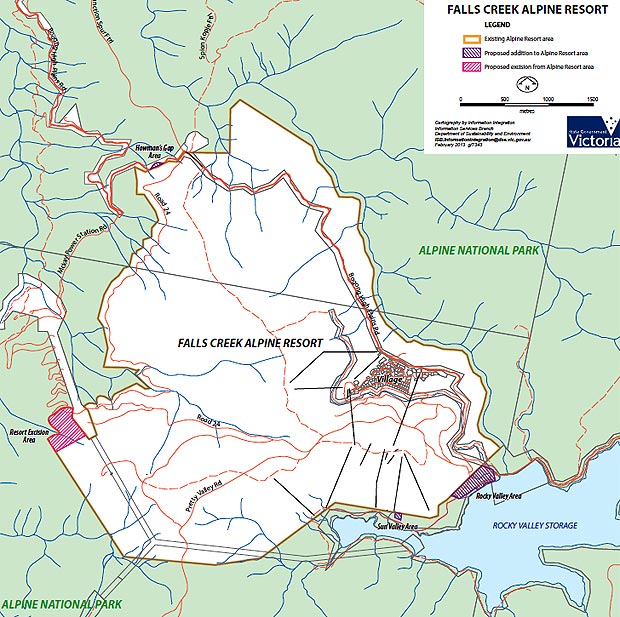
alpine2The Baillieu government has redrawn the boundaries of the Alpine National Park to allow the Falls Creek resort to expand.

On Thursday morning Environment Minister Ryan Smith announced the government would excise almost 10 hectares of land from the national park and add it to the adjoining Falls Creek Alpine Resort area.

The boundary change follows numerous requests from the Falls Creek resort to expand its operations. The resort wants to develop non-winter tourism activities and a high-altitude training camp for athletes.

The changes mean the resort will now be allowed to expand down to the shore of the Rock Valley Storage lake.
In exchange, the government will add almost 12 hectares of land on the slopes of Mount McKay to the park, which Mr Smith said contained snow gum woodland.

“Victoria’s alpine resorts make significant contributions to their local economies and to tourism in the state,’’ Mr Smith said.

‘‘This amendment is part of a long-term strategy to increase visitation, including in the non-winter months and ensure all Victorians can access and enjoy their natural environment,’’ he said.

“We want to encourage more altitude training, lake events, road cycling and mountain biking.’’

Mr Smith said the proposed amendments were part of Baillieu government’s plan to enable new ‘‘environmentally appropriate investments’’ on public land, including national parks, forests and alpine resorts.

In August the government decided to open up Victorian national parks to private tourism development following recommendations by the Victorian Competition and Efficiency Commission.

Guidelines to deem what development will be allowed in parks are still being finalised by Mr Smith, who will have final say over what projects would go ahead.

The decision to redraw the Alpine National Park boundaries to allow an expansion of the Falls Creek resort is separate to the August decision.

The Victorian National Parks Association’s Philip Ingamells said the process to redraw the Alpine National Park boundaries had been secretive.

“The government seems to think that if someone wants a development in a national park, they can simply excise that area from the park without any public consultation,’’ he said.

‘‘Management of our finest natural areas should be transparent, honest and based on the best scientific advice. We need to know what other developments they are planning for our magnificent national parks.”

Comment was being sought from Falls Creek Alpine Resort management.

The Alpine National Park was the site of the Baillieu government’s controversial cattle grazing trial, which was blocked by the Commonwealth under national environment law.

Splitboard festival on in 2013

379329_10151481327404273_1847261366_nFirstLight Boards have organised the second Australian splitboard festival for this winter. This year it will happen in both Victoria and NSW.

The NSW Splitfest DownUnder will be held on weekend of the 23rd of August in the NSW main range.
Register here.

The VIC Splitfest DownUnder will be held on the weekend of the 6th of September at Mt Hotham.
Register here.

Help keep gold prospecting out of national parks!

The Baillieu Government wants to give prospectors and fossickers more freedom to dig up our most treasured national parks.The government has directed the Victorian Environmental Assessment Council (VEAC) to recommend that prospectors and fossickers should be permitted to expand their activities into the Alpine, Yarra Ranges, Baw Baw, Croajingolong, Errinundra, Lake Eildon, Lind and Mitchell River national parks, as well as the Lerderderg State Park.

Fossicking is already allowed in a number of Box-Ironbark parks in central Victoria. But despite a requirement that park managers monitor the impact of this damaging activity, no assessment has been carried out.

Prospecting in Victoria's national parks
> Take action

Our national parks are there to conserve our precious natural environments.

Please join us. VEAC cannot recommend that prospecting not be permitted in all of the parks, even if that is what its evidence shows.

PLEASE send your comments to the VEAC investigation by the deadline of Monday, 18 February 2013.

There are two easy ways to send a submission:

1. QUICK SUBMISSION

Just add your comments to our online submission and click SEND.

Quick email submission

2. PERSONAL SUBMISSION

In your own words, tell the government why our national parks should not be used for damaging activities like prospecting and gold panning.

Some suggestions:

  • Fossicking (metal detecting, digging holes and panning for gold) causes unnecessary damage to streamsides, and can threaten rare species such as ground orchids.
  • Our national parks are set aside to protect our natural areas for future generations. They are there for passive recreation, not exploitation.
  • Many of the rivers that flow through these parks are already listed as Heritage Rivers, and Natural Catchments. These additional levels of protection should be respected.
  • Fossicking is already allowed in a number of Box-Ironbark parks in central Victoria. But there has been no monitoring of their impacts as required by park management plans.
  • Fossicking and panning damages streamsides, causes erosion, and silts up rivers. In old gold-bearing streams, already worked over many years ago, mercury and other pollutants can be released into streams when soil is disturbed.
  • Fossicking and gold panning can damage the many important Aboriginal cultural heritage sites in the region.
  • While prospectors insist they behave responsibly, many don’t. The parks in the investigation area are in relatively remote areas, and fossickers’ activities will be difficult if not impossible to supervise or monitor.
  • Managing prospectors and fossicking will take park rangers away from other essential activities, at a time when staff numbers are already well below what’s needed for park management.
  • Many rivers, streams and catchments are important for rural, regional and city water supplies. We should be aiming to improve their condition, not compromise it.
  • There is already plenty of opportunity to fossick for gold in the extensive State Forest areas in eastern Victoria, outside national parks.
  • VEAC should have the opportunity to recommend no prospecting in parks, but the government has already decided that prospecting will be allowed in nine new parks (Alpine, Yarra Ranges, Baw Baw, Croajingolong, Errinundra, Lake Eildon, Lind and Mitchell River, and Lerderderg State Park).

Send your submission by Monday 18 February 2013 to:

Email: prospecting.investigation@veac.vic.gov.au

Or if sending by mail address your submission to:

VEAC
Level 6, 8 Nicholson St
East Melbourne 3002
Victoria, Australia

More information

The VEAC website has lots if useful information including maps and park overviews.

VEAC website

Read Phil Ingamells’ analysis of this issue in his article ‘Prospecting in Wonderland’.

Prospecting in Wonderland

Blog at WordPress.com.

Up ↑