Search

Mountain Journal

Environment, news, culture from the Australian Alps

Author

Cam Walker

I work with Friends of the Earth, and live in Castlemaine in Central Victoria, Australia. Activist, mountain enthusiast, telemark skier, volunteer firefighter.

‘adventures in saving snow’

Australia has any number of well known sports people. What sometimes surprises me is how few prominent skiers/ boarders – that is people connected with our mountains – actually speak out on environmental issues. This example from the excellent Wend magazine profiles extreme skier from the USA, Alison Gannett, and her advocacy work on climate change.

Alison Gannett–Adventures in Saving Snow

(author: James Mills)

Image: Wend

There are plenty of people out there talking about climate change. But how many are actually doing something about it? Even those of us who spend a lot of time outdoors can be guilty of contributing to the destruction of the natural environment we love. We fly in jets from place to place for the sake of adventure. And many of us are still driving low gas mileage, carbon emitting SUVs. Our active lifestyles can really hurt the planet. So that’s why we can all take a few lessons from professional skier and environmental advocate Alison Gannett.

“I went to school for climate change and majored in education for environmental issues. And then I went to school for solar design for alternative home building,” she said. “At the same time, I had a professional skiing career, doing crazy things like the X-Games and jumping off cliffs for a living.” While she had two careers running parallel to one another, Gannett suffered a devastating crash at the X-Games and because she was badly injured and unable to compete, several of her sponsors immediately dropped her. That got Gannett to thinking.

“I realized how shallow a lot of my ski industry sponsors were,”  she said. “I decided, wouldn’t it be cool to partner with companies that have more at stake and care more about than just selling clothing?” Though many of the competitors and colleagues thought she was crazy for chasing the more lucrative sponsorship deals, Gannett changed her professional priorities to work instead with companies who share her environmentally conscious values. “I want to chase ethics,” she said. “I want to work with companies that have the same beliefs that I do.”

It turns out that there are plenty of sponsors out there willing to support Gannett’s mission to raise awareness for the ongoing crisis of climate change. Blending her interests in sustainable living and an active lifestyle, she’s proven to be a very effective spokesperson for both. “As an athlete getting older, I’d have to say that I have better sponsor relationships now than I ever did,”    she said. “And now working with the Save Our Snow Foundation and working with schools, working with Congress, working with the White House I’m saving our snow, saving our planet and making the world a better place.”

Allison Gannett is the kind of adventure athlete that walks her talk. While still leading an exciting life as a professional skier, she’s making a big difference in educating the general public on the realities of climate change. And through her work at the Save Our Snow Foundation and on her own organic farm in Colorado, she’s showing us what we each can to do to slow it down.

You can find Alison’s website here.
Alpine grazing action alert

A new dilemma for the government:

According to The Age newspaper, “traditional owners of Victoria’s high country have threatened the Baillieu government with legal action, accusing it of “stepping over the mark” in the controversial return of cattle to the Alpine National Park.”

The government appears to be in the bunker and not responding to a number of recent stories in The Age.

UPDATE, 12/1/11: it has just been announced that the government has secretly put a small number of cows back in the Alps Park in order to “prevent any potential Federal Government injunction”. (!!)

This secrecy flies in the face of the Ted Baillieu’s committment to transparent government.

Check this letter from the Environmental Farmers Network on the grazing decision.

Background

Cattle were removed from the Alpine National Park in 2005 by the government of Steve Bracks. This was an important step forward for good land management in our state. Since then, some of the long term damage caused by decades of grazing have started to heal.

However, the Victorian Coalition announced in the build up to the November election that it would return cattle grazing to Victoria’s alpine national parks as a tool to reduce fire risk.

It probably made sense to summer graze cows in the alps when the practise started in the 1800’s. Given what we now know – of the ecological damage they cause – it made sense to remove them from the precious alpine areas.

Putting them back into the Park – in the very headwaters of our most significant river systems in a time of climate change – would mean turning our backs on common sense land management and scientific evidence. Grazing greatly damages the alpine systems, including the peat beds, that release high quality water into our river systems across the north east of the state.

Research on alpine grazing has consistently shown that the pro grazing mantra ‘grazing reduces blazing’ simply isn’t true.

The Victorian National Parks Association has substantial information on the question of grazing and fires which is available here.

You can also see the CSIRO’s finding on grazing and fire here.

We need to send a strong message to the new government that the majority of Victorians do not support the re-introduction of grazing into the Alps and other protected areas like the Barmah forest.

TAKE ACTION

Please write to the Premier and Environment minister, explaining that you are opposed to the reintroduction of cattle grazing into Victoria’s alpine environment.

You could mention that the grazing of cattle in a national park is inconsistent with conservation management, which is the main purpose of national parks protection. It will not help reduce fire risk. Our alps are at great risk from climate change and do not need that degradation that will come with grazing.

Simply send a brief and polite email outlining your concerns, with your name and address to:

The Hon Ted Baillieu MP
Premier of Victoria
ted.baillieu@parliament.vic.gov.au

The Hon Ryan Smith MP
Minister for Environment and Climate Change
ryan.smith@parliament.vic.gov.au

It would be great if you could cc us a copy so we know how many letters have gone in: foe@foe.org.au

Please send this alert on to your friends. Thanks!

The Ducane traverse

As summer kicks in, its tempting to get happily distracted by long gone snow and cold. I have been struggling to write content these last few weeks, so am ‘recycling’ a piece that hasn’t appeared on the front page yet: a summary of the Ducane traverse, in the southern end of the Cradle Mountain Lake St Clair National Park.

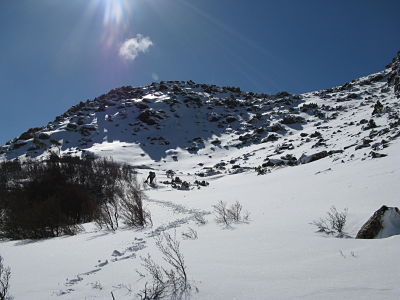
climbing past Falling Mountain

Tasmania has notoriously un-predictable winter conditions, but the Ducane can provide  spectacular skiing when it’s in condition, on steep slopes and in gullies.

The ‘traverse’ is generally seen as being the walk/ snowshoe from Ducane Gap, on the Overland Track, over Castle Crag and Mt Massif, into Big Gun Pass, and then exiting onto the Ducane Range proper. From here you head out past the Pool of Memories and down to the head of Pine Valley via the Geryon climbers camp, or through the Labyrinth to the Parthenon track that takes you to Pine Valley hut.

Its awesome terrain at any time, especially winter, which is when these images and report are from. Enjoy.

the Gould circuit

Mt Gould saddle

Another great and mostly off-track trip in the Cradle Mountain National Park in  Central West Tassie is the ‘Gould circuit’. It’s a nice three day trip to and from Narcissus hut at the northern end of Lake St Clair. If you continue north into the Labyrinth or west onto the Guardians you can easily stretch it into a longer journey (one option is to keep going over the Ducane Range and Mt Massif, to exit onto the Overland track at Ducane Gap).

The following are some slightly vague reflections on the Circuit.

‘Moulding our landscape with fire’

re-growth, Mt Stirling, VIC

The following is from a piece by well known naturalist Bob McDonald, and taken from the ABCs ‘Drum Unleashed’ website.

Australia and Victoria in particular have been labelled among the most bushfire-prone areas of the world.

Before any analysis of the causes of the 2009 Black Saturday fires, the assumption was made publicly that the “lack of fuel reduction burning” was the “cause” of this catastrophe.

By implication it must have been Aboriginal people who burned the bush continually to maintain low fuel low loads. But did they? Just published research evaluated fire frequency using charcoal occurrence from more than 200 sites in Australasia over 70,000 years – concentrated around south-east Australia. It tells a completely different story. The results reveal how dramatic the increase in fire in the Australian mainland landscape has been since Europeans.

The full article can be found here.

biomass power plant planned for New South Wales far south coast.

Image: Chip-Busters

The proposal to put a biomass plant in southern NSW is heating up again.

South East Fibre Exports wants to build a plant at Eden to generate electricity from woodchip timber waste.

Anti woodchipping group Chip-Busters have previously said “our forests are amongst the most carbon dense in the world, home to a vast array of wildlife and critical to the health of our water catchments and rivers in the face of the looming climate catastrophe. Woodchipping them for paper pulp or biomass energy is just plain stupid”.

Full story here.

Canoeing Lake St Clair

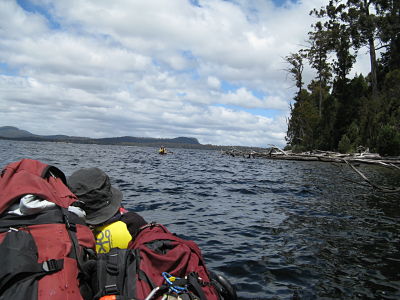
Lake St Clair, or Leeawuleena, at the southern end of the Cradle Mountain-Lake St Clair National Park, is perhaps best known for being the end of the famous Overland Track. Nowdays, most Overland walkers catch the ferry out from Narcissus Hut, avoiding the last days wander along the estern shore of the lake.

While it is fairly popular with folks who have sea kayaks, it is one of the great secrets for those who want to tour in open canoes, with easy road access, lots of great campsites, and a big patch of open water.

There are some images from a recent trip here.


what would a Coalition victory mean for the Victorian Alps?

Little Mt Higginbotham, VIC

With the prospect of the Coalition taking power following yesterday’s state election it is worth taking a few minutes to think about what this might mean in terms of a change in attitude to the Victorian High Country.

The most obvious short term implication would be if the Coalition was actually able to implement its promise to return cattle to the Alpine National Park. (Phil Ingamells of the Victorian National Parks Association recently explained why this is most unlikely).

The Mountain Cattlemen’s Association of Victoria (MCAV) is hoping the Coalition will act on it’s promise to re-introduce cows to the Alpine National Park. They say this would be a good thing because “cattle grazing (is) a proven management tool to reduce fuel loads”.

You don’t have to be a genius to know that a cow, given the choice between a succulent plant and a prickly shrub, will choose to eat the former. Over time, at at scale, this drives sub alpine vegetation towards scrubbier vegetation types – which will be more flammable. ‘Alpine grazing reduces blazing’ has been consistently proven incorrect by a number of studies. There are a range of other reasons to keep cattle out of the headwaters of our most significant river systems, not least of which is water quality. Lets hope common sense will prevail on this one.

They have also announced that they would intensify logging and replace native forest ecosystems with Mountain Ash ‘plantations’.

Another, longer term issue is climate change. As we know, climate science tells us that the Alps are at grave risk from climate change unless we can greatly reduce greenhouse emissions in the near future.

The Victorian Coalition was noticeably absent from the climate change debate through most of this year, and didn’t even bother to release their climate change policy before the election.

They did release an energy policy (just 4 days out from the election) and there are various points of detail in that policy that should worry anyone who is wanting action on climate change from the Party that forms the next state government.

This includes the fact that:

  • they have provided very little detail on how Victoria might meet the existing 20% emissions reduction target,
  • there is no mention of the scale of the problem of climate change,
  • there is no direct commitment to a phase-out of Hazelwood or any other coal fired power station,
  • finally, it includes a regressive policy on wind farms.

As leader, Ted Baillieu has shown a complete lack of interest in the issue of climate change. The next few years are pivotal if the global community is to respond effectively to the threat of global warming. Victoria must do a fair share of this work. Based on their actions over the past year, it seems clear that a Coalition government would send Victoria backwards on this most pressing of issues.

In the build up to the election, environment groups released a series of scorecards assessing Party policies. In the final version, the Greens scored 93%, the ALP was next best on 52% and the Coalition was far behind on just 22%.

The scorecard can be found here.

renewable energy in the mountains

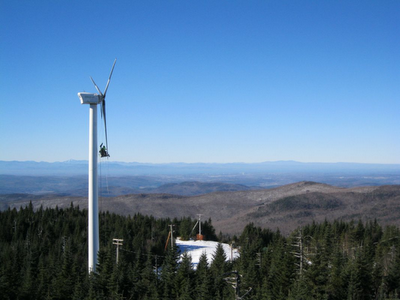
A small but growing trend amongst snow resorts in North America is the development of renewable energy within the resort area. Given the high visual impact of existing infrastructure within resorts from chairlift and snow making infrastructure, there could be a strong argument for the inclusion of at least a few wind turbines in each Australian resort.

Image: Snowboard Green

One recent example of this trend overseas comes from Bolton Valley Resort, a locally owned and operated family ski and snowboard area, has constructed the first wind turbine at a Vermont ski area.

The following report comes from Snowboard Green: http://snowboardgreen.blogspot.com/2010/11/bolton-valley-resort-in-vt-utilizing.html

The turbine is located near the top of a Quad lift in an existing clearing adjacent to the ski patrol hut. It produces in excess of 300,000 kilowatts of power annually, the equivalent of electricity consumed by 40-to-45 Vermont households.

The turbine, a Northwind 100 manufactured by Northern Power Systems of Barre, VT measures 121 feet in height from the ground to the top of the tower. The distance from ground to the top of the blade is 156 feet. Each blade is coated with Teflon to protect against icing. It is the same process used on turbines in the Bering Sea. The turbine will not be obviously visible from beyond five miles away from the site.

The turbine will be set up to feed excess power that is not consumed by Bolton Valley into the grid through the Vermont net metering program. It is the first turbine at a Vermont ski area and just the second at a ski area in the United States.

Hopefully more ski resorts in the US and around the world will follow suit!

You can find the website for Bolton Valley here. http://www.boltonvalley.com/

Jumping Bass Strait

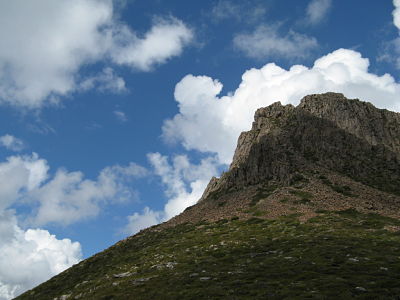
Sunrise on The Acropolis & Mt Geryon, TAS

So far, this site has focussed solely on mainland Australia. But with winter over and everything warming up, we are coming into peak time for wanders and other outdoor adventures in Tasmania. And after all, Tassie has our rockiest and wildest mountains.

So it seemed like time to start to include some content from the Southern Island. I thought I would add a few random shots from some recent mid winter Tas trips to get things rolling.

Please feel free to send stories, updates, or images on anything mountain-related from Tasmania.

Posts on Tasmania will be added here.

Climbing Castle Crag, TAS
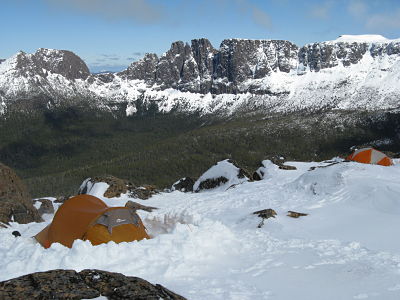
Camp near Castle Crag

Plan to re-open Buffalo Chalet emerges

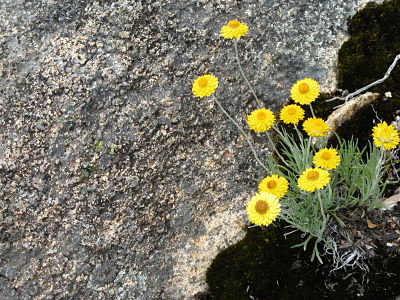
Wildflowers, Buffalo Plateau, VIC

The resurrection of the landmark Mount Buffalo Chalet is a step closer to reality after the state government agreed to help a local community group develop a plan to redevelop the building.

The government will give it a 12-month deadline and $200,000 to develop a viable business model that will redevelop and operate the 100-year-old chalet. The building is Victoria’s first ski lodge and was a plum holiday destination for Melbourne’s wealthy.

The community group, known as the Mount Buffalo Community Enterprise, has 16 shareholders, including well-known local business figures such as John Brown of Brown Brothers Wines and Tom O’Toole from the Beechworth Bakery. But the biggest name among shareholders is former deputy prime minister and current ambassador to the Vatican, Tim Fischer.

The group pledged that if it revived the chalet, it would distribute 51 per cent of profits to a community foundation, with the balance to be shared between investors.

From the article Mt Buffalo’s ‘grande dame’ wins powerful new friends by Darren Gray, The Age, October 29, 2010.
For the full story, check here.

Why cattle will never again roam free in the Victorian high country

Summer storm on the Bogong High Plains, VIC.

An opinion piece by Phil Ingamells of the Victorian National Parks Association about the Victorian Coalition’s promise to return cattle grazing to Victoria’s high country.

He suggests that the Coalition seems to be playing politics with the cattlemen, promising to bring them back to the high country, even though they must know it can’t actually happen.

The article is available here.

Blog at WordPress.com.

Up ↑