Search

Mountain Journal

Environment, news, culture from the Australian Alps

Getting ready for the fires of the future

We know that climate change is driving hotter and drier summers, and making fire seasons worse, and this is impacting on mountain environments. From the huge fires in Tasmania over the 2018/ 19 summer to repeated wildfire in the Victorian Alps which is changing the nature of ecosystems, fire is increasingly impacting negatively on mountain ecosystems. We also know that we need to expect a ‘highly active’ fire season this summer.

While the impacts on natural systems is obvious, there are also many economic ones, as longer and more dangerous fire seasons see mountain areas closed to tourism and other economic activity.

There is also the threat to the ability of fire fighting services to fight fires wherever they emerge. Traditionally, the various fire services share resources, both between the states and internationally. But as fire seasons become longer, there is more overlap of local fire seasons, and hence it is harder for individual states to release fire fighting equipment and crews to support other areas.

The economic cost of fighting fires also goes up.

And as demands on fire fighting agencies increase, there is the risk that ‘asset management’ (protection of human structures) can override the need to protect sensitive natural environments where there simply aren’t enough resources to fight all the fires.

Recently, 23 emergency services experts from every state and territory have written to the federal government, asking for strategic national firefighting resources to cope with climate change.  They have joined together to highlight the risks of worse and more sustained fire seasons to our ability to fight fires in an effective and timely fashion.

Continue reading “Getting ready for the fires of the future”

Snowy 2.0 will be ‘Environmental Vandalism’

The NSW government has now released the Environmental Impact Statement (EIS) for the Snowy 2.0 hydro project.

At the core of the Snowy Hydro 2.0 expansion will be the establishment of a new underground tunnel linking the Tantangara and Talbingo reservoirs and the commissioning of a new underground power station that will operate as Australia’s largest pumped hydro energy storage system.

The main works for the Snowy 2.0 project will include the removal of an estimated 9 million cubic meters of excavated rock. The federal government owned Snowy Hydro has proposed that more than half of this excavated material be relocated within either the Talbingo or Tantangara reservoirs, with the remaining material used to establish permanent structures, or for land forming.

While the prospect of a renewed Snowy Hydro scheme, operating as the ‘battery’ for the eastern seaboard, has appeal from a climate angle, it has not – until now – been clear what the physical footprint of the project might be. The EIS outlines the likely direct impacts of the works that would be required under the scheme. The National Parks Association of NSW (NPA) says that the EIS ‘proposes a completely unacceptable level of damage to Kosciusko National Park’.

Continue reading “Snowy 2.0 will be ‘Environmental Vandalism’”

Climate change pushing the alpine zone off mountains

We know that temperatures are increasing around the planet, and that this temperature increase is not uniform – areas at higher latitudes are experiencing a faster warming than areas closer to the equator. We also know that our own alpine environments are being affected by more erratic snow seasons, greater drought and longer fire seasons, and that this is affecting both plant and animal communities. This warming is more apparent at higher elevations.

Australia’s higher mountain ranges are relatively low and located at moderate latitudes. Our alpine zones are often quite isolated from each other, which increases the risk of localised species or community loss if a devastating fire impacts any particular area. We know that the snow line is rising and snowpack is in decline. As the snowline gets higher, warmer conditions will allow species to colonise higher up the mountain zones, potentially meaning that, over time, true alpine vegetation communities are ‘pushed’ off the top of mountains. For instance, recent research conducted by Brodie Verrall and Catherine Pickering from Griffith University found that subalpine grasslands will be impacted by ‘warmer and drier conditions becoming more common and repeat fires in some areas’, (resulting in changes to) ‘the distribution and composition of this and other communities in the Australian Alps’.

Continue reading “Climate change pushing the alpine zone off mountains”

Reducing waste at Mt Hotham

The following update on efforts to reduce the amount of rubbish going into landfill at Mt Hotham comes from the Resort Management Board:

‘Hotham’s pristine environment is a key reason people visit year after year, and it’s the responsibility of the Mt Hotham Alpine Resort Management Board (MHARMB) to protect this precious place. Over the past two decades MHARMB has worked to reduce the amount of rubbish exiting the resort into landfill. From 2002 to 2010 an active recycling program saw the amount of collected compacted recyclables double, and from 2010 to 2017 the amount of annual waste sent to landfill reduced by 112.5 tonnes.

The Chaser’s War on Waste has helped bring the issue of waste and its impact on the environment to the notice of everyone, but Australia continues to be to among the most wasteful nations in the developed world. However, Hotham is doing its bit in this battle and even as visitation grows year on year, the resort continues to reduce the amount of rubbish it puts into landfill.

Here on the mountain, MHARMB provides transparent red bags for municipal waste, clear bags for recycling and ‘Livin Bin’ green containers with opaque compostable liners for organics and food waste. In winter garbage is collected every day, with all waste from around the mountain taken to the recycling shed where it is sorted. The transparent red bags recently replaced opaque black bags to allow collection staff to identify and remove any items that can be recycled rather than be placed in landfill.

The empty plastic bags and all cardboard is baled and recycled by the garbage team, while co-mingled recycle items are sent to Tambo Waste near Bairnsdale. General trash is sent to the resort’s landfill site at Cobungra, while food waste is put in skips until full and are then delivered to the Cobungra facility to be composted. The compost is then used for revegetation programs.

Batteries are taken by MHARMB too (via collection bin in the MHARMB office), and cigarette butts are collected from butt bins; both are sent for recycling while the resort’s hard waste collection has recently expanded to include e-waste. Additionally, foam boxes are collected, stored and at the end of the ski season taken to Albury Transfer Station where they are chipped and melted into blocks for reuse – last year half a tonne of foam left the resort.

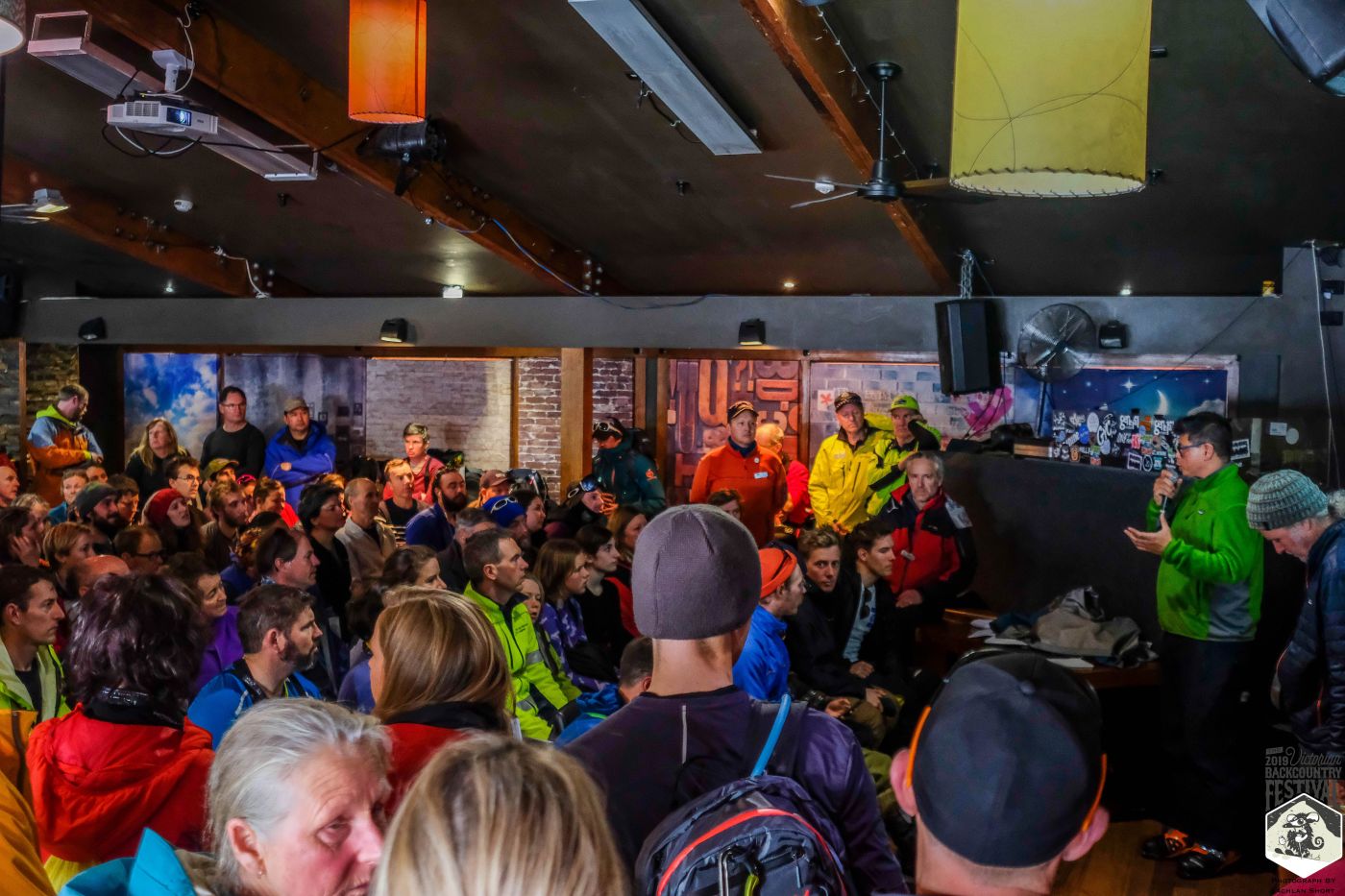
Bev Lawrence David FThese are the main collection streams on the mountain but there are also many other items gathered and recycled by individuals, lodges and even Hotham Kids Club. Many of these initiatives have been kickstarted by MHARMB’s Environmental Officer Bev Lawrence (pictured here at the recent Backcountry Festival), a local icon who is passionate about reducing waste to preserve our fragile environment.

“Landfill is filling up and if we don’t slow it we’re just going to go under with rubbish. If something can be recycled or reused rather than being put into the ground – great,” Bev said. “People who get involved in recycling tend to see the long-term picture and the garbage team here at Hotham is really passionate and very committed to what they do.”

Bev says people often don’t believe the effort the resort goes to reduce solid waste and to dispel any myths, she runs tours of the recycling shed for anyone wanting to learn more. If you are interested in a tour of the Hotham recycling centre you can email Bev at environmental@mthotham.com.au.


Continue reading “Reducing waste at Mt Hotham”

Backlash forces International Ski Federation to adopt pro-climate position

You might remember when the president of the International Ski Federation (FIS) Gian Franco Kasper went on-the-record in February, denying human-caused climate change and the science that supports it? Many in the snow sports community were suitably outraged, and Protect Our Winters (POW) started a letter writing campaign to ensure that FIS adopted a position consistent with mainstream climate science.

Following the campaign, FIS announced this week that it had joined the U.N. Sports for Climate Action Framework and made it part of its sustainability policy.

POW reports that ‘after seven months and more than 9,000 letters sent to FIS from the outdoor community, check out what we’ve accomplished together––it’s encouraging news and shows what the outdoor community is capable of’.

Continue reading “Backlash forces International Ski Federation to adopt pro-climate position”

What’s happening with the Tyndall Ranges ‘Iconic Walk’?

The Tasmanian government promised $20 million at the last election to develop Tasmania’s “Next Iconic Walk”, which was intended to be another hut-based multi-day ‘Three Capes Track’-style development. After a public call for ideas last year, some 20 odd submissions were apparently received, but the full list has never been made public. Then, after another internal process without public scrutiny or clearly detailed selection criteria, the chosen option was announced on 26 July.

Based on a proposal from the West Coast Tourism Association, it focuses on the Tyndall Range. This is unfortunate as the original proposal didn’t do this, instead mentioning it only as a possible final-stage option. But it is not clear how this proposal will be moved forward, beyond the recent announcement that there will be ‘consultation with the public’.

Continue reading “What’s happening with the Tyndall Ranges ‘Iconic Walk’?”

VIC backcountry festival 2020

After receiving resounding feedback about the 2nd Victorian Backcountry festival, we have decided to lock in dates and locations for 2020.

It will be a three day festival, held from Friday to Sunday, September 4 – 6.

Due to the huge level of support from the Hotham community and businesses and attendees, we will keep the festival at Hotham.

We will keep the basic format – lots of tours and workshops, speaker’s program, outdoor bar, AST 1 avalanche training, and an extended trip after the festival. Spreading the festival over three days will allow us to fit more in.

There is still time to provide feedback. Check the online form here. We’re getting some really great feedback on how to make it a better event, so please take a few minutes to let us know your thoughts.

If you know of any major clashes with these dates, please let us know asap. Cam.walker@foe.org.au

See you out there.

The Mountain Pygmy Possum recovery program gets ready for a tough summer

Each spring for thousands of years, tens of millions of bogong moths (Agrotis infusa) have migrated more than 1,000 kilometres from their breeding grounds in southern Queensland, north and the western slopes of New South Wales, and Victoria, to caves in the Australian Alps.

Continue reading “The Mountain Pygmy Possum recovery program gets ready for a tough summer”

How the outdoor industry supported #ClimateStrike

In the last few days, millions of people from around the world marched to demand serious action on climate change. While the climate strikes were initiated and led by students, people from all walks of life joined in. From First Nations people to unionists, a huge cross section of society were out and on the streets. Girls in Afghanistan, school students in Uganda, small rural communities and more than 2,600 businesses in Australia alone.

As we know, climate change poses an existential threat to wild landscapes across the planet. So how did the outdoor community, and the businesses that rely on a healthy outdoor environment support the strike?

For me, a local standout was the climate strike event organised at Mt Hotham in the Victorian Alps. While ski resorts in Australia have been slow to act on emissions, change is slowly coming and this community-led initiative gives me hope.

What else happened?

Continue reading “How the outdoor industry supported #ClimateStrike”

Support the #climatestrike – wherever you are

On September 20 people around the world will be standing up to confront the climate crisis because our politicians won’t.

Australia is already on the frontlines of the climate crisis. Prolonged drought. Flash flooding. Erratic winters. Catastrophic bushfires, severe cyclones and heatwaves. But just at the time when we need to ramp up climate solutions, our government wants to open the floodgates to new coal, oil and gas projects that put all of us at risk.

So, on September 20, three days before the UN Emergency Climate Summit, school students are inviting everyone to join them for the biggest ever global #ClimateStrike. There are more than 100 events planned around Australia (check here to find your closest event).

Members of the Mt Hotham community will be supporting the strike (check here for details).

If you can’t join the strike, why not post your support from wherever you are.

Outdoor adventure relies on healthy natural environments. Whether you walk, climb, ride, paddle, ski, trail run, snowboard – or anything else – the environment you love is at risk from climate change.

And if you work in the outdoor industry, your livelihood is at risk from out of control climate change. For instance, the Australian ski industry alone generates more than $1.8 billion a year and employs more than 18,000 people. Yet under current greenhouse scenarios, climate change could cut Australia’s ski season by more than two months.

It’s easy to support the strike without showing up >

  • Take or post a photo of you in a favourite place.
  • Post on whatever platform you prefer, using #climatestrike and #PlacesWorthProtecting and say that you support the strike and want governments to act on climate change. Tag in the PM: @ScottMorrisonMP

And why not sign our petition to the PM while you’re at it?

Protect Our Winters is mobilising the outdoor community to take action on climate change. You can find out more and sign up for their newsletter here.

Other ideas on taking action are available here.

IMGP1038

Below: The Hotham community is supporting #ClimateStrike. Images: Karl Gray

mt hotham2

mt hotham

mt hotham3

mt hotham4

Hotham strike poster

Image below: Kelly van den Berg

Kelly

Image below: Climate strike in Jindabyne. Photo: Shawn Marlene Joynt-Davies

Jindabyne

Image below: Bright, NE VIC. Photo from Sustainable Upper Ovens.

Bright

70930555_10157878752828487_6332387905914273792_n

Image below: Josh Fletcher, Protect Our Winters Australia. Mt Buller.

Josh

Josh2

Image below: Bright Brewery.

‘CLIMATE ACTION // We’re made for the mountains – we live, play, and brew here. Climate change is already impacting our mountain home and the future threats to the places we love are terrifying. Massive kudos to the students of Bright P-12 College for organising today’s local #climatestrike Our mountains are definitely #placesworthprotecting

Bright brewery

Image below:

marncat

Look at this beauty. It’s seriously #worthprotecting Change needs to happen. #placesworthprotecting #climatestrike

Marncat

Image below:

hannahmajigy

#placesworthprotecting . Supporting the #climatestrike because #weallneedwinter . @scottmorrisonmp we need climate action to protect these places

Hannah
Image below: Brett Webb.
Brett Webb

wildernesssports

The @globalclimatestrike is happening TOMORROW (Friday 20th) There are over 100 events across Australia happening but if you can’t be there, why not post a photo of your favourite place. Even better, one of yourself in your favourite place. Tag yourself in to #ClimateStrike. Add your voice.

wilderness sports

Image below:

snowsafetyaustralia

Mining was a big part of my earlier life. Paid for my way of life for a long time. Whether its coal, iron ore or limestone, these industries are still needed but there are now options to reduce our carbon footprint. I now work in renewables for a large wind farm generating zero emissions and with no need to fuel the turbines with anything other than free wind it’s a win – win scenario for the generation market.
Dont let the government tell you it’s fake news.
#protectourwintersaus

Adam W

Image below:

brodyleven

Let’s go absolutely huge tomorrow. globalclimatestrike.net for a march near you
pics by @jamesqmartin

Brody

Image below: Mountain Kitchen, Dinner Plain.

Students from the Alpine School heading to the climate event.

Mtn Kitchen

handmade.2483

Let’s protect all of are favourite places#climatestrike #placesworthprotecting

handmade

Image below:

patagoniaaus

Todays #climatestrike in Sydney was incredible. We’re inspired by the next generation that lead the march.
Our leaders can’t ignore their push for action.
There’s no room in government for climate deniers.
#answerwithaction 📷 @jarrahlynch

Patagoniastrike

Image below: From Respect The Mountain (Hobart).

Protecting our winters. The people’s mountain – dogs are welcome too!
Thankyou to all the climate action strikers who were out there in force yesterday.

Image Credit: Gary Tew, kunanyi/Mt Wellington 2018.

kunanyi

Image below:

thenorthface_aunz

A number of our stores will be closing today to support Global Climate Marches across Australia and New Zealand.

TNF

“I support action on climate change not just because I want to protect the beautiful places in which I play, but because it is basic common sense to care for the one planet we have. Climbing and Paragliding, my two favorite sports owe many of their evolutions to advancements in efficiency and technology – the same innovations that are helping with the climate crisis. I’m proud to be on The North Face Team that shares these values and is making meaningful action to reduce their impact and inspire others to do the same.” Words by @cedarwright

Image below: Paddy Pallin

Paddy Pallin is proud to support the Global Climate Strike.
⠀⠀⠀⠀⠀⠀⠀⠀⠀
Join us, we are striking for the future of our planet!⠀⠀⠀

Paddy Pallin

Update on the kunanyi/ Mt Wellington cablecar proposal

Mount Wellington Cableway Company (MWCC) want to build a cablecar up the face of kunanyi/ Mt Wellington, in Hobart. This is being resisted by a determined community based campaign. Things have been a bit quiet of late. Here is an update from Residents Opposed to the Cable Car which highlight some significant shortcomings in the development application for the cablecar proposal.

Continue reading “Update on the kunanyi/ Mt Wellington cablecar proposal”

‘This is what climate change looks like’. Impacts on mountain environments

The Climate Council have released a report called This is What Climate Change Looks Like (available here). It has lots of good, albeit depressing, information about how climate change is already impacting on natural environments across the continent, including mountain environments.

Mountain Journal has covered these issues before – increased fire risk to Gondwanic remnant vegetation in Tasmania, threats to iconic species like the Mountain Pygmy Possum and loss of snowpack, but this is a succinct collection of stories about impacts on wild nature in Australia.

The report notes that ‘droughts, ‘dry’ lightning strikes and heatwaves are transforming many Australian forests’ including the alpine ash and snowgum forests that we know and love.

Continue reading “‘This is what climate change looks like’. Impacts on mountain environments”

Blog at WordPress.com.

Up ↑