Search

Mountain Journal

Environment, news, culture from the Australian Alps

Tag

climate change

Auden Schendler on climate change – skiers can make a difference

After a decade of inaction, the Australian snow industry is finally starting to engage meaningfully on the issue of climate change. With Perisher having been bought by the Vail Resorts group, it has been swept along in that companies efforts to achieve carbon neutrality for it’s operations by 2030. And Thredbo recently became the first Australian resort to formally join Protect Our Winters (POW) the activist group seeking to mobilise the snow sports community.

There is, of course, still plenty of room to move. Many resorts, like Mt Hotham, are still effectively in denial about climate change, opting for the ‘we’ll just invest more in snow making capacity’ option. But as the recent visit by POW founder Jeremy Jones showed, there is a significant interest in the snow community about climate change.

We are starting to see some great leadership from prominent skiers and riders like Nat Segal, who is a vocal advocate for climate action. The interview below comes from Powder magazine and features a conversation with Auden Schendler of the Aspen resort. Auden is often seen as a key global spokesperson on climate because of his work at putting Aspen on a sustainable footing. This reflection has some significant things to say about what is and what isn’t possible in the resorts and what is required if we are to take effective action to limit climate change.

Two salient points that stand out for me from this interview are:

“We have to acknowledge or understand as a starting point that to be sustainable has got to mean solving climate change.

On climate, if you’re not at risk politically or from public criticism, and if you don’t feel uncomfortable, if it doesn’t hurt, you’re probably not doing enough on climate”.

The take home message from Auden is that making your operations greener is not an end point. It’s part of the pathway to solving climate change. This is going to involve sustained and public advocacy for the adoption of policies which will tackle climate change in a meaningful way – ie, engagement in good old fashioned politics. As he eloquently puts it, it means advocating for ‘systemic change’.

He reminds us that the current option adopted by most resorts is simply not going to work:

‘You can’t adapt to where we’re headed … we’re headed toward four degrees Celsius’.

Continue reading “Auden Schendler on climate change – skiers can make a difference”
More frequent fires threaten snow gums

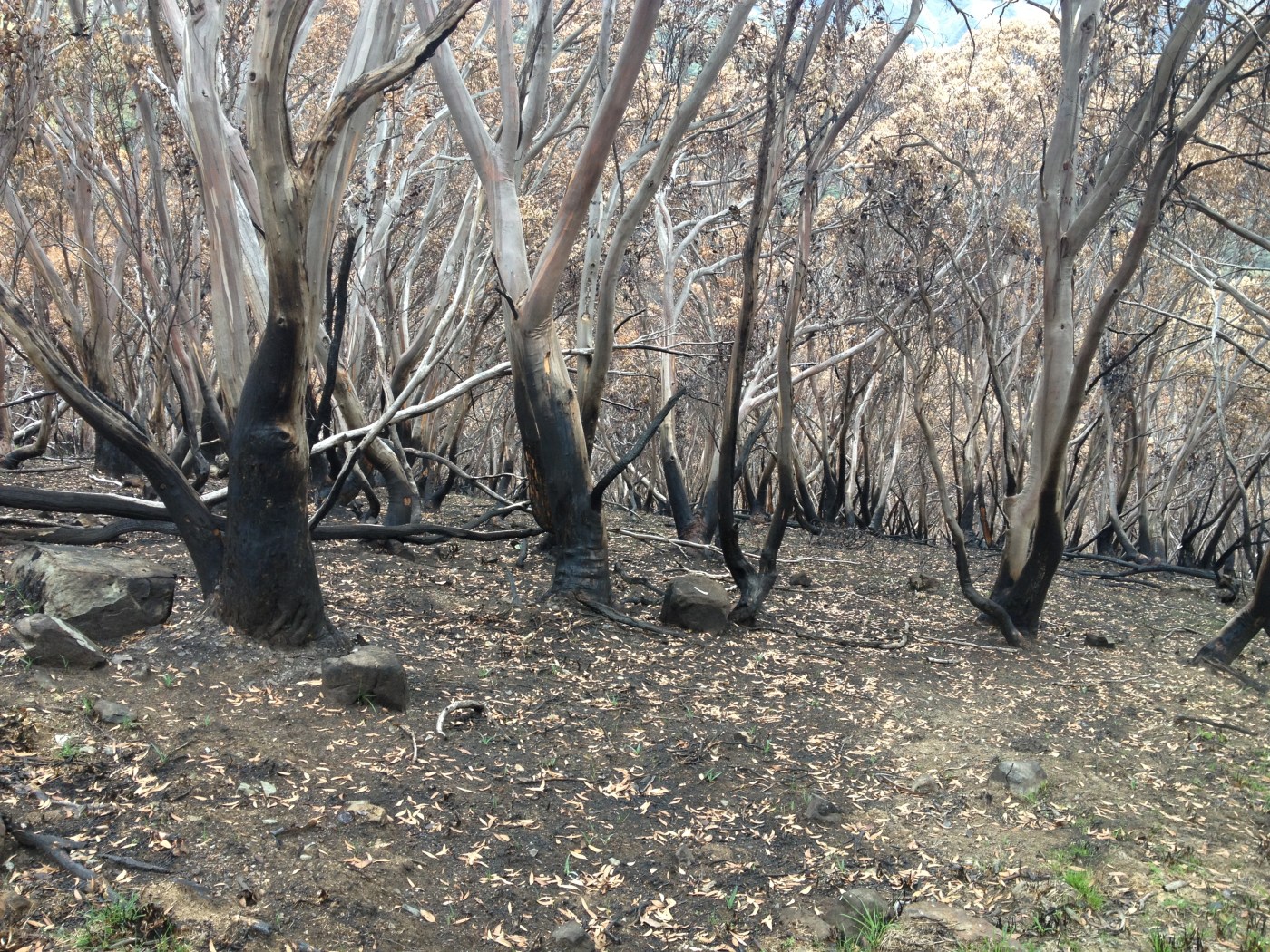
Fire has had a significant role in shaping mountain ecosystems in Australia for millions of years. But climate change is making our fire seasons more extreme and longer in duration.

What this means is that we are seeing more and more areas being burnt more frequently. In the case of the Victorian mountains, I have seen some areas of alpine ash and snow gums that have been burnt three times in a decade. Each year it feels like the world is getting poorer as these forests are impacted time and again, potentially beyond their ability to recover.

It’s the same story everywhere. Who can forget the devastating fires in Tasmania over the summer of 2016?

As we hear warnings that this summers fire season may be a bad one, massive fires are raging across much of western North America, causing many people to flee from their homes and communities. Vast areas of land are being burnt. For instance one fire in California swept through an area called Nelder Grove, which is home to 2,700-year-old giant sequoia trees. Human assets like historical buildings are also being threatened or destroyed.

There are fires across much of the rest of the northern hemisphere too. Check the incredible maps in this article entitled ‘This is how much of the world is currently on fire’.

Recent research here in Australia demonstrates that fire impacts are growing on snow gum forests and will continue to do so in future. Mountain Journal has reported on a number of these reports in the past. A new report from researchers at Melbourne University has a shocking message: ‘over 90% of the Victorian distribution of snow gums has been burned at least once since 2003. What is of greater concern though, is that each of the large fires of the last 15 years has overlapped to some extent, leaving thousands of hectares of snow gums burned by wildfire twice, and sometimes three times’.

Continue reading “More frequent fires threaten snow gums”

Australian snow pack in decline since 1957

Anyone who is paying attention to the state of our winters knows that they are getting more erratic. Often they start later (it’s a rare thing to ski on natural snow on opening weekend) and subject to more rain events, with big impacts on snow pack. While our climatic patterns go through natural wetter and drier cycles, climate science tells us that these patters will become more extreme, with less overall snow and shorter seasons.

Anecdotes and personal experience are one thing. But when did the snow pack actually start to decline?

While all resorts track snowfall, the benchmark of snowfall in Australia over time comes from Spencers Creek, at a site at 1,800 metres above sea level, in the Main Range of the Snowy Mountains. The following article comes from ABC Rural and gives a sense of the decades worth of data that is available from this site, and the process of getting the data. The measuring site was originally established to give the Snowy Hydro managers a sense of what water was trapped in the snow pack and hence how much water would be released in the spring. As skiers and riders, what it gives us is a long term summary of the trends in snowpack over the past six decades.

The take home message is that, overall, snowpack has been declining for decades and unabated climate change will make that worse. While the article does not drill into this issue in detail, previous analysis of this data by Terry Giesecke suggests that:

“There has been a downwards trend (in snow pack) from 1957 to 1989. It then goes up dramatically for about four years, before resuming a downwards path”. This research suggests that the increase in snow depth between 1990 and 1994 could have been due to global cooling which occurred as a result of major volcanic activity in the Philippines in 1991. Using data collected up until 2016, it also notes:

“There is evidence of further decline in the first 16 years of the 21st century.”

The full article is below.

Continue reading “Australian snow pack in decline since 1957”

Vail aims to become a ‘sustainable tourism destination’

Mountain Journal recently reported that the famous Colorado resort of Vail had announced its intention to ‘commit to zero net emissions (partly through use of renewable energy to run its operations), zero waste to landfill and zero net operating impact to forests and habitat by the year 2030’.

Vail is a town built around ski field development. While only about 5,500 people live there (supported by a large ‘down valley’ community in towns like Avon and Edwards who must commute to work) it hosts as many as 2.8 million visitors a year.

Aspen, located to the south west, is probably better known for its sustainability efforts, but Vail’s commitment is ambitious. The recent announcement on energy and waste came from Vail Resorts Inc, the company that runs the resort operations. There is also a commitment from the Town of Vail, based in the valley below the resort, to become North Americas first sustainable tourist destination certified through the Global Sustainable Tourism Council.

Continue reading “Vail aims to become a ‘sustainable tourism destination’”

Vail commits to zero net emissions by 2030

Unless we act decisively now, climate change poses an existential threat to life as we know it. For people who love the outdoors or whose livelihood relies on good snowfall or a healthy environment – the skiing and outdoor industries – there is an added incentive to be engaged and active.

No person, business or sector can solve the problem on their own, but that’s kind of the point: we need all hands of deck to deal decisively with this looming threat.

It’s good to remember that many in the community are taking action. Around the world there is a growing willingness to be actively involved in responding to climate change – through mitigation (reducing the production of greenhouse gases), supporting behaviour change, engaging in advocacy, and developing cleaner production methods.

Here are two good news stories from the USA.

Continue reading “Vail commits to zero net emissions by 2030”

Jeremy Jones at Mt Buller, July 23

GET HIGHER WITH JEREMY JONES

23 JUL 2017

Internationally renowned big mountain snowboarder Jeremy Jones is highly regarded for what he can do on a snowboard and now also for his important work leading the non-profit organisation “Protect Our Winters” (POW) championing awareness and action on climate change.

Jeremy is visiting Mt Buller and will present his award-winning snowboard film “Higher” on Sunday 23 July at 7.15pm.  He will also speak about his passion for protecting the mountains he loves and why ‘we need winter’.


Higher is the third in an inspiring trilogy of films that started with “Deeper” and “Further” and documents Jeremy taking on extreme snowboarding adventures deep, far and high into the mountains starting near his home in Squaw Valley, then Jackson Hole Wyoming, Alaska and Nepal.

Many snow films, including some he’s made earlier in his career, use helicopters to access the lines they ride and film.  In “Higher” Jeremy climbs each peak under his own steam working with his brother Todd and Steve at Teton Gravity Research to create the film.

***The night will book out quickly with tickets on sale at the Rip Curl store and Photo Shop at Mt Buller ***

Jeremy will take part in a Q&A and talk about his snowboarding career, his work with POW and his passion for riding which has seen him create his own snowboard range and spend time riding with his wife and children.  He is on holiday in Australia but accepted an invitation from his friend Tony Harrington to come and speak.  Jeremy is planning a ‘ride’ day in which he looks forward to exploring Mt Buller with local boarders and experiencing snowboarding amongst the snow gums.

Protect Our Winters began ten years ago. Since founding the organisation Jeremy has grown the awareness and action of POW to include a global network of over 130,000 supporters and engaging with 60 million + snowsports enthusiasts.  As Jeremy explains,

Though we can dress up for meetings, in the end we are pro athletes, dirtbags and diehards; for us, winter is not just a passion, but a way of life.  Right now, we have the luxury of worrying about how climate change might impact the outdoor industry. Right now, we get to help dictate the outcome rather than react to a foregone conclusion. If we sit on our hands for the next two decades, we won’t be worried about powder days, tourism or having fun. We’ll be worried about the stability of our environment, our jobs and our economy.”


Continue reading “Jeremy Jones at Mt Buller, July 23”

The ski industry and climate change. The denial continues

We’re now into early July and the only skiable ski in any of the resorts is there because of snow making. And while everyone in the ski industry knows what’s happening when it comes to climate change, they continue happily on the pathway of ‘diversification’, expanding activities in the ‘green season’ and investment in snow making equipment, to the exclusion of any meaningful action on climate change.

I always struggle to understand this. Surely any smart business can ‘walk and chew gum’ at the same time – in this case that would mean diversifying your year-round tourism ‘offerings’ while investing in snow making while also walking the talk on climate. Its also called mitigation, it means doing things like shifting your operations to using renewable energy instead of coal. What is astonishing is that there is so little meaningful action by Australian resorts.

Continue reading “The ski industry and climate change. The denial continues”

A perspective on the future of Australian snow

Dave Bain

This piece follows on from a previous article I wrote in 2012 for Protect Our Winters (POW) (Bain 2012). It takes a quick look at what the observed trends have been in Australian snowfalls over the past few decades. Regardless of people’s stance on climate change, these observations are a hard look at the likely future of Australia’s alpine environment, and our winter enjoyment.

Continue reading “A perspective on the future of Australian snow”

Action now means more snow later

We all know that winter is in trouble. Climate change is already impacting on snowfalls and winters are becoming more erratic.

A recent report commissioned by the Alpine Resorts Co-ordinating Committee (ARCC) confirmed, yet again, the grim prognosis facing the snow industry and snow lovers if we don’t take serious action to radically reduce our contribution to global warming.

Continue reading “Action now means more snow later”

As we get older, the forests get younger

In recent weeks we have heard the astonishing news that ‘up to half’ of the corals on the Great Barrier Reef may have died in the past two years. This confirms the worst fears of environmentalists and scientists and has led to an outpouring of grief by many people. It seems that, day by day, our world gets poorer as we lose iconic landscapes.

Many people know it: they can see landscapes that are disappearing or changing before their eyes. ‘Climate tourism’ (‘see the glaciers before they melt’) is actually a thing. Yet we continue, as a society, as if everything is normal.

Continue reading “As we get older, the forests get younger”

The 2017 Alpine Industry Conference

In early May, the Alpine Resorts Co-ordinating Council (*) (ARCC) hosted the ‘Alpine Industry Conference’ in Marysville.

While many participants were understandably focused on the imminent announcement about what will happen to the alpine resort management boards, and the overall theme of the conference was ‘managing a changing landscape’, a key issue was the threat posed by climate change to the very survival of the ski industry.

Continue reading “The 2017 Alpine Industry Conference”

Reducing the impact of our snow obsession

Outside magazine recently posted a great piece on the environmental impact of skiing/ riding. Well, one particular aspect – the amount of carbon pollution we produce through driving or flying to get to ski destinations.

They tracked and collated the travel mileage during winter of their most snow-obsessed staff, then consulted a carbon offset specialist, who estimated they would have to plant 704 trees to sequester all the carbon generated.

Continue reading “Reducing the impact of our snow obsession”

Blog at WordPress.com.

Up ↑