Search

Mountain Journal

Environment, news, culture from the Australian Alps

Tag

fire

Climate change and rise of the ‘mega fire’

Recent research by CSIRO, Australia’s national science agency, shows that climate change has driven a ‘significant increase’ in Australia’s forest fire activity over the last three decades.

A lengthening of the fire season towards Autumn and Winter were also identified, along with an increase in fire activity in cooler and warmer regions including alpine forests in Tasmania and tropical rainforests in Queensland.

This is not really ‘new’ news. The impacts of climate change in terms of length of fire season and intensity of fire is well documented (for instance, the head of the firefighting agency for Victoria’s public lands, Chris Hardman, notes that there has been a 170% increase in bushfire ignitions over the last 50 years, a 20% reduction in spring rainfall, and a 40% increase in very high and severe fire risk days.

What is especially interesting is that this research, which was published in Nature Communications is the first of its kind in that it combines analysis of previous forest fire sites with eight ‘drivers’ of fire activity including climate, fuel accumulation, ignition and management (prescribed burning).

Continue reading “Climate change and rise of the ‘mega fire’”

Calling mountain firefighters

You may have seen that we are now producing occasional print runs of a Mountain Journal magazine. The first one came out in August this year, is slowly being distributed, and available as a PDF here.

The themes of the first edition were First Nation Voices and Living with Fire. Based on feedback, a popular section was the ‘Around the Campfire’ pages, which feature chats with a number of people.

The second edition will also have a focus on fire but coming from the human side of the story. That’s where I hope you might come in.

Continue reading “Calling mountain firefighters”

Climate change & fire. The more we learn, the clearer it gets

Its mid November, just a couple of weeks until the start of winter in the northern hemisphere. After a horror summer of fires across the North of the planet, fires continue to threaten communities and landscapes in many areas. This week, mandatory evacuations were announced in the area of Estes Park in Colorado, as some ski resorts in that state prepare to open. The Larimer County Sheriff’s Office announced “evacuate the area immediately and as quickly as possible. Do not delay leaving to gather belongings or make efforts to protect your home or business.” Meanwhile, the city of Denver is getting close to its record for latest First Snow of the season. And after a summer of extreme weather, the north west of North America has been hit by massive floods.

What we do know is that climate change influences wildfire now. The evidence for this is so widespread and compelling that there is really no point in even trying to argue its not a real phenomena. Here is a quick recap of some of the most recent research into climate change and wildfire.

Continue reading “Climate change & fire. The more we learn, the clearer it gets”

Climate change is coming for the Places we Love

We all remember the terrible fire season of 2019/20. Among the huge range of impacts on people and landscapes, one significant detail was that the tourism season basically didn’t happen across much of the south east that year. Mountain towns, ski resorts, even valley communities were evacuated. Lots of people missed out on summer holidays. And many workers and businesses suffered terrible economic losses (compounded soon after by covid lockdowns).

It makes you wonder what the future looks like for communities that rely on beautiful natural environments to attract visitors, who then underpin the local economy. With forecasts of longer and more intense fire seasons, and more erratic snowpack in winter, it is hard not to see a future where ecosystems and local economies don’t struggle to adapt to the changes that are coming.

This problem is likely to occur everywhere. For instance, recent research, published in Global Environmental Change, looked at how the use of state and federal public lands in the United States may change in the next 30 years under two different warming scenarios.

The biggest changes, they found, will come during the summer months. Their research showed that by 2050 it will ‘simply be too hot to have fun outdoors in many places’.

Continue reading “Climate change is coming for the Places we Love”

Can ‘super seeds’ reduce the risk of local extinction of Alpine Ash?

Fire has always been a part of life here in Australia (well, at least for the last 60 million years). And as a result much of our vegetation is fire reliant or fire adapted. But climate change is changing fire seasons, making them longer and more intense. And this is having a terrible impact on many fire sensitive vegetation communities. The Alpine Ash is one of these.

After a series of fires in the early 21st century, the Victorian government had to intervene to ensure the survival of Alpine Ash communities through a ‘forest recovery program’ (source). Since 2002, more than 85% of the Alps bioregion has been burnt by several very large fires. Alpine Ash require around 20 years between intense fires in order for regrowth to be able to produce seed (source), and more frequent blazes are threatening the viability of this vegetation community across the Alps.

This restoration initiative has been an effective program which sources seed and then aerial sows areas which have been devasted by wildfire.

However, the program is being stretched by more regular fires and a review of the 2019/20 fires found that it doesn’t have enough seed stock to deal with bad fire seasons.

Now, Greening Australia and Minderoo Foundation have joined together to find ‘super seeds’ from the Alpine Ash which are suited to a changing climate.

Continue reading “Can ‘super seeds’ reduce the risk of local extinction of Alpine Ash?”

‘Wildfires, deforestation and global heating turn 10 Unesco forests into carbon sources’

A recent report looked into the impacts of climate change and other human activity on protected areas. It was pretty much as you would expect – these areas, protected because of their special values, are now at risk. According to various media stories (for instance this one in The Guardian) ‘Forests in at least 10 Unesco world heritage sites have become net sources of carbon since the turn of the millennium due to wildfires, deforestation and global heating’.

While this report takes a global perspective, it does contain details on two Australian systems – the Greater Blue Mountains Area and Tasmanian World Heritage Area – there are also some details relevant more broadly to protected areas in mountain areas of south eastern Australia.

Continue reading “‘Wildfires, deforestation and global heating turn 10 Unesco forests into carbon sources’”

Progress on a fire management plan for the TAS World Heritage Area

The Tasmanian Wilderness World Heritage Area (TWWHA) is one of the largest conservation areas in Australia, covering 15,800 km², or almost 25% of lutruwita/ Tasmania. It contains huge areas of wild landscape.

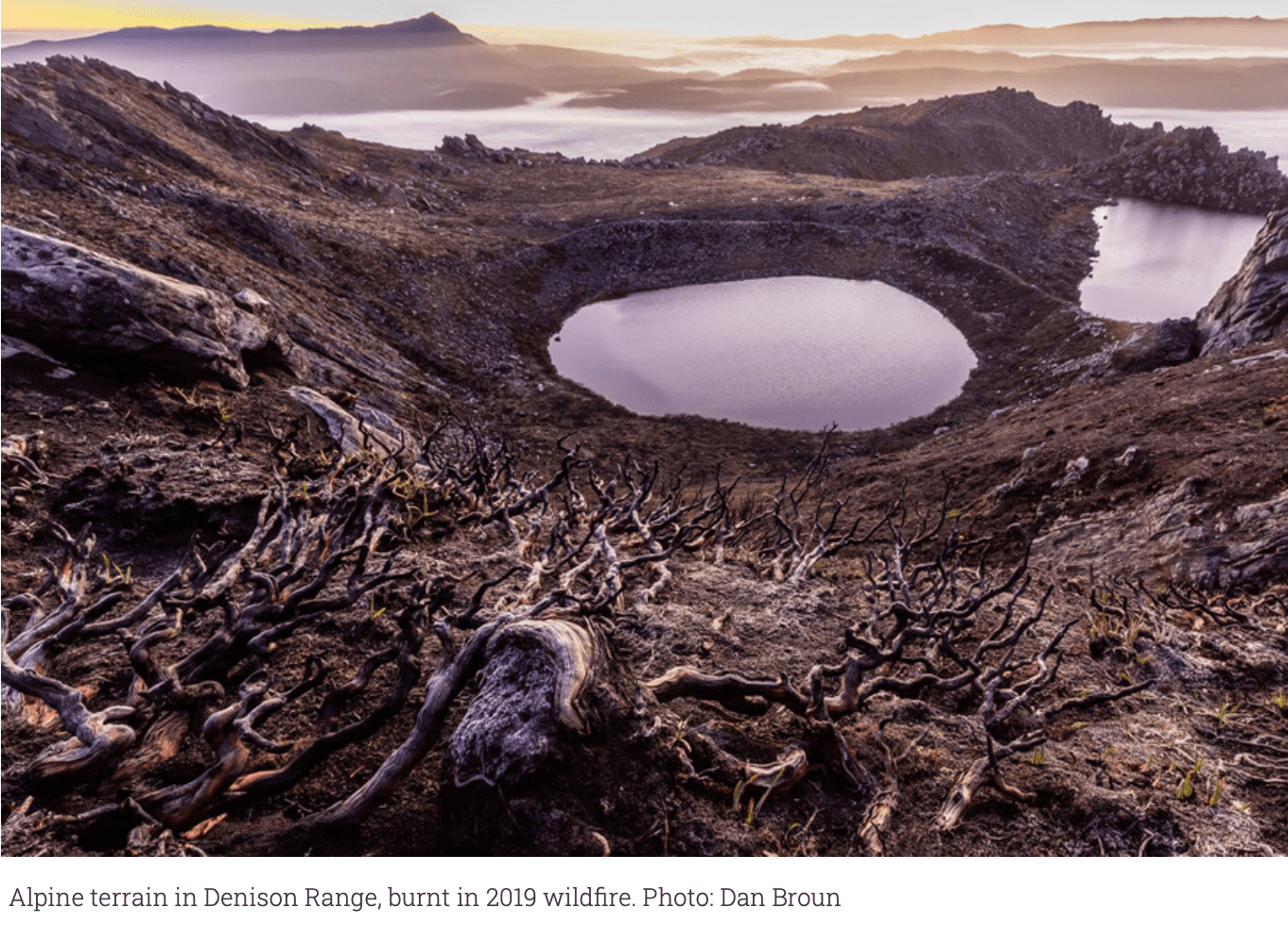
Sadly, fire is a huge threat to many vegetation communities in the TWWHA which are fire sensitive, particularly in the context of a changing climate.

We know that climate change fueled fire regimes threaten the TWWHA. For instance, the amount of vegetation burnt by fires caused by lightning strikes in Tasmania’s world heritage area has increased dramatically this century, according to research led by the University of Tasmania.

Following public consultation in 2020, plans for managing fire in the TWWHA are being developed. The Tasmanian National Parks Association (TNPA) says ‘we are pleased to see belated progress towards the development of a Fire Management Plan for the TWWHA’.

Continue reading “Progress on a fire management plan for the TAS World Heritage Area”

Alpine Ash recovery program not yet ready for mega fires

After the 2019–20 Victorian fire season, the Inspector-General for Emergency Management (IGEM) was charged with ‘investigating Victoria’s preparedness for the fire season, response to fires in large parts of Victoria’s North East, Gippsland, and Alpine regions, and will review relief and recovery efforts’. It has now released its second report, which looks at recovery efforts since the fires (available here).

It makes a series of observations and recommendations relating to the recovery of the environment after the fires. One is especially significant for the future of the Alpine Ash.

Continue reading “Alpine Ash recovery program not yet ready for mega fires”

Fire risk declines as forests get older

There is a long debate about whether logging tall wet Eucalypt forests increases or decreases the flammability of forests. On an intuitive level, it makes sense that allowing forests to become older will make them less flammable: over time the understorey thins out, the canopy closes in and creates a moister micro climate, and fire is less likely to climb up into the crown. In contrast, an area that has been logged will be filled with dense regrowth of highly flammable saplings and be exposed to the drying effect of sun and wind.

This is confirmed on a regular basis by research. New work considers the two common models which are used to describe how fire risk changes over time as the forest grows. The models are the ‘moisture model’, where fire risk initially increases, then decreases, as a stand develops after a fire, and the ‘Olson model’, where fire risk increases as a function of time since previous fire.

This new report – called Fire risk and severity decline with stand development in Tasmanian giant Eucalyptus forest – suggests that the ‘moisture model’ is correct in tall wet forests, and that over time fire risk is reduced.

Continue reading “Fire risk declines as forests get older”

Mt Pinnibar fires part of a bigger pattern

Mt Pinnibar (1,772 metres asl) is a lovely mountain in the far north east of Victoria, up above the Tom Groggin station in the Upper Murray Valley. On a clear day it has spectacular views of the Main Range of the Snowy Mountains.

Sadly it has also been devastated by bushfire. Most recently it was hit by fire during the horror summer of 2019/20.

The following images were taken in mid September 2021 by Trevor Staats and were originally published in the Australian Backcountry facebook group.

Continue reading “Mt Pinnibar fires part of a bigger pattern”

Future fire regimes threaten Alpine Ash

Alpine Ash (Eucalyptus delegatensis) is the classic tree of the sub alpine forests and tends to be replaced by Snow Gum woodlands at higher elevations. In Victoria it is also known as Woolybutt. It only exists in south eastern Australia (there is also a sub species in Tasmania). In Victoria, it occurs at altitudes between 900 and 1,500 metres above sea level.

It has had 84% of it’s range in Victoria burnt since 2002. Large fires occurred in 2002/03 in the north of the Alps, in 2006/2007 in the south. And during 2019/20, around 83,000 hectares of Ash forest was burnt, with 17,800 hectares of this being reproductively immature ash forest that burned at high severity.

We know that large old trees in ecosystems in Victoria which are dominated by Alpine Ash are in ‘rapid decline’. The problem is that Alpine Ash need around 20 years to reach reproductive maturity, so if fires happen more frequently than this, local extinction is possible because there is no seed stock to create a new forest.

New research shows us, yet again, that increased fire regimes threaten this vegetation community. Future fire regimes increase risks to obligate-seeder forests by Sarah C McColl-Gausden, Lauren T Bennett, Dan A Ababei, Hamish G Clarke, and Trent D Penman, and published on 23 September 2021 describes the impacts of fire on Alpine Ash.

Continue reading “Future fire regimes threaten Alpine Ash”

Ecological recovery in Namadgi National Park

In January and February 2020, the Orroral Valley Fire burnt more than 80% of Namadgi National Park in the ACT, leaving large areas blackened and apparently lifeless.

Monitoring the recovery of Namadgi National Park from the Orroral Valley fire has occurred since the fire. This is managed by the Environment, Planning and Sustainable Development Directorate within the Department of Environment, Heritage and Water. They have just released a great visual report on the recovery of animals and vegetation communities in the park. It is mostly good news.

The report is available here.

Some highlights from the report:

Many Candle Bark forests and Snow Gums are recovering quite well.

The rate of recovery appears to be strongly affected by moisture availability.

Wetter sites, such as Snow Gum woodland near Mt Franklin Road, are recovering faster. Snow Gums on drier and rockier sites are demonstrating less recovery.

One exception to the general pattern of good recovery is Alpine Ash (Eucalyptus delegatensis), which is killed by intense fire and must regenerate from seed.

It is uncertain how well Alpine Ash will recover after two intense fires only 18 years apart; Conservation Research ecologists are currently assessing the degree of fire impact and the extent of recovery in Namadgi’s Alpine Ash forests.

Fortunately, some important stands of Alpine Ash were not affected by the Orroral Valley fire. A total of 2,415 ha, or 33% of the Alpine Ash forest in Namadgi, did not burn in 2020.

Some species can benefit from burning.

By killing shrubs, removing leaf litter and creating areas of bare ground, the fire resulted in ideal conditions for the germination of short-lived herbs and grasses.

Billy buttons (Craspedia sp.) covered the burnt slopes of Mt Gingera in November. Later they faded and set seed, to be replaced by other brightly-coloured species. By February, bluebells and paper daisies (Xerochrysum spp.) were the dominant flowers.

We may not see another flowering event like this for years or decades.

How are fauna populations recovering?

Although the fire took a heavy toll on animals, many survived, either in unburnt or lightly-burnt patches or by taking shelter beneath the ground.

The first teams onto the fire ground found a surprising number of birds (click unmute background audio to listen), mammals, invertebrates, frogs and reptiles,

Preliminary results are encouraging. The burnt areas of Namadgi still ring with an impressive array of singing birds.

Blog at WordPress.com.

Up ↑