The theme for this year’s Mountain Journal magazine (which is available as a pdf here) was ‘the mountains are changing, are we ready?’
In delving into the changes being driven by global heating, destructive land use practises, and more people venturing into the mountains, we profiled four of our favourite mountain Icons.
Some icons of the mountains
Bogong moths
The bogong moth (Agrotis infusa) is a night-flying moth, known for its biannual long-distance migration in spring from inland areas to the Australian Alps, where they gather to aestivate (a form of dormancy) until they return to their breeding grounds again in the autumn. They can migrate up to 1,000 kilometres, using the Milky Way and specific star patterns as a directional compass, combined with the Earth’s magnetic field for calibration. They are the first insects that are known to use true celestial navigation. These small moths possess astronomical awareness rivalling that of ancient human navigators.
‘The moths can compensate for the Earth’s rotation, which causes stars to move across the sky throughout the night, and maintain accurate headings even when clouds temporarily obscure portions of the stellar map. Each moth makes this journey only once in its lifetime, meaning this navigational knowledge is innate rather than learned. The discovery suggests that for millions of years, these insects have been looking up at the same stars humans used to explore the world, finding their way across continents by reading the galaxy itself as their map’.
The moths have been of great significance to First Nations people in the south east, who would travel to the mountains to feed on the moths during summer, and they are also a key food source for the mountain pygmy-possum.
Mountain Pygmy-possum
This tiny possum (Burramys parvus) is Australia’s only hibernating marsupial. It hibernates under the snow for up to seven months a year. It is listed as being Critically Endangered.
There are three populations of the possums. They live in the alpine and subalpine boulders found across the Bogong High Plains and Mt Buller in Victoria and around Mt Kosciuszko in New South Wales. There are fewer than 2,000 Mountain Pygmy-possums left in the wild.
They rely on bogong moths for their food. Efforts to protect the endangered species from the threats of climate change and feral animals continue.
The Alpine dingo
Victoria is home to two distinct and genetically pure dingo populations: the Alpine and Mallee dingoes. The Alpine dingo ranges from Mt Buller to the NSW border and into eastern Gippsland, and unlike the classic desert dingo, appears in colours from near-white to almost black. Once thought to be hybrids or feral “wild dogs,” recent genetic research confirms these animals are largely pure, with true hybrids now rare in the wild.
Alpine dingoes are heavier, thick-set and well adapted to cold mountain conditions, and are genetically distinct from other dingo populations. Fewer than 3,000 remain in Victoria, yet many are still legally trapped, shot or poisoned, with 500 – 1,000 killed each year.
As apex predators, dingoes play a vital ecological role by suppressing foxes, cats, deer, goats and pigs. Where dingoes persist, these pests decline — helping protect threatened species such as the Mountain Pygmy Possum, identified by Zoos Victoria as highly vulnerable to fox and cat predation.
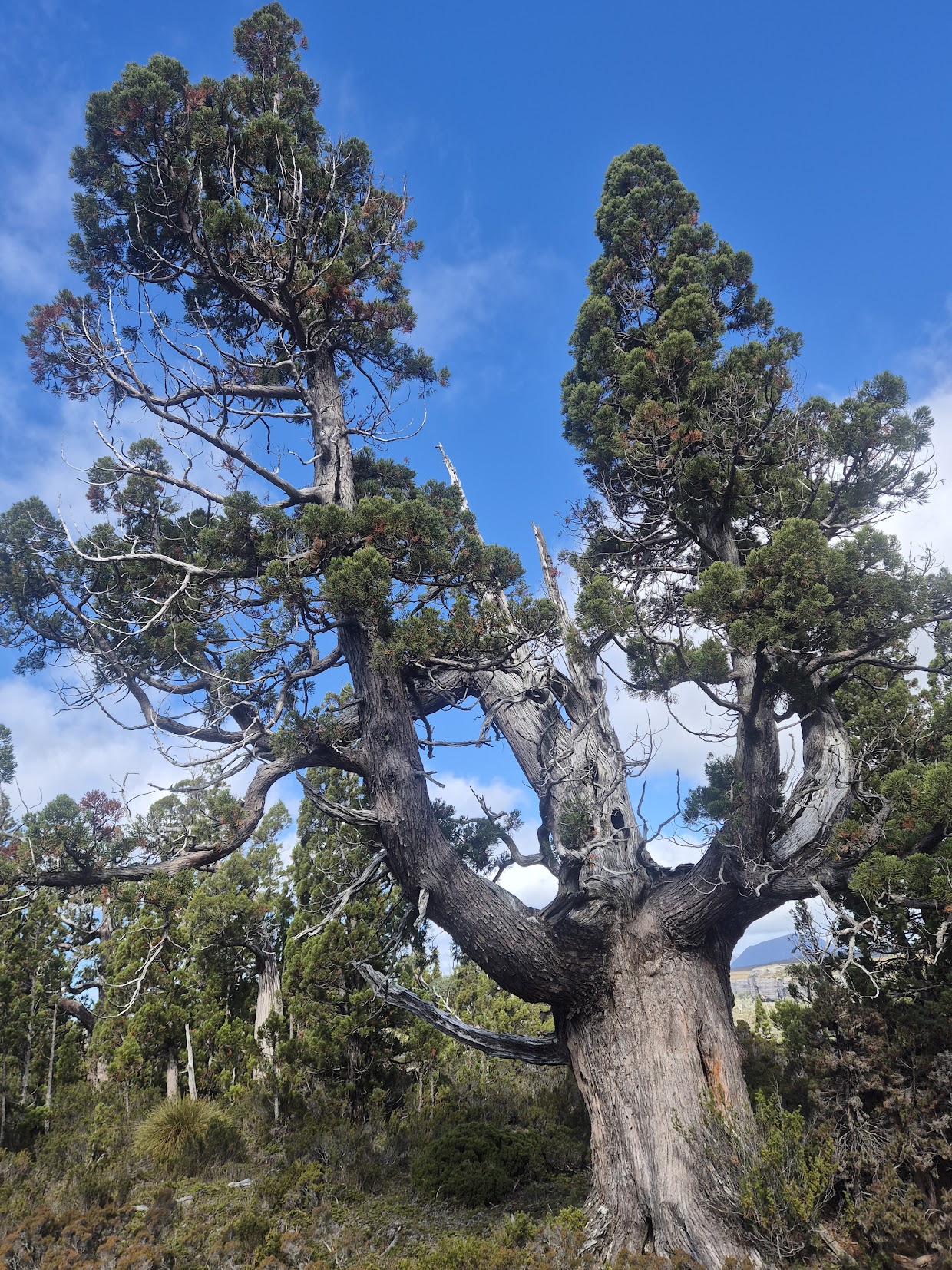
The Pencil Pine
The pencil pine (Athrotaxis cupressoides) is a much loved and wonderfully charismatic tree of the Tasmanian mountains where it is largely restricted to sub-alpine areas above 800 metres. It is one of the Gondwanan species – dating back to the times of the Gondwana super continent – and often grows around tarns, streams and lakes because of its intolerance to fire. Pencil pines can reach ages in excess of 1,200 years, but have little chance of recovery after a fire.
It is hard to imagine the mountains of lutruwita without these wonderful trees.




Leave a Reply