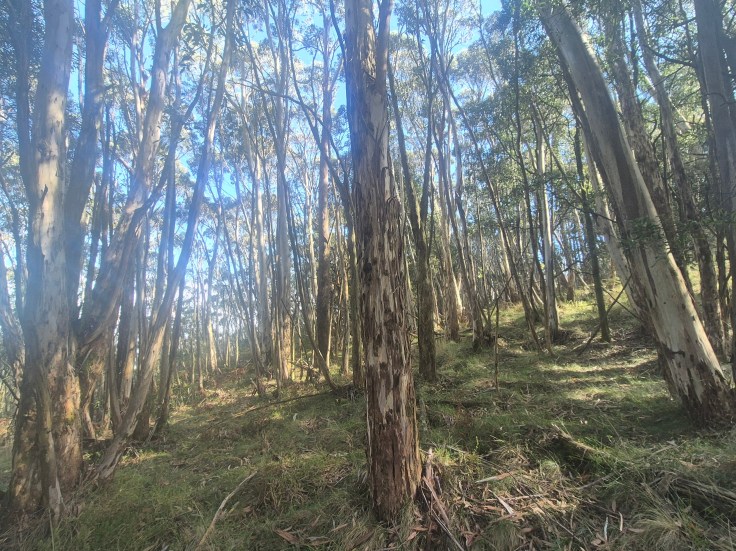
I live on Dja Dja Wurrung country in central Victoria. When I need a bit of mountain time, I head to Mt Macedon for some cooler air and deep green forests. The two small pockets of snow gum that exist on the highest points of the range always draw me, and it is a treat to wander through vigorous regrowth forests of snow gum intermixed with alpine ash.
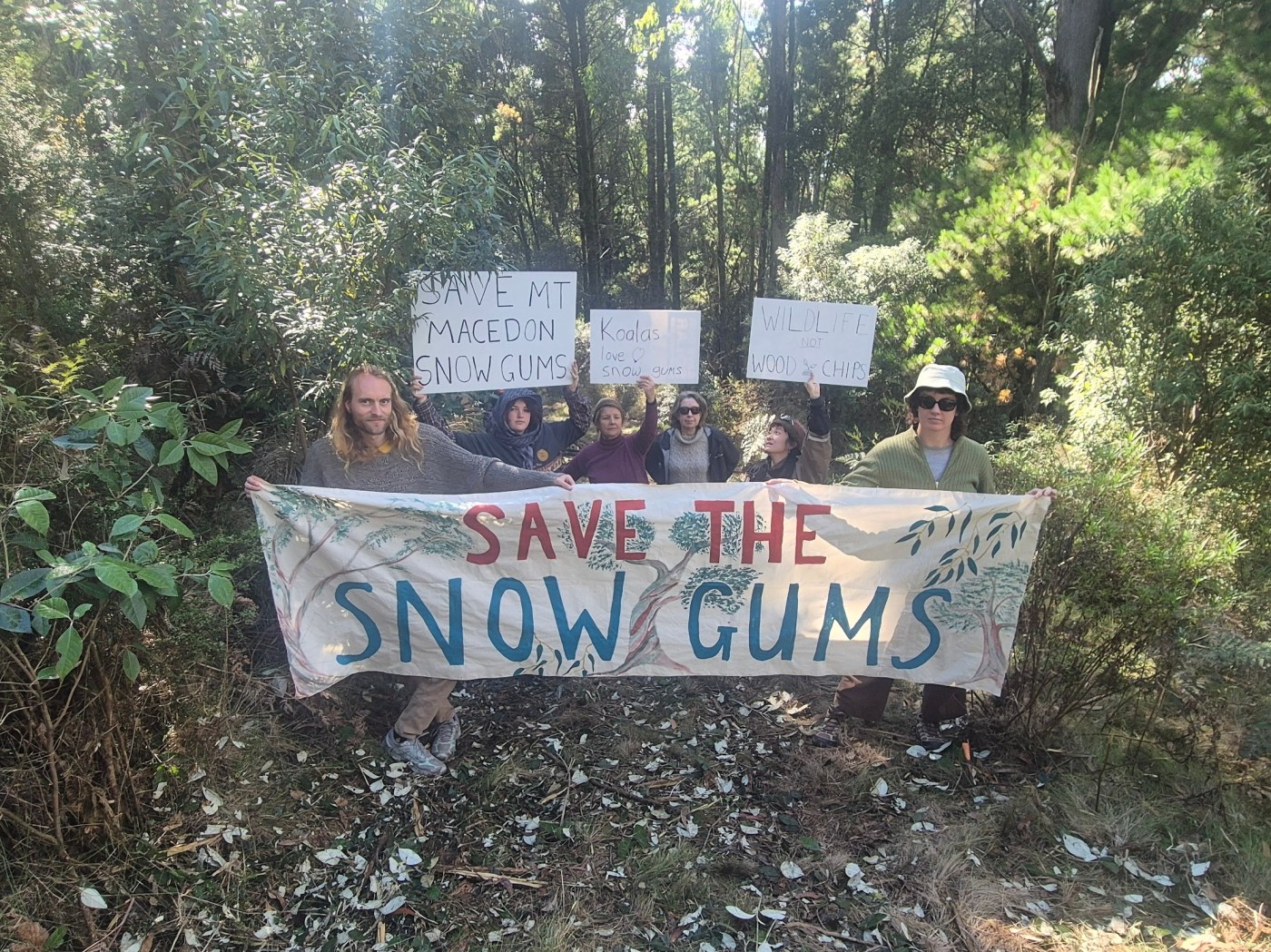
I just spent the better part of a week trying to stop Parks Victoria from destroying almost a hectare of snow gum forest on the Macedon summit in order to restore a historic view towards Melbourne.
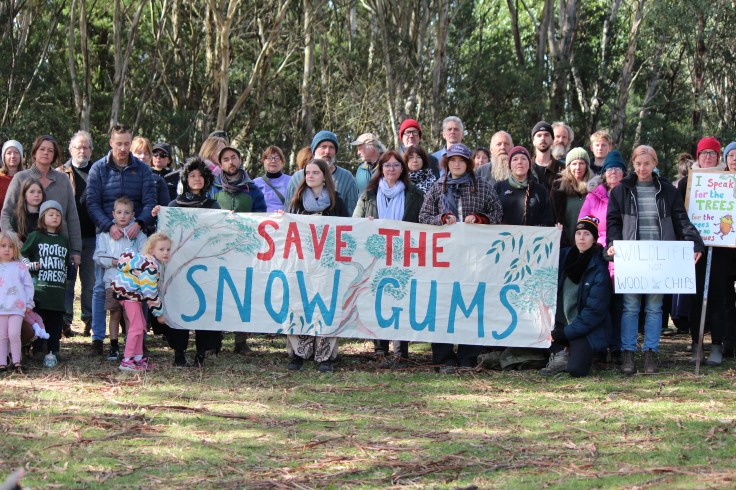
Despite a spirited campaign led by local people, contractors devastated the slopes immediately south of the summit last Friday (April 17). On the Sunday, a planned community rally went ahead and turned into something of a vigil to reflect on the destruction that had just happened. There was grief, sadness, anger and determination. What really struck me was the depth of feeling that so many people expressed for the mountain. Many of us see the mountain as a personal refuge. This destruction of a rare forest has impacted many on a deep level. I heard so many stories of people’s personal connection to the mountain last week.
If you are one of those people I would welcome your story for inclusion here. Send it through: cam.walker@foe.org.au
The following is a reflection on the mountain from 2015.
In our region Mt Macedon, which sits slightly above 1,000 metres above sea level, is our highest peak. In winter it is often briefly visited by snowfall, and it can feel moody and cloudy when it is bright and clear on the basalt plains to the south. Known as Geboor or Geburrh in the Woiwurrung language of the Wurundjeri people, the mountain has a rich mix of species that seem out of place in the dry and open lands of Central Victoria.
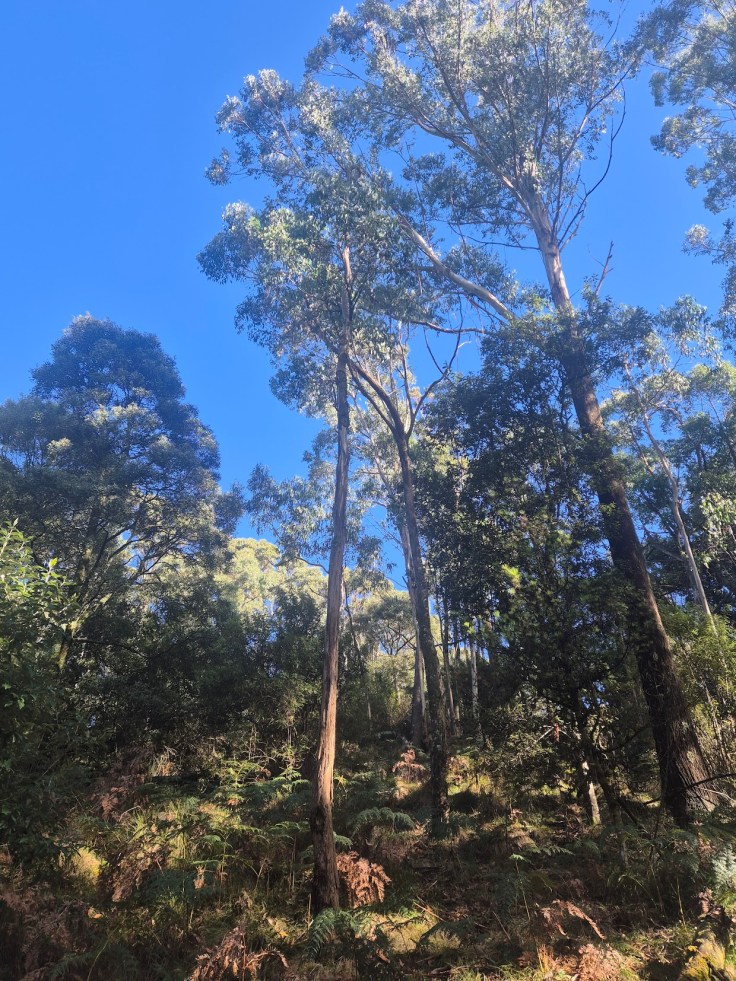
As you climb from the Kyneton plains you pass through dry Messmate/ gum forest and then into a wet Messmate/gum forest. Then up into Alpine Ash and finally pockets of Snow Gum. Since the Ash Wednesday fires of February 1983, there has been prolific regeneration across the mountain, including stands of wattle across much of the summit ridge, and stands of young Alpine Ash crowd in against the road. The understorey contains plants you would expect to find in the gullies of eastern Victoria, such as Hazel Pomaderris and Austral Mulberry, and Mother Shield and Fishbone ferns.
Sheltered gullies with towering Mountain Ash trees and giant ferns can be found within a short distance of the sub-alpine low woodland dominated by Snow Gums on the highest points.
Quite a few plant species that are generally confined to the eastern highlands (the higher hills to the north east of Melbourne) and the Victorian Alps can be found at Mount Macedon at the most western limit of their ranges. Examples of these are the Alpine Ash (Eucalyptus delegatensis) and Mountain Beard-heath (Acrothamnus hookeri).
Other species following a similar distribution are the Sharp Beard-heath (Leucopogon fraseri) and the Mountain Tea-tree (Leptospermum grandifolium), both recently discovered at Mount Macedon.
The fact that this isolated mountain has species that exist well to the east suggests that there was once a much larger cool temperate forest system that has slowly been forced up to the higher elevations as the climate has warmed. There are similar pockets of snow gums in places like the Cathedral Ranges to the north east of Melbourne.
In scientific terms, this appearance of isolated pockets of vegetation is studied through Island Biogeography. Biogeography is the study of the geographic location of a species. Island biogeography is the study of the species composition and species richness on islands. Island biogeography is aimed at establishing and explaining the factors that affect species diversity of a specific community. An island in this context, is not just a segment of land surrounded by water. It is any area of habitat surrounded by areas unsuitable for the species on the island, such as mountain tops. There are other such pockets in Victoria, like the Buffalo Plateau, which hosts sub alpine woodlands and frost hollows separated from the rest of the Alps by dozens of kilometres.
But leaving science aside, what amazes me about these little pockets of isolated vegetation on mountain tops is the slow, beautiful cycles of change that wheel through all landscapes. It stretches my brain as I try to understand the deep periods of time that have passed, as landscapes have slowly warmed and cooled, got drier and wetter, tree lines have climbed, and trees have been pushed out to be replaced by grasslands. What amazes me even more is the fact that indigenous people lived through many of these cycles, including the lower sea levels that saw the land bridge connection to Tasmania and when the Yarra River ran way out onto plains that are now covered by Bass strait. Now as the planet warms, the remnant cooler adapted species like the snow gums are being pushed o the upper elevations of the mountains. There is nowhere else for them to go. Every hectare is precious and we cannot afford to lose any more.
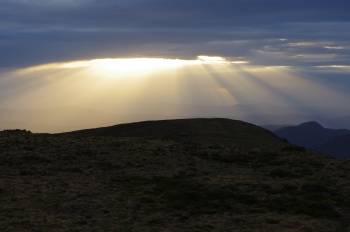
This is the deep time I try to imagine as I sit on the crest of Macedon’s summit ridge, looking out to the south west, feeling those young snow gums pushing at my back, hanging on for dear life in a time of climate change.
Further information and taking action
Sign the letter to the Victorian government here.




 Mountain Journal
April 22, 2026 at 7:04 pm
Did you chain together to stop this???? ‘Reflecting’ on what you say you’ve lost won’t cut any ice with this toxic government