I work with Friends of the Earth, and live in Castlemaine in Central Victoria, Australia. Activist, mountain enthusiast, telemark skier, volunteer firefighter.
As a contribution for Earth Day (April 22) Snowboarder magazine released a trailer for the snowboarding film ‘The Little Things’.
They say:
As snowboarders, we are explicitly tied to the outdoor world. We depend on ample snowfall, cold temperatures, and healthy forestland to provide us with areas in which to strap in and make turns. And that’s just the tip of the environmental iceberg. Fuel to power our cars, trucks, and snowmobiles (and if we’re lucky, helicopters). Power for chairlifts, resources to make equipment, the list goes on and on, and for most of us, the impact of everything doesn’t enter our minds that often when we’re moving from edge to edge down corduroy or through fresh snow. But, and in no way do we or the folks involved in The Little Things Movie intend to be pushy, being considerate of our environment is something vital to take into consideration. Especially for snowboarders.
The Little Things is a snowboard movie/documentary based on environmentally conscious riders who are inspirational through their riding, as well as their sustainable ways of living and thinking. The film to be released fall 2014 is an initiative taken on by professional snowboarder Marie-France Roy and directed by Filmmaker Darcy Turenne in which all the riders are bringing to life the importance of protecting and living in balance with our environment. Riders include Gretchen Bleiler, Tamo Campos, Jeremy Jones, Mike Basich, Meghann O’Brien, Jonaven Moore, Marie-France Roy, and friends.
Christie lists a bunch of things to do to keep occupied and active while waiting for winter to arrive.
How to quench your cravings for snow
Christie Hampton reveals where to find the next best thing to a ski or snowboard fix while you wait for winter.
Autumn is a fickle time of year. The cooler temperatures have probably triggered your desire to ski or board, an itch that won’t be scratched until those snowflakes start to fall but, let’s face it, that could still be months away.
So what can you do to keep the dragon at bay until then? Here’s a few activities that will help satisfy your need for high speed, perilous and expeditious activities until the white stuff hits the ground.
She identifies mountain biking, trampolining, skateboarding, surfing and indoor skiing as good time fillers til the white stuff arrives. She also has some good leads on where to do each of these activities.
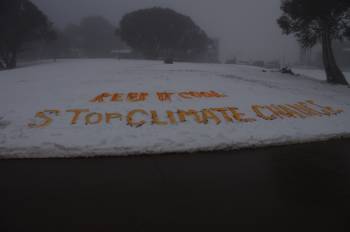
‘keep it cool. Stop climate change’. Dinner Plain, June 2011
The following article has an astonishing fact: 600 U.S. ski areas have disappeared over the past 60 years.
In the article A Snowball’s Chance, written for Boston magazine, Madison Kahn uses the example of Hogback Mountain in Vermont, a small resort that used to be ‘teeming with skiers.’
“The trouble started in the 1970s, when scientists say that temperatures began to rise significantly (in truth, there was little climate research done before then). A series of spotty seasons, coupled with the sharp spike in gas prices brought on by the 1973 oil crisis, hit the mountain hard. It finally shuttered for good in 1986”.
Madison contrasts it with the nearby resort at Mount Snow, which has survived.
“Just 15 miles apart, both ski areas are located in the middle of what was not long ago part of the Northeast’s 120-inch Snowbelt. Why did one die and the other prosper? Simple economics: Mount Snow could afford the snowmaking technology needed to stay open when temperatures began to rise. Hogback couldn’t”.
However, in an observation that should ring bells for us Australians, where much of our snow country is fairly marginal, and where winters are getting warmer, Madison notes:
“making enough snow is becoming an increasingly difficult proposition”.
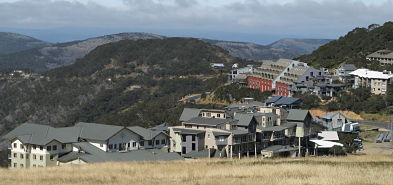
Hotham Village
Research cited in the article suggests that “of the resorts (in the Northeast that are) able to stay open, at least 75 percent will require substantial artificial snowmaking to survive, which, in turn, will significantly increase operational costs and lift-ticket prices”. Skiing or riding in resort in Australia is hardly a cheap option as it is.
“Almost 600 U.S. ski areas have disappeared in the past 60 years, many of them victims of warmer winters. In fact, if warming trends continue at their current rates, within the next few decades, the multibillion-dollar New England ski industry could collapse entirely”.
Here in Australia, there has been a similar response from management boards as they grapple with more erratic winters, with greater attention to snow making and attempts to re-brand resorts as ‘year round’ destinations. Where previously a number of Australian resorts were responding to the threat of climate change, now they have clearly put it in the ‘too hard’ basket. Climate mitigation programs have been quietly dropped as resorts struggle to find new ‘bells and whistles’ to appeal to visitors each year.
Of course, none of this deals with the core problem. Half of U.S. ski areas are opening late and closing early—and in the past 50 years, the average season length in the northeast has decreased by seven days. It’s a similar story here.
It’s interesting to note that in North America, a number of resorts are showing great leadership in terms of playing their part to reduce contributions to global warming.
I recently posted about the need for people who enjoy the mountains to give back to the natural environment in some way. One great option is to join or support one of the many groups that do ecological restoration work or track maintenance. One group that certainly ‘walks the talk’ is the Victorian Mobile Landcare Group, who work across a range of projects in the Victorian High Country.
The following is a report on a recent project they completed on the Bogong High Plains.
For contact details on a range of groups, check here.
Roper’s Hut Track Repair
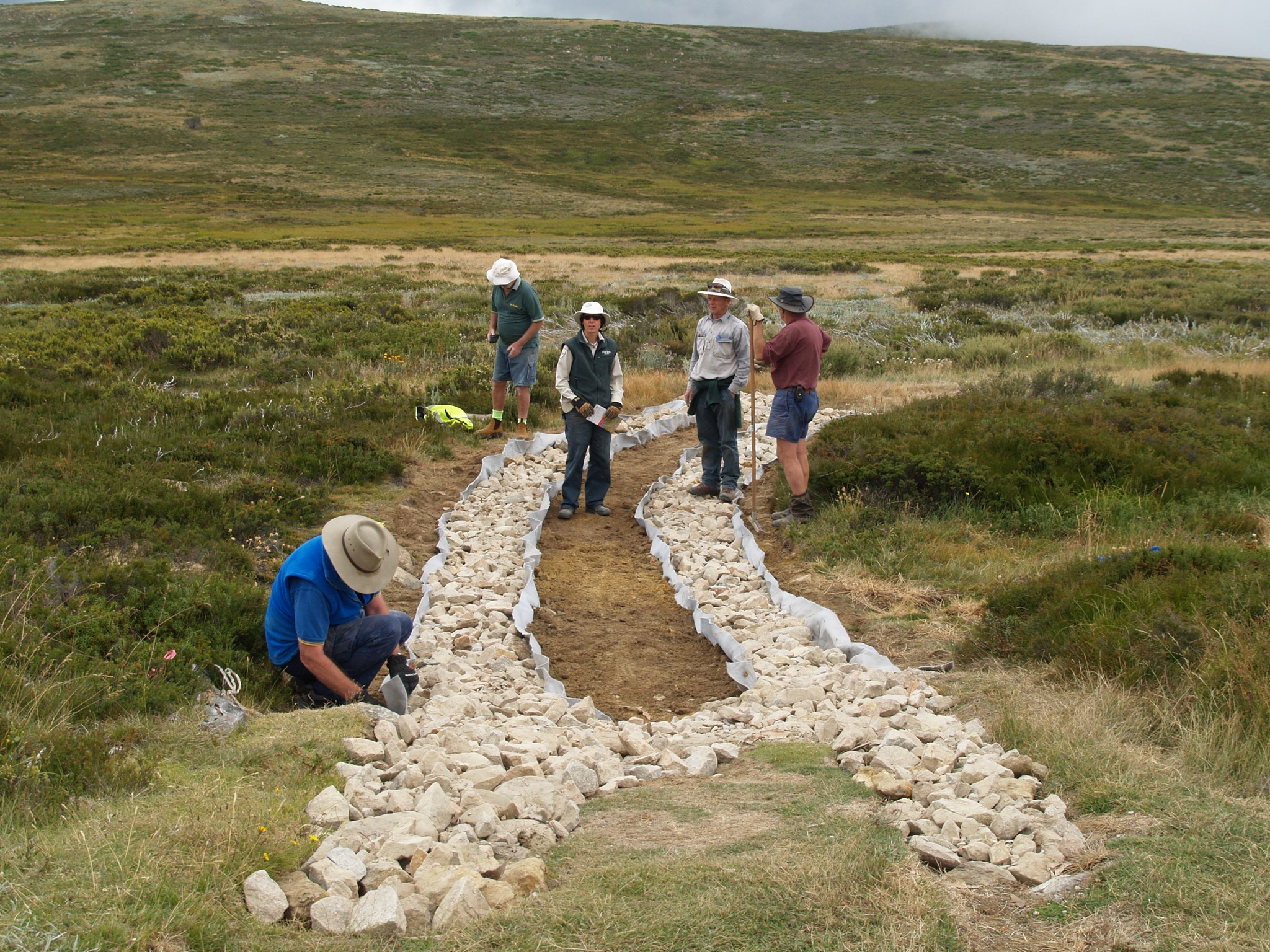
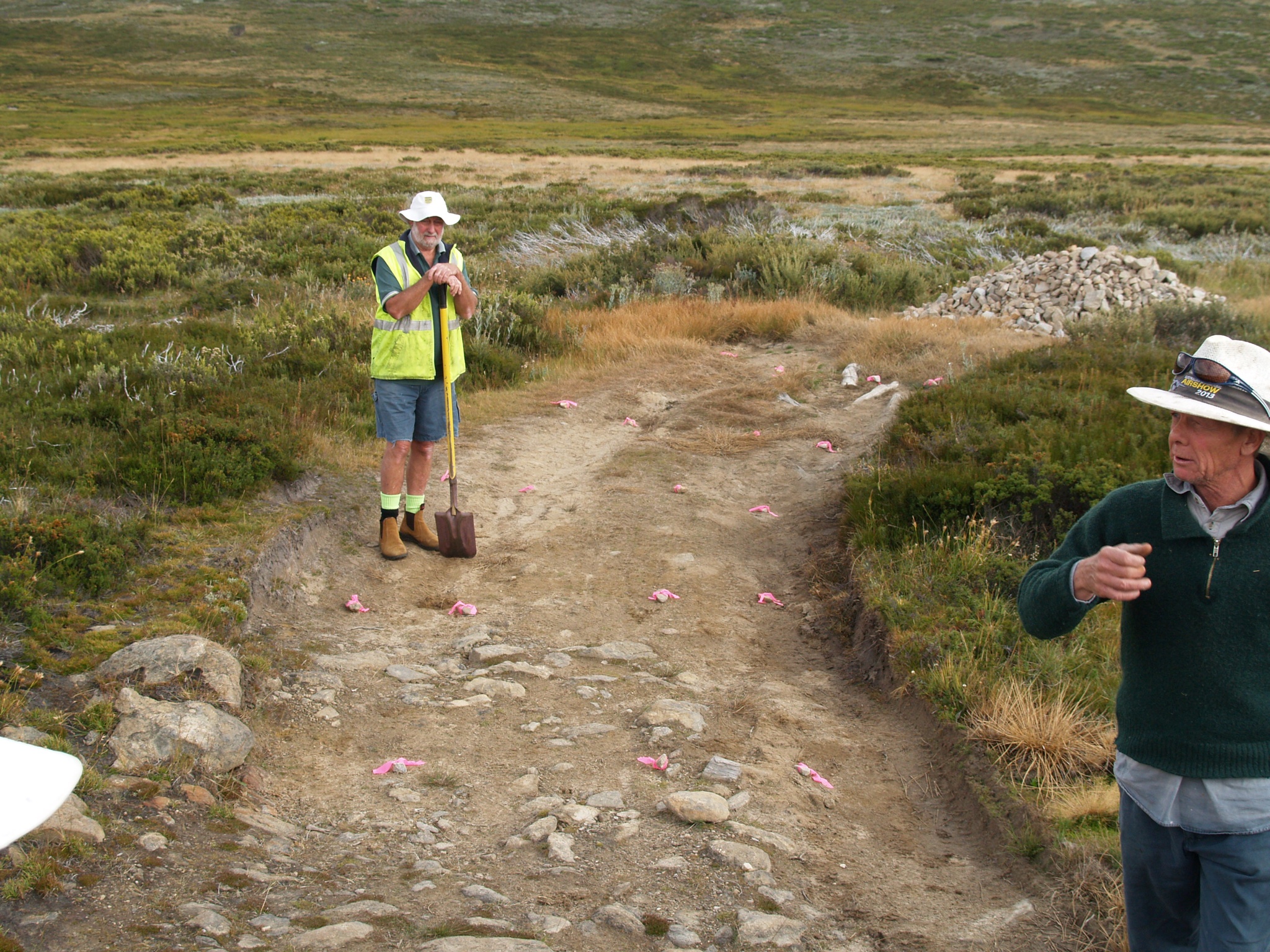
Seven members of the Victorian Mobile Landcare Group Inc. (VMLCG) travelled to Mt. Beauty late on Friday 7 March in order to take on a request from Parks Victoria (PV) to assist create a rock vehicle bridge to protect sensitive sphagnum moss beds which straddle the Management Vehicle Only track out to the iconic Roper’s Hut, burn in the 2003 fires and restored in 2009 by a community effort, headed by the Freemasons Victoria NE District.
This one is the end of work. Time is 1 pm
The team met Parks Ranger Elaine Thomas and contractor Kim, on Saturday morning at Falls Creek and after rationalising vehicles and loads to reduce track impact, travelled out to the Big River Fire Trail and Roper’s Track intersection.
Once fortified by an early morning team, the VMLCG team then walked to the site, and after a JSA and briefing on design and approach by Kim, commenced the work to excavate and create the crossing.
In all, around 4 cubic metres of existing material was moved to make two purpose built and rock-based wheel tracks for both PV and contractor vehicles required to access the hut site. The 4 cubic metres of 75 – 150 mm granite rock used to fill the wheel tracks was kindly donated to the project by AGL, the operators of the recently constructed Clover hydro power station and this kind donation is much appreciated and acknowledged. Without it, this work would not have been possible.
Start of the work at 10am. The pink dots mark the outlines of the track to be built
This one is start of work 10 am. The pink dots are the track outlines we had to create.
This one is start of work 10 am. The pink dots are the track outlines we had to create.
The VMLCG was originally tasked for two days but with the combined effort of the team and Parks Victoria rangers, the entire project was completed between 10 am and 1:30 pm on the Saturday – and after a quick lunch, the crew returned to Falls Creek and an early mark for the weekend!
The next phase of the project will be when the VMLCG returns with Fintona Girls’School to plant out around 450 alpine shrub species to stabilise the soil around the tracks and reduce their visual impact. It is expected in time, the spot will become barely noticeably and yet provide a much needed stabilising base for the occasional and required vehicle access.
We’ll let the before and after photos speak for the work done.
The VMLCG specialises in the development and delivery of remote area landcare projects and works collaboratively with a number of conservation groups on a diverse range of projects across Victoria. They can be reached via http://www.vmlcg.org.au
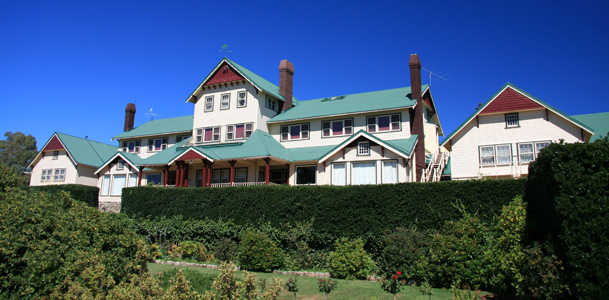
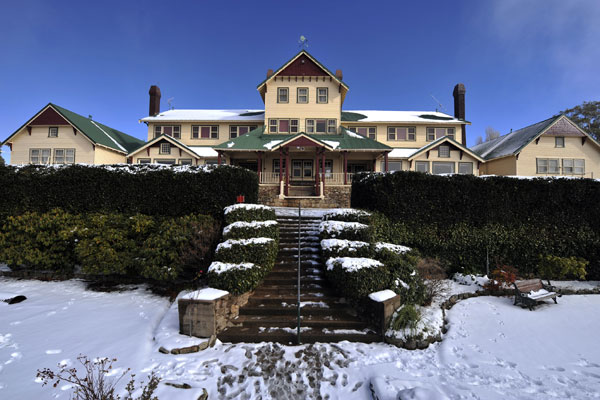
As a further development in the long running saga about the historic chalet on the Buffalo Plateau, The Weekly Times is reporting that the two accommodation wings on the chalet can now be demolished.
The journalist is Chris McLellan.
Iconic Mt Buffalo chalet to be saved by knocking some of it down
Image: SMH
DEMOLITION works can proceed on the Mt Buffalo chalet after heritage protection orders were lifted.
Two wings will be knocked down to make way for a $7.5 million restoration and allow the chalet to be reopened as a day visitor centre.
Heritage Victoria granted the permit over the objections of the National Trust which supported efforts to restore the century-old chalet but not at the cost of about 40 per cent of the building.
The chalet closed in 2007.
There is still debate about whether the demolition works will need Federal Government approval as it is included on the National Heritage List.
A clearing sale of hundreds of items from the chalet will be held on May 4.
Heritage Victoria executive director Tim Smith said the permit would allow the main chalet building to be restored “to its former glory”.
Benalla MP Bill Sykes said work had started on the restoration with maintenance work well under way.
Expressions of interest closed this week for community representatives to oversee the redevelopment.
This recent piece comes from Powder magazine, and focuses on the situation in North America.
The Truth About Snow
An interview with the world’s top skiing climatologist, Daniel Scott
When it comes to the future of snow—and more importantly, the future of skiing—Daniel Scott is the man with the answers. Or, at least, the man with the possibilities. Will the Northeast have snow in 30 years? No. Will Colorado? Yes. Scott holds the Canada Research Chair in Global Change and Tourism at the University of Waterloo in Ontario—the first research facility in the world to comprehensively investigate the relationship between climate change and skiing, starting in the 1980s. Many of the computer models used in Europe today come from the university. Scott built his own model 10 years ago and has been using it ever since to predict what will happen to skiing in the next century.
When it comes to reading the future, Scott does not pull his punches. He co-authored a report that spelled the coming end of half of the ski resorts in the Northeast in the next 30 years. He also contradicted studies saying Colorado would suffer the same fate—saying that most climate models are done from a hydrology point of view, and leave out snowmaking in their predictions. The point being, Scott’s studies are scientific, without a conservative or progressive bent. And in a world flooded with misinformation, this is the kind of resource skiers need.
There is no doubt that our fire seasons are getting longer and more intense. Here in the south east, in terms of massive fires (greater than 250,000 ha), Victoria experienced two such events in the 19th century and five in the 20th century. In less than two decades, we have already had three mega fires in the 21st century. Many alpine areas have been burnt three times in the space of a decade.
There is no coherent overall response as yet by state or federal governments that outlines how we should respond to the growing interaction of climate change and wildfire. Sadly, our Prime Minister is in denial, having claimed that since ‘fires have always been part of our landscape’ there is no link to climate change. The Victorian state government has been challenged on the lack of attention to climate change in it’s approach to managing fire risk. Reducing fire risk is therefore about reducing fuel load and getting larger equipment , not about reducing greenhouse gas emissions or accepting that enhanced fire risk is the new reality for much of the country.
The following report, from Grist, outlines a different approach. The US government has released a strategy that aims to respond to the changing nature of fire threats. One aspect that especially interested me is the fact that it includes an approach that aims to ‘restore and maintain landscapes that are resilient to fire.’ In Victoria, we seem to be doing the opposite. There is a politically driven target that dictates that 5% of the state will receive fuel reduction treatment each year. This is in spite of the fact that some vegetation types don’t need burning to maintain ecological health, and others can become more flammable with the wrong fuel reduction approaches, and others are directly threatened by too much fire.
Climate change just reshaped America’s wildfire strategy
Like a tree in a greenhouse, America’s forest fire problem is growing ominously. Rising temperatures and declining rain and snowfall are parching fire-prone areas and juicing conflagrations. On Thursday, following years of meetings and scientific reviews, the Obama administration published a 101-page strategy that aims to help meet the country’s shifting fire threats.
The National Cohesive Wildland Fire Management Strategy divides the nation according to fire risks, and profiles the communities that face those risks. “No one-size-fits-all approach exists to address the challenges facing the Nation,” the strategy states.
Despite covering 70,000 communities and 46 million homes, the strategy can be boiled down to guidelines that aim to do three main things: restore and maintain landscapes that are resilient to fire; brace communities and infrastructure for occasional blazes; and help officials make wise decisions about how and whether flames should be doused. Here’s what that all looks like in flowchart form:
“As climate change spurs extended droughts and longer fire seasons, this collaborative wildfire blueprint will help us restore forests and rangelands to make communities less vulnerable,” said Mike Boots, chair of the White House Council on Environmental Quality.
some good conditions from last year. Early July 2013, Mt Loch, VIC
Once the weather starts to cool down in southern Australia, something interesting starts to happen to this website: traffic to the ‘sidecountry’ skiing and boarding guide to Mt Hotham starts to climb, peaking in early June.
Its that time of year where we can almost smell the snow and are locking in trips. While this rain has been good, its still really warm. So, what type of winter do we have coming? After last years boom-and-bust cycle of good snow alternating with warm air and rain, lets hope its more consistent. The media is warning of a strong El Nino event this winter, meaning warm and dry conditions. The much trusted weather guru, The Grasshopper who writes for Mountain Watch recently released their initial forecast for the 2014 season.
Amongst some interesting analysis of what an El Nino event actually means, the bottom line on forecast is:
More likely than not we will have a mediocre to above average season and there will be plenty of opportunity for fresh provided you are ready for it. But even if things tend towards the lower end of the scale, my gut tells me we will be compensated by plenty of cool clear nights with copious amounts of snow making to keep the groomed areas looking tip top.
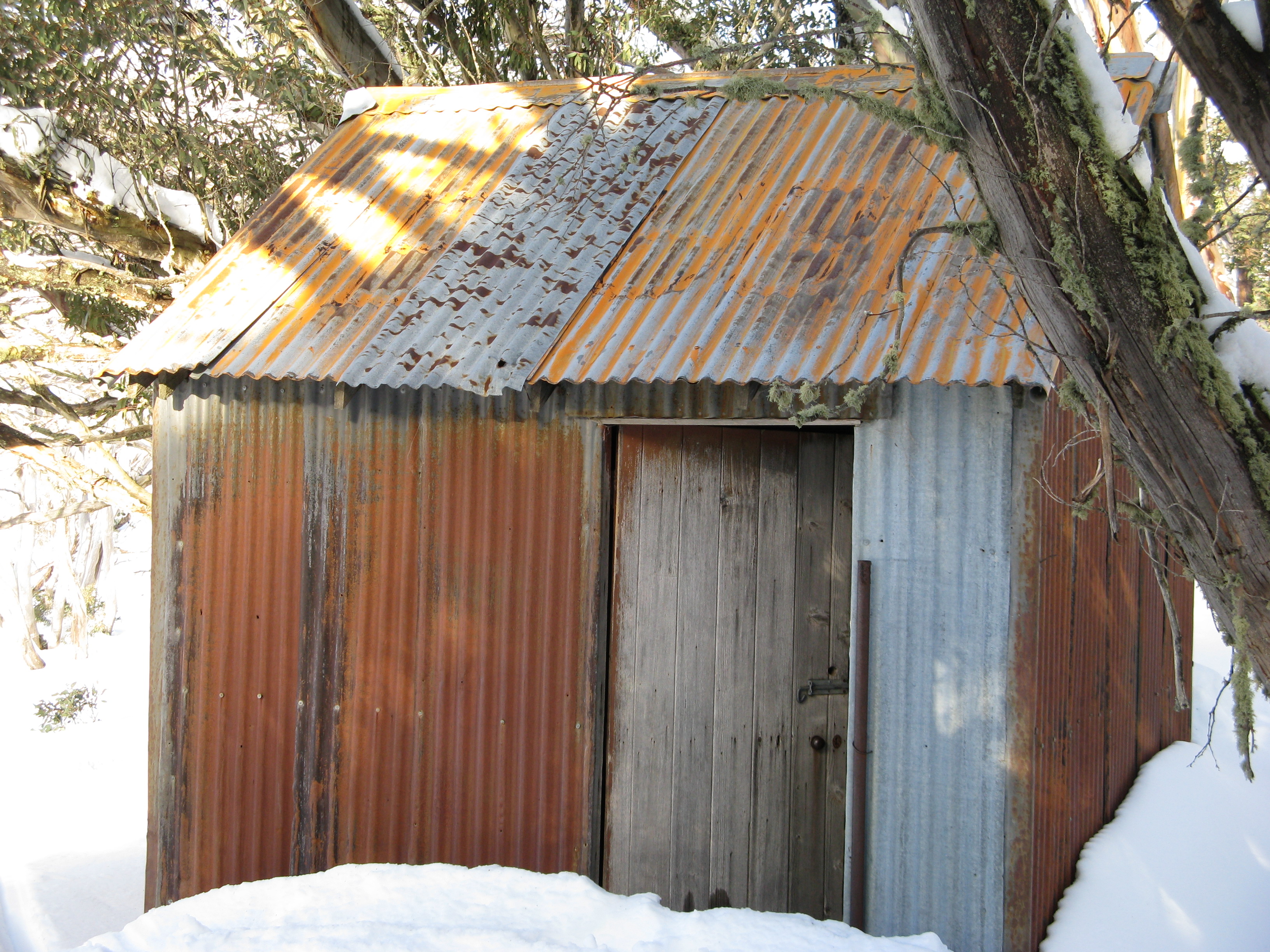
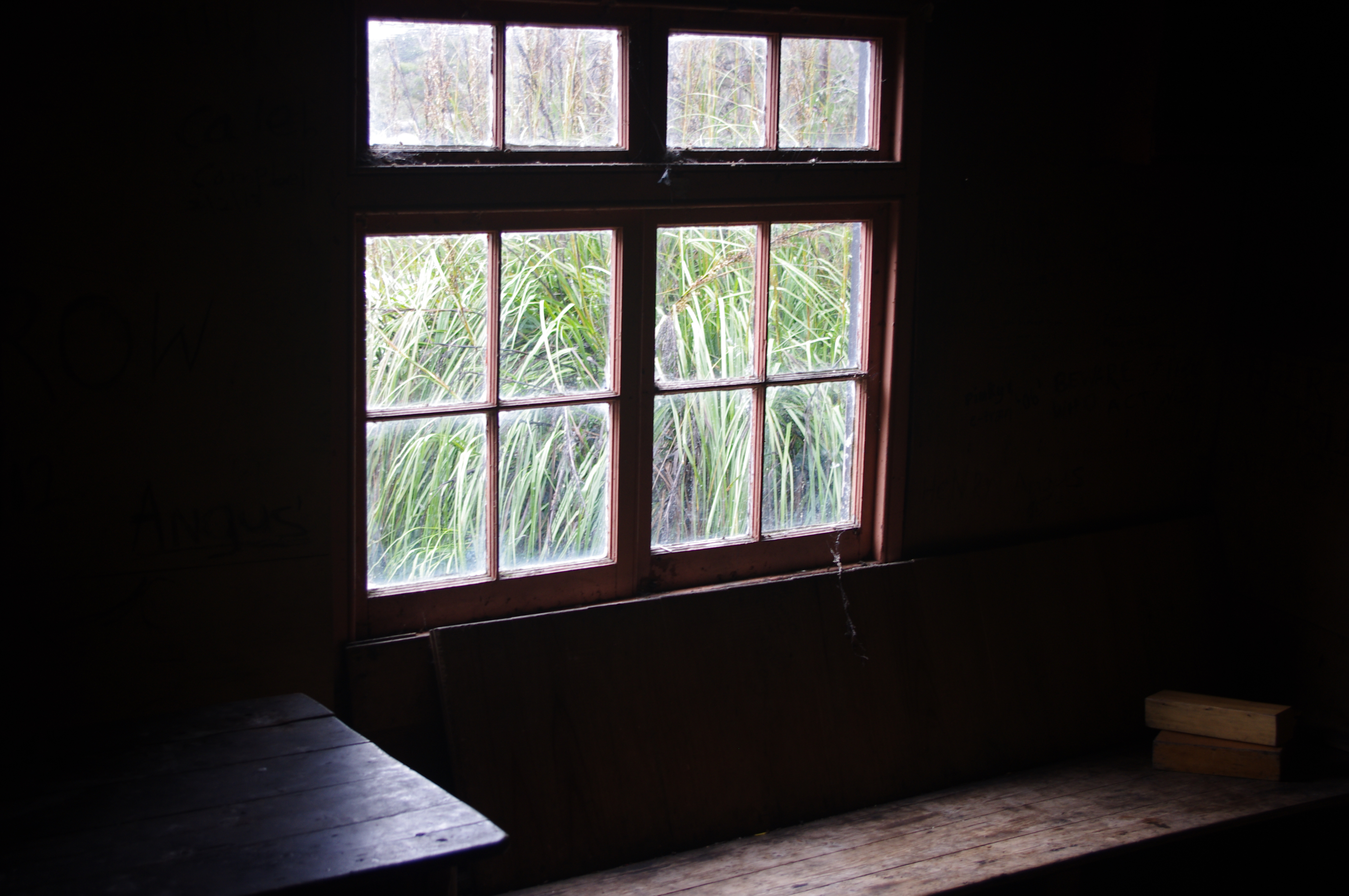
Huts in the mountains can be a vexed issue. Huts will tend to attract people and so tend to concentrate visitation within a larger area. As one example, most people who climb Mt Bogong tend to then turn towards Cleve Cole hut rather than head across to the Hooker Plateau. This tendency to influence visitation can be both good and bad.
They are part of the cultural history of the high country, and reflect major stages in the post colonisation era: cattle grazing, forestry, hydro, even fire watch towers and, more recently, huts built for recreational purposes. We also have a number of strange and random anomalies, ones that don’t really make sense: Craig’s hut near Mt Stirling as an example, which was built as a set for a film. There are, of course, those whose primary function is safety, such as Seaman’s hut near Mt Kosciusko, and huts that belong to clubs or even schools (Geelong Grammar on Mt Stirling).
I have always tended towards the position that we don’t need more huts in the high country. With incremental pressure as ski resorts increase their footprint and the risk of private developments within Victorian national parks and the precedent of private enterprise in a number of Tasmanian parks, I don’t think we need more infrastructure. There have been some hut removals that make ecological sense (such as Albina Lodge, above the western slopes of the Main Range in the Snowy Mountains). I certainly understand the need for huts in strategic spots for safety. And I do appreciate the history of these places, the incredible work of getting materials into hut sites in the early days and the bush skills of the builders. I love the work of Klaus Hueneke, who has chronicled the heritage of the huts.
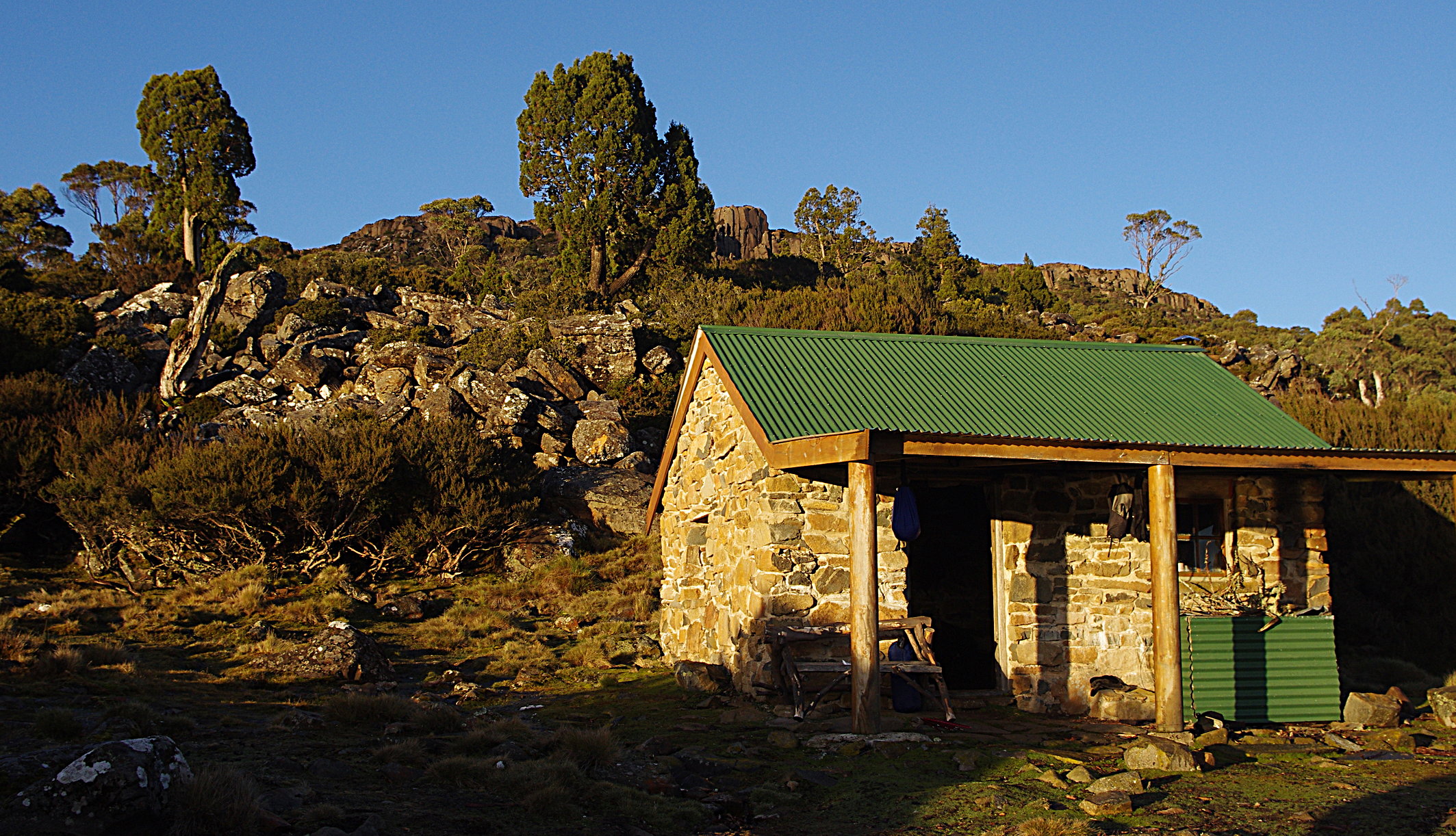
the hut at Lake Nameless, Central TAS
With the rise in wildfire over the past decade, we have lost many of the iconic huts. There have been some excellent rebuild efforts, such as Michel’s at Mt Bogong. The Victorian High Country Huts Association was founded after the major bushfires of February 2003, to try and preserve remaining huts. Some huts are looked after by organisations and this can give people a strong connection to ‘their’ hut, and various groups exist to look out for huts in general (partial list below).
For me, it’s a rare thing to find a hut that is more appealing than a tent, but amongst my favourites are Seamen’s and the ‘Schlink Hilton’ in the Snowies, Vallejo Gantner at Macalister Springs, Cleve Cole on Bogong (of course), and the hut at Lake Nameless in Central Tasmania. I love the location of the ridiculously ugly house on Mt Wills.
For hut fans, we have recently been posting photos on Mountain Journal’s facebook page. Please feel free to join in and post your favourite pics.
the hut at Newgate Tarn, TAS
I recently spotted the article below, highlighting the value of the ‘secret’ hut stash around many resorts, the little known hang out spot. I remember a rough hut that lasted several years on the northern slopes of The Bluff in Victoria which was popular with some backcountry skiers and boarders. I went to look for it one spring and it was gone (it had been tarp and pole heavy, more a glorified camp than a hut).
What I loved about this article is that it highlights that for all of us who use huts, there are personal and social memories that build up: of friendship, adventure, good dinners, long and late night conversations with strangers. I held my 30th birthday at Vallejo Gantner hut and have spent the last 4 new years at Bluff Spur hut on Mt Stirling with a big gang of friends. Part of the cultural – as opposed to technical – history is preserved in log books and, increasingly, on line. For instance, check the newsletters from the Mt Bogong Club, who have been looking after the Cleve Cole hut since 1965. In many countries there is the tradition of the hut warden, which can add to the sense of hut culture. I like the short film Winters of my Life, an appreciation of the decades-long service of Howard Weamer, who for the past 35 years has spent his winters as a hutkeeper in Yosemite’s backcountry.
Secret stashes, shacks included, are a part of skiing in the same way that early mornings and long drives are. If you are dedicated you will have yours, you’ll know the good ones, and the people to share them with inbounds and out. People who love the mountains cultivated them, probably long before you got there.
While on a recent walk in Mt Field national park in Tasmania, I was struck by the amount of track work that had been done in the four years since I was last there. Much of this is in the fragile areas from Negate Pass through to K Col.
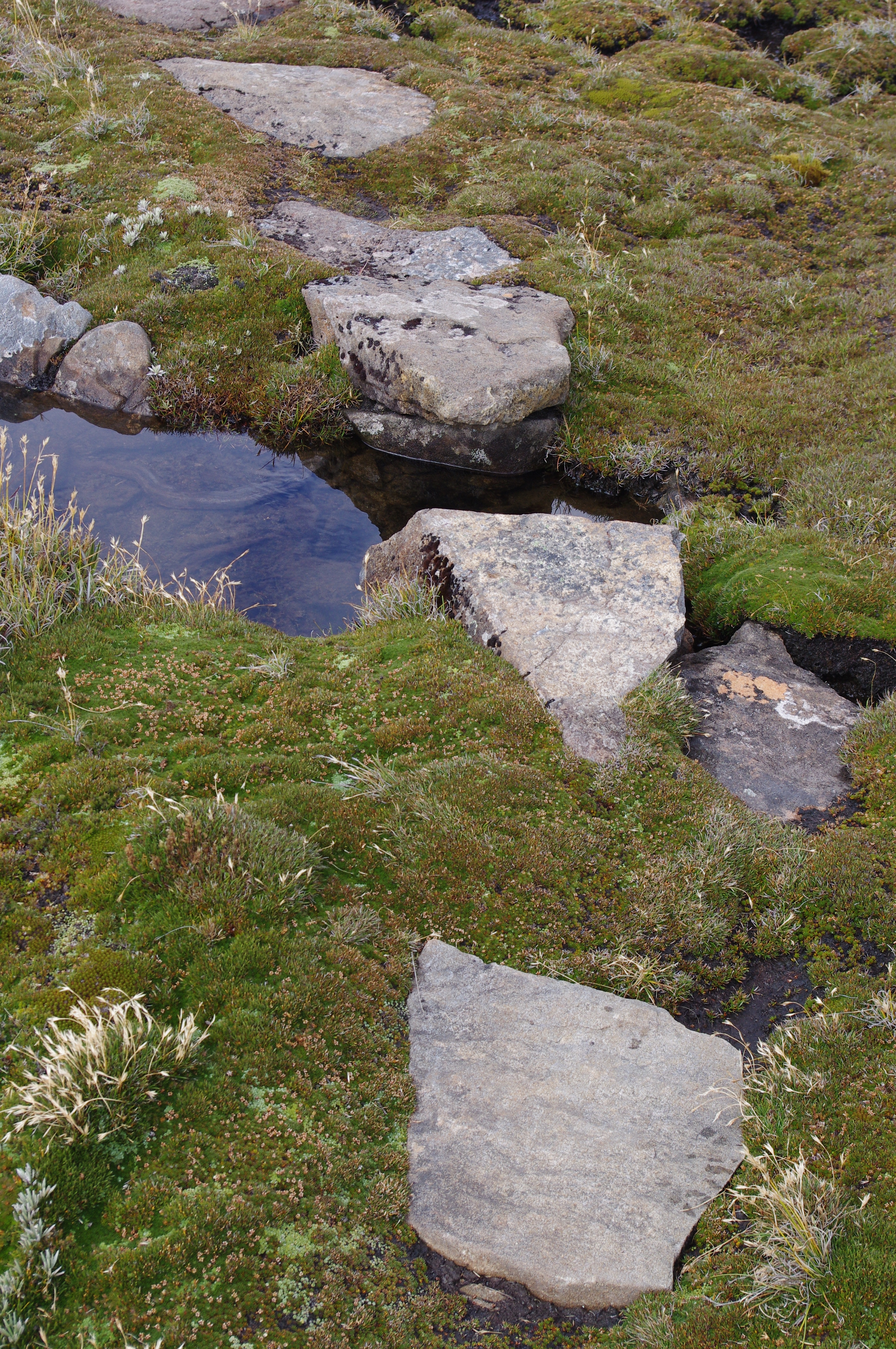
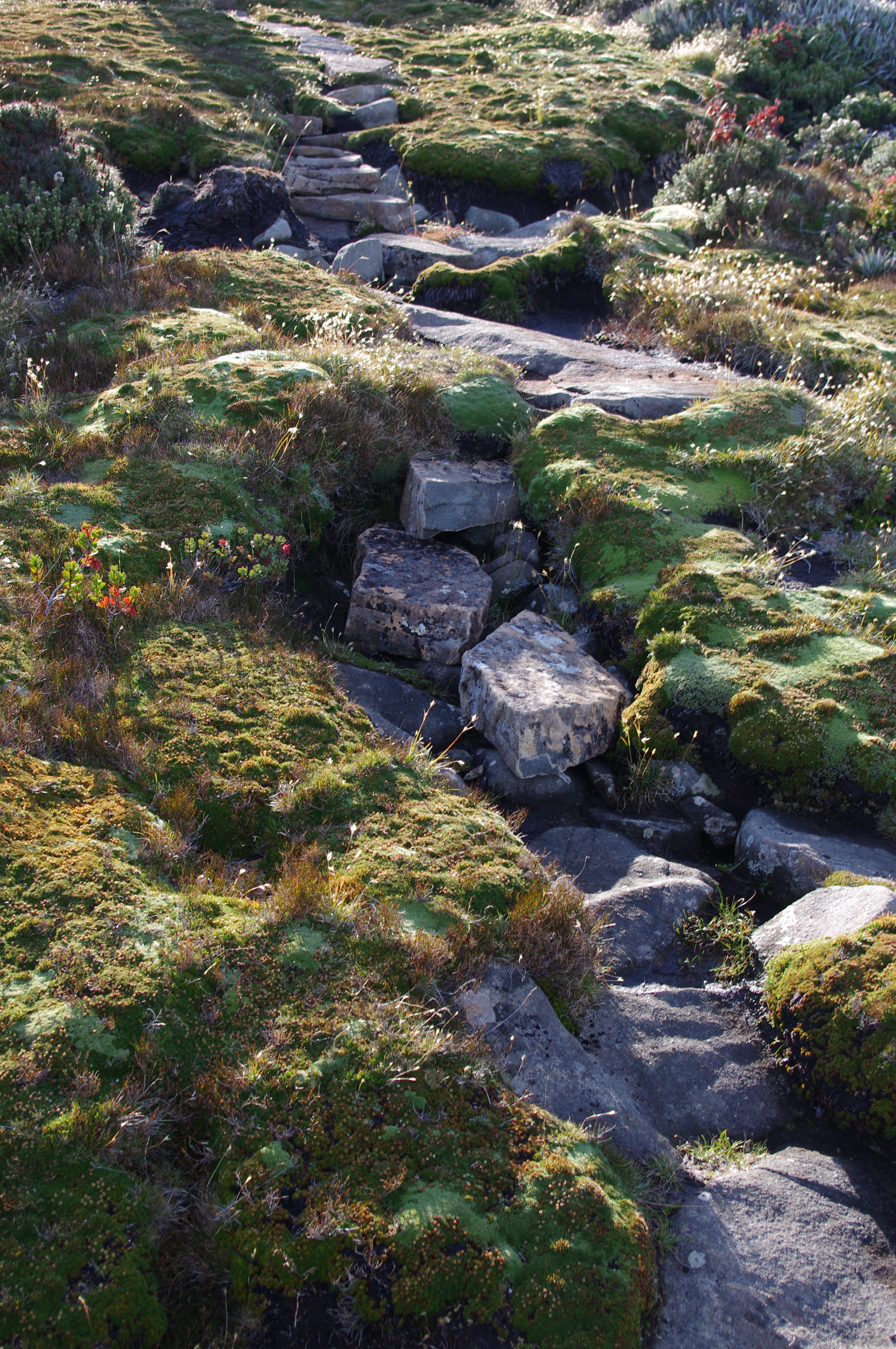
I was reminded of the fact that track work can be incredibly aesthetic. In Tasmania there have been various stages in creating and stabilising tracks, with less use nowdays of locally cut timber, in favour of treated pine and lots of boardwalks. This is never very nice looking in it’s own right, and often needs helicopter lifts to get to remote areas, and hence has a higher environmental impact than locally cut wood. But the stone work in many places, including Mt Field, is fantastic. Thanks to the Parks Service workers, contractors and volunteers who have put in so much effort for so long to stabilise the track network in the mountains.
Although I have walked in remote areas since I was a teenager, I sometimes found track works an intrusion on my enjoyment of wild landscapes. Of course, I eventually realised that in popular – and especially alpine areas – they are a necessary part of reducing impact, by channeling what otherwise may be a myriad of smaller braided trails into a single pathway.
Then the poet Gary Snyder introduced me to the idea of track construction, of laying stones and other trail stabilisation as meaningful work, a way for us to interact with the wild. His poem Riprap and other works constantly remind me of that. Track building is a subtle, low impact way to engage mindfully with landscape.
Lay down these words
Before your mind like rocks.
placed solid, by hands
In choice of place, set
Before the body of the mind
in space and time:
Solidity of bark, leaf, or wall
riprap of things:
Cobble of milky way,
straying planets,
These poems, people,
lost ponies with
Dragging saddles—
and rocky sure-foot trails.
The worlds like an endless
four-dimensional
Game of Go.
ants and pebbles
In the thin loam, each rock a word
a creek-washed stone
Granite: ingrained
with torment of fire and weight
Crystal and sediment linked hot
all change, in thoughts,
As well as things.
As we walked out from a fantastic trip, I was reminded that helping out on working bees to stabilise tracks is a great way of giving back to the places we love. If you live in Tasmania, you may want to get involved with Friends of Mt Field, a volunteer group that does much of the track work there. But where ever you are there will be a group doing this type of vital work. You will find some contacts here.
I recently reviewed the ski film All.I.Can. It’s such a great film, but has an awful take home message when it comes to climate change. So when I spotted this film, I was instantly cheered up.
Momenta is a new documentary starring legendary snowboarder Jeremy Jones, climber Conrad Anker, and other big-mountain athletes. It aims to mobilise people to stop a climate-wrecking proposal to ramp up coal exports from the western USA to China.
No, its not going to have the amazing skiing and mountain images of films like All.I.Can. But it brings some significant voices to the debate that – hopefully – can reach the skiing and boarding community and get them organised against this proposal.
The idea for “Momenta,” one of this year’s must-watch environmental documentaries for people concerned about climate change and the future of snow, was hatched in Boulder’s Flatirons in the fall of 2012. Big-mountain snowboarder Jeremy Jones was visiting town with Chris Steinkamp, executive director of Protect Our Winters (POW), the climate change group Jones founded. The two men decided to take a hike to brainstorm ways that POW could rally opposition against a major climate threat that has received scant attention from the national media—a coal train.
“We don’t have the ability yet to mobilize a grassroots army, so we decided a documentary was the best way to get the word out,” Steinkamp says.
“Momenta” sheds light on a climate-wrecking proposal to ship vast amounts of Rocky Mountain coal to Asia. The film stars Jones, legendary climber Conrad Anker and other big-mountain athletes who speak about the changes they’ve seen in the mountains during their lifetimes—as well as biologists, climate scientists, physicians and activists who detail the detrimental consequences of the plan hatched by energy companies, which will excavate vast coal deposits in Montana’s and Wyoming’s Powder River Basin, transport it by rail to the Pacific Northwest, then ship it across the Pacific.
Critics deride the coal-to-China plan as “Keystone on steroids,” a reference to the controversial Keystone XL Pipeline proposal that would transport tar sand oil from Alberta, Canada, to the Gulf Coast for export. Keystone has been called a climate bomb. Burning the Powder River Basin coal, however, poses an even bigger climate threat. “That coal has to stay in the ground,” environmental author and activist Bill McKibben explains in the film.
Mt Buller is already over developed. Is the road part of a plan to see similar development on Mt Stirling?
In 2008, the Mt Buller and Mt Stirling Alpine Resort Management Board applied for permission to build a road through old growth alpine ash across the north side of Corn Hill from Mt Buller to Mt Stirling.
This was ostensively to provide a route for people to escape the mountain in the case of a fire blocking the main road. However, it would pass through a considerable area of dense forest and then across to Mt Stirling, which then requires a long drive down to the Delatite River, where the existing Buller road emerges from the forest. If there is a major fire burning out of the Delatite Valley across the northern side of Buller it is hard to see how a major evacuation would work above the same area of forest. It would be a huge financial investment for a road that would probably never need to be used. A much cheaper option would be to ensure the community gathering site on the mountain contains a fire refugee able to withstand an intense fire.
So, is there something else going on? The Victorian National Parks Association (VNPA) believes the real intent is to make it easier to build accommodation on Mt Stirling because it would greatly improve vehicle access to the higher sections of the mountain.
The VNPA says it would just require a ‘simple amendment’ to the current planning scheme to allow development.
The road was knocked back several years ago, but now the resort is trying to gain approval again.
There have been various attempts to develop ski resort facilities on Mt Stirling over the years, and this has long been resisted by many in the community. Mt Buller is already heavily developed, and Mt Stirling provides opportunities for cheaper, lower impact winter and summer recreation. It has recently seen the development of major mountain biking trails, and provides access to walkers, skiers, 4 wheel drivers, and horse riders.
 As a contribution for Earth Day (April 22) Snowboarder magazine released a trailer for the snowboarding film ‘The Little Things’.





 Mountain Journal
Recent Comments