Search

Mountain Journal

Environment, news, culture from the Australian Alps

Giving back

IMGP7211While on a recent walk in Mt Field national park in Tasmania, I was struck by the amount of track work that had been done in the four years since I was last there. Much of this is in the fragile areas from Negate Pass through to K Col.

I was reminded of the fact that track work can be incredibly aesthetic. In Tasmania there have been various stages in creating and stabilising tracks, with less use nowdays of locally cut timber, in favour of treated pine and lots of boardwalks. This is never very nice looking in it’s own right, and often needs helicopter lifts to get to remote areas, and hence has a higher environmental impact than locally cut wood. But the stone work in many places, including Mt Field, is fantastic. Thanks to the Parks Service workers, contractors and volunteers who have put in so much effort for so long to stabilise the track network in the mountains.

Although I have walked in remote areas since I was a teenager, I sometimes found track works an intrusion on my enjoyment of wild landscapes. Of course, I eventually realised that in popular – and especially alpine areas – they are a necessary part of reducing impact, by channeling what otherwise may be a myriad of smaller braided trails into a single pathway.

Then the poet Gary Snyder introduced me to the idea of track construction, of laying stones and other trail stabilisation as meaningful work, a way for us to interact with the wild. His poem Riprap and other works constantly remind me of that. Track building is a subtle, low impact way to engage mindfully with landscape.


Lay down these words

Before your mind like rocks.

placed solid, by hands

In choice of place, set

Before the body of the mind

in space and time:

Solidity of bark, leaf, or wall

riprap of things:

Cobble of milky way,

straying planets,

These poems, people,

lost ponies with

Dragging saddles—

and rocky sure-foot trails.

The worlds like an endless

four-dimensional

Game of Go.

ants and pebbles

In the thin loam, each rock a word

a creek-washed stone

Granite: ingrained

with torment of fire and weight

Crystal and sediment linked hot

all change, in thoughts,

As well as things.

IMGP7470As we walked out from a fantastic trip, I was reminded that helping out on working bees to stabilise tracks is a great way of giving back to the places we love. If you live in Tasmania, you may want to get involved with Friends of Mt Field, a volunteer group that does much of the track work there. But where ever you are there will be a group doing this type of vital work. You will find some contacts here.

Check the Friends of Mt Field site here.


Momenta: More than a Film

6a00d83451b96069e201a3fcb001f0970b-800wiI recently reviewed the ski film All.I.Can. It’s such a great film, but has an awful take home message when it comes to climate change. So when I spotted this film, I was instantly cheered up.

Momenta is a new documentary starring legendary snowboarder Jeremy Jones, climber Conrad Anker, and other big-mountain athletes. It aims to mobilise people to stop a climate-wrecking proposal to ramp up coal exports from the western USA to China.

No, its not going to have the amazing skiing and mountain images of films like All.I.Can. But it brings some significant voices to the debate that – hopefully – can reach the skiing and boarding community and get them organised against this proposal.

As reported in Elevations Outdoors magazine:

The idea for “Momenta,” one of this year’s must-watch environmental documentaries for people concerned about climate change and the future of snow, was hatched in Boulder’s Flatirons in the fall of 2012. Big-mountain snowboarder Jeremy Jones was visiting town with Chris Steinkamp, executive director of Protect Our Winters (POW), the climate change group Jones founded. The two men decided to take a hike to brainstorm ways that POW could rally opposition against a major climate threat that has received scant attention from the national media—a coal train.

“We don’t have the ability yet to mobilize a grassroots army, so we decided a documentary was the best way to get the word out,” Steinkamp says.

“Momenta” sheds light on a climate-wrecking proposal to ship vast amounts of Rocky Mountain coal to Asia. The film stars Jones, legendary climber Conrad Anker and other big-mountain athletes who speak about the changes they’ve seen in the mountains during their lifetimes—as well as biologists, climate scientists, physicians and activists who detail the detrimental consequences of the plan hatched by energy companies, which will excavate vast coal deposits in Montana’s and Wyoming’s Powder River Basin, transport it by rail to the Pacific Northwest, then ship it across the Pacific.

Critics deride the coal-to-China plan as “Keystone on steroids,” a reference to the controversial Keystone XL Pipeline proposal that would transport tar sand oil from Alberta, Canada, to the Gulf Coast for export. Keystone has been called a climate bomb. Burning the Powder River Basin coal, however, poses an even bigger climate threat. “That coal has to stay in the ground,” environmental author and activist Bill McKibben explains in the film.

You can find out more on the Momenta facebook page and read a review from the Sierra Club here.

You can find the trailer for the film here.

As Jeremy Jones says in the film: ‘we know the solution. we know renewables work. And it’s time to embrace them.’


new road proposed for Mt Stirling

Mt Buller is already over developed. Is the road part of a plan to see similar development on Mt Stirling?

In 2008, the Mt Buller and Mt Stirling Alpine Resort Management Board applied for permission to build a road through old growth alpine ash across the north side of Corn Hill from Mt Buller to Mt Stirling.

This was ostensively to provide a route for people to escape the mountain in the case of a fire blocking the main road. However, it would pass through a considerable area of dense forest and then across to Mt Stirling, which then requires a long drive down to the Delatite River, where the existing Buller road emerges from the forest. If there is a major fire burning out of the Delatite Valley across the northern side of Buller it is hard to see how a major evacuation would work above the same area of forest. It would be a huge financial investment for a road that would probably never need to be used. A much cheaper option would be to ensure the community gathering site on the mountain contains a fire refugee able to withstand an intense fire.

So, is there something else going on? The Victorian National Parks Association (VNPA) believes the real intent is to make it easier to build accommodation on Mt Stirling because it would greatly improve vehicle access to the higher sections of the mountain.

The VNPA says it would just require a ‘simple amendment’ to the current planning scheme to allow development.

The road was knocked back several years ago, but now the resort is trying to gain approval again.

There have been various attempts to develop ski resort facilities on Mt Stirling over the years, and this has long been resisted by many in the community. Mt Buller is already heavily developed, and Mt Stirling provides opportunities for cheaper, lower impact winter and summer recreation. It has recently seen the development of major mountain biking trails, and provides access to walkers, skiers, 4 wheel drivers, and horse riders.

The VNPA is tracking this issue. Check their website for updates.

the Dark Snow project

“ There’s no place on earth that’s changing faster — and no place where that change matters more — than Greenland. ”
– Bill McKibben

dark_snow_wordmark_blackThe first-ever Greenland expedition relying on crowd source funding aims to answer the ‘burning question’: How much does wildfire and industrial soot darken the ice, increasing melt?

Fossil fuel combustion creates carbon emissions that increase atmospheric thickness, warming climate. The occurrence of wildfire increases with climate warming, increasing soot loading of the atmosphere. Some of this soot is transported through the atmosphere and is deposited on glaciers, lowering their reflectivity, increasing solar energy absorption, increasing melt rates.

While watching wildfires raging across his home state of Colorado, climatologist Jason Box was struck by the question of whether the dark wildfire soot could contribute to the Greenland melting?

Dark Snow is a field and lab project to measure the impact of changing wildfire and industrial soot on snow and ice reflectivity. Soot darkens snow and ice, increasing solar energy absorption, hastening the melt of the “cryosphere”.

They mounted an expedition to Greenland to consider the impacts. A lot of their work is fairly technical. But its an intriguing concept.

Check their website for details and updates.

Forests Forever Easter Ecology Camp

Spend Easter in the heart of East Gippsland 18-21 April, 2014

Every Easter for the past 30 years Environment East Gippsland has been showing people the best of East Gippsland’s beautiful and complex forests as part of its Forests Forever ecology camps.

Participants camp on the Brodribb River surrounded by peppermint and manna gums.

Over four days people can spotlight for nightlife, sample hearty home made soups, learn the history of the ongoing fight to save these forests and how they can help.

> Book online
> Download flyer

A range of guided short and longer drives and walks into the forests are led by experts in forest conservation, wildlife and rainforests.


NATURE’S ARK

East Gippsland has some of the most ancient and beautiful forests in the world. The area’s huge trees and rich dense understorey capture and store carbon, create rain and produce clean water in abundance.

Although they have been relentlessly clearfelled for the past 50 years, the remaining stands of unaltered forest are like an ark; habitat for some of Victoria’s most charismatic wildlife, like the Quoll, Yellow-bellied Glider, Long-footed Potoroo and large forest owls and Glossy Black Cockatoo.


CAMP HIGHLIGHTS

  • Be guided by expert ecologists and botanists into old growth and rainforests, spotlight for nocturnal animals.
  • Spend four days learning about East Gippsland’s ancient forests and the impacts of logging.
  • Camp by the beautiful Brodribb River in Goongerah.
  • This event has been organised by Environment East Gippsland and the Victorian National Parks Association.
  • All proceeds go to help the campaign to save these forests.


COST

  • Full 4-day weekend (18-21 April): $60 (concession $40)
  • One day only: $25 (concession $15).
  • Under 13s free.


HOW TO BOOK YOUR SPOT

The best way to book your spot is via the Environment East Gippsland website.

For more information please email forestsforever@eastgippsland.net.au (preferred) or phone (03) 5154 0145.

Please note: By participating in this event you agree to do so at your own risk. For more details visit www.disclaimer.vnpa.org.au


HOW TO GET THERE

Environment East Gippsland has produced fun maps to help you get to the Forests Forever Ecology Camp.

Download maps

Bike Buller

Bike-Buller213Flow magazine is a great local mag that covers the mountain biking life.

The following is from the introduction to their recent story on mountain biking at Mt Buller in Victoria’s high country.

I’m on the chairlift for the second time that morning during day 2 of Bike Buller when my phone chimes in from the top pocket of my CamelBak. It’s Will, who’s here in Buller for the first time – his text reads simply:

“Holy shit my milkshake!”

Decoding Will’s particular blend of babbled enthusiasm, I know that the Delatite River Trail has lived up expectations and has left him, as we promised, as frothy and shaken up as any good vanilla ‘shake should be. Thinking back to my first ever run down the Delatite, I can recall how he must be feeling – the manic speed of it all, the stomach clenching fear as you get off the ride line and big rocks start flicking your wheels about, the disbelief at just how long it keeps it on descending. And finally a mixture of relief at having survived unscathed, and desire to just do it all again RIGHT NOW.

Check the story here.

Review: All.I.Can

allicanThis film is billed as the best selling ski film of all time. One that ‘compares the challenges of big mountain skiing to the challenges of climate change’. I liked its trailer, which did seem to be saying something about over consumption and energy. As a backcountry skier and climate campaigner, I was stoked when I finally got to watch it, a few years after it came out.

Yes, its beautiful, compelling and also great fun, covering some of the finest skiing terrain on the planet. There are great people skiing incredible lines, and having a lot of fun doing it. There is an urban skiing scene that is one of the best clips I have ever seen in a ski film.

But in its claim that it is tackling the climate change issue, it is also a dangerous piece of propaganda for ‘business as usual’ capitalism. I am amazed that the film wasn’t paid for by coal companies. How can a group of switched on people get it so wrong?

My review is available here.

Hawkweed Eradication Program

The following is a reportback from Parks Victoria on this summer’s Hawkweed program. For several years PV has been co-ordinating a program on the Bogong High Plains aimed at getting this invasive weed under control.

Volunteers help to eradicate dreaded Alpine weed

orange_hawkweedVolunteers are helping to eradicate one of the state’s worst weeds from the Victorian Alps. Hawkweed is an extremely invasive member of the daisy family and is a State prohibited weed in Victoria. It has already caused major environmental damage in North America, Japan and New Zealand. Three species have been discovered in the Falls Creek Alpine Resort and surrounding Alpine National Park. An eradication program is underway and being jointly overseen by Parks Victoria, the Department of Environment and Primary Industries and Falls Creek Resort Management. Universities, research organisations and volunteers are also helping with the eradication program.

Over summer, 59 volunteers made a significant contribution by seeking out Hawkweeds across the vast and rugged alpine landscape. Volunteers from the Victorian National Parks Association, Weed Spotters, Landcare and Bushwalking clubs, as well as individuals joined forces for the hunt. They searched a total area of 73 hectares over a five week period in December and January, discovering 15 Hawkweed infestations.

“The search involved approximately a thousand hours of surveillance over rough terrain and often in challenging weather conditions,” said Keith Primrose, Operations Manager for the Hawkweed Eradication Program with Parks Victoria.

The project was assisted with information from Parks Victoria’s Research Partners Program by the University of Melbourne, Parks Victoria and DEPI. This helped locate and prioritise Hawkweed infestations.

Falls Creek Resort Management supplied accommodation for the volunteers free of charge.

This meant they stayed on the mountain for the surveillance work and enjoyed their free time in this beautiful landscape.

Parks Victoria Volunteer Coordinator Yohanna Aurisch says these enthusiastic teams are making a real difference. “We had an amazing season with a fabulous bunch of volunteers and we can’t thank them enough for their time, hard work and dedication. They discovered infestations of Orange, King devil and Mouse-ear Hawkweeds and have helped us take another step towards eradicating this highly invasive pest.”

Keith Primrose says only a committed approach will see the eradication of Hawkweed from the Victorian Alps “Without the dedication and effort of these volunteers this program has significantly less chance of success.”

Planning is already underway for next year’s season and recruitment starts later this year. For more information contact Keith Primrose via info@parks.vic.gov.au

If you think you have seen a Hawkweed please contact DEPI on 136 186.

Three Rivers


Image: Brainsick Productions

Brainsick Productions have released a lovely 6 minute meditation on whitewater paddling in Australia called Three Rivers.

It reflects on the early descents of the Franklin, where paddling parties weren’t really sure of what awaited them down river, then shifts to the Mitta Mitta, which flows from Victoria’s high country, and finishes on the Herbert River in Queensland.

You can find it here.

Brainsick is Australian grassroots production company creating ‘meaningful media about outdoor environments in an attempt to build positive relationships with nature.’

NSW Government to remove independent Snowy Scientific Committee?

The Snowy River, in Kosciusko National Park looking downstream from Island Bend Dam

The NSW Government’s Bill to amend the Snowy Hydro Corporatisation Act and replace the independent Snowy Scientific Committee with an advisory committee under the control and direction of Katrina Hodgkinson (NSW Minister for Primary Industries) passed the Lower House last week.

Check here for some background.

One of the key benefits of the current Committee is that it was “firmly independent of government” as Ms Hodgkinson puts it (ie, doesn’t tow a government line).

According to a report in the SMH:

Scientists, including former members of the six-member scientific committee, said the separation from powerful interests such as the giant Snowy Hydro Ltd gave the panel a critical watchdog role that is likely to be lost. Irrigators, Snowy Hydro and government officials from NSW and Victoria are likely to hold sway, they say.

Independence is “the way scientists give you the best advice”, said Sam Lake, an aquatic expert from Monash University, who served on the committee.

It is set to pass the Upper House Tuesday 25th March unless the Shooters and Christian Democrats change their mind and vote against it.

An independent Snowy Scientific Committee is vital for the restoration of the Snowy River and all other rivers affected by the Snowy scheme.

take action

If you value the Snowy, please write to the Christian Democrats and Shooters and Fishers policy managers, urging them to oppose the government’s Bill.

A quick email is sufficient.

Possible text:

(cut and paste, make any changes you want, add your name and address and email to the two emails below).

Dear Paul and Robert

Snowy Hydro Corporatisation Act

I write to you to express my concerns about the NSW Government’s Bill which will amend the Snowy Hydro Corporatisation Act and replace the independent Snowy Scientific Committee with an advisory committee under the control and direction of Katrina Hodgkinson.

I believe it is essential that the panel continue to be composed of independent, appropriately skilled people. If the proposed changes in the Bill are passed, a critical watchdog role is likely to be lost. Irrigators, Snowy Hydro and government officials from NSW and Victoria are likely to hold sway, rather than scientists.

Having the ability to get independent advice is the best way for government to make sound, long term decisions about the Snowy River. An independent Snowy Scientific Committee is vital for the restoration of the Snowy River and all other rivers affected by the Snowy scheme.

I urge you to vote against the proposed amendments to the Snowy Hydro Corporatisation Act.

Yours sincerely,

Send to:

Paul.Green@parliament.nsw.gov.au  for the Christian Democrats

robert.despotoski@parliament.nsw.gov.au for the Shooters and Fishers Party

or alternatively contact the Minister directly:

Katrina Hodgkinson: office@hodgkinson.minister.nsw.gov.au or call her office on (02) 9228 5210.

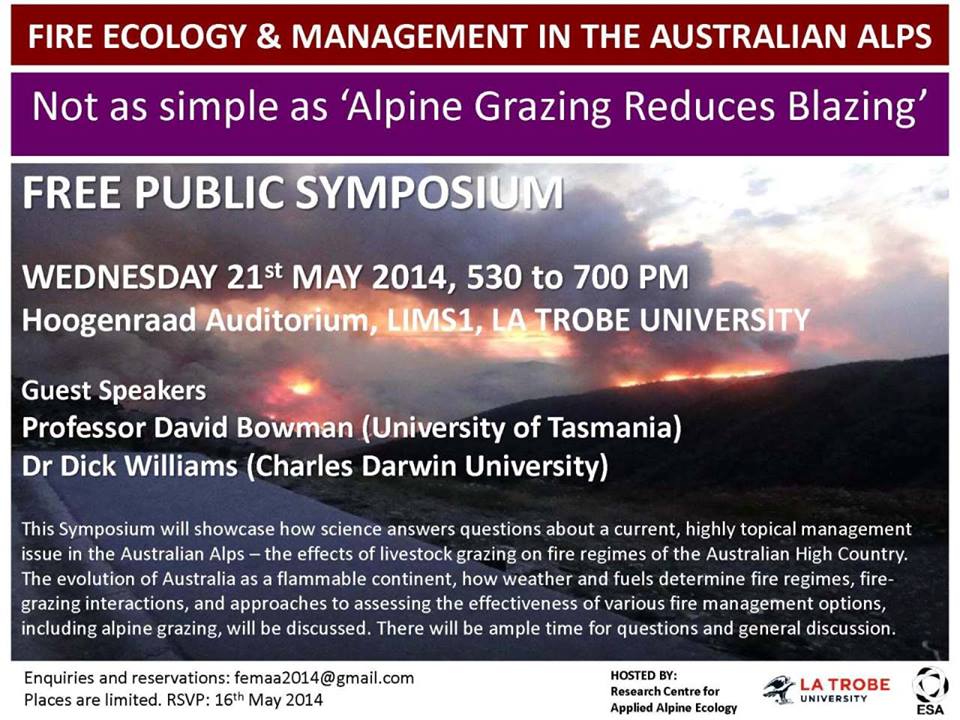
cattle back in Alpine national park. Ryan Smith’s legacy?

The Age is reporting that:

Image from The Age. Graphic: Jamie Brown

Cattle have returned to the Alpine National Park for the first time in three years, with animals released in recent days under the Napthine government’s grazing trial.

It is understood that a little under 60 cows were brought into the park either on Wednesday night or Thursday morning, marking the start of the program.

The move follows the state government getting approval for its grazing plans from federal Environment Minister Greg Hunt earlier this month. The state government says the trial will test whether cattle grazing lowers bushfire risk by reducing fuel loads.

As pointed out by Phil Ingamells of the Victorian National Parks Association:

“the trial was not science, rather a political promise to the cattlemen to protect their privileged grazing rights in the park”.

“Decades of evidence show how much grazing harms the park. But it does nothing to reduce grazing risk,” he said.

Read more in the article by Tom Arup here.

And background on the trial here.

Environmental policy in a time of climate change

Environment Minister Ryan Smith with mountain cattle graziers, Wonnangatta Valley. source: MCAV

The state government has doggedly pursued this grazing trial since it came to power, and the environment minister Ryan Smith has been closely involved in efforts to get cattle back into the park. The first attempt was knocked back by the previous federal government. The current proposal has recently been approved by Coalition Minister Greg Hunt.

Victoria’s environment is in bad shape. Imagine how things could be improved if Mr Smith put as much effort into reducing Victoria’s contribution to climate change. Or protecting Mallacoota from the destructive development at Bastion Point. Or if he acted to protect the habitat of the endangered Leadbeaters Possum which is threatened by logging. Or … (insert any number of other issues here: for instance or check this list from Environment Victoria).

Sadly, he has instead overseen the demolition of the Victorian Climate Change Act. Development of renewable energy has basically stopped on his watch, which can only give benefit to the fossil fuel industry.

Meanwhile, he has pursued this project, widely described as being more about politics than land management.

Will he be remembered as the minister who turned his back on climate action and habitat protection, whose one legacy was to put cattle back into a national park?

VIC map for web

last days for the Toolangi treehouse?

a view from the treehouse

On sunday 10 November, 2013, a young activist called Hannah Patchett launched a long term tree sit to highlight the immediate threats to the Leadbeaters Possum through continued destruction of its habitat. Logging threatens the survival of this species in the Central Highlands to the east of Melbourne.

A range of people have lived in the treehouse since then, bearing witness to the on-going destruction of the precious ash forests.

Now the treehouse has been issued with an eviction notice from the Department of Environment and Primary Industries (DEPI), which expires on the 9th of April. At this point it is expected that DEPI will remove the treehouse on or soon after the 9th.

A group of people connected with the treehouse are currently appealing to DEPI (Department of Environment and Primary Industries) to provide an ongoing permit for the treehouse, or to at least give some reason why a permit has been denied. At this stage we can only assume that the treehouse will be torn down and destroyed if a permit is not granted.

You can keep track of developments by following the treehouse on facebook.

Blog at WordPress.com.

Up ↑