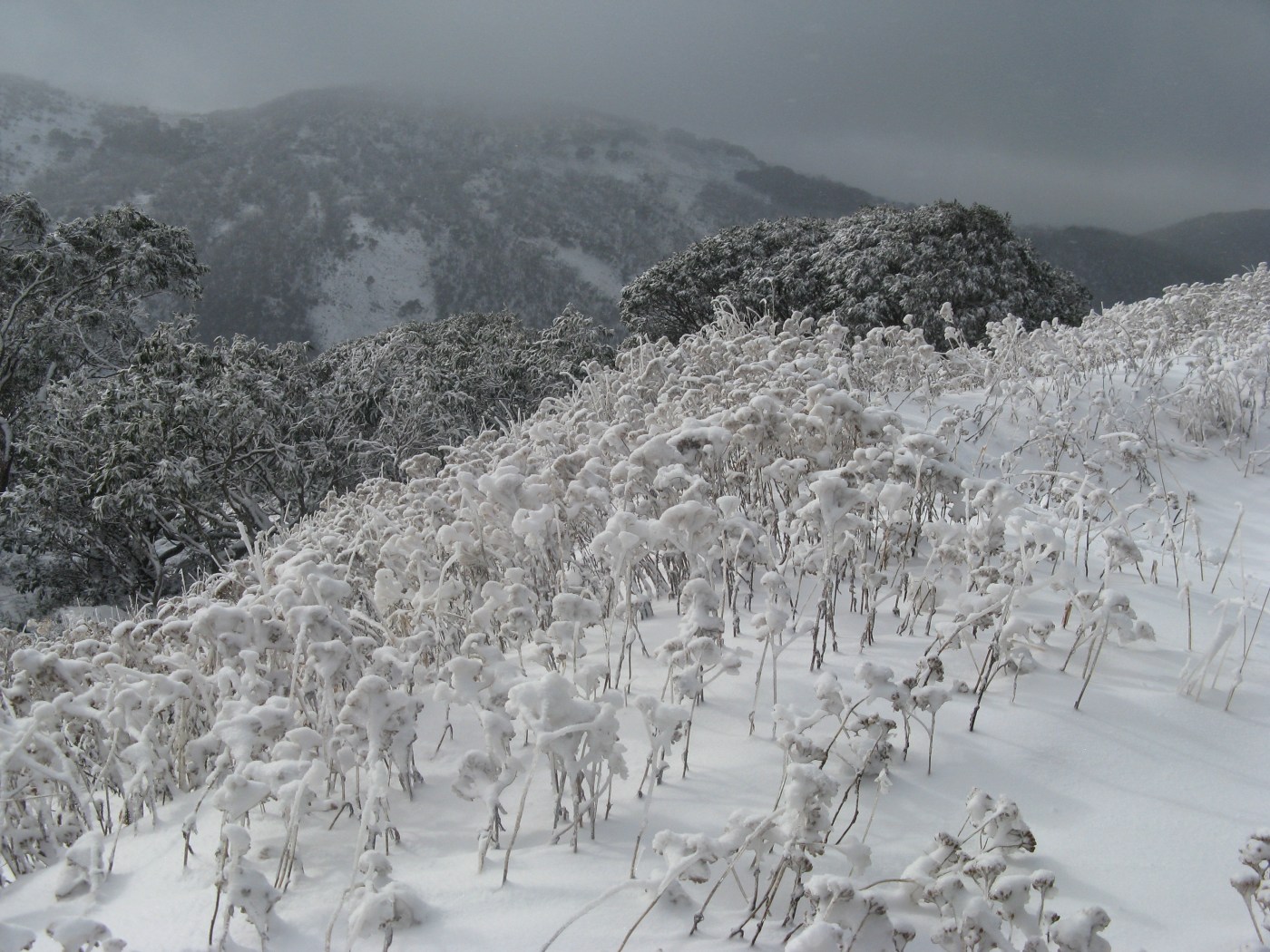
So, after the ‘autumn break’ and decent rainfalls across the south east, we are finally steering towards cooler and wetter conditions which are expected to bring the first significant snowfalls of the year.
As reported on MountainWatch, the esteemed forecaster Grasshopper is quoted as saying:
“At this stage it’s looking like some snow worth mentioning – it’s plenty cold enough – but the totals won’t be crazy. Don’t expect this snow to stick around, at best it will ruin a few hiker’s days and help to cool the ground. But any ground-cooling event at this time of year is positive!”
‘So this mightn’t be a season-starter, but it’s worthwhile getting hyped about’.
And the final analysis?
5 to 20cm across Friday/Saturday (Alert level: Confident).
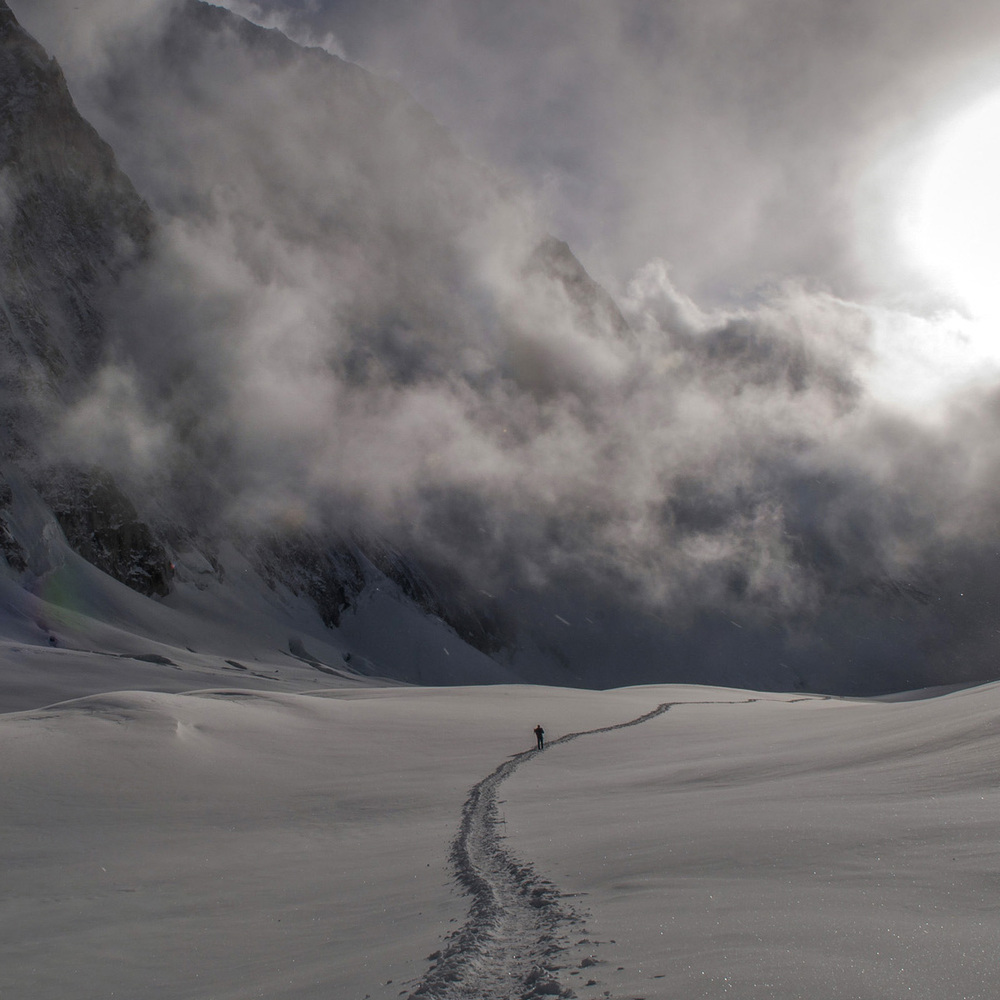
On April 18, an avalanche on Mount Everest swept through a line of Sherpas preparing the climbing route for their commercial clients. Sixteen men were killed, making it the deadliest day in the mountain’s history.
Many people in the climbing and outdoors community are responding. I like this project from the US, raising funds for the families of those killed and injured, by selling (amazing) photos.
The project is called For Our Sherpa Friends. They say:
We are a group of ten photographers who have worked extensively with the Sherpa people and are devastated by this tragedy. For us, this is a moment to ask how we can help our Sherpa friends—both in this time of crisis and in the years to come. As a first step, we are donating the prints you see here, a selection of our photographs of the Everest region and its people, curated by our editors, National Geographic’s Sadie Quarrier and Outside’s Amy Silverman. One-hundred percent of proceeds from this sale (after the cost of printing) will go to the Sherpa community via the nonprofit Alex Lowe Charitable Foundation, which has been working with Sherpa climbers in the Khumbu since 2003.
By purchasing a print today, you are helping provide relief to Sherpa families in crisis, as well as long-term support that transcends this single incident. Together, we will build a more comprehensive safety net for the high-altitude workers who help so many Westerners realize their dreams of the summit.
The festival is run by not-for-profit hosts, and in Australia, all funds raised will support the Friends of the Earth campaign against new coal and gas.
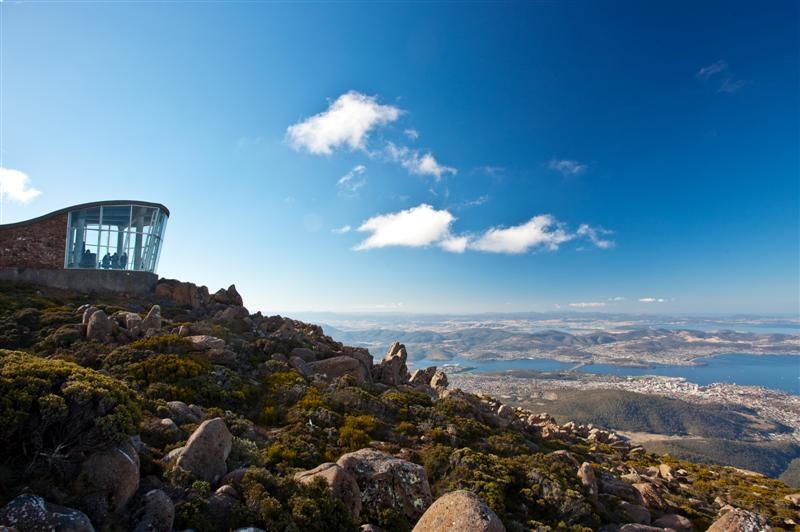
The following update comes from the Hobart group Respect the Mountain, who are concerned about plans to build a cable car up Mt Mount Wellington/ Kunanyi (check here for some background).
Dangerous precedent to be discussed at Hobart City Council meeting on 28th April
April 25, 2014
A dangerous precedent is to be discussed at the Hobart City Council meeting in Town Hall on Monday 28th April at 5pm.
Mount Wellington Cableway Co. (MWCC) is hoping that council will grant landowner permission to extend the boundary of the Pinnacle Zone without any indication of what will be built in the area between the lookout and the top of the Organ Pipes.
Currently the area below the lookout platforms are protected from development. If the MWCC gets their way, then panaromic views from the top of the mountain could be marred by cables protruding beneath them.
This has the potential to set very a dangerous precedent for any future development on the mountain. Without any plans or specifications provided to council, the proponent is asking the City of Hobart to blindly provide permission to develop outside of established development zone. If the Hobart City Council agrees to this request, then it sets a precedent for any further proposals to be able to design wherever they want on the mountain!
MWCC are also yet to reveal exactly what they plan to build on the summit. Apart from a cableway station, other potential buildings that have been discussed include restaurants, cafes, visitor centre, accommodation, and an ampitheatre/function centre. This would form an enormous footprint on the fragile alpine environment and naturally wouldn’t all fit within the current development zone.
It is our belief that the cable car is being used to cloak an enormous development at the pinnacle.
Revelations at the MWCC breakfast launch just before Easter focused mostly on what they had planned on Cascade Brewerys land. Very little was mentioned about what was planned for the summit other than MWCC planned to fly an open-top cable car over the Organ Pipes.
Current revelations of plans are eerily similar to the 1993 Skyway plans that was to start at Cascades and used an aerial tram to travel to the summit where a restaurant and ski field were to be erected.
Respect The Mountain is calling on all concerned residents of Hobart to contact their Aldermen over the long weekend via mobile or email to register their concern before Monday’s meeting. Contact details are available on Respect The Mountain’s Facebook page, Twitter account and website. Alternatively, members of the public can attend the meeting at Town Hall at 5pm.
After struggling financially for several years, it has been announced that the day-to-day management of the Baw Baw alpine resort has been handed to private enterprise.
As with many key decisions taken by the current Coalition government, it appears to be blind to the reality of climate change. Climate science is consistently pointing out that the lower elevation resorts will suffer from shorter and more erratic snowcover earlier compared with higher resorts. Yet government continues to ignore the huge elephant in the room.
Like other resorts, Baw Baw has sought to broaden its appeal in recent years, with a strong focus on ‘green season’ activity and an emphasis on arts and culture, and community-orientated events. Let’s hope the new management continues to develop a diverse range of low impact events that can draw in larger numbers of people.
Belgravia Leisure will manage the resort on a fee for service basis “with the incentive to improve financial performance”.
Board Chair Vicky Papachristos welcomes Belgravia who has a proven track record in the leisure industry, managing over eighty facilities throughout Australia including successfully managing Lake Mountain.
“I am delighted with Belgravia’s appointment because this will allow them to gain an understanding of the resort’s commercial operations and to assist us with improving the long term sustainability of the resort for the future”.
“We are looking to them to bring new ideas and expertise to help us achieve our vision for Mount Baw Baw to become a more vibrant centre for year-round alpine experiences.
“For some years the resort has required additional funding from Government to remain operational. This funding will continue but we will be drawing on Belgravia’s expertise to reduce this burden on the taxpayer and produce a better overall offering,” she said.
“Belgravia will apply their significant experience to manage the resort and produce efficiencies. We will work with them to develop a plan to secure investment in the resort to ensure the long term independent financial sustainability of the resort.”
Minister for Environment and Climate Change, Ryan Smith said: “The private operation of Mount Baw Baw Alpine Resort by Belgravia Leisure is a major boost for tourism and the economy. It will help to build a more innovative and sustainable future for the resort so that its facilities can be enjoyed by Victorians and visitors to the area.”
Belgravia Leisure will assume management responsibilities for the resort immediately and in time for the 2014 snow season. They will report to the Board and will be subject to the same legislation and regulations that are currently in place.
The contract follows the tender process that commenced in November 2013 seeking expressions of interest from private operators to manage and operate Mount Baw Baw. The contract is for one-year with the option to extend this arrangement.
As a contribution for Earth Day (April 22) Snowboarder magazine released a trailer for the snowboarding film ‘The Little Things’.
They say:
As snowboarders, we are explicitly tied to the outdoor world. We depend on ample snowfall, cold temperatures, and healthy forestland to provide us with areas in which to strap in and make turns. And that’s just the tip of the environmental iceberg. Fuel to power our cars, trucks, and snowmobiles (and if we’re lucky, helicopters). Power for chairlifts, resources to make equipment, the list goes on and on, and for most of us, the impact of everything doesn’t enter our minds that often when we’re moving from edge to edge down corduroy or through fresh snow. But, and in no way do we or the folks involved in The Little Things Movie intend to be pushy, being considerate of our environment is something vital to take into consideration. Especially for snowboarders.
The Little Things is a snowboard movie/documentary based on environmentally conscious riders who are inspirational through their riding, as well as their sustainable ways of living and thinking. The film to be released fall 2014 is an initiative taken on by professional snowboarder Marie-France Roy and directed by Filmmaker Darcy Turenne in which all the riders are bringing to life the importance of protecting and living in balance with our environment. Riders include Gretchen Bleiler, Tamo Campos, Jeremy Jones, Mike Basich, Meghann O’Brien, Jonaven Moore, Marie-France Roy, and friends.
Christie lists a bunch of things to do to keep occupied and active while waiting for winter to arrive.
How to quench your cravings for snow
Christie Hampton reveals where to find the next best thing to a ski or snowboard fix while you wait for winter.
Autumn is a fickle time of year. The cooler temperatures have probably triggered your desire to ski or board, an itch that won’t be scratched until those snowflakes start to fall but, let’s face it, that could still be months away.
So what can you do to keep the dragon at bay until then? Here’s a few activities that will help satisfy your need for high speed, perilous and expeditious activities until the white stuff hits the ground.
She identifies mountain biking, trampolining, skateboarding, surfing and indoor skiing as good time fillers til the white stuff arrives. She also has some good leads on where to do each of these activities.
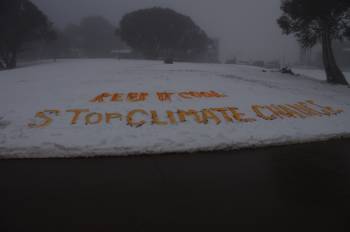
‘keep it cool. Stop climate change’. Dinner Plain, June 2011
The following article has an astonishing fact: 600 U.S. ski areas have disappeared over the past 60 years.
In the article A Snowball’s Chance, written for Boston magazine, Madison Kahn uses the example of Hogback Mountain in Vermont, a small resort that used to be ‘teeming with skiers.’
“The trouble started in the 1970s, when scientists say that temperatures began to rise significantly (in truth, there was little climate research done before then). A series of spotty seasons, coupled with the sharp spike in gas prices brought on by the 1973 oil crisis, hit the mountain hard. It finally shuttered for good in 1986”.
Madison contrasts it with the nearby resort at Mount Snow, which has survived.
“Just 15 miles apart, both ski areas are located in the middle of what was not long ago part of the Northeast’s 120-inch Snowbelt. Why did one die and the other prosper? Simple economics: Mount Snow could afford the snowmaking technology needed to stay open when temperatures began to rise. Hogback couldn’t”.
However, in an observation that should ring bells for us Australians, where much of our snow country is fairly marginal, and where winters are getting warmer, Madison notes:
“making enough snow is becoming an increasingly difficult proposition”.
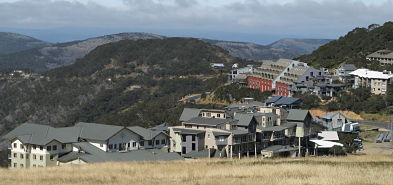
Hotham Village
Research cited in the article suggests that “of the resorts (in the Northeast that are) able to stay open, at least 75 percent will require substantial artificial snowmaking to survive, which, in turn, will significantly increase operational costs and lift-ticket prices”. Skiing or riding in resort in Australia is hardly a cheap option as it is.
“Almost 600 U.S. ski areas have disappeared in the past 60 years, many of them victims of warmer winters. In fact, if warming trends continue at their current rates, within the next few decades, the multibillion-dollar New England ski industry could collapse entirely”.
Here in Australia, there has been a similar response from management boards as they grapple with more erratic winters, with greater attention to snow making and attempts to re-brand resorts as ‘year round’ destinations. Where previously a number of Australian resorts were responding to the threat of climate change, now they have clearly put it in the ‘too hard’ basket. Climate mitigation programs have been quietly dropped as resorts struggle to find new ‘bells and whistles’ to appeal to visitors each year.
Of course, none of this deals with the core problem. Half of U.S. ski areas are opening late and closing early—and in the past 50 years, the average season length in the northeast has decreased by seven days. It’s a similar story here.
It’s interesting to note that in North America, a number of resorts are showing great leadership in terms of playing their part to reduce contributions to global warming.
I recently posted about the need for people who enjoy the mountains to give back to the natural environment in some way. One great option is to join or support one of the many groups that do ecological restoration work or track maintenance. One group that certainly ‘walks the talk’ is the Victorian Mobile Landcare Group, who work across a range of projects in the Victorian High Country.
The following is a report on a recent project they completed on the Bogong High Plains.
For contact details on a range of groups, check here.
Roper’s Hut Track Repair
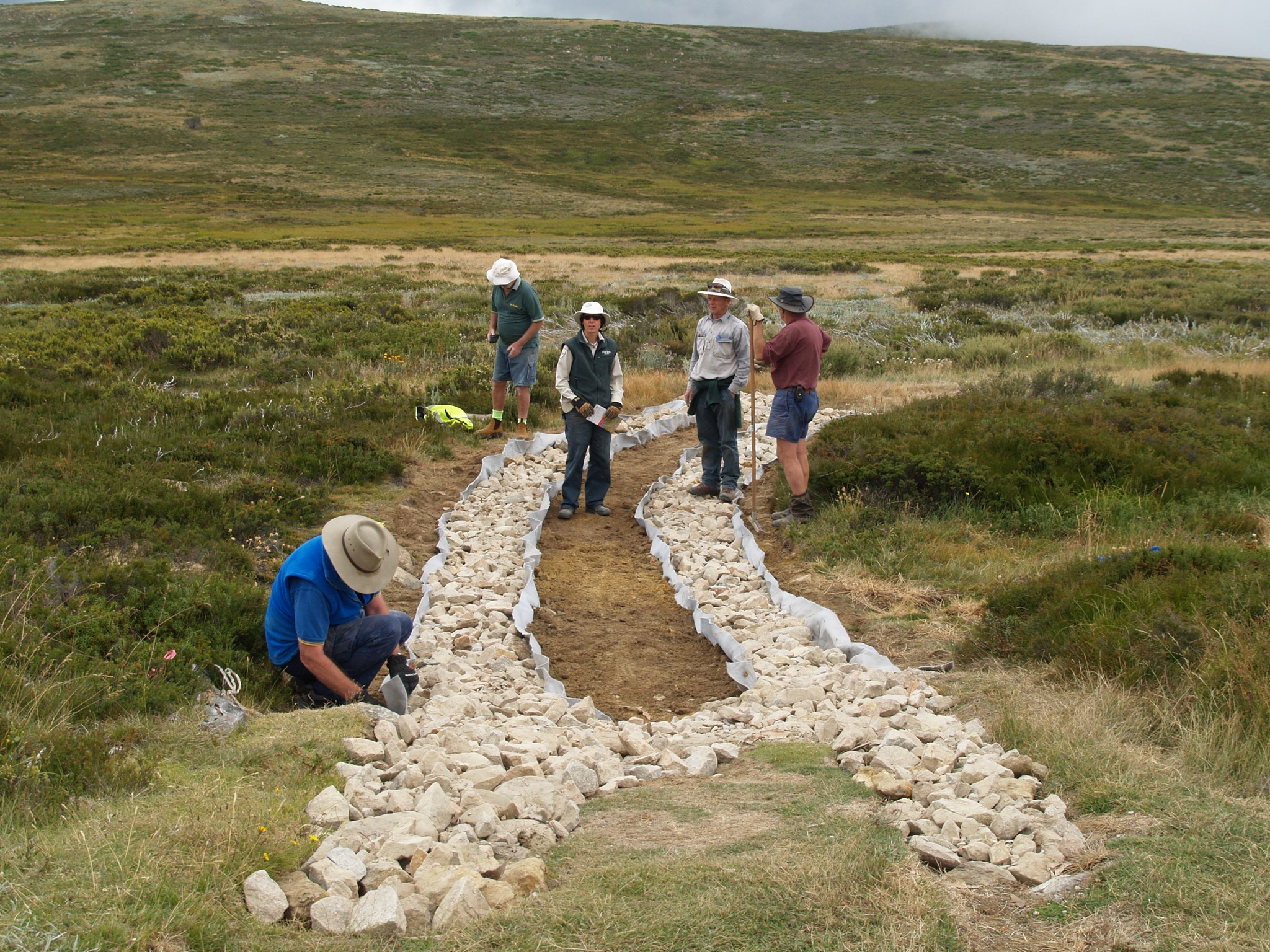
Seven members of the Victorian Mobile Landcare Group Inc. (VMLCG) travelled to Mt. Beauty late on Friday 7 March in order to take on a request from Parks Victoria (PV) to assist create a rock vehicle bridge to protect sensitive sphagnum moss beds which straddle the Management Vehicle Only track out to the iconic Roper’s Hut, burn in the 2003 fires and restored in 2009 by a community effort, headed by the Freemasons Victoria NE District.
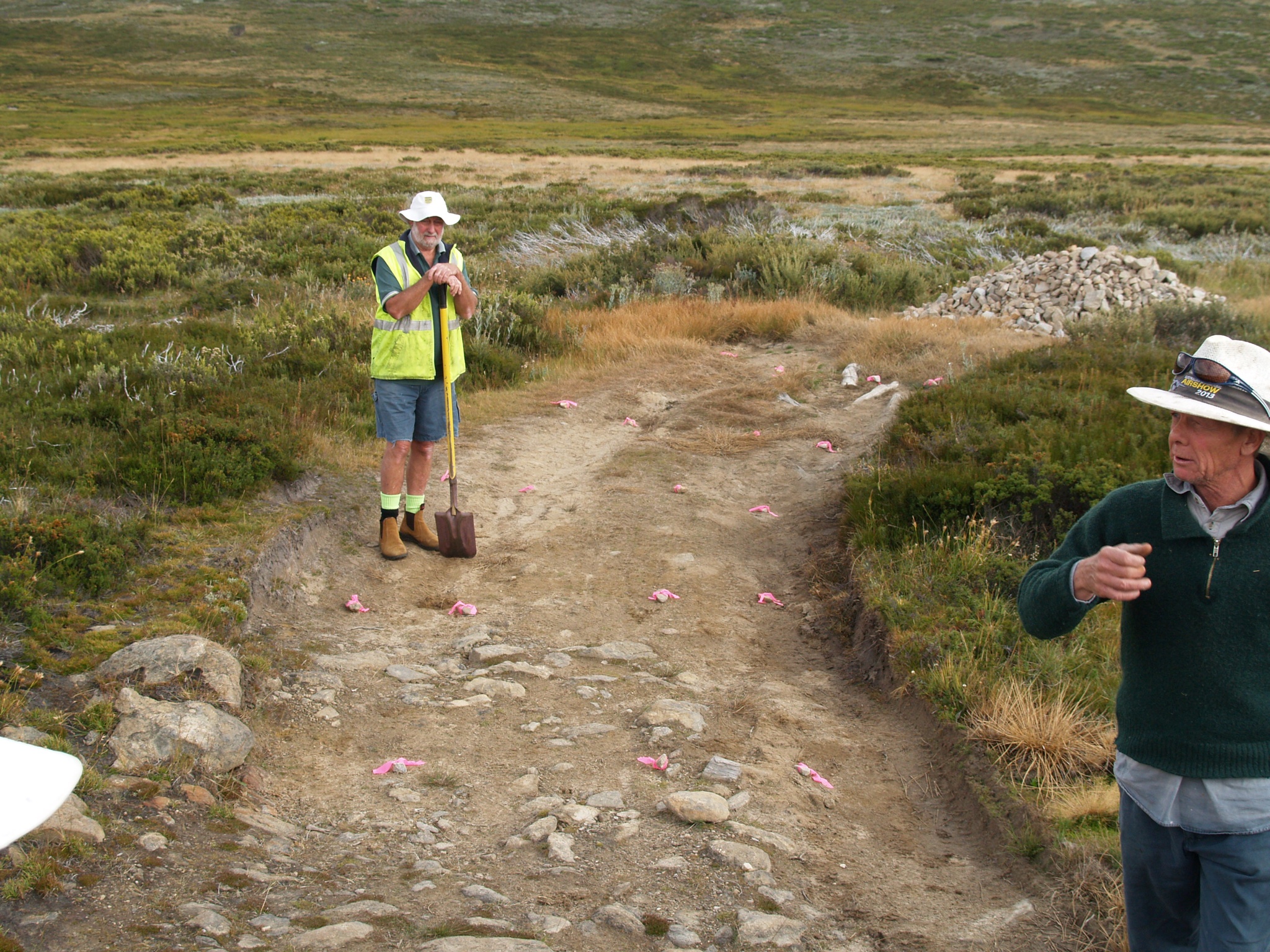
This one is the end of work. Time is 1 pm
The team met Parks Ranger Elaine Thomas and contractor Kim, on Saturday morning at Falls Creek and after rationalising vehicles and loads to reduce track impact, travelled out to the Big River Fire Trail and Roper’s Track intersection.
Once fortified by an early morning team, the VMLCG team then walked to the site, and after a JSA and briefing on design and approach by Kim, commenced the work to excavate and create the crossing.
In all, around 4 cubic metres of existing material was moved to make two purpose built and rock-based wheel tracks for both PV and contractor vehicles required to access the hut site. The 4 cubic metres of 75 – 150 mm granite rock used to fill the wheel tracks was kindly donated to the project by AGL, the operators of the recently constructed Clover hydro power station and this kind donation is much appreciated and acknowledged. Without it, this work would not have been possible.
Start of the work at 10am. The pink dots mark the outlines of the track to be built
This one is start of work 10 am. The pink dots are the track outlines we had to create.
This one is start of work 10 am. The pink dots are the track outlines we had to create.
The VMLCG was originally tasked for two days but with the combined effort of the team and Parks Victoria rangers, the entire project was completed between 10 am and 1:30 pm on the Saturday – and after a quick lunch, the crew returned to Falls Creek and an early mark for the weekend!
The next phase of the project will be when the VMLCG returns with Fintona Girls’School to plant out around 450 alpine shrub species to stabilise the soil around the tracks and reduce their visual impact. It is expected in time, the spot will become barely noticeably and yet provide a much needed stabilising base for the occasional and required vehicle access.
We’ll let the before and after photos speak for the work done.
The VMLCG specialises in the development and delivery of remote area landcare projects and works collaboratively with a number of conservation groups on a diverse range of projects across Victoria. They can be reached via http://www.vmlcg.org.au
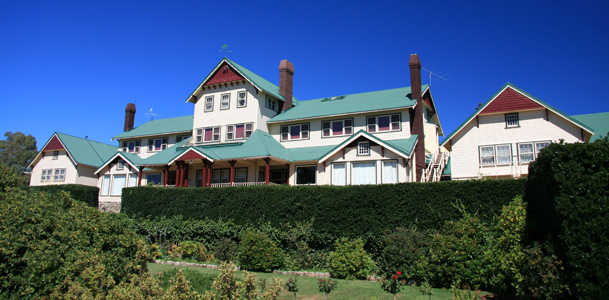
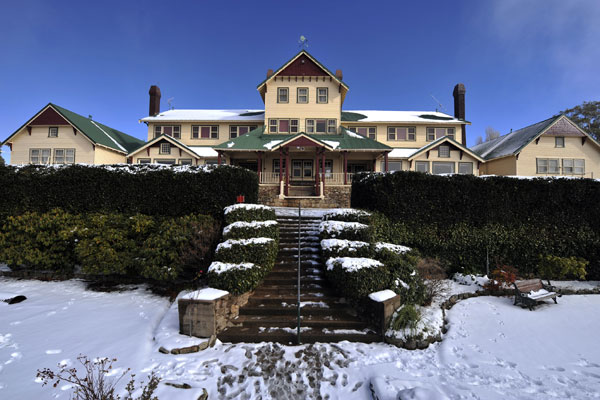
As a further development in the long running saga about the historic chalet on the Buffalo Plateau, The Weekly Times is reporting that the two accommodation wings on the chalet can now be demolished.
The journalist is Chris McLellan.
Iconic Mt Buffalo chalet to be saved by knocking some of it down
Image: SMH
DEMOLITION works can proceed on the Mt Buffalo chalet after heritage protection orders were lifted.
Two wings will be knocked down to make way for a $7.5 million restoration and allow the chalet to be reopened as a day visitor centre.
Heritage Victoria granted the permit over the objections of the National Trust which supported efforts to restore the century-old chalet but not at the cost of about 40 per cent of the building.
The chalet closed in 2007.
There is still debate about whether the demolition works will need Federal Government approval as it is included on the National Heritage List.
A clearing sale of hundreds of items from the chalet will be held on May 4.
Heritage Victoria executive director Tim Smith said the permit would allow the main chalet building to be restored “to its former glory”.
Benalla MP Bill Sykes said work had started on the restoration with maintenance work well under way.
Expressions of interest closed this week for community representatives to oversee the redevelopment.
This recent piece comes from Powder magazine, and focuses on the situation in North America.
The Truth About Snow
An interview with the world’s top skiing climatologist, Daniel Scott
When it comes to the future of snow—and more importantly, the future of skiing—Daniel Scott is the man with the answers. Or, at least, the man with the possibilities. Will the Northeast have snow in 30 years? No. Will Colorado? Yes. Scott holds the Canada Research Chair in Global Change and Tourism at the University of Waterloo in Ontario—the first research facility in the world to comprehensively investigate the relationship between climate change and skiing, starting in the 1980s. Many of the computer models used in Europe today come from the university. Scott built his own model 10 years ago and has been using it ever since to predict what will happen to skiing in the next century.
When it comes to reading the future, Scott does not pull his punches. He co-authored a report that spelled the coming end of half of the ski resorts in the Northeast in the next 30 years. He also contradicted studies saying Colorado would suffer the same fate—saying that most climate models are done from a hydrology point of view, and leave out snowmaking in their predictions. The point being, Scott’s studies are scientific, without a conservative or progressive bent. And in a world flooded with misinformation, this is the kind of resource skiers need.
There is no doubt that our fire seasons are getting longer and more intense. Here in the south east, in terms of massive fires (greater than 250,000 ha), Victoria experienced two such events in the 19th century and five in the 20th century. In less than two decades, we have already had three mega fires in the 21st century. Many alpine areas have been burnt three times in the space of a decade.
There is no coherent overall response as yet by state or federal governments that outlines how we should respond to the growing interaction of climate change and wildfire. Sadly, our Prime Minister is in denial, having claimed that since ‘fires have always been part of our landscape’ there is no link to climate change. The Victorian state government has been challenged on the lack of attention to climate change in it’s approach to managing fire risk. Reducing fire risk is therefore about reducing fuel load and getting larger equipment , not about reducing greenhouse gas emissions or accepting that enhanced fire risk is the new reality for much of the country.
The following report, from Grist, outlines a different approach. The US government has released a strategy that aims to respond to the changing nature of fire threats. One aspect that especially interested me is the fact that it includes an approach that aims to ‘restore and maintain landscapes that are resilient to fire.’ In Victoria, we seem to be doing the opposite. There is a politically driven target that dictates that 5% of the state will receive fuel reduction treatment each year. This is in spite of the fact that some vegetation types don’t need burning to maintain ecological health, and others can become more flammable with the wrong fuel reduction approaches, and others are directly threatened by too much fire.
Climate change just reshaped America’s wildfire strategy
Like a tree in a greenhouse, America’s forest fire problem is growing ominously. Rising temperatures and declining rain and snowfall are parching fire-prone areas and juicing conflagrations. On Thursday, following years of meetings and scientific reviews, the Obama administration published a 101-page strategy that aims to help meet the country’s shifting fire threats.
The National Cohesive Wildland Fire Management Strategy divides the nation according to fire risks, and profiles the communities that face those risks. “No one-size-fits-all approach exists to address the challenges facing the Nation,” the strategy states.
Despite covering 70,000 communities and 46 million homes, the strategy can be boiled down to guidelines that aim to do three main things: restore and maintain landscapes that are resilient to fire; brace communities and infrastructure for occasional blazes; and help officials make wise decisions about how and whether flames should be doused. Here’s what that all looks like in flowchart form:
“As climate change spurs extended droughts and longer fire seasons, this collaborative wildfire blueprint will help us restore forests and rangelands to make communities less vulnerable,” said Mike Boots, chair of the White House Council on Environmental Quality.








Recent Comments