Search

Mountain Journal

Environment, news, culture from the Australian Alps

Tag

climate change

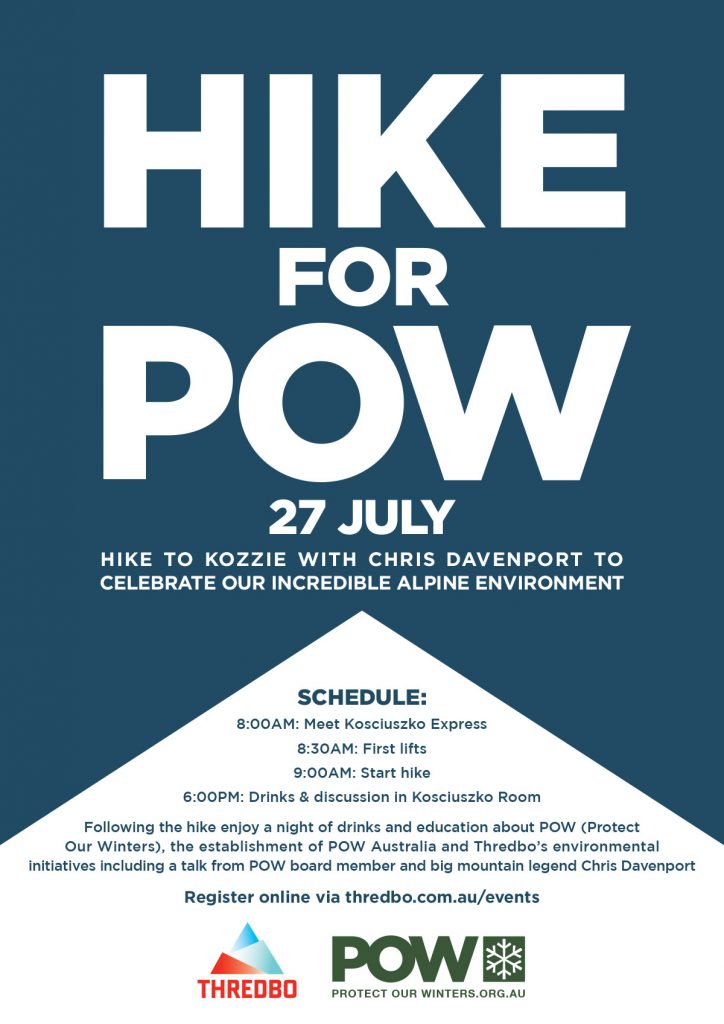
Hike for POW with Chris Davenport

Thredbo, Protect Our Winters and Chris Davenport present a day of raising awareness around POW and the importance of protecting our beautiful and unique environment.

You can join a hike to the summit of Mt Kosciuszko  on friday 27 July at Thredbo, followed by a discussion night with Chris.

Continue reading “Hike for POW with Chris Davenport”

Australia rallies to Protect Our Winters

An Australian chapter of Protect Our Winters (POW) will be officially launched this week, with a visit from pro skier Chris Davenport.  Chris is a POW board member and will be visiting Thredbo and Mt Buller as part of his trip.

Chris will speak at Mt Buller on July 24 and at Thredbo on Friday July 27. There will also be a ‘Hike for POW’ to the summit of Mt Kosciuszko during the day on the 27th.

The following media release comes from POW Australia:

Continue reading “Australia rallies to Protect Our Winters”

‘Getting outside into wilderness reminds us it’s important to speak up for pristine places’

Everywhere you look, wild nature is in free fall. Climate change poses an existential threat to winter snow and the mountains we love. Horses and deer are causing devastating impacts on the high country. The Tasmanian government keeps pushing ahead with plans for commercial development in the World Heritage that the community spent decades working to protect. In the Daintree in far north QLD, hunting dogs are devastating the cassowary population. It’s the same story everywhere.

Yet we continue with ‘business as usual’ politics. The federal government continues to dither on energy policy, hamstrung and blocked by the climate deniers in its ranks. It often feels hopeless.

What we need is for people to get off the fence and get active. As Forrest Shearer, the prominent snowboarder and activist says, the main thing is to ‘show up’ – to get off your butt and get active – where you can, using the tools and points of influence you have. I regularly bemoan the lack of leadership from within the outdoor community. It is the landscapes we love and enjoy in our climbing, riding, walking, skiing and paddling that are being impacted. Yet vocal leadership on issues that matter continue to be few and far between in the ‘outdoor sector’.

So you have to acknowledge it wherever it happens – including the outdoor media.

Continue reading “‘Getting outside into wilderness reminds us it’s important to speak up for pristine places’”

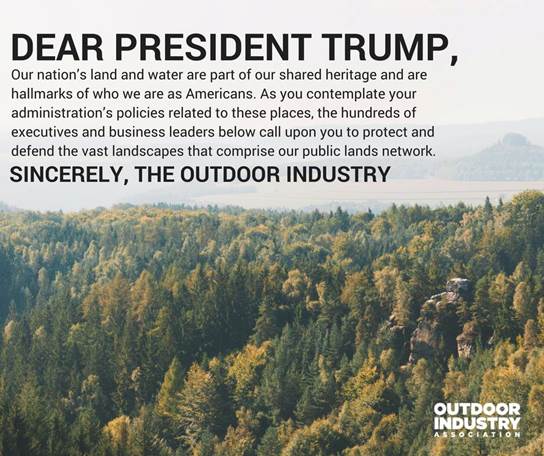
‘The outdoor industry will be the next NRA’

Reid Singer, writing for Outside Online, said recently (The Outdoor Industry Will Decide the Next Election) that the growing power of the outdoor industry was starting to influence national land politics in the USA.

“Not so long ago, the outdoor industry had essentially zero influence in state and national politics. Though individual companies played a role in conservation campaigns and other causes, there was little collective muscle to push issues … the way, say, Big Oil can fight against higher fuel-efficiency standards in cars”.

(The lack of influence has) “started to change in recent years, thanks to two developments. First, in 2006, the Outdoor Industry Association (OIA) began publishing an annual report detailing the massive impact of recreation on the U.S. economy, now responsible for $646 billion in annual consumer spending (twice what Americans spend on pharmaceuticals) and 6.1 million jobs (a big enough number that recently proposed legislation could require the Commerce Department to start tracking it). Second, in 2013, Sally Jewell, then CEO of REI, became secretary of the interior, instantly guaranteeing that recreation would be a part of every major discussion about the use of federal public lands”.

Continue reading “‘The outdoor industry will be the next NRA’”

Climate change will make snow a ‘premium product’ like ‘fine wine’

Climate change poses an existential threat to the ski industry in Australia. A recent report commissioned by the Victorian government suggests that the end of natural snow could be as close as a couple of decades.

As noted by Adam Carey in The Age, without serious action to tackle climate change, ‘the likeliest outcome is that Victoria’s snow resorts will gradually close, until just one or two remain in business by mid-century, offering an increasingly rarefied experience’.

You would think that people who earn their living from snow would be paying attention to what is happening and perhaps even playing their part to reduce emissions.

Apparently not.

Continue reading “Climate change will make snow a ‘premium product’ like ‘fine wine’”

Report into climate impacts on Victorian resorts

There is no doubt that climate change is already impacting on snow conditions in Australia, and hence impacting on the industries that need snow to be viable. When it comes to responding to this existential threat, there are three key options: ignore it (in the hope it will go away), reduce our contribution to the problem (also called mitigation) or just try to adapt to the changes that the problem brings (also known as adaptation). With few exceptions, ski resorts in Australia have opted for the first and the third options. A sensible, responsible and forward thinking ski industry would be doing both adaptation and mitigation.

A report released by the Victorian government will help local resorts steer themselves along the path of adaptation.

Continue reading “Report into climate impacts on Victorian resorts”

11 MONTHS – 3 CONTINENTS – 33 SUMMITS

Josh Worley is a Brisbane mountain climber who is undertaking a world mountain climbing initiative titled Vertical Year

The aim is to climb more than 30 mountains in 2018 with a goal of raising $100,000 for ReachOut Australia and the Climate Council.

Over 140 days, Josh will climb 33 separate peaks – eight of them greater than 6,000 metres – and travel more than 34 vertical kilometres of technical terrain. The trip spans ice climbing in the Canadian Rockies, the Peruvian Andes, big wall rock climbing in the Sierra Nevada and alpine routes in New Zealand’s Southern Alps.

Continue reading “11 MONTHS – 3 CONTINENTS – 33 SUMMITS”

Mountain Ash forests facing ‘collapse’

There is ever growing evidence of the impacts of climate change on natural ecosystems. We know that, without meaningful action now, the future of alpine vegetation in Australia doesn’t look good. This is true around the world. For instance, research shows that, in many instances, forests in the western part of the USA are not growing back after wildfire, and warmer temperatures are being blamed.

Here in Australia, longer and hotter summers are increasing the risk of longer fire seasons. Some parts of the Alps have been burnt three times in the space of a decade or so, with resulting impacts on what species grow back.

Continue reading “Mountain Ash forests facing ‘collapse’”

An interview with Peter Gardner

I first learnt of Peter through his Ngarak Press, which published a wide range of books on local issues and had a real bioregional feel to it’s approach. His regional histories and materials on indigenous peoples in Gippsland and what we would now call the Frontier Wars changed the way many people look at the occupation of the east of the state and the mountains above Gippsland. His bookstores in Ensay and Swifts Creek were real institutions. While now mostly focused on climate change, he continues to be a significant historian for the region, having lifted the lid on the many massacres which happened during and after occupation.

You can read the profile here.

Climate change impacts on resorts – and how they’re taking action to reduce emissions

We all know that climate change poses an existential threat to the snow and alpine environments that we love. While Australia’s lower mountains and modest latitude make it something of a miracle that we even have snow, there is little doubt that already our seasons are getting shorter, with less snow (our snow pack has been in decline since 1957).

But it is disturbing to see the impacts that are happening elsewhere, in countries at higher latitudes and with higher peaks. This recent story sums up some of what’s happening in North America, and how some resorts are responding.

Continue reading “Climate change impacts on resorts – and how they’re taking action to reduce emissions”

The economic impacts of climate change on winter sports

Protect Our Winters has released an update of it’s report ‘the economic contributions of winter sports in a changing climate’. It is yet another reminder about the economic benefits of the snow industry, both in local economies and at the national level, and the threat posed by climate change to this economic activity.

Continue reading “The economic impacts of climate change on winter sports”

Older forests experience ‘smaller and less severe’ fires

A new study in the journal Austral Ecology provides the most comprehensive analysis ever performed of the fire history of forests in the Australian Alps. This is a significant piece of work because it says that unburnt forests are less fire prone than those that have been recently burnt.

This has implications for how we manage these forests and woodlands. The current widely held assumption is that by reducing fuel loads, fire reduces the flammability of most eucalypt-based forests.

Continue reading “Older forests experience ‘smaller and less severe’ fires”

Blog at WordPress.com.

Up ↑