Conservation Volunteers Australia (CVA) and Parks Victoria are embarking on their 3rd year of a joint maintenance program of the Australian Alps Walking Track from November 2014 to mid-March 2015. They are looking for fit and strong outdoor volunteers to join the program, committing 6 days to support the track maintenance activity.
Ross Grant, Parks Victoria Ranger in Charge, says the volunteers will be working in some of Victoria’s most spectacular scenic locations on a variety of projects.
This trip is from several years ago but remains an impressive effort: a traverse of the Alpine Walking Track (AWT) from near Canberra through to Walhalla in winter.
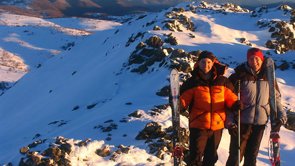
This short video gives some highlights of a trip done in 2005 by two brothers, Andrew and Mark Oates. The main ranges images are lovely, but it’s the earlier stages of slogging through the wet plains of the northern Snowies and fording flooded rivers that is perhaps the most impressive.
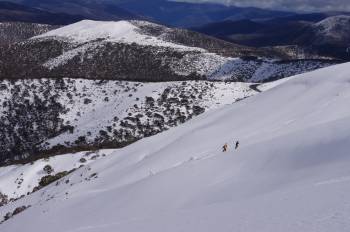
Our first seven days involved walking and carrying our skis, with pack weights around 35 kg. We first put on our skis just after Kiandra and apart from one or two days of pure walking we were able to ski most of the way from there to Hotham. A 60 cm dump of light dry snow near Thredbo helped keep us on our skis but it also made the first few days afterwards extremely challenging. Even with the fattest touring skis available we were still sinking at times thigh deep in snow with our skis on.
After crossing the three highest peaks in the ACT, NSW and Victoria we reached Hotham after four weeks. Unfortunately though the snow did not last – our fifth week out, from Hotham to Howitt saw us experiencing a week of solid rain and strong winds. This resulted in much of the existing snow along the remainder of our route melting away before our eyes.
The AWT remains the quintessential trail through the Australian Alps, and at 680 km in length remains a committing project with complex logistics, because of the need for multiple food drops along the route. You can find some extra info on the track here.
Conservation Volunteers Australia and Parks Victoria are calling out for volunteers to help restore remote sections of the 650-kilometre Australian Alps Walking Track.
Last summer saw helpers spend 120 days in Alpine National Park Across repairing 23 kilometres of track, laying 930 metres of rubber matting and installing eight water bars to prevent erosion at locations including The Knobs, Mount Sunday and Mount McDonald.
Park ranger Nigel Watts said: “It’s a win-win situation for us and for them; an opportunity to get out into the Alps, help with managing this area and enjoy this beautiful landscape.
“Remote sections of the track are difficult to maintain over time and help is needed to clear fallen timber off the track, install rubber tiling, brush-cut overgrown vegetation and to install crucial signage and symbols to help guide bushwalkers on their adventures in the Australian Alps.”
The first three projects in Januray and February are rated easy walking but require volunteers who are especially fit and strong to lay rubber tiles and use heavy mattocks over five full days. Accommodation will be provided in Falls Creek.The track work is all on the Bogong High Plains.
The last three projects in March and April are rated hard walking, and involve remote camping in the King Billy/ Mt Magdala/ Mount Clear/Knobs areas.
Peter Hosking, 31 lives near Jindabyne in the Snowy Mountains.
In the summer of 2014/15 Peter will be trekking from Walhalla in Victoria to Tharwa in the ACT. He will be walking along the Australian Alps Walking Track (AAWT), to raise money and awareness for Autism.
Peter says:
After nearly losing my life in a blizzard in 2012 and being a sufferer of ASD, I want to raise money for Aspergers and Autism. My cousin is full autistic. I want to raise awareness not just for Autism but also for anyone who wants to go into the backcountry, to be prepared for all weather conditions and eventualities. My intention is to raise awareness for ASD sufferers so the general public see our condition in a positive not negative or “taboo”.
This article was written by David Bain orignally published as the first of the Global Snapshot series, bi-weekly essays written by Protect Our Winters (POW) supporters, which give their local perspective of climate change.
The home of our snow industry is a unique and highly specialised sensitive alpine environment. So sensitive is much of our alpine environment that motorised vehicles of any kind are basically not allowed outside of the resort boundaries.
This environment is unique partly as a result of the old age of the mountains and lack of mountain building, being in the middle of a continental plate. Only minor glacial activity has occurred, being last present between 10,000 and 30,000 years ago. The total area of the true alpine environment (above the tree line) is small, approximately only 770 km2, which is found as a series of ‘islands’ on top of mountains within a sub-alpine ‘sea’. In the order of some 6,500 km2 of alpine and sub-alpine areas annually receives some snowfall. Our endemic alpine species have largely evolved in isolation from other continents and often on isolated mountain tops only tens of kilometres apart.
Mid summer. Time to be out in the hills. I have been out exploring some of the less known peaks in the Vic High
Twins summit
Country, like Big Hill, south of Mt Beauty, and Mt Sugarloaf just near the old ticket station on the Mt Hotham road above Harrietville.
The stand out mountain so far has been the Twins, a bulky, almost hump-backed mountain just south-west of Mt St Bernard in the Central Alps.
Although it is generally seen from the Great Alpine Road, this peak really presents itself from the south side, with impressive slopes and wonderful views and a sense of remoteness despite being barely 9 km in a straight line from Hotham village.
I keep hearing reports of Bogong Moth’s moving through Canberra, and thought I would add this link to a great overview of this iconic species.
Bogong Moths, Agrostis infusa, migrate over 1,000 km each year from the black soil plains of Queensland and western NSW to the Australian Alps, seeking refuge from the summer heat. Along the way, they travel by night and then in the morning, drop down to the ground to rest in the shade during the day.
This article was written by Abbie Thomas and is available here.
The effects of climate change on Australia’s alpine areas could mean the end of the ski season.
AUSTRALIA’S ski slopes could be completely bare of natural winter snow by 2050 unless concerted action is taken against global warming, according to a government-commissioned report that paints a grim picture of the effects of climate change on alpine areas.
The report, Caring for our Australian Alps Catchments, has found the Alps, which stretch from Victoria through New South Wales to the Australian Capital Territory, face an average temperature rise of between 0.6 and 2.9 degrees by 2050, depending on how much action the international community takes to combat climate change.
A walker has been found near Mt Skene in the Victorian Alps after an overnight search.
The man, 30, was walking from Walhalla to Canberra on the Alpine Walking Track (AWT) when he activated his emergency position-indicating radio beacon on thursday May 12. He was found the next morning, appears to be in good health, and is walking out with police and the search and rescue team.
A police spokeswoman said crews had been searching Mt Skene for the Alphington man on the east side of the Jamieson Licola Rd. There had been substantial snow falls across the Alps over the last few days and conditions have been below zero.
It is understood from media reports that the man was taking six weeks to do the AWT from Walhalla to Canberra.
A release from the Victorian National Parks Association on a recent proposal to open up national parks for private tourism facilities.
MEDIA RELEASE – Tuesday, 8 March 2011
Tourism facilities in national parks could kill the ‘golden goose’
Mount Hotham
The Victorian National Parks Association says a recommendation by the Victorian Competition and Efficiency Commission, to open up national parks for private tourism facilities, is simplistic and would be a dangerous new direction for park management.
“National Parks are becoming a victim of their own success. They are popular and much loved, but now private companies want a piece of the action in a public asset designed to protect nature for the future”.
“There is a danger of killing the goose that lays the golden egg. People visit national parks for an experience they can’t get elsewhere – they want the opportunity to experience the natural world. There is ample opportunity for tourism infrastructure adjacent to parks, where financially viable developments can take place without the more onerous conditions necessarily imposed on infrastructure inside parks.
The VCEC recommendations contradict Victoria’s current, and widely respected, Nature Based Tourism Strategy, which states that “Private investment into any new large scale facility, particularly accommodation other than adaptive re-use of existing infrastructure, should be sited outside the park”.
“There is a lot of tourism potential on private land adjacent to our national parks which allows for certainty of investment, particularly in and around regional towns,” said Mr Ruchel.
“The VCEC draft report fails to appreciate the public land tenure system and its landscape context. Over 60% of Victorian land is privately owned and 80-90% of that has already been cleared. National parks and conservation reserves make up only approx about 18% of the land in Victoria, and are a refuge for plants and animals in a state with relatively little intact native habitat left.”
“The State Government must rule out new major infrastructure in national parks and re-commit to the principles outlined in Victoria’s existing Nature Based Tourism Strategy.”
“The change we need in national park management is a solid commitment to managing our unique natural heritage for all Victoria’s and future generations” he concluded.
For further comment contact:
Matt Ruchel: 0418-357-813
Phil Ingamells: 0427 705 133
Well, time really does race when you’re having fun. It’s hard to believe that Mountain Journal is a year old, emerging as it did from my late summer doldrums in March 2010, when winter seemed like it was still lifetimes away.
And what a winter it was – big storms, flooding rains, and enormous dumps of dry powder. Roads closed, communities snowed in, land slips.
stream at Telephone Box Junction, Mt Stirling, VIC
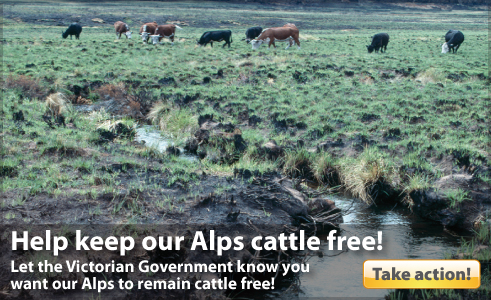
From the original idea of having a mountain-orientated on line journal, influenced by such luminous paper versions of the idea as the Colorado-based Mountain Gazette, it has evolved in various directions: as a forum for various environmental concerns, like alpine grazing and snow mobiles in the back country. As a place to comment on what’s happening across the Alps, and appreciate fun things, festivals, and human-powered activity. Judging by the response (most folks are shy and email me rather than posting comments on the site) it seems that I am not alone in appreciating the various aspects of mountain culture that the Australian Alps offer.
I really enjoyed doing a series of interviews with a range of people connected to the mountains – they shed some light on good work, good ideas and incredible commitment. It has also been a forum to educate and mobilise people, such as with the case of logging near Glen Wills. It became a place to advertise the Australian launch of Protect Our Winters (POW), another side project of mine that will hopefully gather some momentum in 2011.
The most visited sections over the past year have been:
· the Alpine grazing alert
· the ‘side country’ skiing guide to the Hotham area
· the logging alerts
· the proposal to put a ‘skyway’ up onto the Buffalo Plateau
· the launch of POW
· the interviews
· the story on traditional owners of the Alps
But primarily, it has been my way of writing a love story for the mountains that give so much meaning and joy to my life, building on an earlier site on the Alps and broader ‘Bogong bioregion’.
My original vision had been to expand the journal into a ‘real world’ paper version, but the beauty of this project is that it is overtly not commercial in focus, and so the effort of chasing advertising to cover printing costs was all a bit much. So for at least the foreseeable future, this will remain in (green energy powered) cyberspace.
Thanks again for your encouragement and support on the journey so far.
Please feel free to contribute to this project, with news, links, stories, photos, reviews, poetry or any thing else that’s mountain-related.
Here’s to an early winter and deep snow! Regards, Cam






 Mountain Journal
Recent Comments