Search

Mountain Journal

Environment, news, culture from the Australian Alps

Tag

climate change

the Dark Snow project

“ There’s no place on earth that’s changing faster — and no place where that change matters more — than Greenland. ”
– Bill McKibben

dark_snow_wordmark_blackThe first-ever Greenland expedition relying on crowd source funding aims to answer the ‘burning question’: How much does wildfire and industrial soot darken the ice, increasing melt?

Fossil fuel combustion creates carbon emissions that increase atmospheric thickness, warming climate. The occurrence of wildfire increases with climate warming, increasing soot loading of the atmosphere. Some of this soot is transported through the atmosphere and is deposited on glaciers, lowering their reflectivity, increasing solar energy absorption, increasing melt rates.

While watching wildfires raging across his home state of Colorado, climatologist Jason Box was struck by the question of whether the dark wildfire soot could contribute to the Greenland melting?

Dark Snow is a field and lab project to measure the impact of changing wildfire and industrial soot on snow and ice reflectivity. Soot darkens snow and ice, increasing solar energy absorption, hastening the melt of the “cryosphere”.

They mounted an expedition to Greenland to consider the impacts. A lot of their work is fairly technical. But its an intriguing concept.

Check their website for details and updates.

Review: All.I.Can

allicanThis film is billed as the best selling ski film of all time. One that ‘compares the challenges of big mountain skiing to the challenges of climate change’. I liked its trailer, which did seem to be saying something about over consumption and energy. As a backcountry skier and climate campaigner, I was stoked when I finally got to watch it, a few years after it came out.

Yes, its beautiful, compelling and also great fun, covering some of the finest skiing terrain on the planet. There are great people skiing incredible lines, and having a lot of fun doing it. There is an urban skiing scene that is one of the best clips I have ever seen in a ski film.

But in its claim that it is tackling the climate change issue, it is also a dangerous piece of propaganda for ‘business as usual’ capitalism. I am amazed that the film wasn’t paid for by coal companies. How can a group of switched on people get it so wrong?

My review is available here.

cattle back in Alpine national park. Ryan Smith’s legacy?

The Age is reporting that:

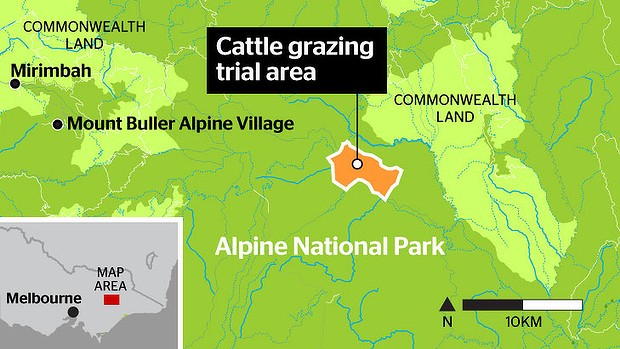
Image from The Age. Graphic: Jamie Brown

Cattle have returned to the Alpine National Park for the first time in three years, with animals released in recent days under the Napthine government’s grazing trial.

It is understood that a little under 60 cows were brought into the park either on Wednesday night or Thursday morning, marking the start of the program.

The move follows the state government getting approval for its grazing plans from federal Environment Minister Greg Hunt earlier this month. The state government says the trial will test whether cattle grazing lowers bushfire risk by reducing fuel loads.

As pointed out by Phil Ingamells of the Victorian National Parks Association:

“the trial was not science, rather a political promise to the cattlemen to protect their privileged grazing rights in the park”.

“Decades of evidence show how much grazing harms the park. But it does nothing to reduce grazing risk,” he said.

Read more in the article by Tom Arup here.

And background on the trial here.

Environmental policy in a time of climate change

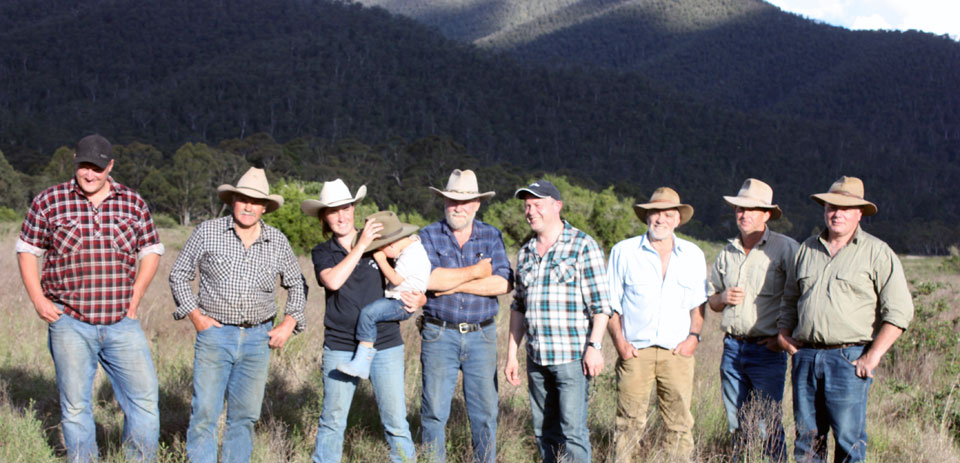
Environment Minister Ryan Smith with mountain cattle graziers, Wonnangatta Valley. source: MCAV

The state government has doggedly pursued this grazing trial since it came to power, and the environment minister Ryan Smith has been closely involved in efforts to get cattle back into the park. The first attempt was knocked back by the previous federal government. The current proposal has recently been approved by Coalition Minister Greg Hunt.

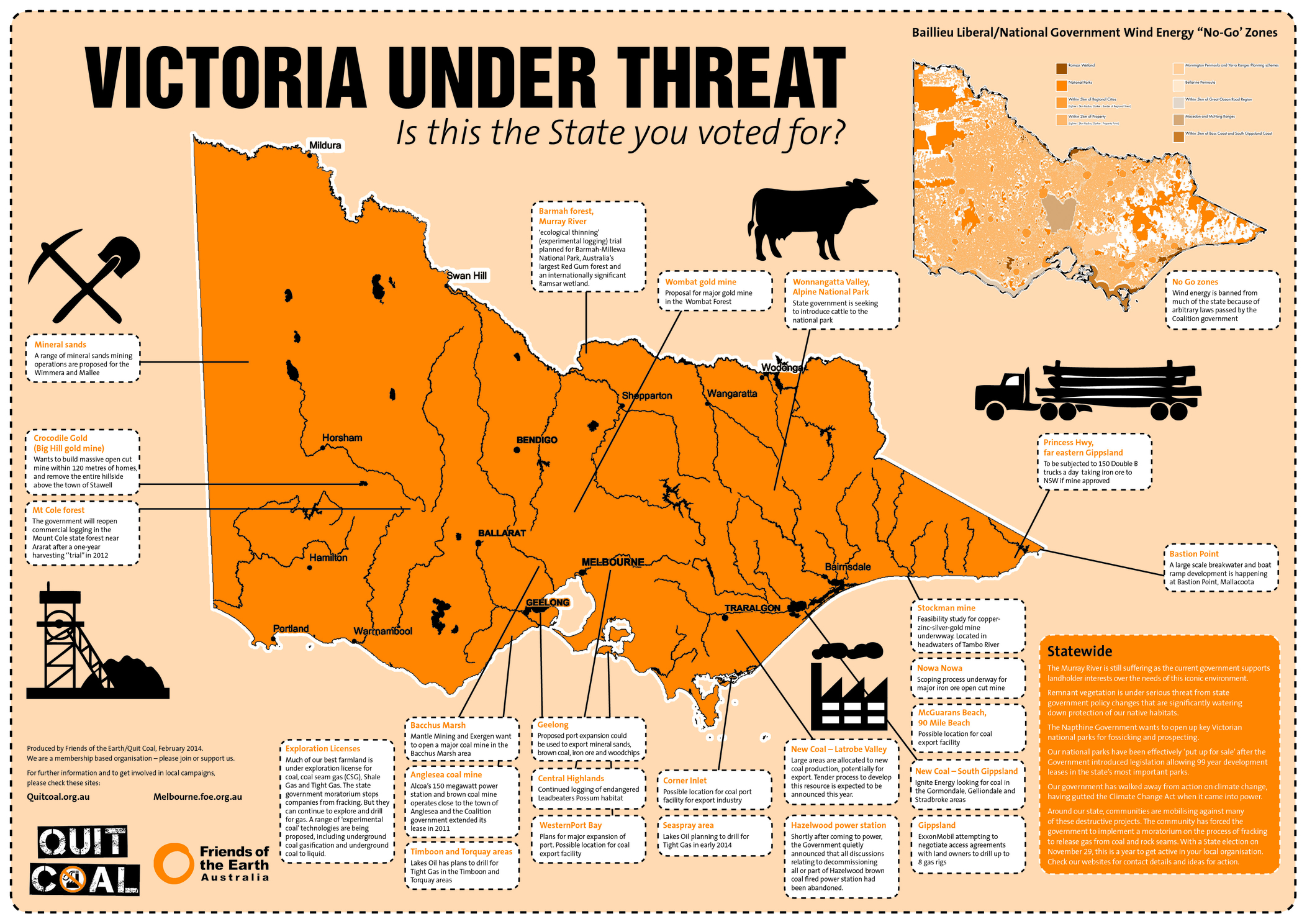
Victoria’s environment is in bad shape. Imagine how things could be improved if Mr Smith put as much effort into reducing Victoria’s contribution to climate change. Or protecting Mallacoota from the destructive development at Bastion Point. Or if he acted to protect the habitat of the endangered Leadbeaters Possum which is threatened by logging. Or … (insert any number of other issues here: for instance or check this list from Environment Victoria).

Sadly, he has instead overseen the demolition of the Victorian Climate Change Act. Development of renewable energy has basically stopped on his watch, which can only give benefit to the fossil fuel industry.

Meanwhile, he has pursued this project, widely described as being more about politics than land management.

Will he be remembered as the minister who turned his back on climate action and habitat protection, whose one legacy was to put cattle back into a national park?

VIC map for web

Point zero zero one

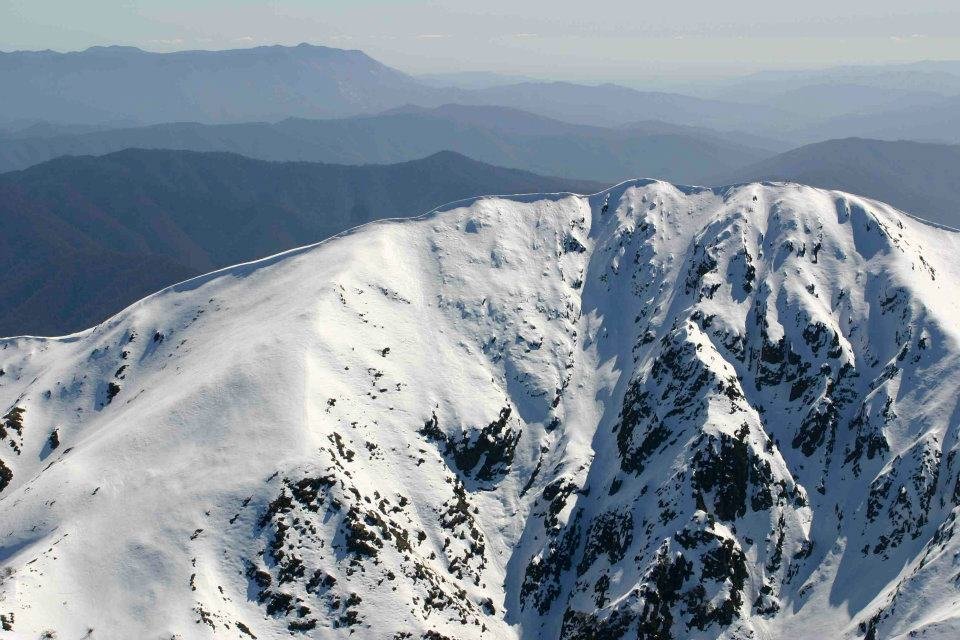
East Face of Mt Feathertop, VIC. Image from the film by Stephen Curtain.

As Tony Abbott threatens to de-list significant areas of the Tasmanian World heritage area (WHA) so the loggers can get to the old growth forests that are currently protected, it’s worth remembering that all our WH Areas are special and most of them are already under pressure from climate change.

No area has as many climate pressures as the Australian Alps. This film from Stephen Curtain offers some great telemark skiing images from the Western slopes of the Main Range in the Snowy Mountains. It also reminds us how unique and vulnerable this landscape already is. There have been several attempts to get World Heritage listing for the Australian Alps over the years. In an era of climate change and ever more demands on wild places, we need more world heritage areas, not less.

Check the film here.

Stephen says:

Point zero zero one (0.001) is the approximate percentage of the Australian continent occupied by the Australian Alps.

Bordering one Territory and two States, this biogeographical island supplies invaluable fresh water to much of south east Australia and provides outstanding natural, spiritual and cultural values.

Although the Australian Alps are recognised as a national iconic landscape by federal national park agencies and Tourism Australia in recognition of such values (see australia.com/campaigns/nationallandscapes/AustralianAlps.htm), World Heritage Listing still eludes the Australian Alps.

Point zero zero one celebrates the fleeting beauty of these Alps.

This short film was an entrant to Bristol’s 2012 Wildscreen Festival in the UK. Visit wildscreenfestival.org/

the Exteme Ice Survey – tracking the loss of the glaciers

The following article comes from the Winter 2014 issue of Mountain Magazine. It tracks the decline of a glacier in coastal Alaska and was written by Tad Pfeffer, scientific partner of the Extreme Ice Survey.

James Balog’s photographs reveal a glacier in retreat.

The tremendous snowfall of the Alaskan coastal ranges funnels down to the waters of Prince William Sound, where the Columbia Glacier calves icebergs into the Valdez shipping lanes. I’ve lived at the Columbia for a few weeks at a time for nearly 10 years, and at glaciers around the world for 35. I watch, measure, photograph, and poke at ice with various tools to reveal the inner workings of this particular cog in the great environmental machine we inhabit. My work is arcane, an oddball pursuit. Or it was. Surveying ice is now mainstream. The state of the world’s climate, and its glaciers, suddenly matters.

Since 1983, the Columbia Glacier’s length has shrunk by a third, losing 12 miles of ice. Pushing icebergs into the ocean at that rate is fast work. The Columbia can move 100 feet per day. In 2006, I used time-lapse photography as an observational tool. The next summer, renowned photographer James Balog and a film crew accompanied me to Alaska to do more.

The result of our work is the Extreme Ice Survey, a collection of large-scale, time-lapse imagery from Alaska, Iceland, and Greenland. Balog’s photos get the crucial point across: These giant systems are changing, and fast. Filmmaker Jeff Orlowski captured the big moments and the frustrating hurdles, and his contribution became the film Chasing Ice. Our collective labor informs those who must act, for the benefit of us all.

And our work continues. The EIS now gathers time-lapse photography from 28 cameras stationed at 13 glaciers in Greenland, Iceland, the Nepalese Himalayas, Alaska, and the Rocky Mountains. South America and Antarctica are next. Each camera collects 8,000 frames annually, taking a photo every half-hour of daylight. The images help the public learn more about glaciers and ice sheets so that 35 years from now, the Columbia might still exist.

Visit extremeicesurvey.org for more information.

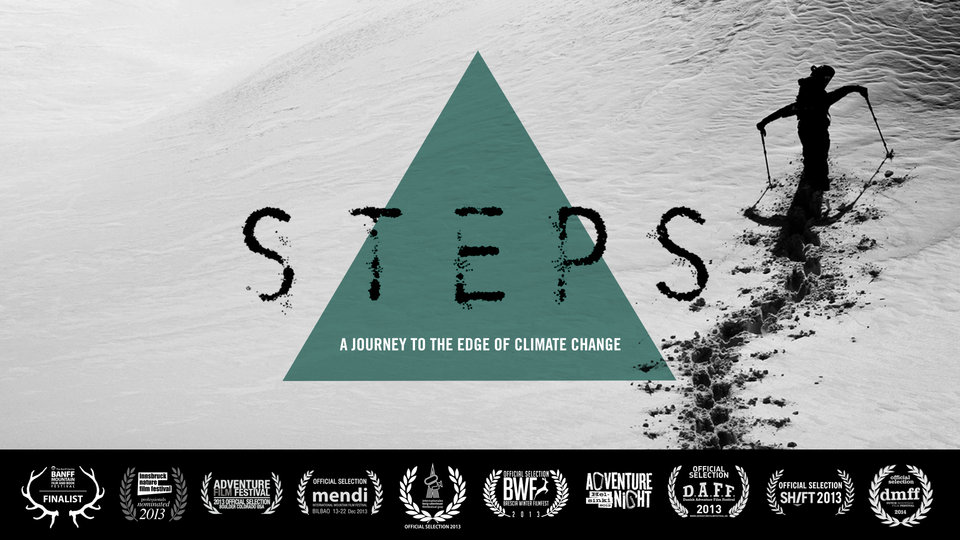
STEPS – A Journey to the Edge of Climate Change (the whole film)

StepsFrom Ride Greener.

After storming cinemas and film festivals across Europe and North America, the first climate-friendly ski and snowboard film, STEPS, is now available online for everyone to watch. STEPS is there to show us how we can snowboard and ski in harmony with nature – without giving up any fun.

Choose how much you pay: You can watch STEPS for FREE or make a DONATION to Ride Greener. Each voluntary donation will be reasonably used and 100% invested in the Ride Greener environmental campaign.

You can watch the film here.

Donation information here

How well has the Napthine government managed our environment?

Sealers Cove, Wilsons Prom NP

The following is from the Victorian National Parks Association.

With a Victorian state election due in November this year a survey has been launched asking people what they think of the Napthine Government’s environmental policy.

If you are concerned about the way the Victorian Government has handled conservation issues please take the survey, it only takes a few minutes at most.

You can do the survey here.

Sochi Olympians speak out on climate change

An interesting piece on the efforts of some Olympians and Paralympians who are speaking out about the need for concerted action to reduce greenhouse emissions. This comes from the Sustainable Play website and is written by Brad Rassler.

Brad notes that just 83 athletes, primarily from the U.S. and Canadian squads, and just a few from outside North America, have signed on to speak about the need for action on climate change at the Sochi Games.

Wouldn’t it be great to see some of our winter athletes raising the issue at the Games?

Sochi Olympians Speak Out On Climate Change

olympic athletesU.S. cross country skier Andy Newell will travel to Sochi, Russia in two weeks to compete in the Winter Olympics. And though his aim is clear — to stand atop the podium — he’s traveling to the Games with more than precious metal on his mind.

For the past two months, Newell, 30, has quietly appealed to his fellow Olympians to leverage the Sochi Games as an opportunity to speak to world leaders about the ravages of global climate change on the winter snowpack. The petition he’s been circulating, Olympic Athletes for Action Against Climate Change, makes the case to his fellow competitors in four paragraphs:

Winter is in jeopardy.  Inconsistent weather patterns caused by a changing climate are causing destruction around the world, and the economic impact is being felt in both large cities and small mountain communities.

    As winter Olympic athletes, our lives revolve around the winter and if climate change continues at this pace, the economies of the small towns where we live and train will be ruined, our sports will be forever changed and the winter Olympics as we know it will be a thing of the past.

    The power we have as Olympians on a global stage is immense.   Let’s use this year to make a collective statement, to send a message to the world’s leaders to recognize the impact of climate change and to take action now.

Please join us by signing this letter.

That letter, addressed to the world’s leaders from the petition’s signatories, is comprised of a simple sentence containing a powerful ask:

“…to recognize climate change by reducing emissions, embracing clean energy and preparing for a commitment to a global agreement in Paris in 2015.”

The call to action refers to the United Nations Framework Convention on Climate Change in Paris, schedule for November 30 – December 11, 2015.

Newell has thus far been joined by 82 athletes, primarily from the U.S. and Canadian squads, and just a few from outside North America. He hopes to have 100 signatures before the Games begin in two weeks, but admits getting athletes to step up and sign has proved tougher sledding than he thought.

“It’s a tricky situation. Not only because it’s hard to get the word out there to people in different countries, but a lot of athletes are reluctant to sign things in general in an Olympic year.  They don’t want to cause a controversy.  They don’t want to use the Olympics as a platform for protest either, necessarily.”

Newell, who counts 350.org founder, author and environmental advocate Bill McKibben as one of his heroes and mentors, concedes that the life of an average Olympian, with its requisite air travel, isn’t exactly easy on the planet.

“We burn a lot of fossil fuels chasing the winter around and trying to go to these competitions.  I think a lot of us feel bad about that.  But that’s our job and our livelihood and our passion.  But at the same time, we try to use that – the professional athlete as a platform — to try to raise the awareness of people that may not understand what’s going on out in the environment.”

“I didn’t necessarily want to use the Olympics as a platform for a protest, necessarily,” Newell says. “But I wanted to at least try to get a lot of athletes on board to sign this letter and basically get it to their heads of state, to say, you know, we’re Olympic athletes and we can’t continue to support ourselves and this kind of livelihood if our winters keep disappearing, and we want you guys to recognize that there is some climate change happening.”

The U.S. cross country team’s winningest athlete and gold medal favorite, Kikkan Randall, has signed the petition.

“I grew up in a family that was very respectful of the opportunities that we had to be out in the environment, and to try to do our part, the best we could, to contribute to the health of the environment,” says Randall. “And certainly being involved in a sport that does rely on the weather and the fact that climate change could effect our sport…I think athletes, doing what we do, we have a great platform to go and encourage others…to do their part.”

Protect Our Winters (POW), a California-based non-profit whose athlete-advocates get the word out about climate change, has stepped forward to boost international attention to Newell’s petition. Chris Steinkamp, POW’s executive director, says that Sochi is an ideal backdrop for an athlete alliance to speak out about climate change.

“The Olympics is the perfect stage for something like this.  Obviously, it has a history of social issues. But I think this is the first time that climate change has come up, and it’s because obviously climate change is a hot issue right now. Sochi is one of those places where it could be a real issue in the next couple of weeks, and the conditions and the weather might be really inconsistent.  So it’s a perfect storm for this issue to be recognized.”

Or maybe an imperfect storm, climatically speaking. Steinkamp says that although climate change is well documented by the science, global leaders have not yet taken the necessary actions to curb its progress, and the time to act is now.

“Every year we all go into these climate conferences, these international global discussions about climate change with high hopes that something is going to be done, and nothing ever really does get done.  So the goal of the letter is two-fold:  To really let world leaders know that something needs to be done, but also let them know that something needs to be done in Paris in 2015.”

Whether international decision makers heed Newell’s call remains to be seen. Steinkamp views the alliance itself, the first of its kind, as a significant flag in the snow.

“The cool thing is that you’ve got these Olympians that are standing up for climate change, and with this platform that they have in Sochi, [they have] the opportunity to speak their mind. Because the only way that the world leaders are going to listen is if the population lets them know about it.”

According to CNN, over 6,000 Olympians and Paralympians will compete in Sochi. Newell has just 82 with two weeks to go.


The practical realties of social change suggest that as more athletes sign the petition, the safer it becomes for those sitting on the fence to participate. This author of Sustainable Play has created his own petition, encouraging the readership of this site to ask the remaining 5,900 to take an Olympic-sized stand for this Olympic-sized issue. Reassure them that climate change transcends mere politics; it’s a phenomenon without borders.


Click on the “petition’s petition” here:


http://tinyurl.com/kn395tj

The Little Things – A new snowboard film project from Marie France Roy

The following comes from Snowboarder Magazine. There is a trend emerging of snowboarders and skiers – who are often keenly aware of how climate change is already impacting on mountain environments – taking on a more vocal attitude about the need for change. This is one more example of this.

the little thingsMarie-France Roy has earned many accolades during her snowboarding tenure for her talent when standing sideways. She has put out some of the most influential video parts of the past decade and has chops in both the backcountry and the streets.

Last season, Marie embarked on a journey to give back to the sport she loves and create a film that would share the stories of snowboarders who are committed to living in a way that positively affects the environment as much as possible. The movie is called “The Little Things” and will follow Marie and the rest of the crew this season before culminating in a release in fall 2014.

You can see the trailer for the film here.

Protect Our Winters launches the POW Riders Alliance

Riders-Alliance-2-300x225In the US, Protect Our Winters has just launched what it is calling its ‘Riders Alliance’, a group of 53 professional snowsports athletes, committed to fighting climate change and speaking out for the environment.

It is a remarkable line up of some of the best skiers and boarders on the planet.

As they say in the release, “Climate change is affecting our lives and careers and it’s in our best interest to use our passion to mobilize the community and bring a new perspective to the policy discussion.”

It’s great to see leadership being taken by so many high profile athletes. The group includesGretchen Bleiler, Jeremy Jones, Sage Cattabriga-Alosa, and Ingrid Backstrom.

The POW Riders Alliance was developed as a central platform for athletes to speak out and create a social movement against climate change.  For example, POW recently led a group of 17 athletes to Washington, D.C. for meetings with US Senators and has reached over 20,000 young students with a message of climate action delivered by pro athletes.

POW believes that by combining the athletes’ passion with their influence, first-hand experience and immense media reach, it represents a new, powerful approach to environmental advocacy.

With the Winter Olympics just a couple of weeks away, POW and Olympic athletes from the Riders Alliance will launch an initiative to call attention to climate change on the world’s largest sports stage in Sochi, Russia in partnership with a group of graduate students from the Yale School of Forestry.

The press release is available here,  and photos of the skiers/ boarders are available here.

Life, death, rebirth and new terrain

near Mt Wills
near Mt Wills

I have been out checking some of my special places, to see how they are faring after last summer’s Feathertop fire. The north razorback fire burnt hot up and out of the Ovens river, past Mt Smythe and into the Upper Buckland River and swinging east around the massive bulk of Hotham and towards Dinner Plain.

Many of the forests along the Sugarloaf Ridge were badly burnt and now big swathes of burnt out country have been clearfelled to protect the Great Alpine Road. I understand the need to cut out the alpine ash close to the road that had been killed in the 2013 or earlier fires, but a major over clearing has happened on the slopes of Mt St Bernard, where fire killed snowgums well back from the road had been clearfelled for no obvious reason.

IMGP6236Parts of this country have been burnt three times in a decade. Each year, the land becomes ever more of a mosaic of new burn, older burn, and pockets of old forest – alpine ash and snow gum – that have survived each onslaught. The 2013 fire has killed off forests, glades, slopes that had survived the earlier fires. The headwater country of the Ovens, Buckland, and Wongungarra were hammered hard over the past summer. To my eyes that land seems poorer, from too many burns in too few seasons.

IMGP6251Fire has always been a part of our landscape. And climate science clearly tells us that longer and harder fire seasons are our future. These last few days I have wandered through alpine ash slopes and snow gum forests that had been completely scorched. Other areas have been lightly burnt, others spared altogether. The fire burnt hot up out of the Ovens, then seemed to turn back around some of the higher ridges on the Divide slower and with less heat. Its incredible to see some areas thick with new fern and daisys, while other areas as still mostly bare soil and logs, dead trees still black, streamers of bark rattling in the breeze. In some areas wattle are shooting back, in others, the beginning of Elderberry Panax groves or thick rushes of snow gums re-shooting around the burl of parent trees. If anything, the most recent fires have increased the mosaic effect on the ground.

Below tree line, the forests on these mountains can look so similar from a distance. Up close it is a mix of montane forests merging to alpine ash, leading to snow gum, the mix of vegetation in each place all dependent on slope and aspect, altitude and soil, fire history and circumstance. These most recent fires have added to the mix of already complex ecosystems and forest types.

In my mind I can see a future of more frequent fires, longer summers, warmer winters, and the land that I know and love so well being transformed into something new and poorer. Less old growth, trees pushed beyond their limits, less diversity of living things. But in the short term – summer to summer, the annual cycle that my mind can hold and understand – I see nature adapting and filling the spaces created by each fire. There is a deep ability for tenacity and resilience, seeking balance. The great unknown we face is that we do not yet understand the point at which we will have crossed beyond the balance of resilience and natural cycle into the time when balance will be broken by a human induced future. Some days I am frightened that no one knows, or will even be able to identify, that point of no return, when resilience is surpassed by a new reality that will make our familiar lands a new country, one that is foreign and strange, beyond anything we have known before.

coal dust killing glaciers

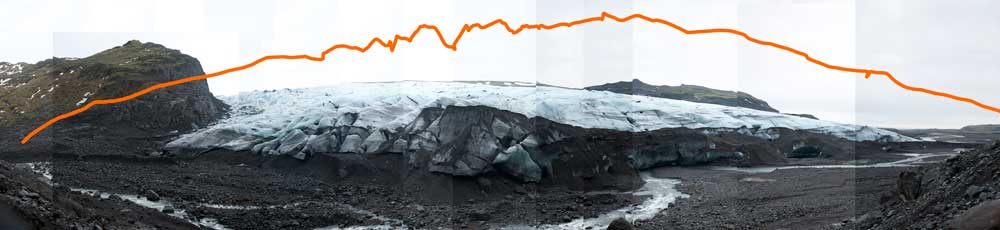
The West Branch of the Columbia Glacier, near Prince William Sound in Alaska’s Chugach Mountains. photo by Ethan Welty.

An interesting piece from Mountain Online. Here in Australia, the 10 year drought in the south east brought noticeable levels of dust onto the snowfields. Dust events are known to impact on snowcover in the South West of the US and have been linked to desertification, over grazing, etc. This article suggests another way human activity has been impacting on snow melt is through burning coal.

New research reveals humans halted the Little Ice Age. Is it too late to learn from our mistakes?

By Patrick Doyle

In July 1998, Thomas Painter took a break from his doctoral studies on the reflective nature of snow to climb the Maroon Bells near Aspen, Colorado. The snow was unusually filthy along his route. On a whim, he scraped the dirt off a small area with his ice axe and continued climbing. After summiting, Painter returned to the snowfield. The clean patch was now a small, extruded tower; the blackened snow rapidly melting around it. “It was sticking up about three inches—in a day,” says Painter.

Around that time, climate scientists were grappling with a conundrum tied to the end of the Little Ice Age, a period of below-average temperatures in the 16th through 19th centuries. Researchers had pegged the ice age’s demise to 1860, when glaciers in the Alps began to retreat. But that theory didn’t quite compute. Regional temperatures continued to decline for another 60 years. If anything, the glaciers should have kept growing.

Painter wondered if dirty snow could have been at play. In 1860, the Industrial Revolution’s coal-burning factories started spewing soot that covered European cities and—Painter guessed—the glaciers in the Alps. He hunted down ice cores from the Alps and found that layers of black carbon began appearing in the mid-19th century. Like the dirty snow melting on the Maroon Bells, the soot liquefied hundreds of meters of glacier in just 20 years. Painter, now an ice and snow scientist at NASA’s Jet Propulsion Lab, published his findings in September 2013. “I was just in the right place at the right time,” he says. “I was thinking of junk falling on snow.”

The study doesn’t just rewrite the ending of the Earth’s most recent ice age; it underlines the fact that humans caused it. Painter’s work also suggests that black carbon settling on snow runs a close second to carbon dioxide as a driver of global warming. Which means the fall of King Coal in North America is good news for snow and glaciers. Nearly half of U.S. energy came from coal in 2007. By 2012 that number had dropped to 37 percent. Expect that trend to continue, driven by increased consumption of cleaner natural gas and the Obama administration’s tighter emissions regulations for future coal plants. And while China’s coal usage has skyrocketed in recent decades, the country’s coal imports finally began to drop this year due to a slowing economy and pollution levels so high they are poisoning the population.

The switch to cleaner fuels can’t happen soon enough. But in India, a growing economy means increasing demand for coal. And more black carbon on Himalayan snow and glaciers. “What we’re seeing in the Himalaya in terms of glacier retreat is profound,” says Painter.

How it works:

Black carbon from coal-burning power plants blows into the atmosphere and settles on the mountains.

Most of that soot lands on glaciers at lower elevations, which are already susceptible to melting from summer sun.

The darkened snow melts at double the speed of clean snow, causing the glacier to retreat up the mountain.

Smaller glaciers are less able to mitigate the effects of climate change, causing a spiral of increased temperatures and less stable weather.

Blog at WordPress.com.

Up ↑