The last few weeks have been incredible across the High Country. In Victoria we passed into spring with fantastic snowmass and in the last few weeks we’ve had sunny days and mostly cold nights. The resorts are still going, at least until this weekend, and there’s lots of backcountry terrain which is accessible with little or no walking.
Mornings have been great, even if you have to battle through a slushfest once the sun is high. A perfect spring after an amazing winter of grey skies, floods, and a series of massive snowfalls.
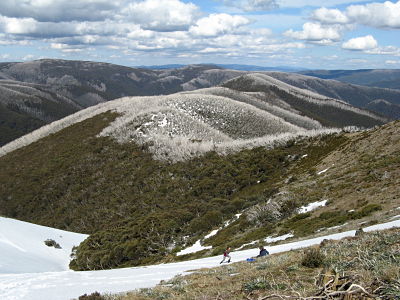
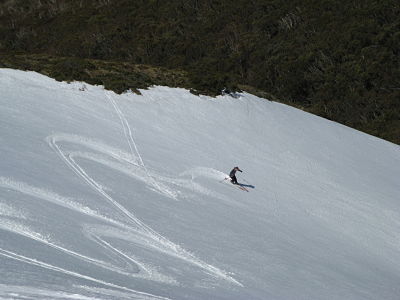
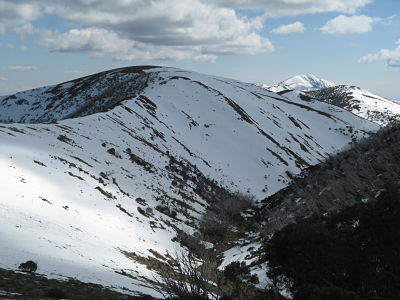
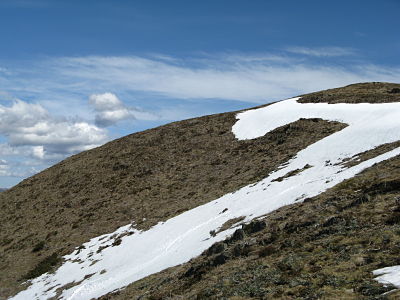
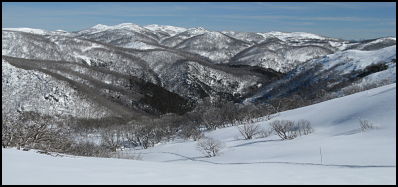
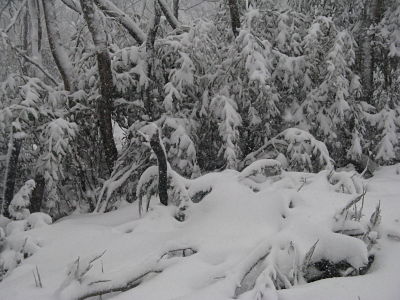
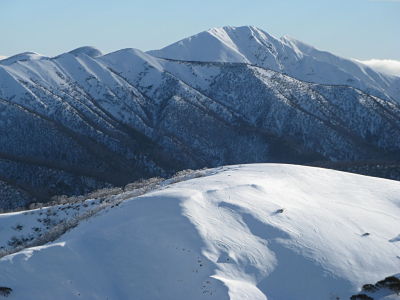
A couple of pictures from Feathertop/ Mt Blowhard in Victoria to honour the end of another season.
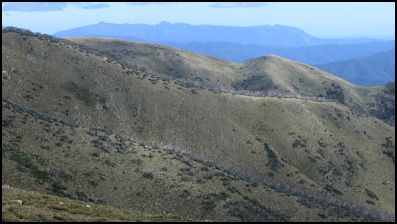
Near Mt McKay, heading to Pretty Valley, Bogong High Plains, VIC
If you’re an Australian skier or boarder, and unless you’ve been living under a log these past few months, you will know that ski legend Steve Lee has been running commercial backcountry ski tours out of Falls Creek resort this winter.
This is great. Getting people out of resorts and into the backcountry is to be supported and encouraged.
What is less great is the emphasis on the use of snowmobiles to get people out there. His tours are geared towards ‘strong’ intermediate skiers and boarders. So if people are fit enough to ski/ board hard terrain, then surely they are fit enough to get on some skis to actually get out there.
In my opinion, this ‘cheap grace’ approach to getting backcountry is a sad development in Victoria. Certainly, the tours are confined to the alpine resort area (even though this is ecologically part of the Bogong High Plains). However, they come with a high annoyance cost to people who are out there under their own steam. It is not clear what ecological assessment, if any, has been made of the tours – for instance, is there an impact on endangered species or vegetation? There is also a bigger picture here: there is the fact that these tours could be a precedent for future snowmobile based developments elsewhere in the alps.
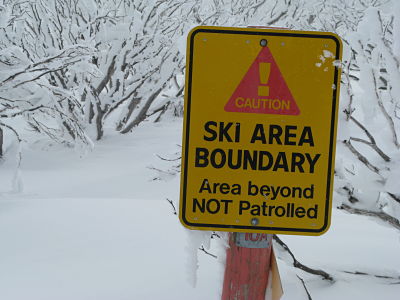
Anyone who has skied backcountry in North America will know the many problems that come with rampant and often uncontrolled snowmobile use. While here in Australia recreational use of snowmobiles is supposedly controlled or banned (for instance in national parks), how often is this actually enforced? As one example, there is growing use within the Alpine national park in the area between Dinner Plain and Mt Hotham and around Dinner Plain village with apparently no intervention from land managers.
Snowmobiles are essential tools in resort management and search and rescue operations. However, the blanket endorsement of commercial use of snowmobiles in the backcountry in almost all Falls Creek promotional materials this winter shows that resorts ‘commitment’ to the environment as being shallow at best and probably a form of green wash.
We should be very cautious about the further introduction of a potentially destructive development in our alpine areas, which appears to have jumped all the approvals ‘hoops’ simply because the proponent of the development is an alpine ‘personality’.
Falls Creek Resort says that it is deeply concerned about good environmental management:
“We are extremely proud of Falls Creek’s reputation as an industry leader in the field of sustainable alpine tourism and development. Our environmental programs reduce our impact on the local environment and acknowledge the importance of maintaining a healthy world beyond our boundary”.
Further information on their approach to the environment is here.
If you have an opinion about the expansion of snowmobiles into the backcountry you may wish to let the resort management know about them.
fcrm@fallscreek.com.au
With the fantastic snowfalls of the past week, theres no shortage of great skiing and boarding options across the Alps.
But many of the backcountry destinations are equally fantastic. For people not experienced in backcountry trips (often remote, and sometimes requiring long access) a good ‘warm up’ option is to get out in the ‘side country’ – those areas just outside ski resorts with easy access.
This quick guide canvasses some of the options available close to Mount Hotham in Victoria. There are similar opportunities at almost every other resort in the country.
BE AWARE that there is some avalanche risk with a number of these slopes at present. If you’re not familiar with avalanche risk assessment, please don’t visit these areas.
Louise Perrin is Environmental Manager for the Mt Buller and Mt Stirling Alpine Resort Management Board. She has been the driving force behind an innovative – and very successful – recovery plan for the endangered Mountain Pygmy Possum.
The possum is the only native mammal that lives in the alpine environment above the treeline and its habitat is threatened by development, climate change and introduced flora and fauna.
The Recovery Plan for the species on Mt Buller was developed in 2005. It contains a range of actions to assist in the continued survival and conservation of the Mountain Pygmy-possum on the mountain. This has relied on substantial support from the Resort Board, the ski lift company, and the Department of Sustainability and Environment, and has even involved the construction of boulder fields to create habitat for the animals.
In spite of the pressures from ski field development through its habitat, the fires of 2007, and the longer term impacts of climate change on alpine environments, the Mt Buller project is a showcase of a program which has helped bring a species back from the brink of extinction.
Lou says “I just want to do my best to ensure that my kids can enjoy this little patch of alpine Australia as much as I do”. But her contribution to this effort has been huge and deserves widespread acknowledgement.
As the Alpine Shire of Victoria’s north east continues with its bizarre ‘cart before horse’ approach to getting a major development going within the Buffalo National Park, it is also doing some useful and considered work on climate change.
Buffalo Plateau from near Mt Hotham
Just this week, Council accepted the final report of a study into the viability of a ‘skyways’ system on Mt Buffalo. Last year Council offered its active support for the proposal, with a community study which was conducted by the Buffalo Skyways Taskforce arm of the Great Alpine Valley Tourism Board.
Unsurprisngly, the study found 64% ‘support’ for the project.
See here for some of the issues associated with developing a major gondola/ skyway project within one of our most significant national parks.
Climate change and the North East
Meanwhile, Council has been working with the adjacent Towong Shire to consider what the expected rise in average temperatures, days of extreme fire-weather risk, drought conditions and a decrease in rainfall and snow will mean for the region, and how to best plan for these conditions.
According to the Alpine Council website:
“The councils assessed how their services and assets would be affected by predicted climate change, including increased frequency and intensity of extreme weather and reduced water availability”.
The CSIRO predicts that temperatures in north-eastern Victoria could be, on average, up to 1.6 degrees warmer by 2030 and up to five degrees warmer by 2070.
Snow fall is expected to be reduced by between 10 and 40 per cent by 2030 and between 22 and 85 per cent by 2050.
The number of very-high and extreme fire-weather risk days is also expected to climb by between four and 25 percent by 2020 and 15 to 70 per cent by 2050.
Alpine Shire Council’s Manager Planning and Environment Services, Heather Green said the findings did not recommend that councils fundamentally change the way they operate. This means that, sadly, there are no real mitigation measures included in Councils response – that is proposals to reduce the emissions of Council operations. Council has taken a simple ‘adaptation’ approach, which is generally seen as being insufficient as a strategy for dealing with global warming.
What is suggested is for Council to consider the likely future impacts of climate change on new developments within the Shire’s area. “For example, factoring predicted increases in flooding and storm events when upgrading urban storm-water systems will minimise the need to replace damaged infrastructure and reduce the risk to the community”.
The climate change risk assessments undertaken by both councils will result in the development of specific service area action plans to enable current services, assets and policies to adapt to the predicted climate variability.
The project has been delivered in partnership with the North East Greenhouse Alliance and funded with the assistance of the Australian Government Department of Climate Change and Energy Efficiency.
For further information on the Councils response and details on expected climate change impacts, see here.
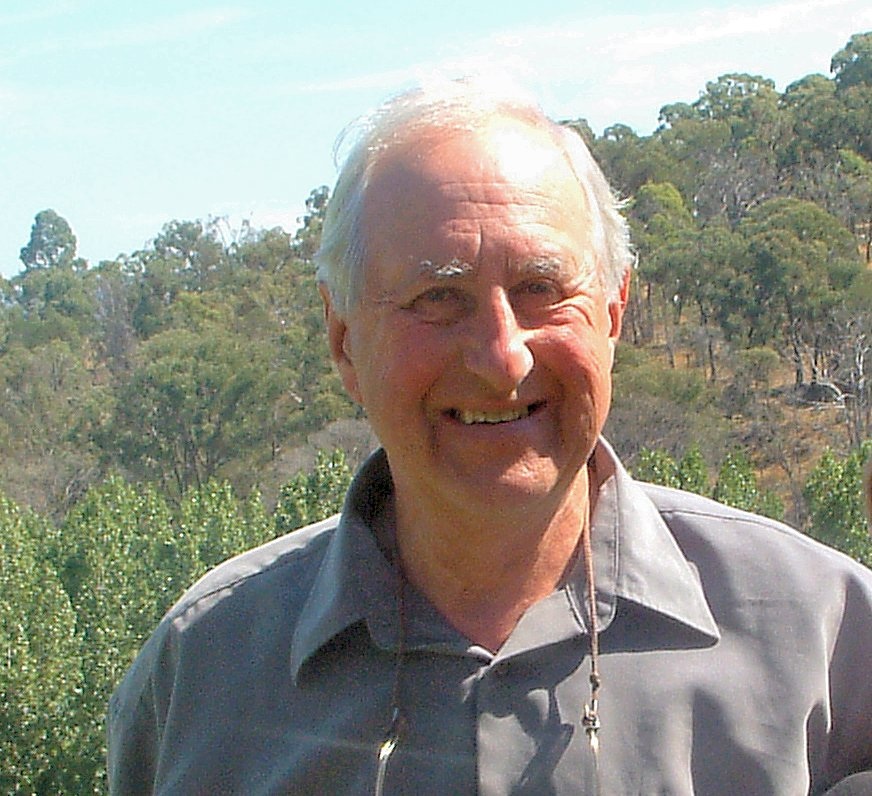
Geoff Mosley has worked for decades to protect wild places in Australia. He helped establish wilderness zones and parks across the south east of the mainland and Tasmania, and has recently released a book on Antarctica. He is active in the field of steady state economics, a keen walker, and widely published activist and thinker.
Perhaps he is best known for his efforts to see a major national park established across the Australian Alps. Much of this vision has now been realised, although he continues to work to see an extension of the Western section of the Alpine National Park and to get World Heritage listing for the forest ecosystems of the south east corner of the country, where Gippsland and NSW meet.
According to Phil Ingamells, of the Victorian National Parks Association, “there has never been more hoo-haa from Parks Victoria over the development of a management plan, and never such an unpromising result, as their draft of their alpine parks management plan”.
He says that the new plan is a “new low”, delivering very little that will enhance environmental protection, despite starting the process well.
A classic image from the Victorian Alps: Mt Feathertop from Hotham. But without serious action on climate change now, our alpine areas are at grave risk.
First Protect our Winters (POW) Australia action alert
The Victorian government is in the final stages of deciding what type of Climate Bill it will deliver as part of it’s election commitments.
Similar Bills in other places – for instance, the UK and Scotland – have set ambitious greenhouse emissions reductions targets (Scotland has committed to 42% reductions by 2020).
We must urge the Victorian government to deliver a strong, world leading Bill. The final decision about the Bill is being taken now. And a strong Bill will greatly reduce Victoria’s contribution to climate change through driving a shift away from our reliance on polluting brown coal power.
POW Australia has issued its first action alert, asking people to email the Premier, John Brumby. It is available here.
We hope POW supporters, skiers and boarders from across Australia will support this on line campaign. Lets get the Australian winter sports community mobilised to protect our winters.
If you walk into the town square in the Victorian ski village of Mt Buller, you will be greeted by a sculpture of a mountain cattleman on his horse. In all of the ‘high country’ towns of south eastern Australia and throughout the ski resorts, there is a pre-occupation with the history of the cattle families that, for generations, drove their stock into the mountains.
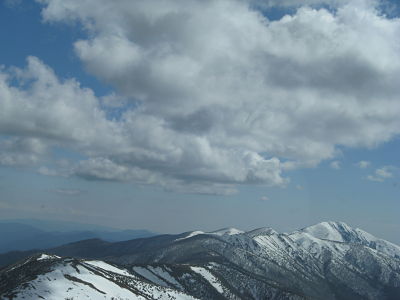
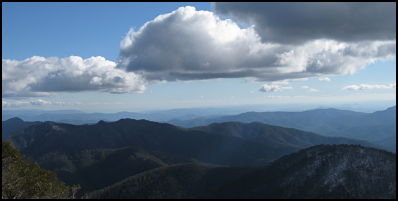
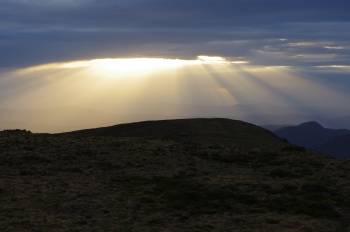
Clouds over Rocky Ridge, Taungurung country, VIC
There are roads, buildings, and events all named after these pioneers, stickers on cars, photos and sculptures, and endless homage to these tough people and their way of life.
But where are the images or mention of the Indigenous people who lived in this country for perhaps 1,000 generations?
The Australian Alps have been inhabited by indigenous nations for millennia. But as Taungurung man Mick Harding said recently “we were removed from our lands” by the invaders and “scattered to the four winds”. But over the past decade or so, a growing number of people and communities have been re-establishing connection to their country.
The much lauded but controversial major re-development of the Mount Hotham alpine village was quietly shelved last month. This long awaited $500 million major restructure of the village would have seen the Great Alpine Road re-routed through the village and was predicated on the major ‘Bale’ re development proceeding. Bale was expected to deliver another 1,414 beds to the village. The global financial crisis was billed as being the main reason the project is not proceeding.
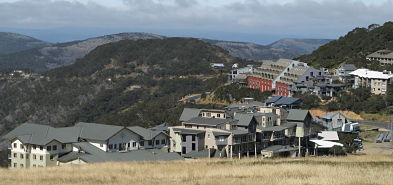
Hotham Village
This marks the end of a long running and concerted plan by big business to damage the mountain resort, and the lapse of the current proposal is good news for any one who wants to see our alpine resorts remain (relatively) diverse and accessible to a range of people.
This is most welcome news. For a full report check here.
Andy Kimber lives on the Warby Ranges near Glenrowan. He has a life long connection with the valleys and mountains of north east Victoria, and has written extensively abut the area, in various forms including songs, as well as helping engender a sense of place for many people in the region, especially students he has taught over the years.
He would be interested in any poems or songs about the mountain valleys of the North East. If you have some, or know where to find some, please email him: andykimber@netc.net.au
And stay tuned for a review of his daughters album ‘Sounds like Thunder’ soon, featuring some fine tracks, including about the Victorian high country.
The Department of Sustainability and Environment and the Alpine Resorts Co-ordinating Council are reviewing the Alpine resorts 2020 Strategy. The strategy was created to guide the the long term planning and management of Victoria’s six alpine resorts.
Mount Buller, VIC
DSE and ARCC will be hosting a series of workshops in June to identify key trends and issues for the future of resorts and look at how the new strategy can address these issues.
Workshops will be held in Melbourne and at or near the six resorts from June 1 until June 23. You need to rsvp for the events.
hayley.hollis@dse.vic.gov.au


 Mountain Journal
Recent Comments