Mid summer. Time to be out in the hills. I have been out exploring some of the less known peaks in the Vic High
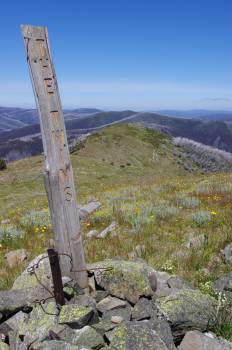
Twins summit
Country, like Big Hill, south of Mt Beauty, and Mt Sugarloaf just near the old ticket station on the Mt Hotham road above Harrietville.
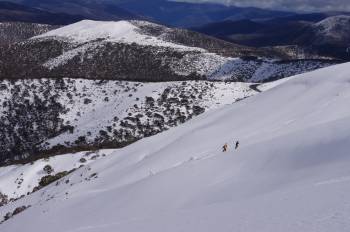
The stand out mountain so far has been the Twins, a bulky, almost hump-backed mountain just south-west of Mt St Bernard in the Central Alps.
Although it is generally seen from the Great Alpine Road, this peak really presents itself from the south side, with impressive slopes and wonderful views and a sense of remoteness despite being barely 9 km in a straight line from Hotham village.
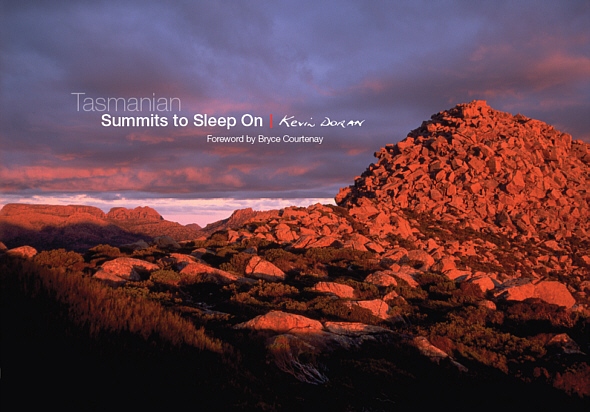
The title of this book pretty much sums it all up: Tasmanian summits to sleep on. This is a gorgeous, large format photo book, focused on 7 peaks that the author, Kevin Doran, has explored and camped out on, from Cradle Mountain in the north and down to Mount Hopetoun in the south west.
This is a large format ‘coffee table style book, with brief stories on seven peaks and fantastic images, and is a celebration both of life time friendships and a long term love affair with Tasmania’s mountain country.
Looking over The Bluff and Mt Eadley Stoney towards the Crosscut Saw
If you have ever skied or boarded at Mt Buller, the Bluff is probably familiar, even if you don’t know its name. It’s the prominent and rocky, long mountain out on the skyline on your right as you ski back to the village down Bourke Street.
Unlike some of its neighbours, like Mt Buller and Stirling, The Bluff doesn’t have a road or other developments on it, so retains a wildness that is lacking on some other peaks in the area. It is an atmospheric mountain, with loads of character. It has great walking and backcountry skiing and boarding.
The following comes from the Border Mail in Albury. Journalist is Brad Worrall. Nov 22, 2011
Image: SMH
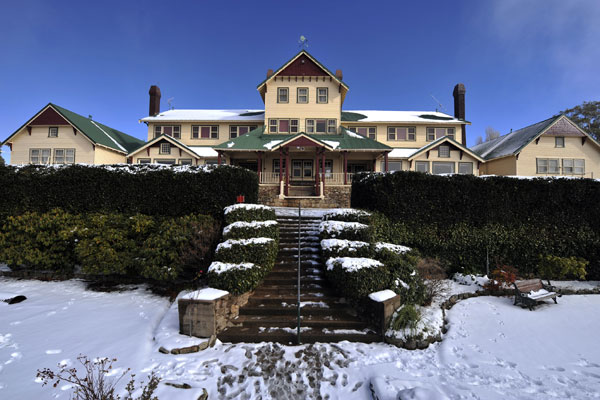
THE future of the historic Mount Buffalo Chalet is again in limbo with the Victorian government rejecting the latest rescue bid.
Mount Buffalo Community Enterprise’s $50 million plan to refurbish the attraction was dismissed by Environment Minister Ryan Smith in a letter two weeks ago.
He said the government was not in a position to fund the proposal at this stage.
But Mount Buffalo Community Enterprise chairman John Brown wants to know what happens next.
“We have written to the Premier to seek clarification on what their plans are to save the chalet,” he said.
“If not our plan, then what and by when?
“The concept plan, which has already withstood close scrutiny from an architectural, heritage and financial perspective, involves a contemporary chalet redevelopment.
“It would breathe new life back into the chalet and the mountain.
“Now all we get is a letter and that is a little dismissive.”
The plan submitted to the government would result in a 99-room hotel-guest house combining contemporary accommodation and preserving the key heritage components of the old chalet.
The plan included low-emissions solar power systems and a new interpretative centre.
The group did not intend to reinstate the ski fields on the Ovens Valley plateau.
The state government would have been required to put up $33 million for the venture, with no return on the taxpayers’ investment.
More than 50 per cent of the profits would have been returned to the community.
Mr Brown wonders whether the government is hoping for a white knight.
“The decision to appoint us came after two rounds of advertising,” he said.
“We were clearly the most attractive option to government at that time, so who will come to the chalet’s rescue now?
“The truth is, today, we are no closer to saving Mount Buffalo chalet than we were five years ago.
“That’s of grave concern to us.
“If the community shares our concern now’s the time to speak up.”
The chalet has been closed since January 2007 in the wake of the bushfires in the North East and an ensuing lease dispute.
Mount Buffalo Community Enterprise’s involvement followed an extensive tender process over 18 months.
In October last year the group entered a 12-month exclusive negotiation period with Parks Victoria.
A $200,000 state bovernment grant and $250,000 of their own money paid for a viability study and the business plan.
I keep hearing reports of Bogong Moth’s moving through Canberra, and thought I would add this link to a great overview of this iconic species.
Bogong Moths, Agrostis infusa, migrate over 1,000 km each year from the black soil plains of Queensland and western NSW to the Australian Alps, seeking refuge from the summer heat. Along the way, they travel by night and then in the morning, drop down to the ground to rest in the shade during the day.
This article was written by Abbie Thomas and is available here.
2011/12 Victorian Alps Hawkweed Surveillance Volunteer Program
Help to protect Australia’s biodiversity from King Devil and Orange Hawkweed on the Bogong High Plains
Orange Hawkweed. Image: Parks Victoria
Native to Europe, Hawkweeds have recently become established on mainland Australia. Posing a serious threat to Australian biodiversity and the structure of natural communities, it is imperative that the incursion is eradicated before it’s too late.
Hawkweeds spread quickly via runners and above-ground roots forming dense mats, inhibiting and out-competing native vegetation. In grassy ecosystems like the High Plains, dense patches of the weed dominate the spaces between grass tussocks that are vital for the survival and recruitment of native flora and fauna.
Survey sessions will be conducted during the active flowering period. All of the sessions will be five days long. Attendance for the full sessions is preferred but is not essential.
Accommodation will be provided at Falls Creek. Breakfast and snacks will be provided as well as one dinner at a local eatery, other meals self catered. Transport will be provided from Falls Creek.
The surveys for 2011/2012 season will be held over the following dates: Session 1: Tuesday the 27th – Saturday the 31st of December Session 2: Monday the 16th – Friday the 20th of January
For more information or to express your interest in the program, please contact:
Keith Primrose
hawkweed@parks.vic.gov.au
Mt. Beauty Parks Victoria Office: (03) 5754 4693
The Federal Government has introduced a regulation under national law that overrides the Victorian Government on Alpine cattle grazing.
Environment Minister Tony Burke today annunced that the new regulation under the Commonwealth’s Environment Protection and Biodverisity Act means that the Gillard Labor Government now has power to stop the Baillieu Liberal Government from introducing cattle into Victoria’s Alpine National Park without proper scrutiny.
“The Baillieu Government was wrong to reintroduce cattle to the Alpine National Park and has set a dangerous precedent for the management of national parks across Australia,” Mr Burke said.
“This whole debacle has been another reminder that when the Liberals win, the environment loses.”
Mr Burke says he is also consulting with state and territory governments on a proposed new regulation which would give extra protection to national parks across Australia.
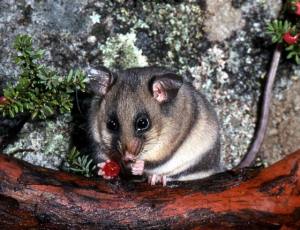
Mountain Pygmy-possum (Burramys parvus). Source: Department of the Environment and Heritage
This article comes from The Age. Journalist: Bridie Smith.
Since 2007, the mountain pygmy possum captive breeding program at Healesville Sanctuary – the only one of its kind in Australia – has been breeding hybrid animals, with one parent from Mt Buller and the other from Mt Hotham.
The first hybrid litter was born in 2008. Now, Melbourne University researchers have shown for the first time that hybrid males are fertile – providing a vital new path for boosting the species’ genetic diversity.
This report comes from The Age, journalists are Josh Gordon and Tom Arup.
A REPORT on the government’s controversial grazing trial in the Alpine National Park has been ridiculed by environmentalists .
Critics said the report — which found ‘‘ large grazing areas with abundant food are preferred by cattle’ ’ and that fences can be useful to keep cattle out of sensitive areas — revealed nothing new.
They said the report on last summer’s trial, released without fanfare by the state government yesterday, represented an expensive and politically motivated exercise that has added no new knowledge about whether grazing cuts the risk of bushfires.
Victorian National Parks Association spokesman Phil Ingamells said the results ‘‘ must be a considerable embarrassment to the government’’ , showing the trial was a waste of time and money, with the effort better spent ridding the park of feral animals and weeds.
The Department of Sustainability and Environment report concluded that cattle damage is most visible in wet areas, that cattle don’t like steep areas occupied by unpalatable shrubs and that they prefer eating exotic grass species over native species.
The report, which will form the basis of a five-year trial, also says the DSE engaged a consultant who confirmed that the government’s choice of remote sites for the trial had made access difficult.
The Age revealed in July the state government had launched a second attempt to reintroduce cattle to the park, after last summer’s trial was derailed by a federal finding that it could represent a ‘‘ controlled action’ ’ under the Commonwealth environment law.
Federal Environment Minister Tony Burke has promised to stop the trial by including almost all of Australia’s 500-odd national parks — the domain of state governments — under federal laws, giving him power to block new grazing, logging and mining projects in the parks.
Mr Burke has now promised the states a lengthy consultation process for the changes to all parks, but will pass a specific regulation to protect just the Alpine National Park in coming months to try to head off any grazing this summer.
Victorian Environment Minister Ryan Smith vowed last night to continue with the trial next summer.
The effects of climate change on Australia’s alpine areas could mean the end of the ski season.
AUSTRALIA’S ski slopes could be completely bare of natural winter snow by 2050 unless concerted action is taken against global warming, according to a government-commissioned report that paints a grim picture of the effects of climate change on alpine areas.
The report, Caring for our Australian Alps Catchments, has found the Alps, which stretch from Victoria through New South Wales to the Australian Capital Territory, face an average temperature rise of between 0.6 and 2.9 degrees by 2050, depending on how much action the international community takes to combat climate change.
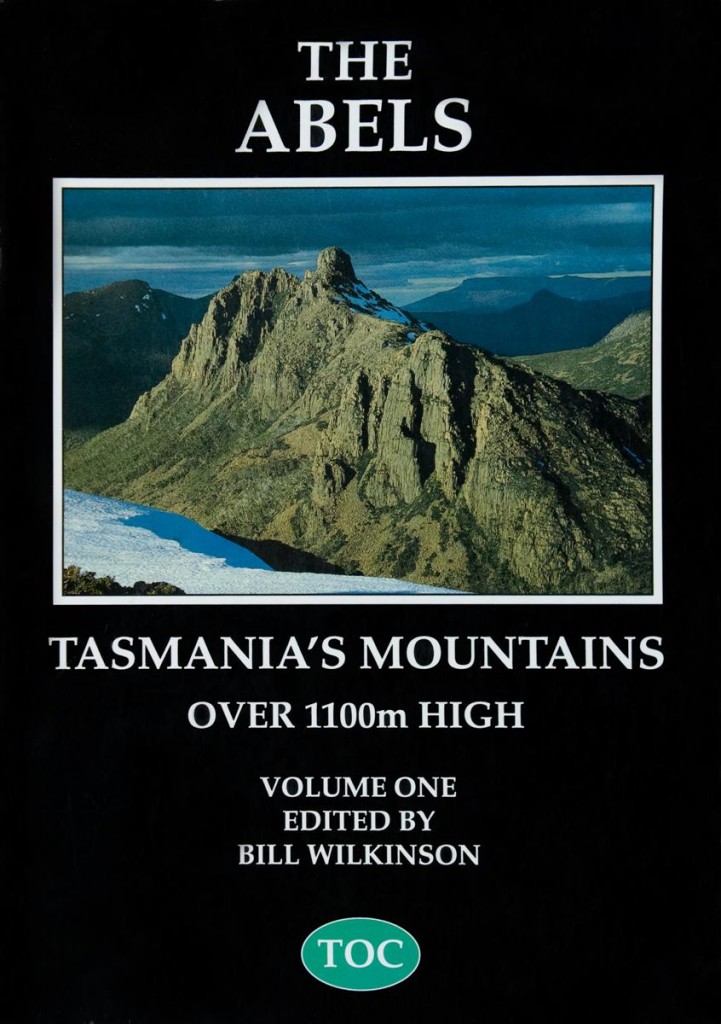
This book, the long awaited second volume covering Tasmania’s mountains over 1,100 metres in height, which covers the west and south west of the state, is absolutely gorgeous.
This volume is considerably longer than the first, with good introductory essays on animals, plants, geology and weather.
As with the first volume, it has profiles on all mountains in the region over 1,100 metres, opening lots of options for peaks you might have glimpsed from afar or seen on a map, but weren’t quite sure about how to get there or what the terrain might be like.
This article comes from the Bright Observer, journalist: ALEX BAIRD
Hopes are high
Group waits for government to back push to give chalet new lease of life
The Gorge, Buffalo Plateau
DESPITE no word from the State Government on the future of the Mount Buffalo Chalet, hope remains strong among members of the consortium fighting to reopen the building that a positive outcome will occur.
The Mt Buffalo Community Enterprise (MBCE) group submitted a comprehensive proposal to Parks Victoria in May, which was designed to show the merits of returning the chalet to its former glory.
MBCE executive director Mark McKenzie-McHarg said while talks were still in place, there had been no official word from the government on whether it would back the chalet, which has been closed since 2007 after a lease dispute.
“There’s no further news at this stage, but we are hoping to hear something in the coming weeks,” he said.
“We are involved in discussions and are hopeful we can come to some sort of arrangement.
“We still feel positive, we don’t have any certainty about this.
“It’s a big project and we feel it’s important to be patient.”
For any plans to go ahead to restore the famous building, Mr McKenzie-McHarg said it would need a “significant government contribution” and while the group had plenty of local support, until a government response was forthcoming, the group wasn’t getting too excited.
“We’ve had a lot of interest from a range of different community groups,” he said.
“We really need the State Government to commit, but until that happens we aren’t trying to have too big a profile.
“We think it’s important to be patient, because it’s such a big project, we’ve already submitted business cases and proposals.
“If we do get their backing, that’s when we’d go out and try and get more people onboard.”





Recent Comments