In the latest development in the decades long saga over cattle grazing in the Alpine National Park, the new Victorian government has confirmed it has stopped the grazing trial established by the previous Coalition government.
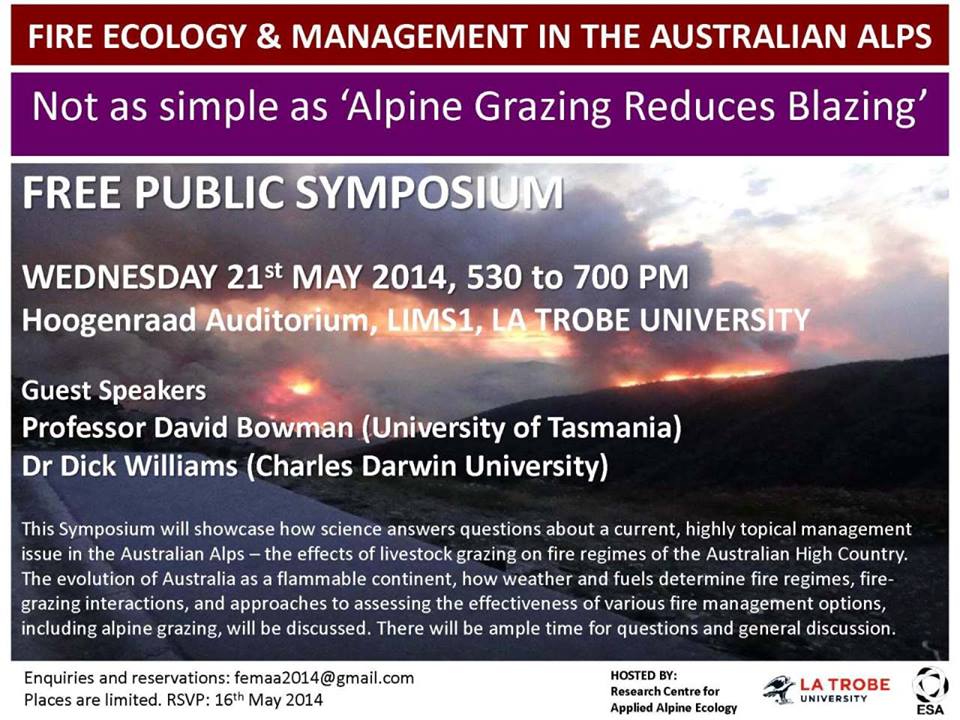
Latrobe University recently hosted a significant event organised by the Research Centre for Applied Alpine Ecology on the much contested topic of alpine grazing and whether it is a useful management tool to reduce fire intensity.
It featured two researchers with long term research backgrounds in the realm of fire and grazing.
Hoogenraad Auditorium, La Trobe Institute for Molecular Sciences
LA TROBE UNIVERSITY, Bundoora Campus
Hosted by the Research Centre for Applied Alpine Ecology, La Trobe University
This Symposium will showcase how science answers questions about a current, highly topical management issue in the Australian Alps – the effects of livestock grazing on fire regimes of the Australian High Country. The guest speakers will address globally important topics such as the evolution of Australia as a flammable continent, how weather and fuels determine fire regimes, fire-grazing interactions, and approaches to assessing the effectiveness of various fire management options, including alpine grazing. This is a public forum about an important land management issue, and there will be ample time for questions and discussion at the conclusion of the talks. The Symposium will be followed by drinks and nibbles.
This Symposium is a must for anyone with an interest in the ecology and management of the Australian Alps. Enquiries and reservations: femaa2014@gmail.com
There is no doubt that our fire seasons are getting longer and more intense. Here in the south east, in terms of massive fires (greater than 250,000 ha), Victoria experienced two such events in the 19th century and five in the 20th century. In less than two decades, we have already had three mega fires in the 21st century. Many alpine areas have been burnt three times in the space of a decade.
There is no coherent overall response as yet by state or federal governments that outlines how we should respond to the growing interaction of climate change and wildfire. Sadly, our Prime Minister is in denial, having claimed that since ‘fires have always been part of our landscape’ there is no link to climate change. The Victorian state government has been challenged on the lack of attention to climate change in it’s approach to managing fire risk. Reducing fire risk is therefore about reducing fuel load and getting larger equipment , not about reducing greenhouse gas emissions or accepting that enhanced fire risk is the new reality for much of the country.
The following report, from Grist, outlines a different approach. The US government has released a strategy that aims to respond to the changing nature of fire threats. One aspect that especially interested me is the fact that it includes an approach that aims to ‘restore and maintain landscapes that are resilient to fire.’ In Victoria, we seem to be doing the opposite. There is a politically driven target that dictates that 5% of the state will receive fuel reduction treatment each year. This is in spite of the fact that some vegetation types don’t need burning to maintain ecological health, and others can become more flammable with the wrong fuel reduction approaches, and others are directly threatened by too much fire.
Climate change just reshaped America’s wildfire strategy
Like a tree in a greenhouse, America’s forest fire problem is growing ominously. Rising temperatures and declining rain and snowfall are parching fire-prone areas and juicing conflagrations. On Thursday, following years of meetings and scientific reviews, the Obama administration published a 101-page strategy that aims to help meet the country’s shifting fire threats.
The National Cohesive Wildland Fire Management Strategy divides the nation according to fire risks, and profiles the communities that face those risks. “No one-size-fits-all approach exists to address the challenges facing the Nation,” the strategy states.
Despite covering 70,000 communities and 46 million homes, the strategy can be boiled down to guidelines that aim to do three main things: restore and maintain landscapes that are resilient to fire; brace communities and infrastructure for occasional blazes; and help officials make wise decisions about how and whether flames should be doused. Here’s what that all looks like in flowchart form:
“As climate change spurs extended droughts and longer fire seasons, this collaborative wildfire blueprint will help us restore forests and rangelands to make communities less vulnerable,” said Mike Boots, chair of the White House Council on Environmental Quality.
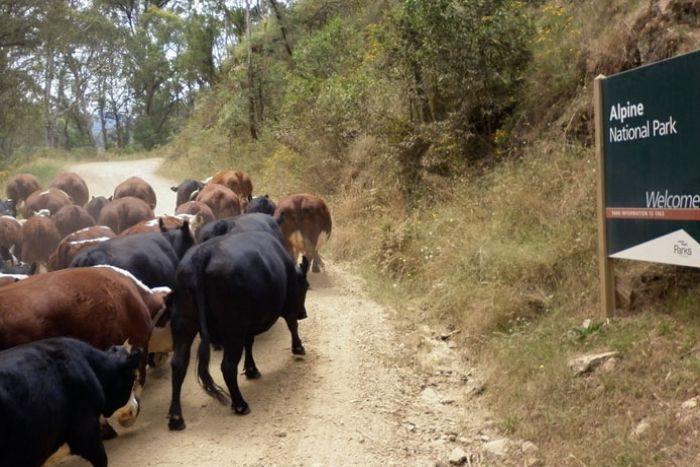
Cattle have returned to the Alpine National Park for the first time in three years, with animals released in recent days under the Napthine government’s grazing trial.
It is understood that a little under 60 cows were brought into the park either on Wednesday night or Thursday morning, marking the start of the program.
The move follows the state government getting approval for its grazing plans from federal Environment Minister Greg Hunt earlier this month. The state government says the trial will test whether cattle grazing lowers bushfire risk by reducing fuel loads.
As pointed out by Phil Ingamells of the Victorian National Parks Association:
“the trial was not science, rather a political promise to the cattlemen to protect their privileged grazing rights in the park”.
“Decades of evidence show how much grazing harms the park. But it does nothing to reduce grazing risk,” he said.
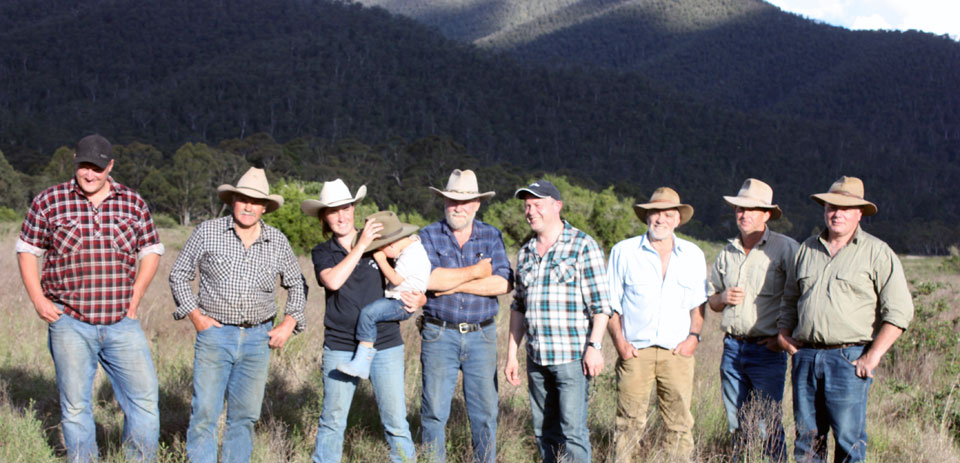
Environment Minister Ryan Smith with mountain cattle graziers, Wonnangatta Valley. source: MCAV
The state government has doggedly pursued this grazing trial since it came to power, and the environment minister Ryan Smith has been closely involved in efforts to get cattle back into the park. The first attempt was knocked back by the previous federal government. The current proposal has recently been approved by Coalition Minister Greg Hunt.
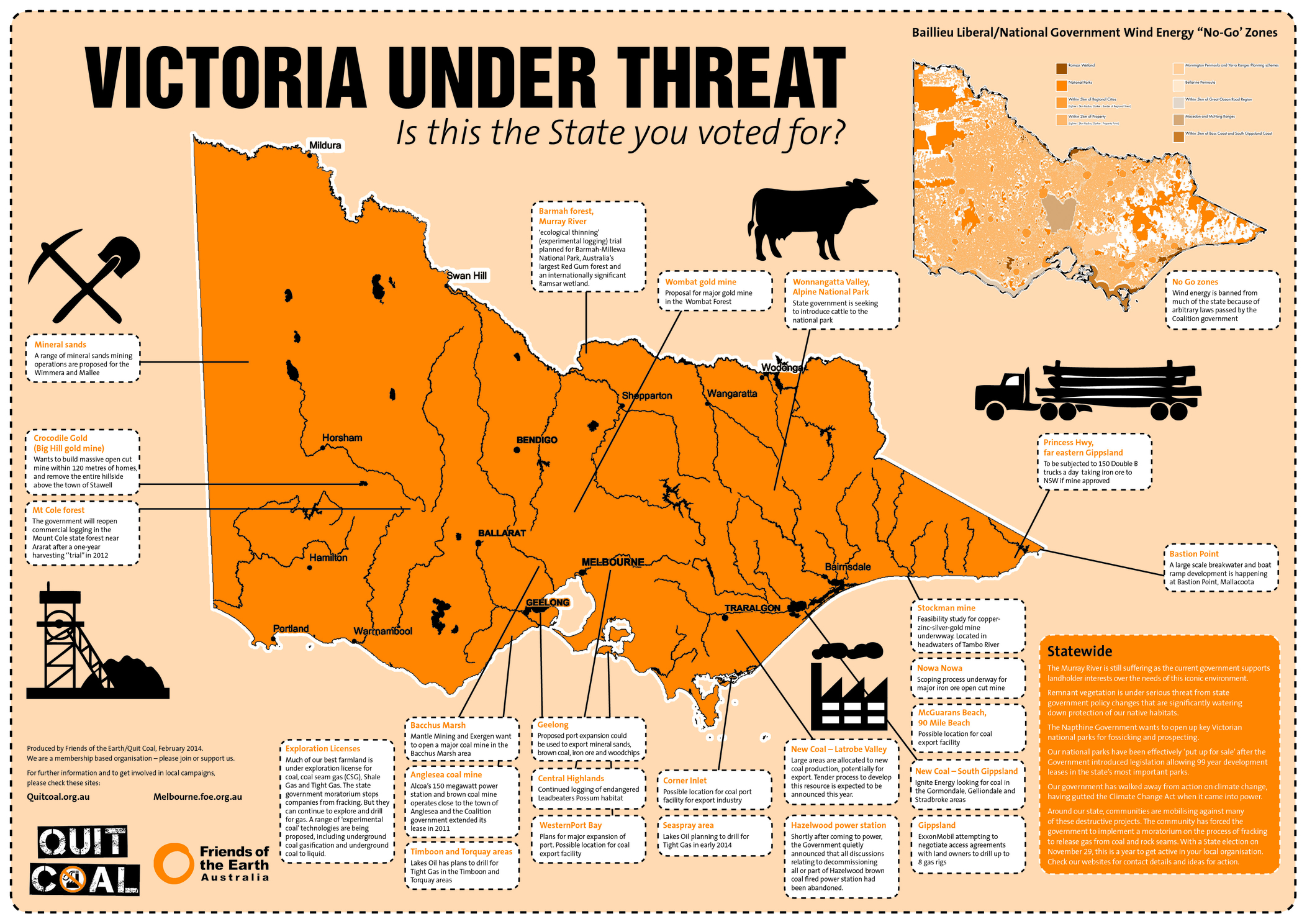
Victoria’s environment is in bad shape. Imagine how things could be improved if Mr Smith put as much effort into reducing Victoria’s contribution to climate change. Or protecting Mallacoota from the destructive development at Bastion Point. Or if he acted to protect the habitat of the endangered Leadbeaters Possum which is threatened by logging. Or … (insert any number of other issues here: for instance or check this list from Environment Victoria).
Sadly, he has instead overseen the demolition of the Victorian Climate Change Act. Development of renewable energy has basically stopped on his watch, which can only give benefit to the fossil fuel industry.
Meanwhile, he has pursued this project, widely described as being more about politics than land management.
Will he be remembered as the minister who turned his back on climate action and habitat protection, whose one legacy was to put cattle back into a national park?
Rob Harris provides an update on the alpine grazing proposal in the Weekly Times.
You will be pleased to know you have a full 10 days to provide input on more than 20 documents. The paperwork is available here.
Environment Minister Ryan Smith with mountain cattle graziers, Wonnangatta Valley. source: MCAV
Cattle grazing in the Alpine National Park could return after a full assessment of a proposed grazing trial
CATTLE could graze again in the Alpine National Park before winter after the Commonwealth agreed to a full assessment of a proposed trial.
Environment Minister Greg Hunt last week opened a 10-day consultation period.
Mountain Cattlemen’s Association of Victorian president Charlie Lovick said the decision for a “full federal environmental assessment” made sense.
“No doubt it’s a polarising issue and it’s going to continue to be, but this takes some of the politics out of it and now the worthiness of a trial can be accessed,” Mr Lovick said.
“The 10-day period and assessment means we could still get up there by late March and a short trial this year before returning next year could certainly be advantageous.”
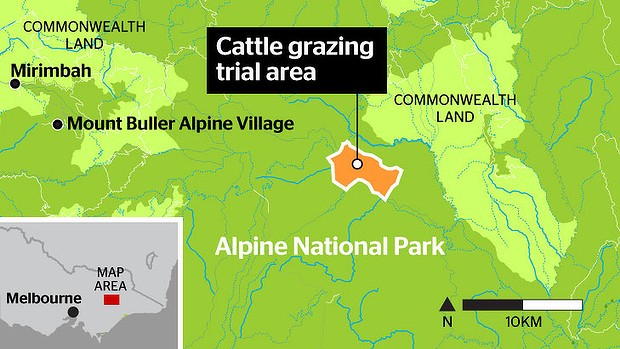
The proposed three-year grazing trial of 60 cattle would take place in the remote Wonnangatta Valley.
Projects deemed by the Commonwealth likely to have a “significant impact” on nationally protected areas requires federal approval.
The process requires the State Government to publish assessments that “clearly articulates any impacts” and will also take into account expert scientific advice and public submissions.
A decision is expected by the end of next month.
Victorian Environment Minister Ryan Smith was asked to submit more information about the trial – particularly a survey of native flora – to the Commonwealth last month.
Grazing in the national park was banned by the Bracks government in 2005.
Mr Smith said the Coalition Government believed there was a “clear need to investigate”.
Past scientific studies, including one by the CSIRO, have ruled grazing did not reduce the risk of fire in Alpine areas.
The Victorian National Parks Association criticised plans to return cattle as “a back door way of getting cheap grazing for their mates” while the Australian Society of Native Orchids has written to the federal minister opposing the return of cattle.
With bushfire season still in full force, the kindest thing that can be said about the Victorian Government order to the community of Woods Point that they abandon their fire refuge is that it is very badly timed.
Woods Point is one of the most isolated towns in the state, in a valley in the Victorian high country. Long sections of heavily forested country must be traversed if people are to leave in the case of fire threat and the need for a community refuge is both obvious and necessary.
The following report comes from The Weekly Times, written by Chris McLennan.
Fury as Woods Point bushfire refuge deemed illegal
A SMALL Victorian town will defy a Victorian Government order to abandon their fire refuge.
Woods Point residents rely on the old gold mine tunnel which has saved the town’s population once before.
Despite the tunnel being the state’s only officially recognised fire refuge for years, new rules governing the construction of refuges have seen the government and local council in the last few weeks refuse to accept legal liability for the structure.
Signs nominating the tunnel as a fire refuge are to be removed and residents fear a gate on the entrance will be padlocked.
”Do they want us to die?” member of the town’s safety committee, Margaret Martyn said.
Fire Services Commissioner Craig Lapsley yesterday said the tunnel, known locally as the adit, did not meet the new building requirements to be a community fire refuge.
The Country Fire Authority yesterday began an assessment of the tunnel hoping to reclassify it as a “Neighbourhood Safer Place” but the question of legal liability remains.
Mr Lapsley said the CFA, Victoria Police and the Fire Services Commissioner would continue to work with Mansfield Shire Council to resolve the issue.
He said before the 2009 Black Saturday bushfires, there was an adhoc and inconsistent approach to the designation of community fire refuges.
Snow gums are the quintessential alpine tree on mainland Australia, generally growing at heights between 1,300 and 1,800 metres asl. Forests and woodlands of Eucalyptus pauciflora can look quite uniform from a distance, but up close they have such character.
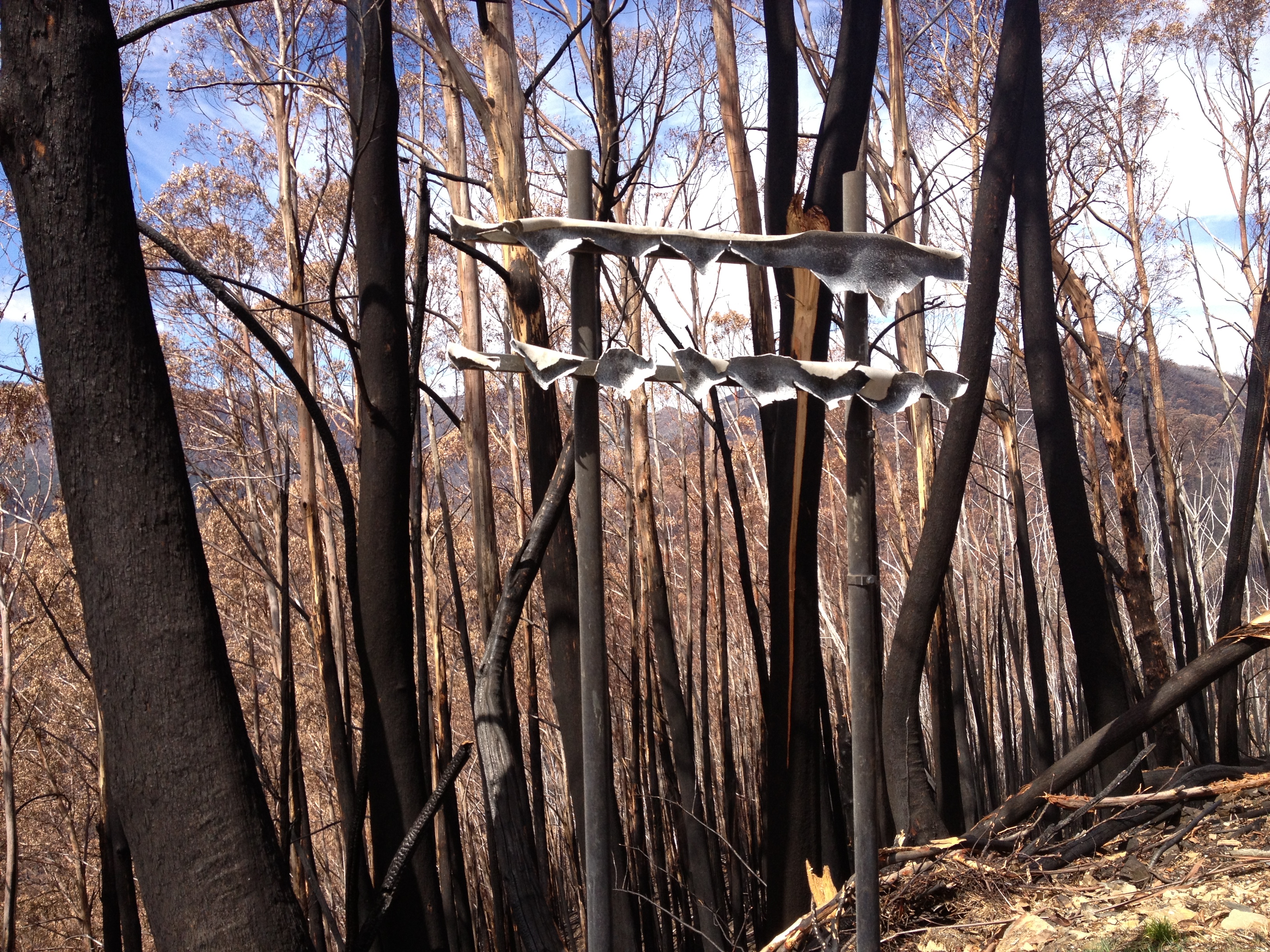
But wildfire has been devastating large swathes of snow gum habitat, with significant fires in the Victorian High Country in 1998, 2002/3, 2006/7 and 2013 and in the Snowy Mountains in 2003.
Research is showing that if we want to allow snow gum forests the chance to recover from these fires, we need to keep the cattle out and do our best to stop any future fire activity.
The following comes from The Weekly Times, journalist is Chris McLennan.
Image: DSE
With government plans to introduce camping fees for staying in national parks (which will draw on Parks Victoria [PV] resources to manage), allow private development in parks, re introduce cattle into the Alpine national park, you do have to wonder about the common sense of this government. Add to this the threat of ever worse fire seasons, and these cut backs seem short sighted and potentially dangerous. Union officials say that more than 500 people, including firefighters, will be caught up in the proposed changes.
Parks are slashing 10% of its workforce but exempt senior and managerial positions, and will target Ranger and Field Service Officer employees instead. Parks will waste $8-$10million paying out retrenched employees trying to save $10-$15million. It’s completely cost counterproductive. Parks Victoria (currently) employs 1,100 staff at 100 national, state, marine and urban parks.
Job fears in Parks Victoria revamp
Parks Victoria staff face an anxious summer after a department-wide restructure was announced just before Christmas.
Union officials claim more than 500 people will be caught up in the proposed changes, which may involve some staff pay cuts and others choosing redundancies.
“Many of these people are our frontline firefighters. They already have a lot on their plate,” Community and Public Sector Union federal secretary Karen Batt said.
A consultation period on the proposed changes will end on January 30 and a Parks Victoria spokeswoman said it may not be until March-April that the reorganisation is finalised. Individual staff are yet to be told which positions will be restructured.
Parks Victoria’s acting chief executive Chris Hardman said there would be no net loss of staff from the restructure. He said the proposed model was designed to significantly enhance the organisation’s services for the Victorian community.
“We are looking forward to hearing from staff and unions as to what they think about the proposal and to assist the organisation to put together the best possible operating model.”
More than 120 jobs have been trimmed from Parks Victoria in the past 18 months.
The Lake Mountain area, near Marysville, was terribly burnt in the fires of early 2009.
Almost every tree on the plateau was killed or burnt back to ground level (snow gums have the capacity to reshoot from the base after the above ground section of the tree is killed). At Lake Mountain, the fire was particularly severe and killed off many parent trees that had survived the 1939 fires.
The landscape was completely transformed from what it had been. Anyone that knew the ‘old’ Lake Mountain couldn’t help but be devastated on their first post fire visit.
The good rainfalls over the summers of 2010 and 2011 greatly assisted the regrowth across the mountain. Whilst the area will not return to anything near to its former state for many years, the regrowth is going well, and the spring/ summer wildflower display is fantastic.
If you haven’t been to Lake Mountain since the fires, Christmas is a great time to go.
The Olden Days (aka the late 1970s). Echo Flat with an intact snow gum forest
The snow gum woodlands and lower alpine ash forests were absolutely devastated in the fires. Regeneration in the snow gum country is now substantial, with regrowth over 3 m high and in most places at least one third the height of the remnant dead trunks. In addition large numbers of Snow Gum seedlings are also thriving.
The open heath and bog areas have been slower to recover, but ground cover is now almost complete.
If you knew the pre-fire landscape, then coming back can be emotionally devastating. The two known stands of Mountain Plum Pine on Echo Flat did not survive the fires. These trees had previously been dated as being between 700 and 800 years old. The remaining colony of Leadbeaters Possums have been removed to Healesville Sanctuary because it wasn’t deemed biologically viable. Most of us won’t see the likes of the original forest, and the landscape itself can seem forlorn.
But life is coming back. There is great walking on the plateau, and the local economies need your support.
The following information comes from the Victorian National Parks Association. A number of significant environmental decisions will be made by the federal environment minister before Christmas, with the danger that they will slip through relatively unnoticed and unreported.
If approved, it can be expected that cattle will be introduced over summer. Last time the Victorian Coalition government introduced cattle to the Alpine Park, they did so without setting in place adequate scientific frameworks to the trial. They had been clearly told that grazing would not be useful in reducing fire risk, yet proceeded to implement their policy.
The fact that the government has withheld information from the federal minister in their current attempt to reintroduce cattle is hardly the basis for assuming this trial will be any more scientifically robust.
Over the next few days Australia’s environment minister Greg Hunt must decide whether or not he will let the Victorian Government put cattle back into the Alpine National Park.
After failing to return cattle to the Alps in both 2010 and 2011 the Napthine Government is again asking the federal government to approve a new cattle grazing trial in the Alpine National Park.
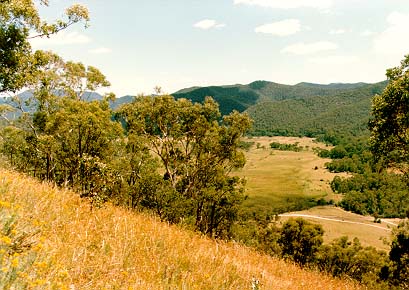
They plan to bring 60 cattle into the remote Wonnangatta Valley, a beautiful river flat that sits below the Howitt High Plains and has been ungrazed by cattle since 1988.
We need your help. Please take action today or as soon as possible:
We cannot allow this grazing trial to go ahead.
The Victorian Government wants to put cattle into the park simply because of a promise it made to some graziers that once held privileged grazing licences.
Their new attempt comes on the back of repeated attacks by the Napthine Government on the integrity of national parks including changing legislation to allow 99 year leases for private development, expanding areas for fossicking and prospecting and making significant cuts to park budgets.
We have also uncovered many serious flaws in the proposed trial:
There is no scientific design for the trial, and apparently no scientists are involved.
There has been no consideration of a location outside of the national park, even though there are many areas where such a trial could be conducted.
The application ignores the considerable evidence that cattle grazing does not significantly reduce alpine fires. There are far more important bushfire research projects on which to spend scarce research funds.
More than 60 years of research shows cattle damage alpine wetlands and the headwaters of many rivers, threaten nationally-listed rare plants and animals, and bring weeds into the National Heritage-listed Alpine National Park.
National parks are the cornerstone of our efforts to protect nature – not cow paddocks or private resorts.
Grazing advocates argue that cattle will reduce the impacts of bushfires when they do occur
Since at least 2006, a number of people have called for fuel reduction burns and a re-introduction of grazing to the river flats around Wonnangatta station. This has variously been claimed as being important for protection of visitors should a wild fire break out, for weed control, and ecological recovery.
Weeds are an acknowledged problem in the valley, with St Johns Wort, blackberry, Cape Broom, sweet briar and Hawthorn all being significant. In many places, the remnant Themeda (Kangaroo grass) flats are being encroached on by weeds.
It has been reported several times that ‘the poor state of the park is strong evidence of State Government underfunding of Parks Victoria’. So, one option to tackle weeds would be to increase PV’s budget. The current state government is cutting staff at present.
The call for a re-introduction of grazing has been promoted largely by people with connections to grazing.
It is interesting to learn that the current attempt to get cattle back into the Alpine national park by the mountain cattlemen is for a relatively low lying area, the flats around the Wonnangatta station. Previous attempts have been for high country grazing. In contrast, the Wonnangatta station sits at about 500 metres above sea level, in very different vegetation to the high country.
So. Could a grazing operation at this elevation be good for weed management and to reduce fuel loads?
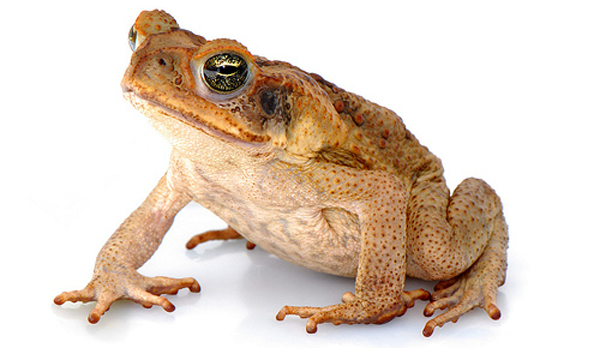
cane toad. Would grazing bring more problems then it solves?
Lets leave aside the fact that many of the problematic weeds in the alpine area were introduced by cattle (hopefully any re-introduction of cattle does not become a solution like the ‘cane toad’ syndrome – where unintended new problems are created in trying to resolve an existing problem).
Lets instead take the cattlemen at face value: that they believe that in this particular location, grazing will reduce fire risk and weed infestation.
Is there a place for grazing by hard hooved and heavy non-indigenous animals in our national parks? And would the proposed grazing trial actually prove if this is the case?
The problem is, we just don’t know. This is because – for whatever reason – the state government has not released any meaningful information about how the grazing trial would work. Given the high level of politics involved in previous attempts to get cattle back into the park, it is hard to trust their motivations unless we have this information.
Media reports say that the trial will be ‘part of a scientific investigation of bushfire prevention options across 2,200 hectares.’ Lets recall that this idea has been discussed with the Environment Minister for at least 10 months before his recent announcement, so its not unreasonable to assume the methodology for the trial is well advanced.
The government could start to resolve the mistrust about their intentions by releasing the outline of their grazing plan. To make an informed decision about whether this is a ‘fair dinkum’ trial, the community needs to know:
Who has created the methodology?
Who will be responsible for managing it?
What scientific evidence is there that grazing will control weeds and fire risk in the way it is claimed?
What is the budget for the program, and where does it come from. Does it just draw from existing Parks Vic budget?
What assessment will be done of current weed infestation and fuel loads prior to the introduction of cattle?
What targets will be set to reduce weed coverage and fuel loads. Different weeds respond in different ways to grazing – what are the strategies for each of the key weeds? And what is the strategy for weeds that are not normally grazed by cattle?
Will the 2,200 ha in the project be fenced? Who will pay for it? Would meaningful results be able to be gained from running the trial on a smaller parcel of land?
Will the adjacent waterways be fenced to keep cattle out of the river? If not why not. What are the likely public health implications of this? (many thousands of people visit and camp in the Wonnangatta each year).
What strategy will be developed to ensure the cattle do not re introduce weeds?
Have the relevant traditional owner groups been consulted and involved in the project?
What will the cattlemen by paying in agistment fees?
Once this information is in the public domain we can start to have an informed discussion about the merits of such a trial. Until then, we have to assume this is just another attempt to get some benefits for political mates. Hardly the basis for forming good policy over how we manage public lands.





Recent Comments