Search

Mountain Journal

Environment, news, culture from the Australian Alps

Tag

climate change

Letter home from the Arctic: when will we miss winter?

A reflection from Anna Langford, currently in the Arctic Circle region of Norway.


People keep asking me why I have come to spend three months in the Arctic Circle. They need a beat of stunned silence to comprehend my answer, ‘to be cold’.

I’m well-practiced at riding out the response – the loss of words, usually followed by a guffaw of laughter and a light-hearted insult. And sometimes a nervous flicker in the eyes, as though I’ve just given myself away as a ghoulish creature who flinches at the touch of sunlight.

I have been travelling since January, when I chose to bail on an Australian summer in favour of an English winter. ‘What are you doing here?!’ people would splutter, upon finding out where I had come from. Had I accidentally stumbled into Melbourne airport and onto a flight to London while on my way to the beach?

Continue reading “Letter home from the Arctic: when will we miss winter?”

Winter 2024 – the washup

If you were in the Victorian mountains during that amazing storm that passed through in the third week of July, you will have experienced winter at its best. In the Victorian backcountry we had already lost much of the base and the fresh snow was unconsolidated, but it didn’t really matter because there was so much of it. That wonderful and particular sound of fresh dry powder creaking underfoot as you weave through the trees on the uphill and that weightlessness as you head back down truly is magic (it always reminds me of that opening scene in the Valhalla film from Sweetgrass – When you’ve seen the season’s first great snow through the eyes of a child—you’ve known true happiness).

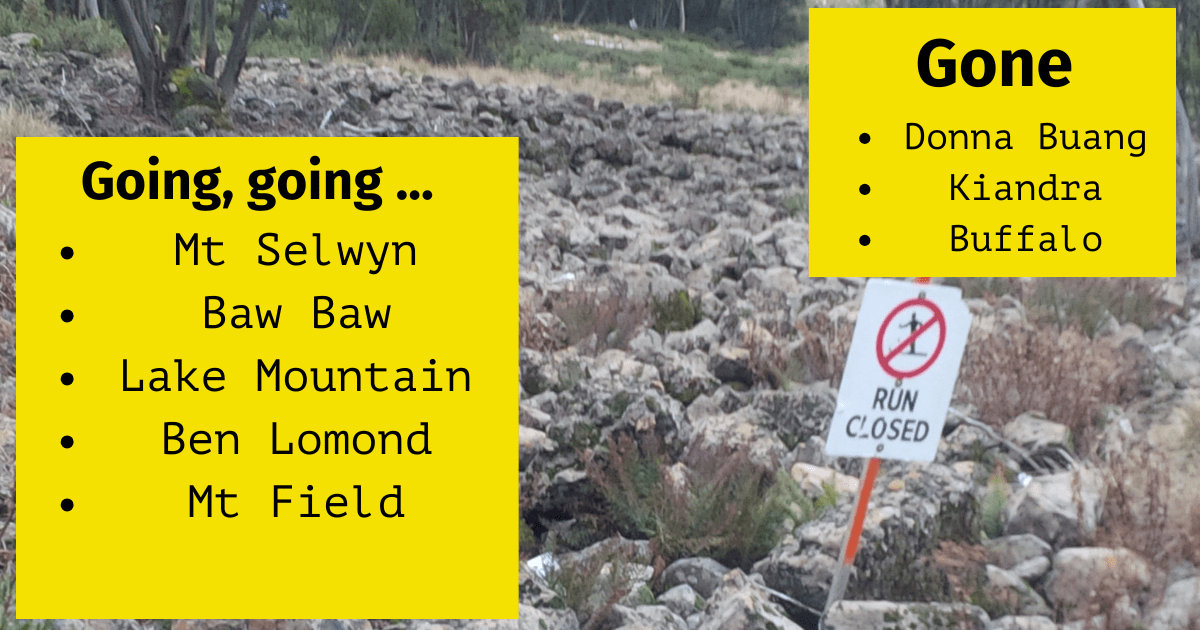
Then the blow drier was turned on, and we all know what happened next. Despite the amazing efforts of the resort groomers, the resorts started to close – the lower elevation ones like Mt Selwyn went first (consistent with what we expect from climate change). As of September 8 there is still cover in the Main Range and a few lifts are still going in places like Falls Creek. But basically the season is done – a whole month early.

This is obviously a huge blow for the businesses who are on their second short winter and everyone who was reliant on a full winter working in a resort or valley town. And, of course, it’s a drag for everyone who just wants to go skiing or riding.

Continue reading “Winter 2024 – the washup”

The first Snow Gum Summit

Announcement of conference: February 14 – 16, 2025

Snow Gums (Eucalyptus pauciflora) are the classic tree of the Australian High Country. They are profoundly different to the trees found in mountain areas in other parts of the world, and give a uniquely Australian sense to our high country. However, they are facing a double threat to their survival: from fire and dieback.

We are hosting a ‘snow gum summit’ which will bring together land managers and academics and anyone interested in the future of this iconic species to explore what needs to be done to ensure the survival of snow gum woodlands, and put the issue firmly on the state governments agenda.

We will be inviting First Nations people, local and state wide environmental organisations, local communities and businesses, groups active in outdoors recreation, and enthusiasts of high-elevation, forest ecosystems.  There will be presentations, workshops and field trips.

This event will happen at Dinner Plain, on GunaiKurnai Country in north eastern Victoria.

Continue reading “The first Snow Gum Summit”

The Bayindeen fire and Snow Gum forests at Mt Cole

Snow gums (generally E. pauciflora ssp. Pauciflora) are the iconic tree of the Australian high country. While they are best known for their dominance of higher elevation areas in north eastern Victoria and the Snowy Mountains of southern NSW, it grows in woodland along the ranges and tablelands, in cold sites above 700 metres, in a long stretch from the far south-east of Queensland, through New South Wales, the Australian Capital Territory, and Victoria, to near Mount Gambier in South Australia and Tasmania.

Snow gums also exist as isolated pockets well away from the higher mountains. For instance there are 53 known remnant Snow Gum sites within a 40 kilometre radius of Ballarat, Victoria. A  large proportion of remnant vegetation in the area occurs as small patches or isolated paddock trees, often on private land.

However there are also some important Snow Gum forests on public land in central and western Victoria. A well known example is on the upper slopes around Mt Macedon. Although these forests were impacted by the 1983 Ash Wednesday fires, the Mount Macedon Snow Gum population have been assessed as being in relatively good health (despite a recent proposal to clear some sections of the forest around the Memorial Cross at Mt Macedon)..

There is also a really important community of Snow Gums growing across the higher hills of the Mt Cole state forest.

Continue reading “The Bayindeen fire and Snow Gum forests at Mt Cole”

Protect Our Winters report: Our Changing Snowscapes

We have known for years that climate change is reducing the overall amount of snow we receive in Australia. The snow pack has been in decline since at least 1957. We also know that the loss of snow is being felt especially at lower elevations and will have enormous impacts on the local economies that have developed around the mountains.

Today Protect Our Winters (POW) have released a comprehensive update on the threats posed by climate change – to snow pack, the mountain environment and animals who rely on a thriving ecosystem, and downstream rivers, and also the impacts on the local economies that rely on good snowfalls.

Continue reading “Protect Our Winters report: Our Changing Snowscapes”

Celebrating the survivors

Across the mountains of south eastern Australia, climate change is already driving profound change. In many places in the high country, snow gum forests are facing a double threat: dieback, caused by a native beetle is killing individual trees, and climate change driven fire regimes are devastating vast areas of forest.

Recent research by John Morgan, Michael Shackleton and Zac Walker from the Research Centre for Applied Alpine Ecology at La Trobe University highlights that ‘Long-unburnt snow gum forests (now) comprise less than 1% of snow gum forests in the Victorian Alps’.

We know that snow gums can survive fire. We also know that across the Alps snow gum woodlands are starting to collapse from too frequent fire. That’s why we have to appreciate and protect the old forests that remain.

Continue reading “Celebrating the survivors”

Mountain Icons: the majesty of Mt Buffalo

Mountain Journal has slowly been compiling a collection of stories of ‘mountain icons’. In this contribution, Anna Langford reflects on her long connection to the Buffalo plateau.

How instinctively we reach for the superlatives – the oldest, fastest, biggest – when we want to distinguish something above its peers.

Mount Buffalo has no such claims on its fellow mountains: it is not the tallest, steepest, or remotest… and say nothing of its dismal snowpack that frays year by year.

There is only one superlative I insist on assigning it. To me, Buffalo has always been the grandest of our peaks.

Continue reading “Mountain Icons: the majesty of Mt Buffalo”

‘They offer great beauty. They offer shelter. They nurture us.’

Across the Australian high country, the snow gum woodlands are facing an existential threat from dieback and climate change driven fire regimes.

These threats are detailed here, as are some potential solutions.

While the loss of these forests would have major physical and ecological impacts on mountain environments, what would it mean for our personal connection to the high country? For me these trees are an essential part of life in the mountains. When I drive or walk up from the valley and have a wander among old trees, I feel like I have come home. I know these forests have been here for time beyond our imagining:

Continue reading “‘They offer great beauty. They offer shelter. They nurture us.’”

2024 Backcountry film festival Melbourne screening – April 22

The annual Backcountry Film Festival is put together by the Winter Wildlands Alliance (WWA), screens around the world, and is hosted locally by Friends of the Earth and RMIT Outdoors Club.

The 2024 season will screen in Naarm/ Melbourne on Monday April 22.

It will be screening a collection of short documentaries and ski movies about the pursuit of adventure in the mountains, artistic vision, friendship, and how the snowsports community is adapting to a changing environment.

Continue reading “2024 Backcountry film festival Melbourne screening – April 22”

‘Long-unburnt snow gum forests are now exceedingly rare’.

Across the mountains of south eastern Australia, climate change is already driving profound change. In many places in the high country of NSW and Victoria, snow gum forests are facing a double sided threat: dieback, caused by a native beetle is killing individual trees, and climate change driven fire regimes are devastating vast areas of forest. Climate change, drought, insects and soil microbes are all thought to contribute to dieback. The spread and impacts of the beetle appear to be super charged by climate change (more beetles are surviving because of milder winters and more mortality of water stressed trees in summer).

More frequent and intense wild fire also poses an existential threat to the survival of snow gum woodlands and forests. A new report reveals the scale of the fire impact on these forests in the Victorian high country.

In the paper ‘Long-unburnt stands of snow gum (Eucalyptus pauciflora Sieber ex Spreng) are exceedingly rare in the Victorian Alps: implications for their conservation and management’, John Morgan, Michael Shackleton and Zac Walker from the Research Centre for Applied Alpine Ecology at La Trobe University highlight that ‘Long-unburnt snow gum forests (now) comprise less than 1% of snow gum forests in the Victorian Alps. We identify where long-unburnt snow gum stands persist in the Victorian Alps and outline why management intervention is necessary to protect unburnt refuges and, more broadly, to allow mature/adult stands (such as occur on the Baw Baw Plateau) to develop into future old forests’.

Continue reading “‘Long-unburnt snow gum forests are now exceedingly rare’.”

Profile: Hilary McAllister from For Wild Places

Hilary McAllister describes the development and role of the trail running group For Wild Places.

Activism and the outdoors are two pursuits that, in recent years, have evolved into a symbiotic relationship.  As history would have us believe, activism is a pursuit of the immensely passionate. Dedicated souls who shun societal expectations, choosing to reside in remote, sometimes damp, forest camps, utilising our scarcest resource – time – to protect wild places under threat.

Growing up in an average, rural family, this path to activism felt out of reach to me, too extreme for my somewhat beige sensibility. But along with descriptors such as accident-prone, nomad and feminist, activist has made its way onto my bio and into my way of life.

Continue reading “Profile: Hilary McAllister from For Wild Places”

MJ turns 14

JAN 2024

What even happened last year? Another mild summer, no big fires, then truly dazzling amounts of autumn snow, a great start to winter, then, nothing. Rain and warm temps and misery and the snow pack was gone, not to return. Early end to the season in many places, especially the lower resorts. The usual denial and grumpy guys ranting on line if you dared to mention the ‘climate’ word. Muddy spring and now, another mild summer – a bit different to the El Niño scorcher we had been expecting (so far at least).

Yes, this is the new reality. Climate systems turned on their heads. Wild floods up north, while more than 14 million hectares burnt across the Northern Territory alone during our spring. Erratic winters and wild swings of weather. Buckle in, because it’s not going back to ‘normal’ any time soon.

Then there are the wars raging across many parts of the planet.

And yet, the world can still feel right. Those long autumn days with a slow wander across snow plains, the light rich, the air cool, the distant peaks calling. We are blessed to live in a safe corner of the planet with beautiful hills and forests, rivers and high plains. The freedom and safety to explore. Let us be grateful, as we work for a better world for all.

You can read the full reflection here.

Blog at WordPress.com.

Up ↑